
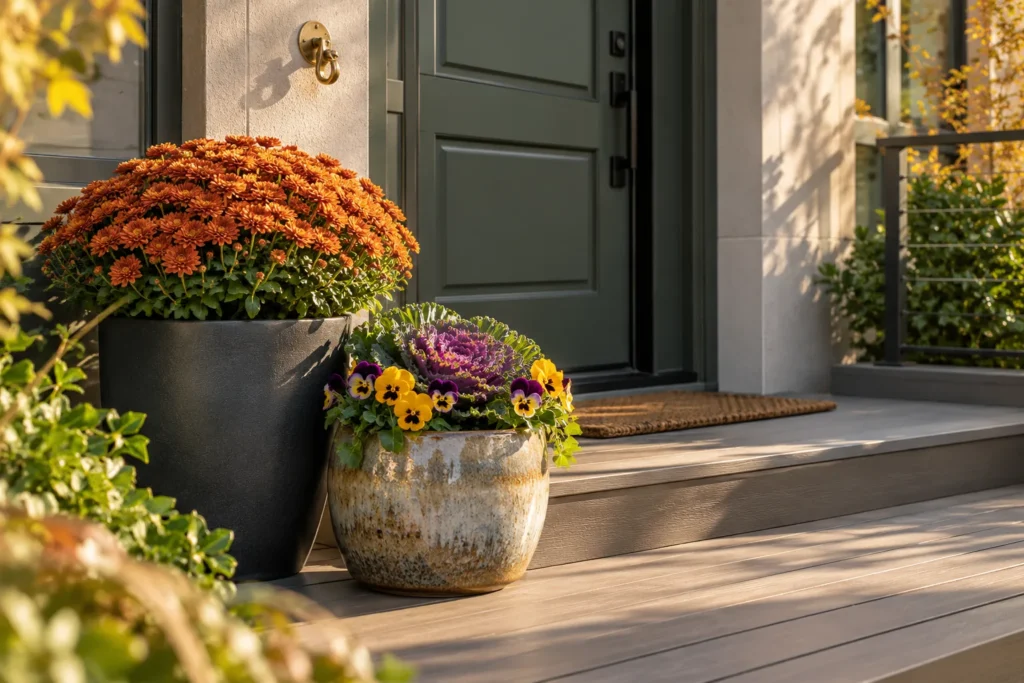
The mums at the grocery store entrance are three for the price of two, the air finally feels like October, and the pot by your door is still holding a sun-scorched petunia from July. You know what you want the stoop to look like. You’ve seen it on Pinterest forty times.
The problem on a small porch isn’t finding fall front porch planter ideas. It’s finding ones that survive the first freeze, fit beside the door without blocking it, and won’t hurt the dog that sniffs every pot on the way in. Most of the pretty round-ups skip all three questions.
In an apartment with a cat and a dog, anything at nose height by the door gets inspected, so the pet note under each idea here isn’t an afterthought. Every combination below comes with a cold limit, a pot size and a plain word on whether a pet household can use it. For the rest of the year, our year-round front porch container ideas pick up where this fall-only list leaves off.
Table of Contents
At a Glance
- Most fall porch plants shrug off a light frost. Pansies tolerate light freezes, ornamental kale survives to about 5°F once it’s acclimated, and many fall container plants come through about 20°F without damage.
- Buy pots at least 8 to 10 inches across. Anything smaller only holds small plants and dries out fast on a sunny step.
- Mums and English ivy are toxic to cats and dogs. Pansies, China asters, coral bells, fountain grass, calendula, snapdragons, sage, thyme, Boston fern and camellia are listed as non-toxic by the ASPCA.
- Water only when the top inch of mix is dry. Cool weather plus wet soil rots roots faster than frost browns a leaf.
- Clay, ceramic and glazed pots can crack in a freeze. Plastic, wood or fiberglass pots are the safe ones to leave out.
If your stoop is sunny and nobody has four legs, one big mum pot ringed with kale is the easiest win. If a dog or cat shares the porch, start with the pansy bowl or the coral bells and sedge pot. If the spot gets under four hours of sun, skip mums and jump to the shady porch group or the Boston fern in Idea 16. If the stoop is windy, start with the hens and chicks trough in Idea 15.
Fall Front Porch Planter Ideas for a Tiny Stoop
When the only floor space is a square beside the door, one pot has to do the work of a whole display, so each of these three ideas is built around a single container that reads as finished on its own. Pick the one that matches your sun and your household, and you’re done in an afternoon.
Idea 1: One Oversized Garden Mum in a Big Pot
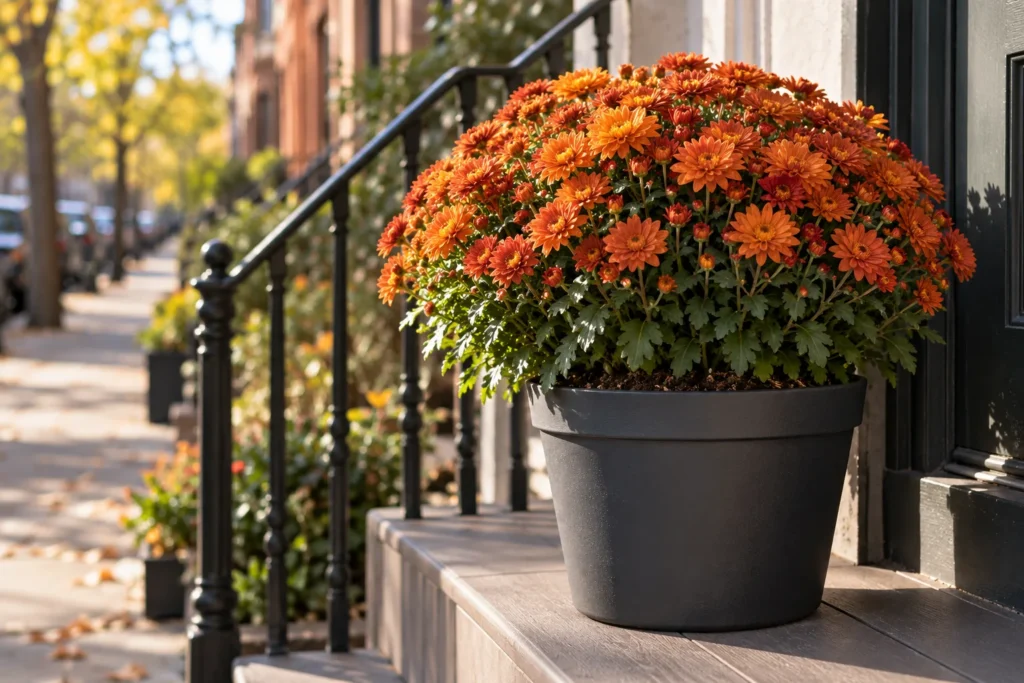
A single hardy garden mum (Chrysanthemum × morifolium, sold as “garden mum”) in a pot 12 inches or wider is the fastest way to make a stoop look like October. One plant, one pot, instant color, and nothing to arrange.
Mums want about 6 hours of direct sun, so this is the idea for a south- or west-facing door. Water when the top inch of mix feels dry, and expect the flowers to last about four weeks before the plant fades back to green foliage. That’s normal, not failure.
For a first fall pot we’d choose one large mum over three small ones, because a single plant in a 12-inch or larger pot dries out slower and reads as finished from the sidewalk. Small pots need watering almost daily on a sunny step.
A word on coming back next year: the mums sold in full bloom in fall are usually florist types, and florist mums generally don’t survive winter outdoors. Hardy garden mums are rated for zones 5 to 9, but in a pot even those are a long shot (see What Actually Matters). Treat the display as a season, and consider the return a bonus.
Pet note: the ASPCA lists all chrysanthemums as toxic to cats and dogs, with vomiting, diarrhea, drooling and skin irritation among the signs. If a pet uses the porch, go to the pet-safe group instead. Renter note: a light plastic pot means you can carry it in on a hard-freeze night.
Idea 2: Ornamental Kale Center with a Pansy Ring
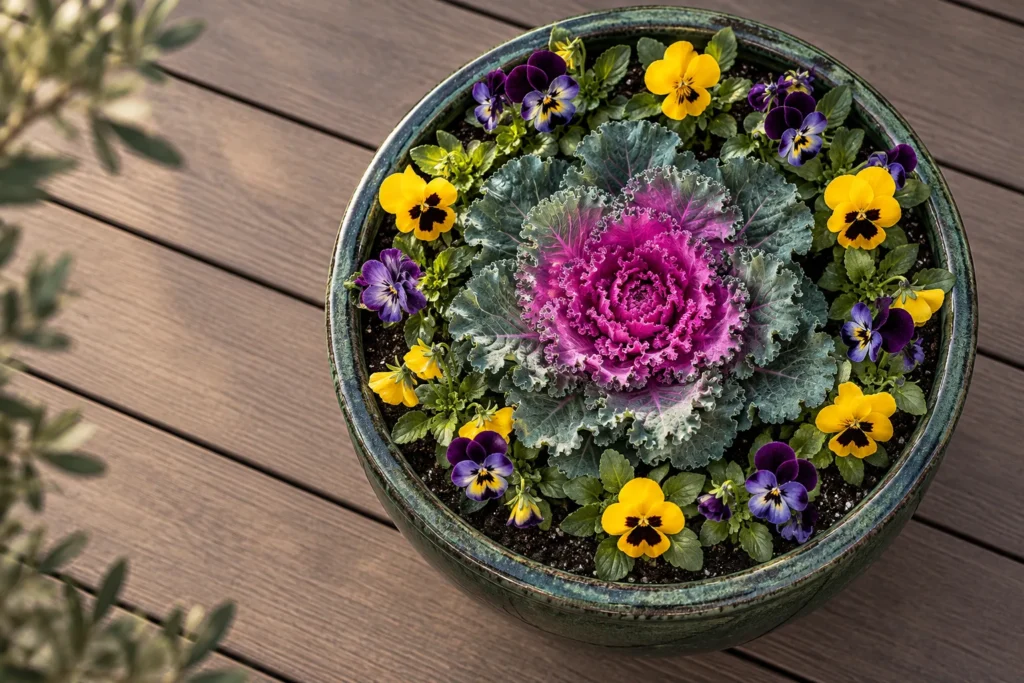
Put one ornamental kale or flowering cabbage (Brassica oleracea) in the middle of a wide pot and tuck pansies around the rim. This is the planter that improves as the weather turns, which makes it the smart buy for anyone reading this in late October.
Kale is the only common fall porch plant that gets better as the weather gets worse. Its white, pink and red pigments show up as nights cool, the color is most vivid below about 50°F, and acclimated plants survive to about 5°F. A typical plant reaches about 12 inches wide and 15 inches tall, so pick a pot that gives it that room with the pansies outside it.
Give it a sunny spot. The pansies take full to part sun and keep blooming while the kale colors up, so the pot never has a dull week. Their cold limits are covered under Idea 4.
Pet note: pansies are on the ASPCA non-toxic list. Ornamental kale isn’t on the list either way, so keep pets from grazing it and check the exact plant with the ASPCA before buying if your dog eats leaves for sport.
Idea 3: Coral Bells and Evergold Sedge Foliage Pot
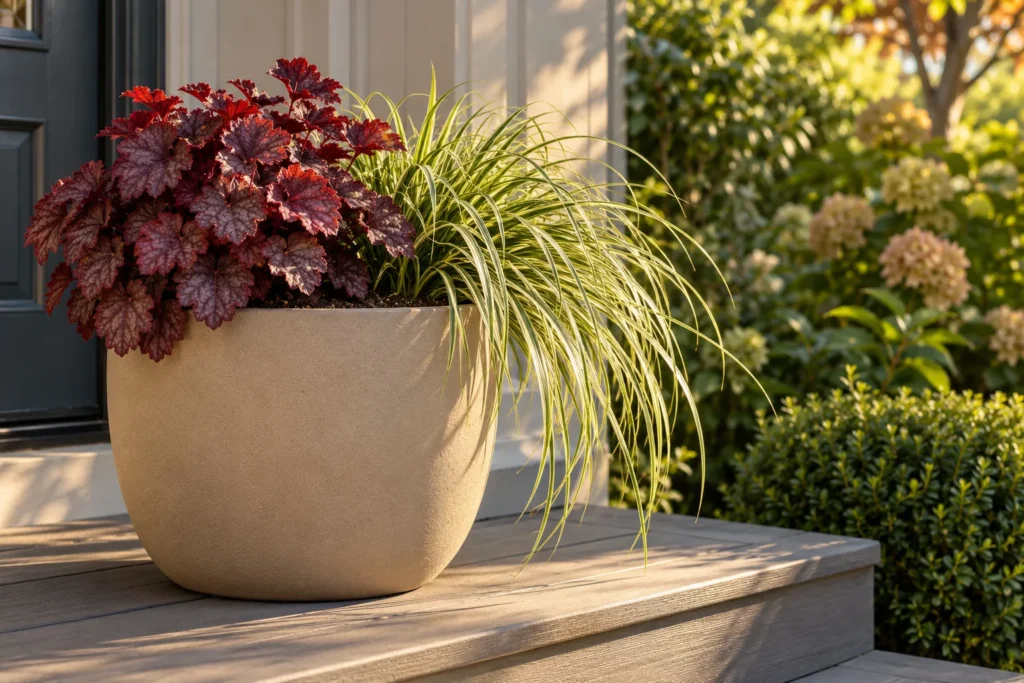
Coral bells (Heuchera) with ‘Evergold’ sedge (Carex oshimensis ‘Evergold’) gives you a pot that still looks intentional in December, because both are evergreen to semi-evergreen perennials that suit containers and part shade. No flowers needed; the burgundy, caramel or silver heuchera leaf does the work against the striped sedge.
Heuchera is rated for zones 3a to 9b and grows 6 to 20 inches tall and wide. ‘Evergold’ sedge is rated for zones 5a to 9b and reaches 12 to 18 inches. Both take full sun to part shade, though heuchera leaves scorch in hot, dry full sun, so an east-facing door suits this pot best.
This is the pot to check most often, because the sedge doesn’t tolerate drought. Give it a container with a drainage hole and water when the top inch is dry, which in cool weather may be only once a week.
Pet note: the ASPCA lists coral bells (Heuchera sanguinea) as non-toxic to cats and dogs. The sedge isn’t on the list, so the same “check your exact plant” advice applies.
Pet-Safe Fall Porch Planters for Dog and Cat Households
If a dog or cat passes the front pots every day, the usual mum-and-ivy combination is the one to skip, and these three looks give you the same fall color from plants the ASPCA lists as non-toxic. It’s the same pet-safe thinking we use for houseplants in a home with cats and dogs, moved outside.
If a pet shares the porch, we’d skip mums entirely rather than try to keep them out of reach, because the ASPCA lists the whole genus as toxic and a porch pot sits at sniffing height. English ivy (Hedera helix), the trailing filler in half the Pinterest planters, is also toxic to cats and dogs, and its foliage is more toxic than the berries. Boxwood (Buxus) is on the toxic list too. One more trap: the “ornamental pepper” entry on the ASPCA list is Jerusalem cherry (Solanum pseudocapsicum), a toxic plant, so check the exact species before buying any pepper-look plant.
Non-toxic doesn’t mean edible or irritation-free. The ASPCA notes that any plant material can cause mild stomach upset, so a pet that eats a mouthful of pansies may still throw up on the rug.
Idea 4: The Pansy and Viola Color Bowl
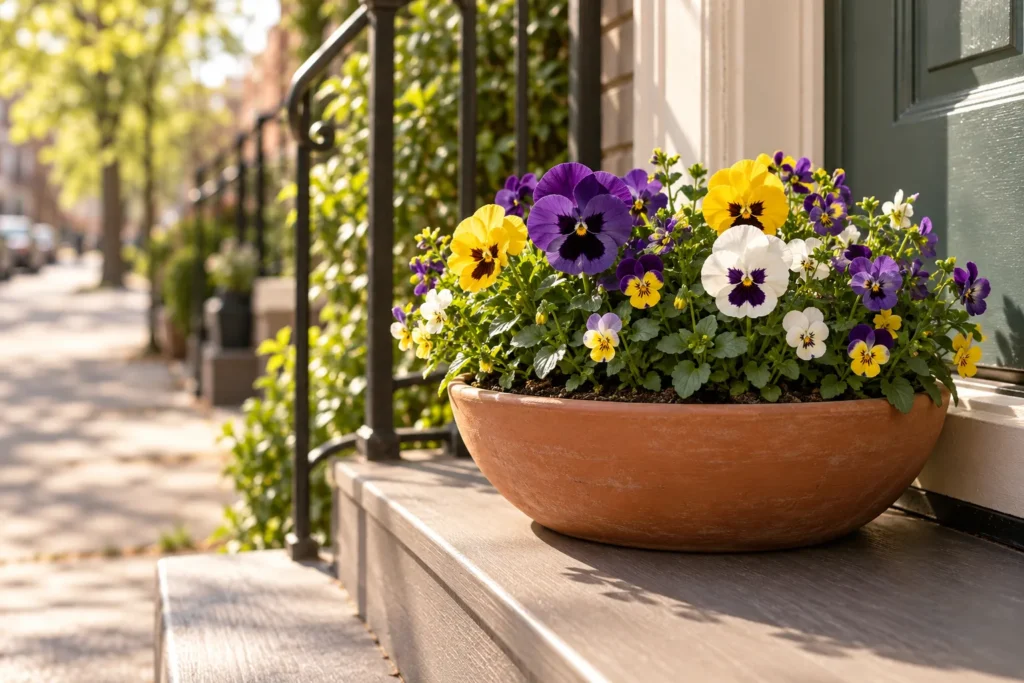
A wide, shallow bowl packed with pansies (Viola × wittrockiana) and violas (Viola spp.) is the best cool-season flower planter you can put at ground level in a pet home. The ASPCA lists pansies as non-toxic to cats and dogs, and extension guides rank pansies and violas as the top annuals for cool-season color.
They tolerate light freezes well and bloom best when days stay above 32°F. Plants grow 4 to 10 inches tall and about as wide, so a 14-inch bowl takes five to seven of them planted close. Full to part sun keeps them compact; in warm spells or low light they stretch and flop.
Violas carry smaller flowers but need less deadheading, which matters if you’d rather not pinch spent blooms every weekend. Feed container pansies lightly with a water-soluble fertilizer every one to three weeks if you plan to keep them going; a six-week display can skip it.
In a pet household the lowest pot gets the most sniffing, so this is the one to put at nose height and keep the mums, if you have any, up on a plant stand. Where cold allows, a bowl planted in early fall keeps color until snow.
Idea 5: Asters and Fountain Grass
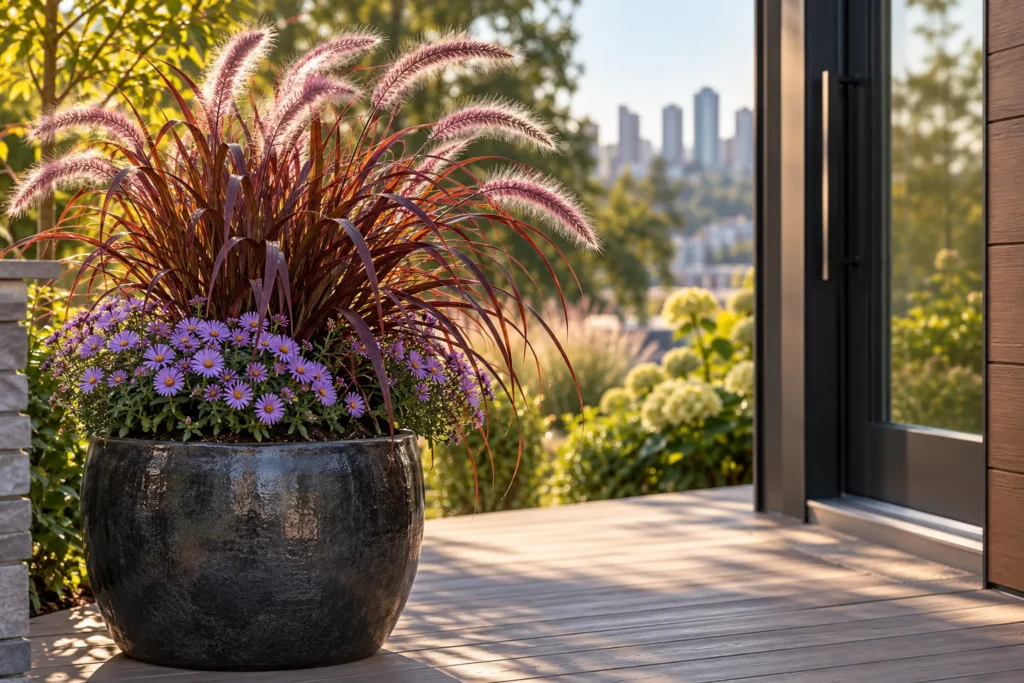
Compact asters around a purple fountain grass (Pennisetum setaceum ‘Rubrum’) give you height and late-season flowers from two plants the ASPCA fall-plant guide lists as non-toxic: fountain grass and China aster (Callistephus chinensis). Garden centers also sell compact Symphyotrichum asters bred for pots; those aren’t on the list by name, so check your exact aster with the ASPCA before buying.
The grass is the thriller here. It grows 2 to 5 feet tall, colors best in full sun, and is hardy only to about zone 8, so everywhere colder it’s a one-season plant that dies when it freezes. That’s fine for a fall display; just don’t pay perennial prices for it.
Use a heavy pot. A 3-foot grass in a light plastic container is a sail on a raised stoop, and one gusty afternoon will put it on the sidewalk. If you live in a warm, dry region, check your state’s invasive plant list before planting this species outdoors, since it self-seeds in some climates.
Idea 6: Edible Fall Herb and Greens Pot
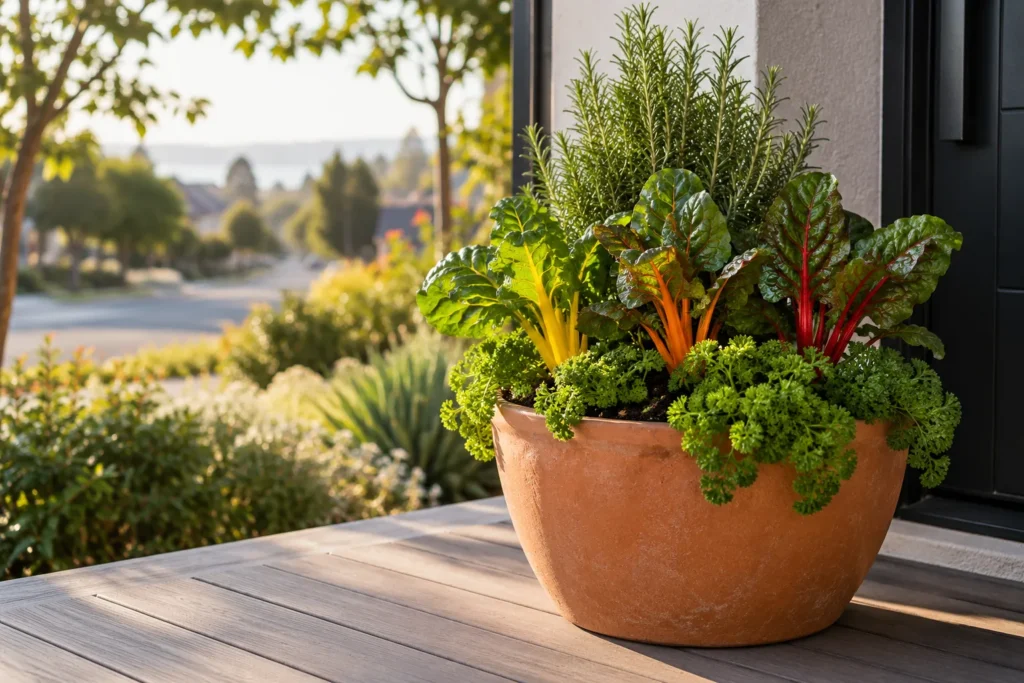
Rosemary (Salvia rosmarinus, listed by the ASPCA under its older name Rosmarinus officinalis), ‘Bright Lights’ Swiss chard (Beta vulgaris) and parsley make a fall pot you can cook from, and all three suit cool-season containers. The chard’s yellow, orange and red stems are the color; the rosemary is the upright structure; the parsley fills the edge.
Chard tolerates light frost, and rosemary is evergreen, though its winter hardiness varies by zone, so north of its range treat it as a season-long plant and bring it inside or let it go. Rosemary and Beta vulgaris (the species that covers both beets and chard) are listed as non-toxic to cats and dogs.
Because you’ll eat from this pot, read the label before using any pesticide on it; most products sold for ornamental plants aren’t labeled for edibles. Rinse leaves before cooking. In a pet home it’s also the pot a dog is most likely to nibble, which is a reason to keep it clean rather than a reason to skip it.
Ideas for a Shady or North-Facing Porch
A covered or north-facing porch rules out the sun-hungry mums, and that’s fine, because the plants that look best in November are mostly foliage anyway. These two combinations are built for part shade and still carry color.
Idea 7: Evergreen Fern and Coral Bells Shade Pot
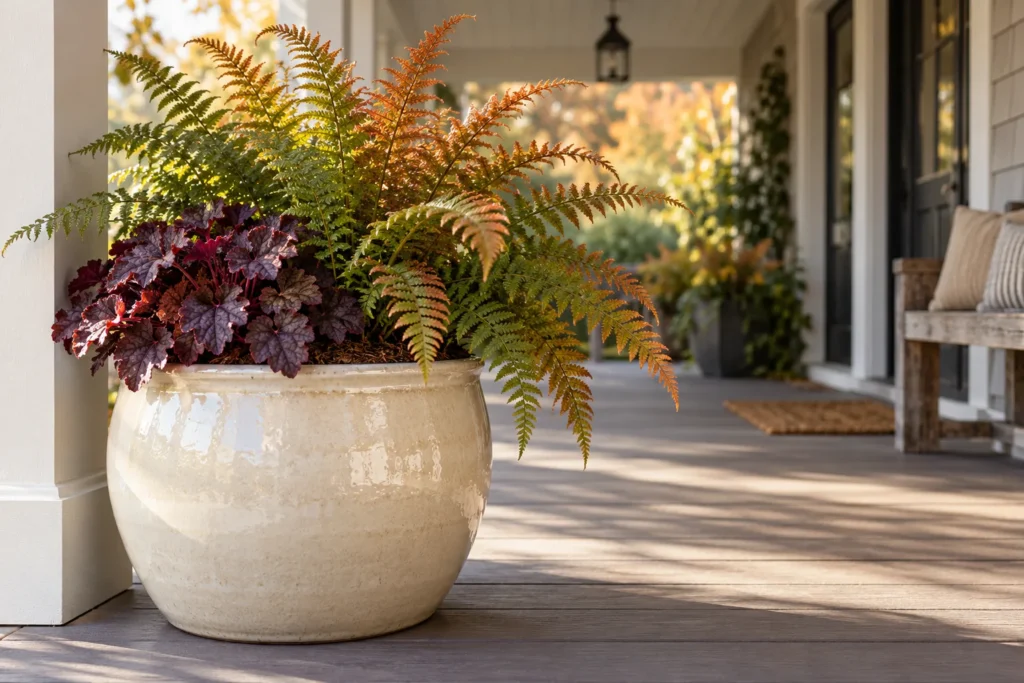
Autumn fern (Dryopteris erythrosora) or holly fern (Cyrtomium falcatum) with a dark-leaved coral bells is a shade pot that holds its shape from fall straight through winter in mild zones. Both ferns are standard picks for fall-through-winter containers, and heuchera takes partial shade happily (its zone and size details are under Idea 3).
The look is copper fronds against plum or black leaves, which reads as “fall” without a single flower. Keep the mix evenly moist but never soggy, and give the pot a drainage hole, because a shaded porch dries out slowly and a waterlogged fern rots at the crown.
Pet note: coral bells are on the ASPCA non-toxic list; the ferns named here aren’t listed either way, so check your exact fern on the ASPCA list before buying if you have pets. For more plants that cope with a dim entrance, see our shade-loving plants for a north-facing balcony.
Idea 8: Part-Shade Pansy Pot with a Trailing Edge
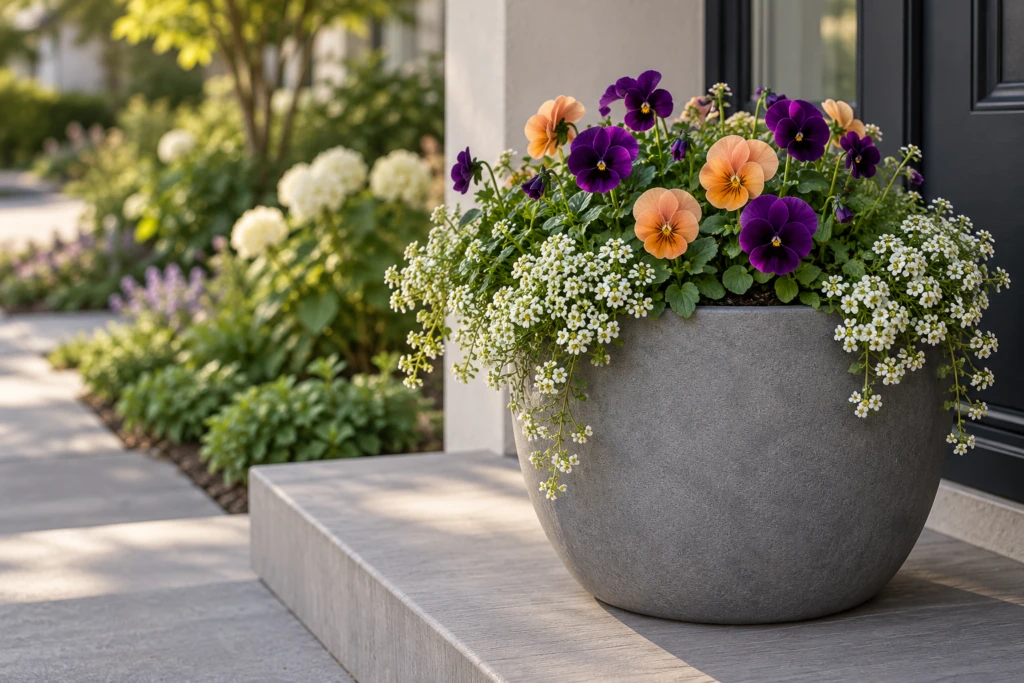
Pansies in the middle with sweet alyssum (Lobularia maritima) planted along the rim gives a part-shade step the one thing foliage pots lack: a soft, trailing edge. Pansies actually do well in partly shaded spots as long as they get regular water, and alyssum is the classic fall spiller for the rim.
Plant the alyssum right at the edge and let it drape; it won’t need pinching. The pansy care and cold limits are the same as the sun bowl in Idea 4, minus the stretching problem, since shade keeps them cooler.
Pet note: pansies are listed non-toxic; alyssum isn’t on the ASPCA list, so check it before buying for a pet home. If you’d rather hang the color than set it on the step, our shady porch hanging basket combinations use the same shade-tolerant logic overhead.
Budget and Refresh Ideas
You don’t have to start from empty pots. The cheapest fall planter is usually the summer one with the tired plants pulled and two cold-hardy ones dropped in, and the second cheapest needs no watering at all.
Idea 9: Refresh the Summer Pot Instead of Replacing It
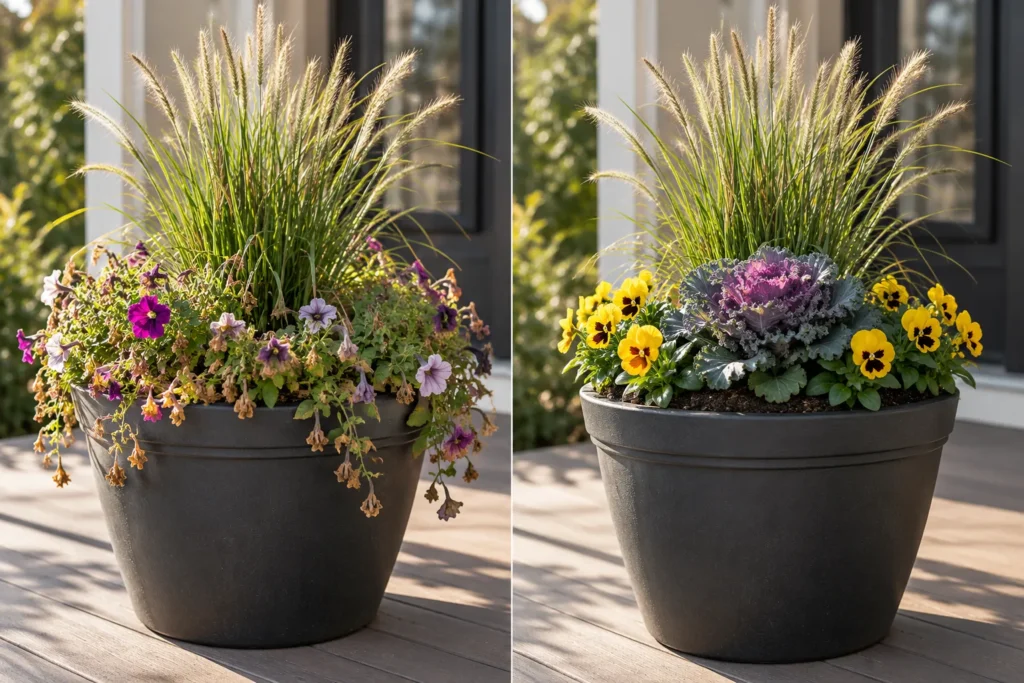
Keep the pot, keep the healthy grass or tropical in the middle, and replace only what’s finished. This costs the price of two or three cool-season plants and takes about twenty minutes.
- Deadhead and cut back leggy annuals first. If a petunia or coleus still looks good after a trim, it can stay until frost takes it.
- Pull dead plants out roots and all, then scrape off and replace the top few inches of mix with fresh potting mix. In a large pot you can instead work in some compost or a little slow-release fertilizer.
- Plant the new kale, pansies or heuchera more densely than you would in spring. Fall growth is slow, so the pot won’t fill in on its own; what you plant is what you’ll see.
- Water it in, then leave the fertilizer alone. A short fall display doesn’t need feeding.
Cost level: low. If the pot itself is the problem, cracked or ugly, our cheap planter and pot DIY ideas cover the low-cost swaps before you buy new.
Idea 10: Pumpkins and Gourds as the No-Water Planter
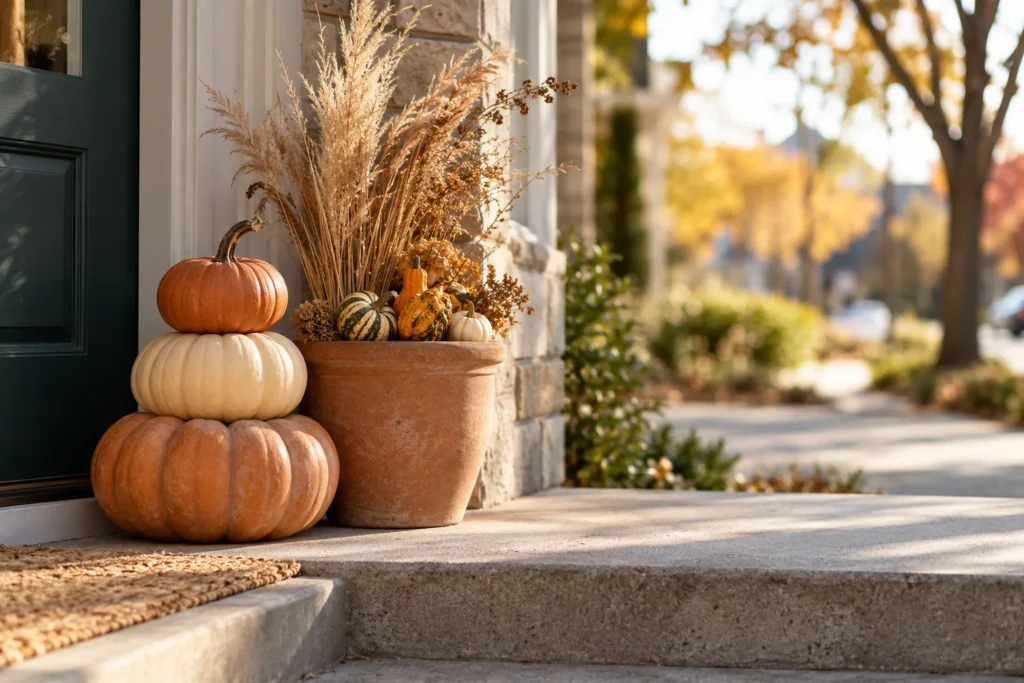
Stack three pumpkins largest to smallest into a topiary, or fill a pot with small gourds and a bundle of cut grass plumes, and you have a fall planter that never needs watering, feeding or frost cover. For a renter with no spare minutes, this is the honest answer.
Pumpkins and gourds (Cucurbita species) are listed by the ASPCA as non-toxic to cats and dogs. Still, remove any that go soft; a dog that eats a spoiled gourd gets an upset stomach the same way it would from any rotten food. Set the stack to one side so the walking line and the stairs stay clear.
Nothing to drill, nothing to water, easy to clear in five minutes. When the look changes in November, the pumpkins move indoors as table decor and the pot is free for a kale or heuchera.
Ideas That Last Into Winter
If you want one pot that still looks intentional in January, build it from perennials rated well below your zone and from grasses that stay standing after frost. These two ideas are the ones you don’t take down.
Idea 11: ‘Autumn Joy’ Sedum and Standing Grass
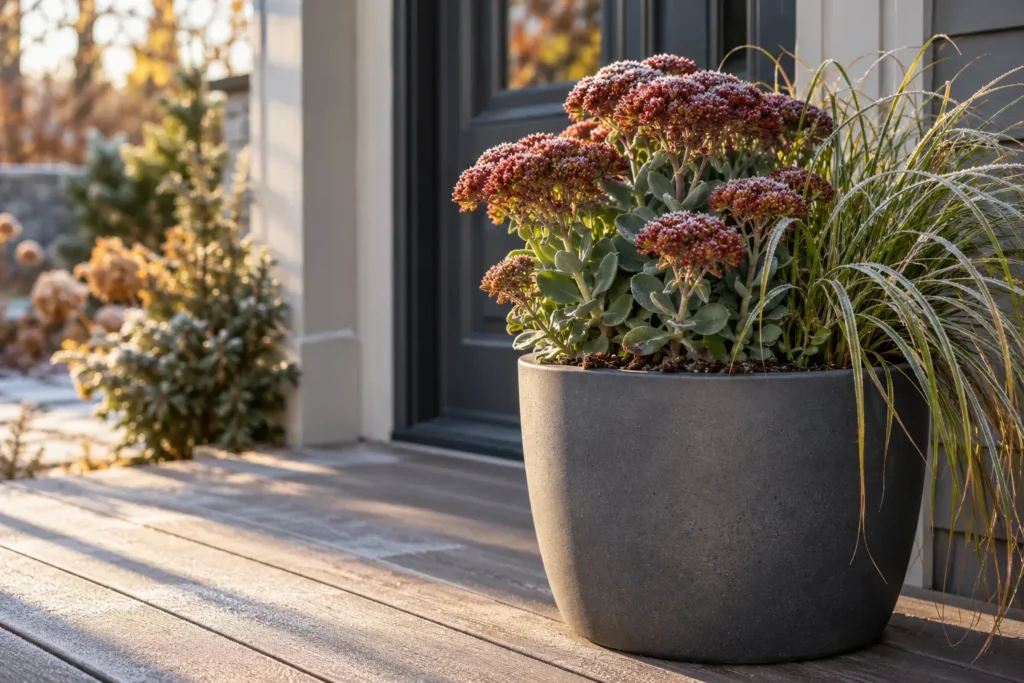
‘Autumn Joy’ sedum (Hylotelephium spectabile ‘Autumn Joy’) with a sedge or hardy grass is the pot you leave out. The sedum is rated for zones 3a to 10b, grows 1 to 2 feet tall, opens pink and deepens to red as the season ends, and the dried heads stand through snow if you don’t cut them.
Give it full sun, at least 6 hours, and sharp drainage; it won’t tolerate wet soil. Pet note: this plant has low toxicity if eaten, so it belongs with the non-pet ideas, or up on a stand where a dog can’t reach it.
Overwintering a pot is a different game from overwintering a garden bed, because container roots can get as cold as the winter air. The Penn State guidance on overwintering container plants is to choose perennials rated two zones hardier than your own zone, use a larger pot for more insulation, and water well before the soil freezes, since dry soil freezes faster than moist soil.
Clay, ceramic and glazed pots may crack when wet mix freezes inside them, so use plastic, wood or fiberglass for anything staying out. Group pots against the house wall, and on a hard-freeze night a clay pot gets wrapped in burlap or moved to an unheated garage.
Idea 12: Stair-Step Pots When There Is No Floor Space
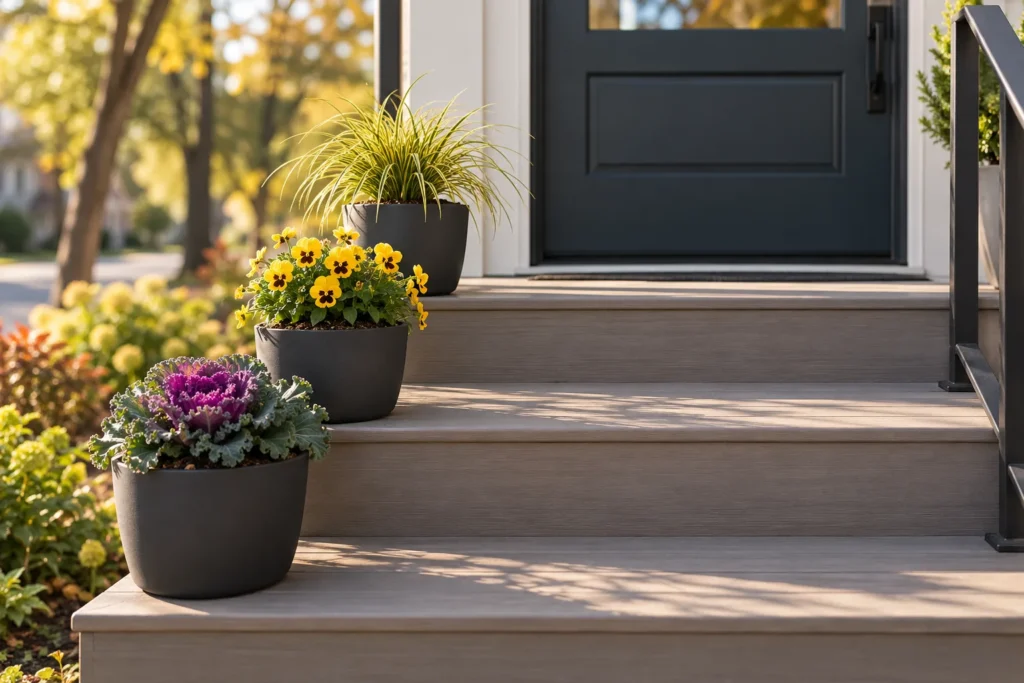
When the porch is really just three steps and a mat, run three pots in graded sizes up one edge of the stairs, each holding a single plant from the ideas above: kale on the bottom, pansies in the middle, sedge on top. It fills the vertical space, reads as one display, and leaves the door free.
Keep the pots at the 8-to-10-inch minimum or larger (the sizing reasons are in How to Pick). For a sense of volume, a small flowering plant is happy in 1 to 3 gallons at 4 to 6 inches deep, and a medium plant like kale wants 4 to 6 gallons at 8 to 12 inches deep.
Safety first on stairs: keep the walking line and the handrail side clear, and check your lease and building rules, since some buildings limit what can sit on shared steps. In a small apartment, light pots also mean the whole display comes inside in one trip on a cold evening.
If your steps are too narrow even for that, a DIY tiered plant stand tucked beside the door holds the same three pots in one footprint, and our railing planter box ideas move the color up onto the rail without drilling.
Idea 13: Thrifted Galvanized Bucket of Calendula and Violas
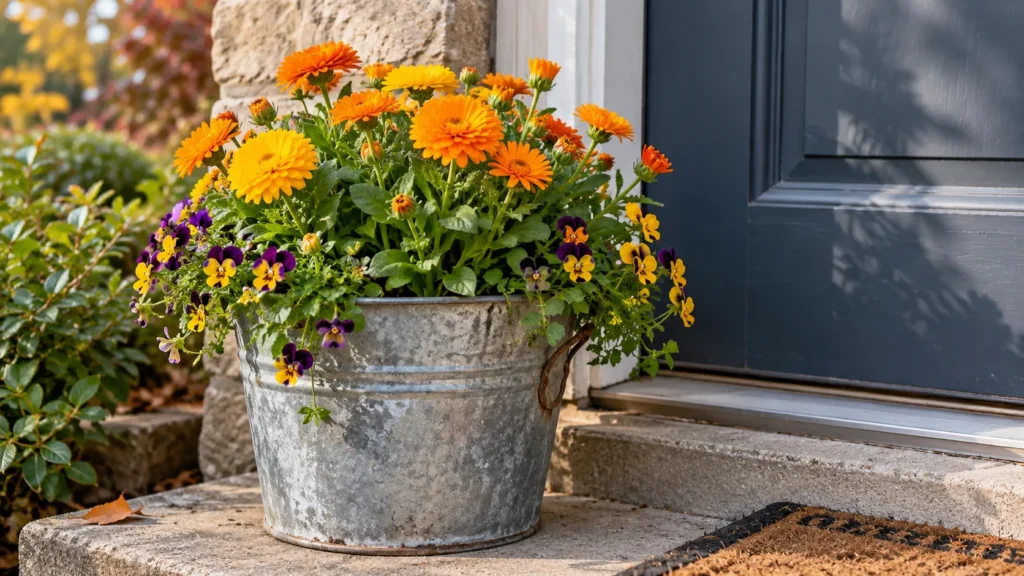
A secondhand galvanized bucket or washtub, with three or four drainage holes drilled in the bottom, holding calendula (Calendula officinalis, sold as pot marigold) with violas tucked around the rim. Orange and gold against gray metal reads as October without a single mum.
Calendula wants full sun and any well-drained mix, grows 1 to 2 feet tall and wide, and keeps blooming until the first heavy frost. Compact types such as ‘Bon Bon’ stay near 12 inches, which suits a 12-to-14-inch bucket. Plants that sulked in summer heat typically recover when cooler weather returns, so a marked-down late-summer plant is a fair buy.
Water when the top inch is dry. Metal heats up fast in sun, so give the sides some afternoon shade, or set a plastic nursery pot inside the bucket to keep the roots cooler.
Pet note: the ASPCA lists pot marigold (Calendula officinalis) as non-toxic to cats and dogs, and violas are covered under Idea 4. Read the tag, because “marigold” is also sold for Tagetes, a different plant. Cost level: low; the bucket is the splurge, and a thrift store has one for a few dollars.
Idea 14: Thrifted Wooden Crate of Snapdragons and Sage
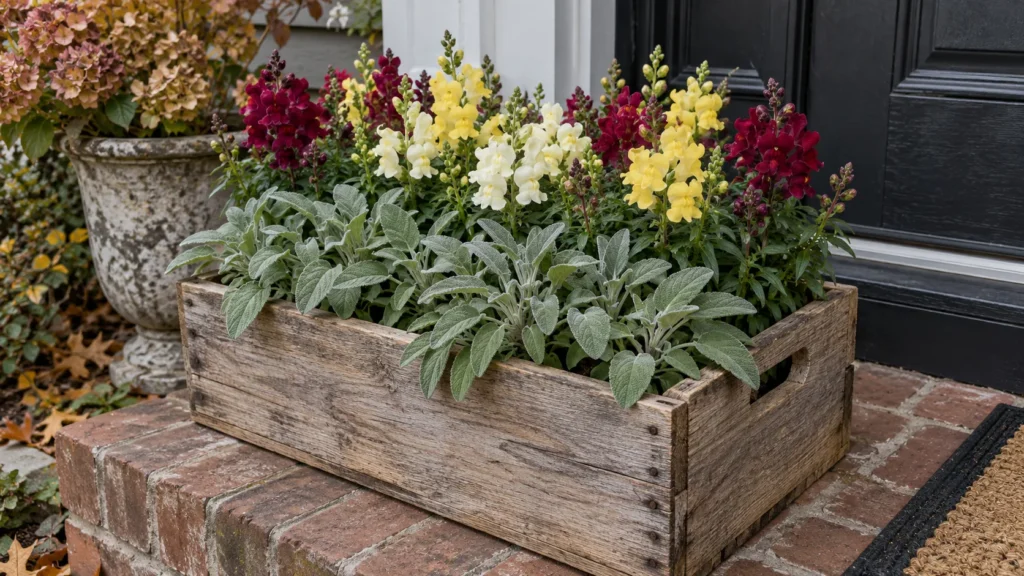
An old wooden crate or drawer, lined with a plastic nursery pot or a layer of landscape fabric, makes a budget planter for snapdragons (Antirrhinum majus) with culinary sage (Salvia officinalis) along the front edge. Spiky flowers over gray-green leaves, and wood doesn’t crack in a freeze the way clay does.
Snapdragons are a cool-season annual that does best in spring and fall. They need full sun but handle light shade, and Illinois Extension calls them very cold tolerant, carrying on until a very hard frost kills them. Choose a dwarf or medium type, 6 to 16 inches tall, so nothing in the crate needs staking. The sage keeps its leaves after the snapdragons finish, and you can cook from it.
Water when the top inch is dry. A crate drains fast, so check it twice a week on a sunny step.
Pet note: the ASPCA lists garden snapdragon (Antirrhinum majus) and common sage (Salvia officinalis) as non-toxic to cats and dogs. Cost level: low. If the crate has gaps, the nursery pot inside is what holds the mix, so the crate itself only needs to look good.
Idea 15: Hens and Chicks Trough for a Windy or Exposed Stoop
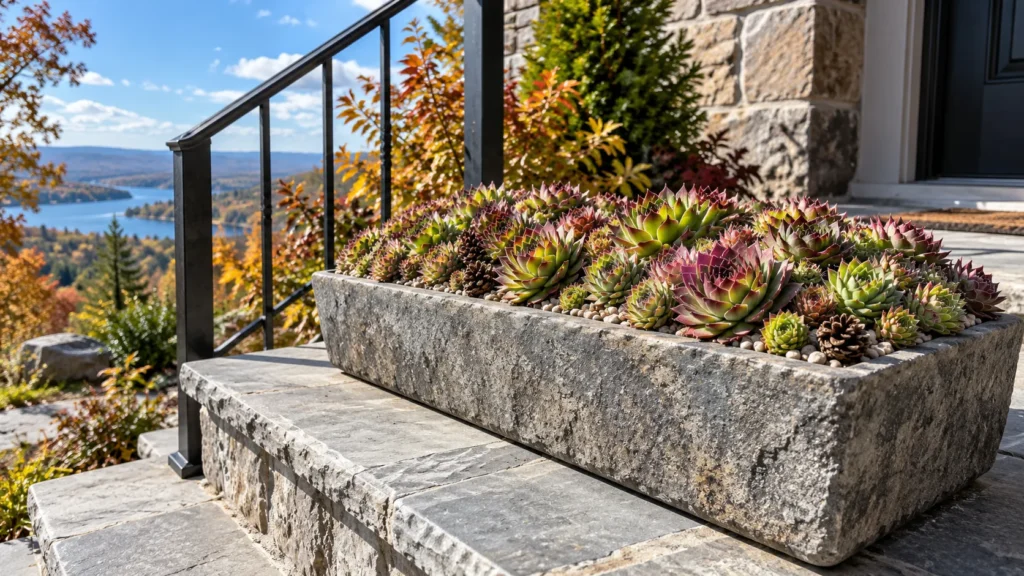
On a raised stoop that catches wind, tall plants are sails and light pots tip over. A low, heavy trough (resin, hypertufa or stone look, never thin clay) packed with hens and chicks (Sempervivum tectorum) just ignores the weather. The rosettes are 3 to 4 inches across, so there’s nothing to blow over.
Sempervivum tectorum is rated for zones 3a to 8b, wants full sun with afternoon shade in very hot spots, and needs sharp drainage; a cactus mix or potting mix cut with grit works. It’s evergreen, and some forms turn pink to lavender in winter. Plant it edge to edge and top the mix with pea gravel, which stops soil blowing out and adds weight.
Don’t overwater. In fall, water only when the mix is dry, which may be every two weeks. In a frost-proof container this trough stays out all winter.
Pet note: the ASPCA’s “hens and chickens” entry is Echeveria elegans, listed non-toxic to cats and dogs; Sempervivum isn’t listed by name, so keep pets from grazing it and check with the ASPCA. A few pinecones or small gourds on the gravel make it read as fall.
Idea 16: Boston Fern on a Stand for a Shaded North-Facing Porch
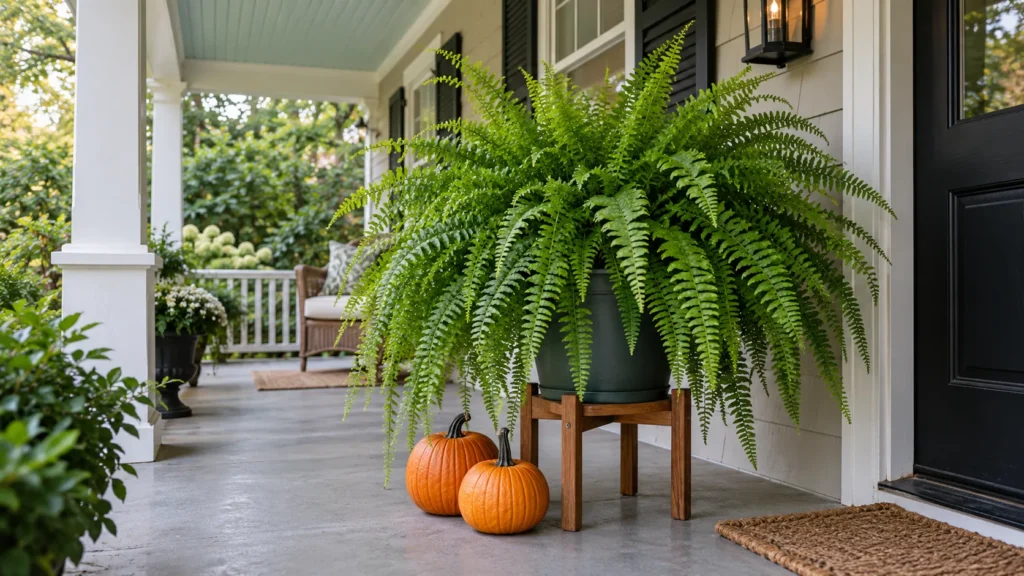
A covered north-facing porch with no direct sun rules out almost every fall flower, and a Boston fern (Nephrolepis exaltata) in a 14-inch plastic pot on a short stand, with a pumpkin or two at its feet, is the display that works in that light. Ferns grow in dappled to full shade and burn in direct sun.
This is an early-to-mid-fall idea, because Boston fern is hardy only in zones 9 to 11. Clemson’s advice is to move it inside before night temperatures fall below 50°F. From there it’s a houseplant for winter, or you cut the fronds to 3 inches and store it anywhere that stays above 40°F. For a renter that’s a bonus plant, not a chore.
Water when the soil is dry; yellow fronds mean overwatering. If it dries out badly, soak the root ball in a bucket of water for an hour.
Pet note: the ASPCA lists Boston fern as non-toxic to cats and dogs, and pumpkins are covered under Idea 10. Cats love to chew fern fronds, which is a stomach-upset risk rather than a poisoning one, and the stand keeps most of the plant out of reach.
Idea 17: Dwarf Alberta Spruce Box That Lasts Past Thanksgiving
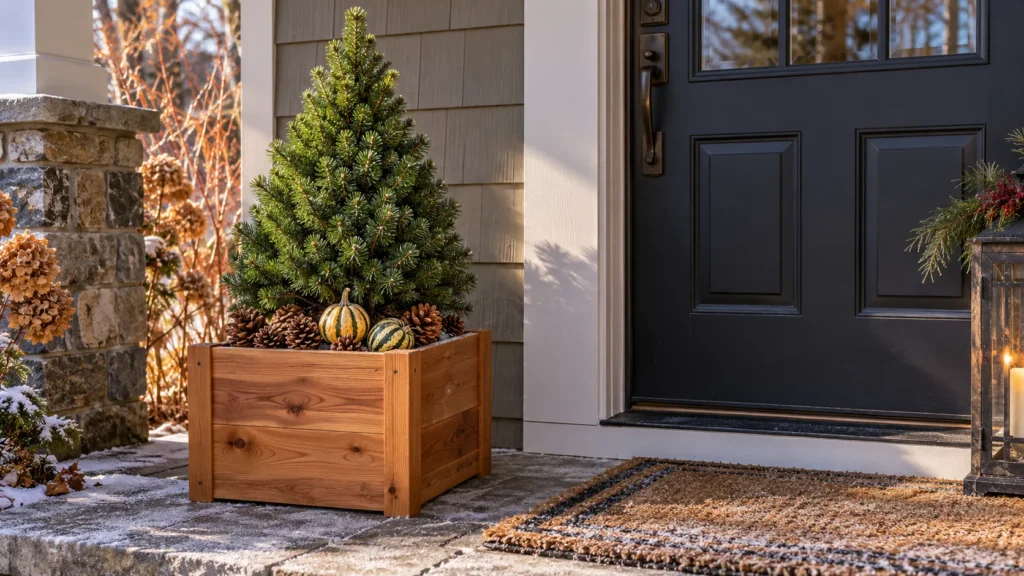
A dwarf Alberta spruce (Picea glauca ‘Conica’, listed by NC State as Picea laxa ‘Conica’) in a 16-inch wooden box or thick plastic pot is the evergreen idea: a tidy cone that looks the same on Halloween, at Thanksgiving and on New Year’s Day. Dress the soil with pinecones and small gourds for fall, then swap in a string of lights later.
It’s rated for zones 3 to 6 and grows slowly, about 3 to 4 feet tall and 1.5 feet wide after ten years, so a 2-foot nursery plant fits a 16-inch box for several seasons. It prefers full sun, tolerates part shade, and needs protection from strong wind, so stand it against the house wall. It does best with cold winters and cool summers and struggles in hot-summer zones.
Water when the top inch is dry and water well before the soil freezes. By Penn State’s two-zone rule in Idea 11, a potted spruce is a safe bet in zones 5 and 6.
Pet note: spruce isn’t on the ASPCA list either way. The needles are sharp enough to irritate a mouth, so keep a chewing dog off it. Cost level: medium; it costs more than a mum but it’s the one plant here you’ll still own next fall.
Idea 18: Sasanqua Camellia for Late-Fall Flowers in Zones 7 to 9
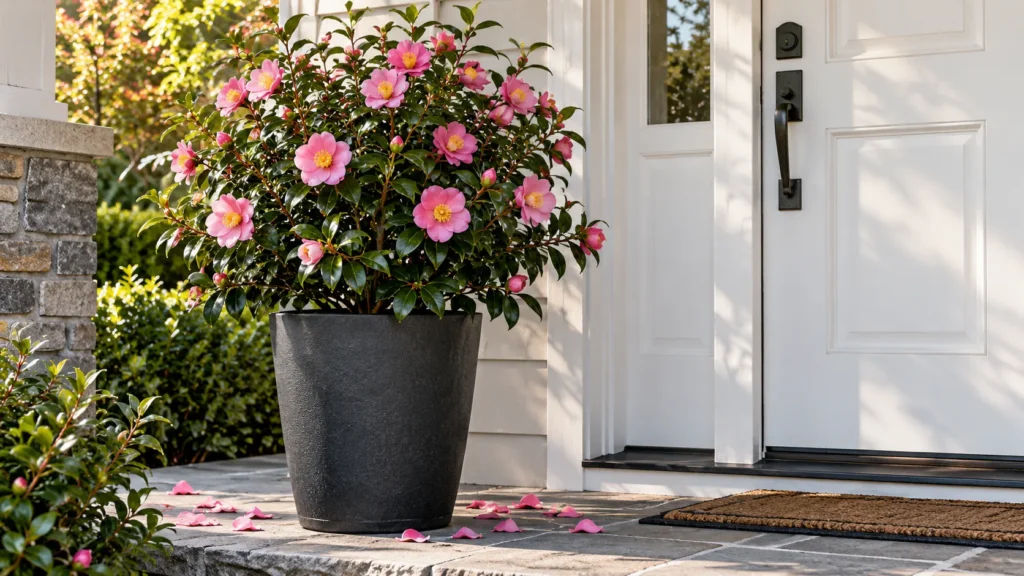
In zones 7 to 9, a sasanqua camellia (Camellia sasanqua) in a 16-to-18-inch pot gives you real flowers, white, pink or red, in late fall and winter, right when the mums are finished. It’s the Thanksgiving-flower idea for the South and the Pacific coast, and the glossy evergreen leaves carry it the rest of the year.
NC State rates it for zones 7a to 9b in full sun to part shade. In the ground it reaches 6 to 14 feet, so ask the nursery for a compact or dwarf cultivar and let the pot slow it down. An east-facing door, with morning sun and afternoon shade, suits it best. Use an acidic, well-drained potting mix and don’t let the pot dry out while the plant is in bud.
Water when the top inch is dry. Choose plastic or fiberglass, because a camellia this size in a glazed pot is both crackable and too heavy to move.
Pet note: the ASPCA lists camellia (Camellia japonica) as non-toxic to cats and dogs; sasanqua is the same genus but isn’t listed by that name, so check your exact plant. North of zone 7, skip this and go to Idea 17.
Idea 19: ‘Karl Foerster’ Grass and Kale, Then Evergreen Boughs for Winter
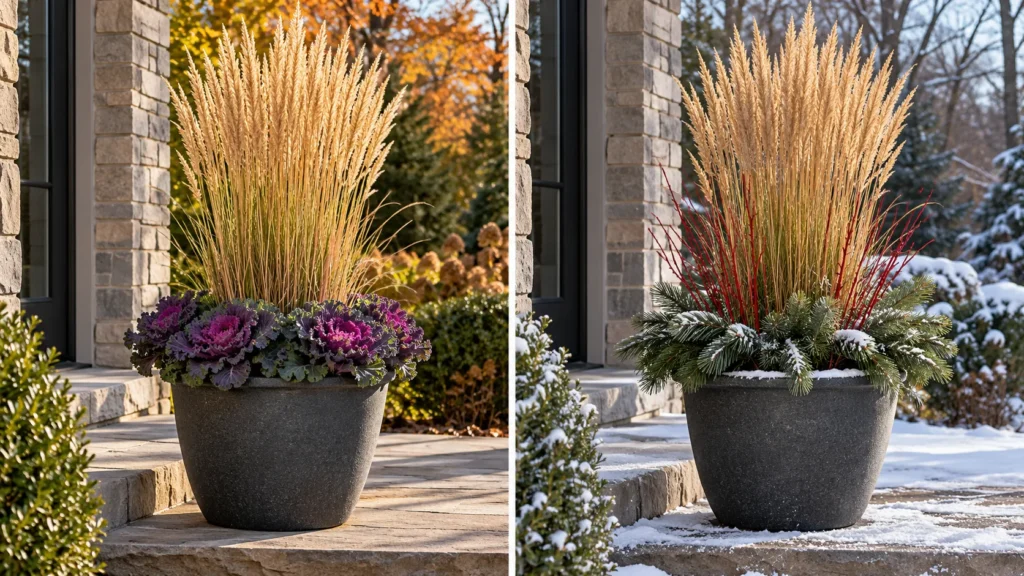
Put one ‘Karl Foerster’ feather reed grass (Calamagrostis × acutiflora) in the middle of a heavy 16-to-18-inch frost-proof pot and ring it with ornamental kale. When the kale finally gives up in late fall, pull it and push cut evergreen boughs and red-twig dogwood stems into the mix around the standing grass. That’s a winter pot without buying another plant.
The grass is rated for zones 3 to 9, forms a clump 2 to 3 feet tall and under 2 feet wide, and by fall carries tan plumes that stay upright through winter. Wisconsin Extension notes the stems may flop in heavy rain or wind but return to vertical once dry. Give it full sun; in shade it leans. Cut it to 6 inches in late winter before new growth. The kale’s cold limit and sizing are under Idea 2.
Water when the top inch is dry, and water the pot well before the soil freezes.
Pet note: the ASPCA lists ‘Karl Foerster’ feather reed grass as non-toxic to cats and dogs, with a warning that its sharp points can scratch; kale isn’t listed either way. Cut boughs aren’t on the plant list, so keep them above sniffing height in a chewing household.
Idea 20: A Matching Pair of ‘Hameln’ Grass and Thyme Pots Flanking the Door
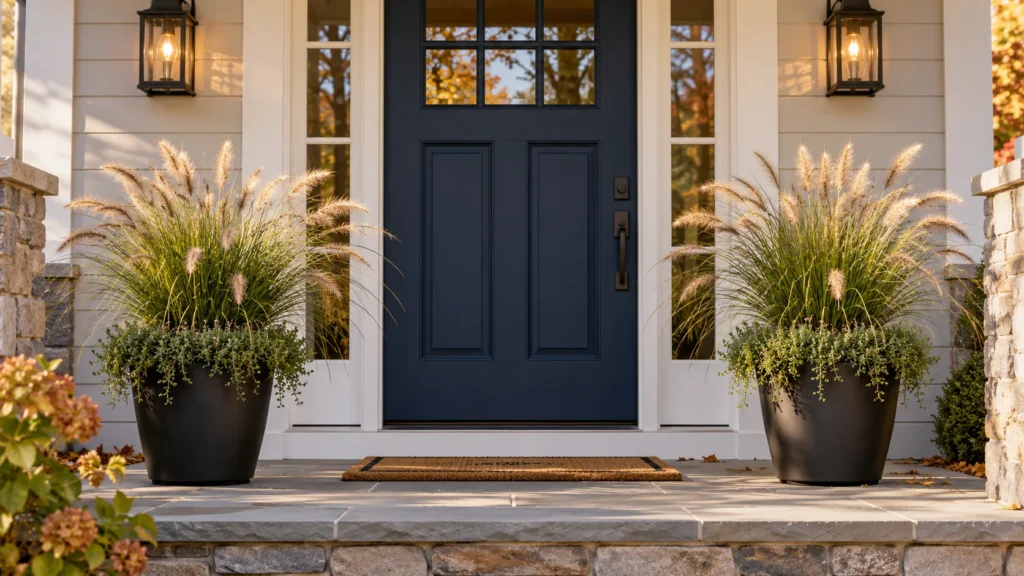
Two identical 14-inch pots, one each side of the door, each holding one ‘Hameln’ dwarf fountain grass (Cenchrus alopecuroides ‘Hameln’, still sold as Pennisetum) with common thyme (Thymus vulgaris) around its base. Symmetry makes a plain door look finished, and each pot stays light enough to lift.
Unlike the purple fountain grass in Idea 5, ‘Hameln’ is a hardy perennial, rated for zones 5a to 9b, that reaches 2 to 3 feet tall and wide with bottlebrush plumes from summer into fall, and the seed heads last into winter. Full sun is best, and NC State’s minimum is a 3-gallon container, which a 14-inch pot covers. The thyme stays low and green at the rim.
Water when the top inch is dry; both plants prefer it on the dry side, so a drainage hole matters more than feeding. Leave the grass standing all winter and cut it back in early spring.
Pet note: the ASPCA lists thyme (Thymus vulgaris) as non-toxic to cats and dogs. Its fountain grass entry is Pennisetum setaceum, also non-toxic; ‘Hameln’ is the same genus but not listed by name, so check it before buying for a pet home.
How to Pick the Right Fall Front Porch Planter Ideas for Your Space
Start from three facts about your porch: your USDA zone, how many hours of direct sun hit the spot, and whether a pet walks past it. Those three answers narrow the twenty ideas to two or three in under a minute.
Your zone comes from the USDA Plant Hardiness Zone Map (updated in 2023), which is based on the 30-year average of each year’s coldest temperature, split into 10°F zones and 5°F half zones. It tells you how cold a normal winter gets, and that’s the number to compare with every plant rating above.
Sun hours decide the plant list. Mums and most fall flowers want about 6 hours of direct sun; under that, build from pansies, heuchera, sedge and ferns. For a stoop that gets under six hours, we’d build the whole display from foliage and pansies and treat flowers as a bonus, because every extension guide on mums lands on the same six-hour figure.
Three if-then rules cover the rest. If a dog or cat uses the porch, choose from the pet-safe group and keep mums off the floor level. If your pot is clay or glazed ceramic and you’re in zone 6 or colder, plan to move it in or wrap it before a hard freeze. If the pot is a six-week display, skip fertilizer; if you planted pansies or perennials you mean to keep, feed lightly once at planting.
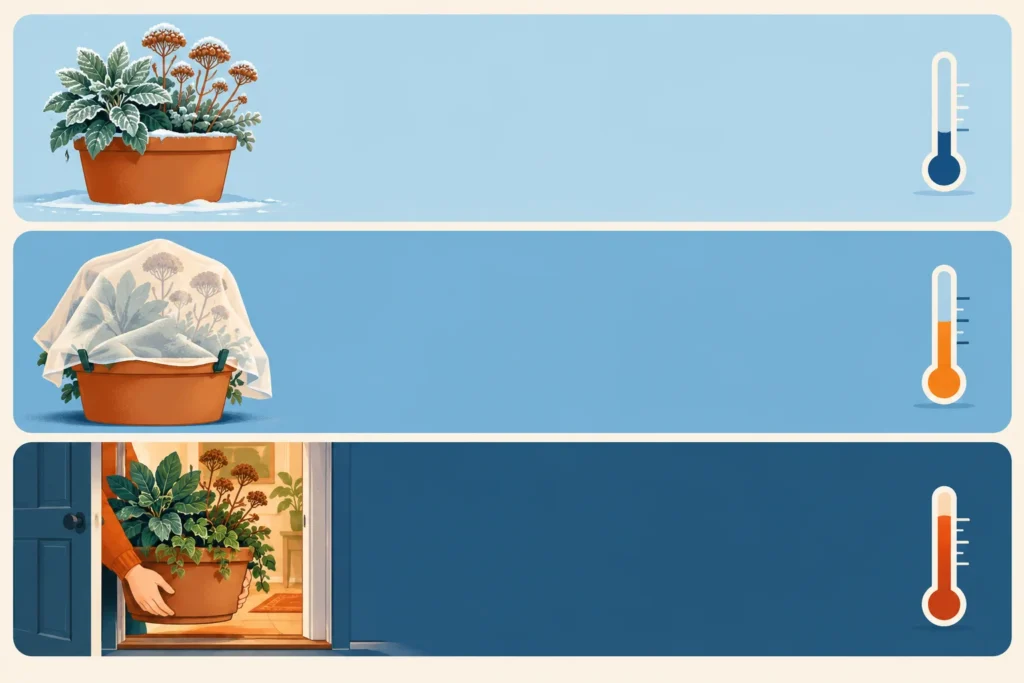
| Term | Air temperature (NWS) | What it means for porch pots |
|---|---|---|
| Frost | 33 to 36°F with light wind | Leaf tips may brown on tender annuals; mums, kale and pansies shrug it off |
| Freeze | 32°F or lower | Cover pots with a light blanket or an upturned larger container overnight; florist mum buds can be lost |
| Hard freeze | 28°F or lower for a few hours | Move clay and ceramic pots in or wrap them; only kale, sedge, heuchera and sedum carry on |
Those thresholds come from the National Weather Service definitions of frost, freeze and hard freeze, and your local forecast uses the same words. Early in fall, about six to eight weeks before your average first freeze, plant fresh and expect a couple of months of display. In mid fall, buy plants already in color, expect weeks rather than months, and keep a cover handy. After the first hard freeze, stick to foliage pots and gourds.
Pot size and drainage are the last check. Most containers should be at least 8 to 10 inches across, every pot needs a drainage hole (a layer of gravel in the bottom does nothing for drainage, so skip it), and a porous clay pot dries faster than plastic. Arrange plants by the usual formula if you combine them: a thriller at least 8 inches tall in the centre, fillers around it, and one or two spillers over the edge.
| Plant | Sun | Cold tolerance | Pot size guide | ASPCA pet status | How long it lasts |
|---|---|---|---|---|---|
| Garden mum (Chrysanthemum × morifolium) | About 6 hours direct | Hardy types zones 5 to 9; florist types not winter-hardy | 12 in or wider | Toxic | About 4 weeks of bloom |
| Ornamental kale (Brassica oleracea) | Full sun | About 5°F once acclimated | 12 in or wider | Not listed; keep pets from grazing | Fall into winter |
| Pansy and viola (Viola spp.) | Full to part sun | Light freezes; blooms best above 32°F | 8 to 14 in bowl | Non-toxic | Until snow in mild falls |
| Coral bells (Heuchera) | Part shade to sun | Zones 3a to 9b | 10 in or wider | Non-toxic (H. sanguinea) | Evergreen to semi-evergreen |
| ‘Evergold’ sedge (Carex oshimensis) | Sun to part shade | Zones 5a to 9b | 10 in or wider | Not listed; keep pets from grazing | Evergreen |
| China aster (Callistephus chinensis) | Full sun | Varies by variety | 10 in or wider | Non-toxic | Weeks, until hard frost |
| Purple fountain grass (Pennisetum setaceum ‘Rubrum’) | Full sun | Hardy only to zone 8 | 14 in or wider, heavy | Non-toxic | Until it freezes |
| Rosemary (Salvia rosmarinus) | Full sun | Evergreen; hardiness varies by zone | 10 in or wider | Non-toxic | Season to year-round by zone |
| Swiss chard (Beta vulgaris) | Full to part sun | Light frost | 10 in or wider | Non-toxic | Until hard frost |
| ‘Autumn Joy’ sedum (Hylotelephium spectabile) | 6+ hours direct | Zones 3a to 10b | 12 in or wider, sharp drainage | Low toxicity if eaten | Winter, heads left standing |
Frequently Asked Questions
Is late October too late to plant fall front porch planter ideas?
No, as long as you buy plants already in color rather than young starts. Fall growth is slow, so a kale, a pansy bowl or a mum in bloom looks finished the day you plant it and holds for weeks rather than months. Plant densely, keep a light cover handy for nights at 32°F or lower, and skip anything tender. The timing by frost date is under How to Pick.
Can I plant mums and pansies together in one pot?
Yes, and they suit each other: both want full sun, both shrug off a light frost, and the pansies keep blooming after the mum’s four weeks of flowers fade. Use a pot at least 12 inches wide so the mum doesn’t dry out daily, and water on the top-inch check. The one catch is pets, since chrysanthemums are toxic to cats and dogs; a pet household should build the pot from pansies and kale instead.
Should I bring fall porch planters inside at night?
Only on a forecast hard freeze, 28°F or lower for a few hours, and even then only for the plants and pots that can’t take it. Pansies, kale, sedge, heuchera and sedum carry on; florist mums, tender annuals and any clay or glazed pot are the ones to cover at 32°F and move in at 28°F. A light plastic pot makes that one trip through the door, which is the main reason to choose one in an apartment.
How long do fall porch planters last?
Plan on about four weeks of bloom from a garden mum, several weeks from China asters, pansies until snow in mild falls, and kale, sedge, heuchera and ‘Autumn Joy’ sedum right through winter. A pot built from the longer-lasting group still looks intentional in January; one built from mums needs a swap in November. The comparison table in How to Pick lists the span for each plant.
Can I reuse the potting mix from my summer pot?
Yes, in a large pot, if you pull the old plants roots and all and replace the top few inches with fresh potting mix, or work in some compost. A six-week fall display doesn’t need fertilizer, so that refresh is enough. Replace the whole mix only if it stayed soggy all summer or a plant died of root rot in it, since the problem is likely still in the pot. The step-by-step refresh is in Idea 9.
What Actually Matters
Most fall planters fail from water, not cold: a pot that stays soggy in 45°F weather rots roots faster than a light frost browns a leaf. So the one habit to keep is the finger test. Push a finger an inch into the mix; if it’s dry, water, and if it isn’t, walk past. In cool weather that may mean once a week.
A quick read on the common problems. A mum gone brown and crisp within days usually dried out between waterings on a sunny step, or took an unprotected freeze (blackened petals after a cold night), or simply finished its four weeks (green foliage, faded flowers); water on the dry check, cover below 32°F, or swap in kale. Pansies stretching with few flowers point to a warm spell, too little light or hunger; more sun, a light feed and cooler nights bring them back. Kale that stays dull green hasn’t been cold enough yet, so wait and don’t feed. A plant yellowing and collapsing at the base in soggy mix means a blocked drainage hole or overwatering; clear the hole, lift the pot onto feet, and water less. A cracked pot after a cold night means clay plus wet mix plus a freeze; move the plants to plastic and bring the clay in.
Be honest with yourself about next year. Plants in containers generally don’t overwinter, and florist mums won’t survive winter frost at all. If you want a mum back, buy a labeled hardy garden mum and plant it in the ground before the soil freezes; the same goes for heuchera and sedum if you have a bed to spare. Compost the annuals, store clay pots dry, and keep the plastic ones for spring.
This week’s action: look up your zone, count the sun hours on your step for one afternoon, and buy a kale, a bowl of pansies and one foliage perennial rather than a mum in full bloom. If you’re starting from a tired summer pot, Idea 9 gets it done in twenty minutes, and that sun-scorched petunia finally gets its retirement.
Sources
- University of Illinois Extension – Give your front porch containers a fall makeover – 20°F cold tolerance of many fall container plants, four-week mum bloom, top-inch watering, root rot in cool wet soil, no fall fertilizer, planting densely in fall, blanket cover below freezing, ‘Bright Lights’ chard
- Clemson Cooperative Extension HGIC – Seasonal Container Gardening: Fall Through Winter – pansies and violas as top cool-season annuals, bloom best above 32°F, violas need less deadheading, compact asters, alyssum spilling, ferns, heuchera, sedge, rosemary, parsley, chard for fall containers
- Iowa State University Extension – Yard and Garden: Fall Chrysanthemums – garden vs florist mums, florist mums not surviving winter outdoors, blooming fall mums usually not hardy cultivars
- Iowa State University Extension – Growing Pansies and Violas – light freeze tolerance, 4 to 10 inch size, full to part sun, stretching in warm or low light, light feeding every one to three weeks
- University of Wisconsin-Madison Extension – Ornamental Cabbage and Kale – survival to about 5°F when acclimated, color below 50°F, 12 by 15 inch size, kale-centre pansy-ring design, chard tolerating light frost
- UConn Plant Science – I Want My Mum: A Fall Classic Through the Ages – six hours of sun for mums, hardy garden mums zones 5 to 9, florist mums not surviving winter frost
- UConn Home and Garden Education Center – Tips from UConn Floriculture Help Spruce Up Container Plantings – deadheading, refreshing the top few inches of mix, pots drying fast on sunny fall days
- UMass Extension – Fall Flowers – containers generally not overwintering, removing old roots and adding fresh mix
- SDSU Extension – Bring New Life to Worn-Out Summer Containers – stacking pumpkins and gourds, reusing them in November
- Penn State Extension – Overwintering Plants in Containers – two-zones-hardier rule, container roots matching air temperature, larger pots insulating, watering before the soil freezes, clay and glazed pots cracking, wrapping or moving pots
- Utah State University Extension – Seven Tips for Container Gardens that Thrill, Fill and Spill – 8 to 10 inch minimum pot, small pots holding only small plants, thriller 8 inches or taller
- University of Maryland Extension – Types of Containers for Growing Vegetables – drainage holes, gravel layer not improving drainage, clay drying faster than plastic, 1 to 3 gallon and 4 to 6 gallon pot volumes
- Mississippi State University Extension – Combination containers follow an easy formula – thriller, filler, spiller roles
- USDA Agricultural Research Service – USDA Unveils Updated Plant Hardiness Zone Map – 2023 map, 30-year average extreme minimum, 10°F zones and 5°F half zones
- National Weather Service, Hastings NE – Fall Frost/Freeze Info – frost 33 to 36°F, freeze 32°F or lower, hard freeze 28°F or lower for a few hours
- NC State Extension Plant Toolbox – Heuchera – zones 3a to 9b, 6 to 20 inches, part shade, scorch in hot dry sun, container use
- NC State Extension Plant Toolbox – Carex oshimensis ‘Evergold’ – zones 5a to 9b, 12 to 18 inches, no drought tolerance, container use
- NC State Extension Plant Toolbox – Autumn Joy Sedum – zones 3a to 10b, 1 to 2 feet, 6+ hours sun, intolerant of wet soil, low toxicity, pink to red flowers
- Missouri State University – Purple Fountain Grass – hardy only to zone 8, 2 to 5 feet, full sun, dies when frozen
- ASPCA Animal Poison Control – Chrysanthemum; English Ivy; Boxwood; Ornamental Pepper (Solanum pseudocapsicum); Coral Bells; Rosemary; Beets (Beta vulgaris); Yellow-Flowered Gourd – species toxicity status for cats and dogs
- ASPCA – Fall Plants: Hazardous or Harmless? – mums toxic; pansies, China aster and fountain grass non-toxic; any plant material may cause mild stomach upset.