

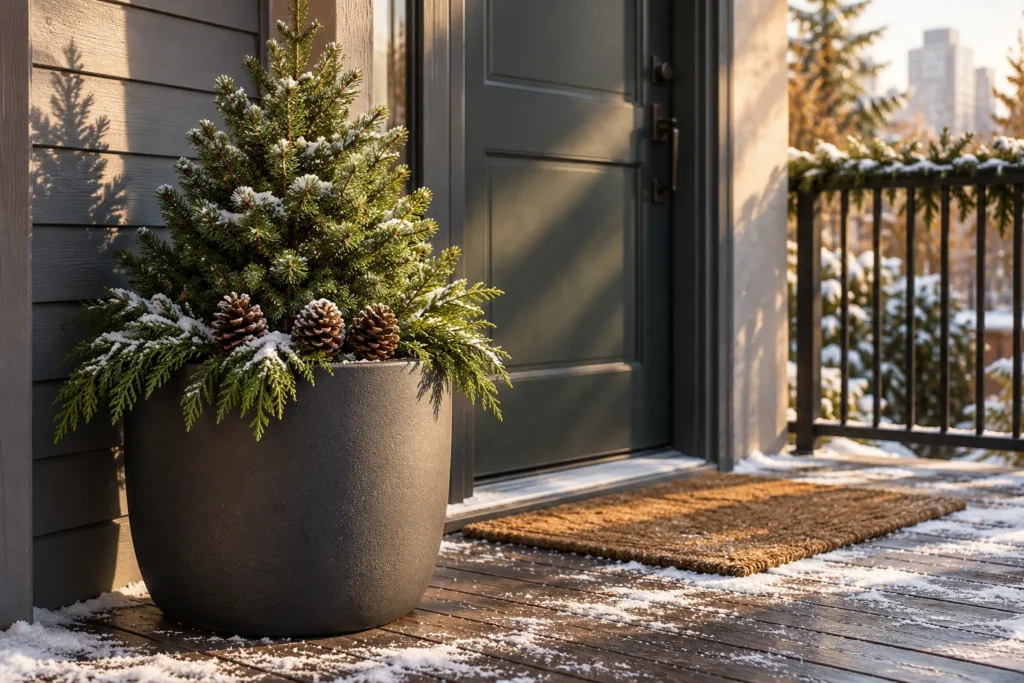
The dwarf spruce looked perfect in the nursery cart, the big pot by your door has been sitting empty since the mums gave up, and now you’re standing there with the plant tag in your hand wondering one thing: will this actually live through January in a container, or should you just stuff the pot with cut branches and call it done?
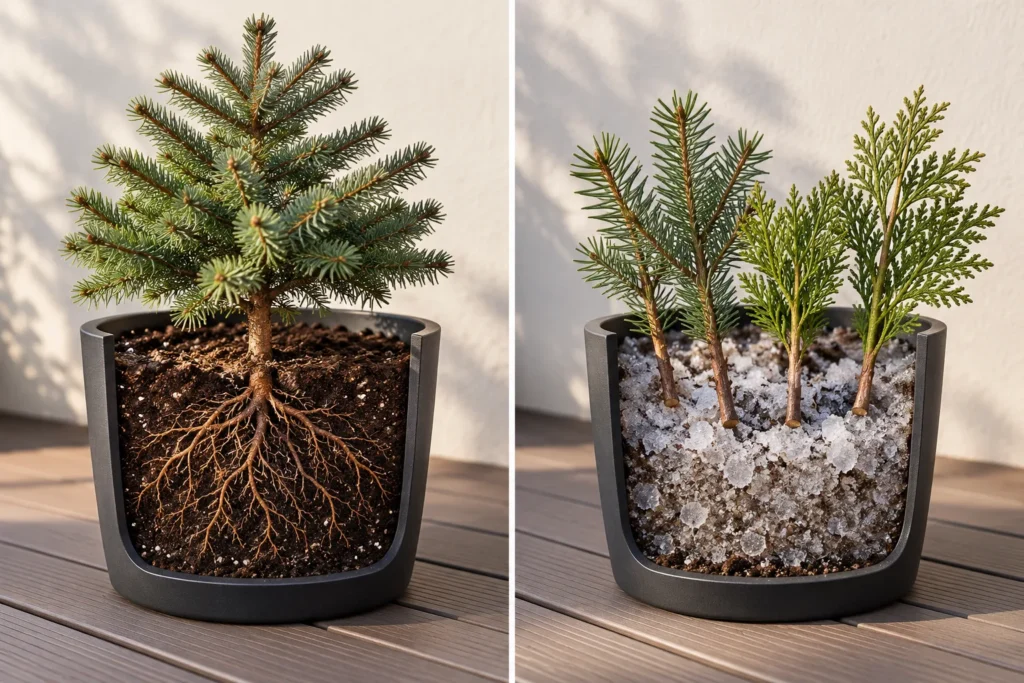
Both work. They solve different problems, and that’s the part most lists skip. A living dwarf evergreen is a buy-once plant that needs a pot-friendly cold rating; a cut-greens pot is a one-winter display where nothing has to survive at all.
These winter porch planter ideas with evergreens are sorted that way, living first, then cut, then combinations, and every idea carries the three facts a small-space grower needs before paying: the USDA zone it can take in a pot, the sun it wants, and whether it’s safe around a curious cat or dog.
Table of Contents
At a Glance
- Pick a living dwarf evergreen if you want a pot that comes back next year; pick cut greens if you want a full, fast, zero-risk display for one winter.
- A live conifer in a pot should be rated about two USDA zones colder than where you live, because roots above ground can get nearly as cold as the air. Each living idea below gives its pot-safe zone.
- Cut-greens pots need no root hardiness: push stems into moist mix, water once, let it freeze. The assembly steps live under Idea 6.
- Skip terracotta and glazed ceramic outdoors where it freezes; use resin, fiberglass, wood, metal or thick plastic with drainage holes.
- Boxwood, holly and winterberry, English ivy, yew, hellebore and Pieris are all on the ASPCA toxic list for dogs and cats. Coral bells and rosemary are listed as non-toxic; check any conifer before it goes where a pet can chew it.
What to do right now: if your mix hasn’t frozen yet, assemble this week and water it in. If it already has, build a cut-greens pot in fresh moist mix and leave it alone until spring. For a first winter pot, we’d start with cut greens in the old mix from your fall container, because nothing has to survive and the only skill involved is pushing stems into damp soil.
Living Dwarf Evergreens That Stay in the Pot All Year
These five are the buy-once option: slow-growing conifers that US nurseries actually stock, each with a pot-adjusted zone so you know before you pay. If you can only afford one live plant in zone 5 or 6, we’d pick the arborvitae or the Alberta spruce over the juniper, because they carry the colder rating that a pot needs.
Give any of them a container at least 4 to 6 inches wider than the nursery pot, filled to about an inch below the rim, and look for growth of roughly 1 to 6 inches a year so the plant can stay in the same pot for several seasons. Water well before the first hard freeze and again during thaws, and keep the pot off bare concrete, which Idea 15 explains. If you’re swapping out the fall porch pot you built in October, the same container and mix will carry any of these through winter.
Idea 1: Dwarf Alberta Spruce in One Big Urn
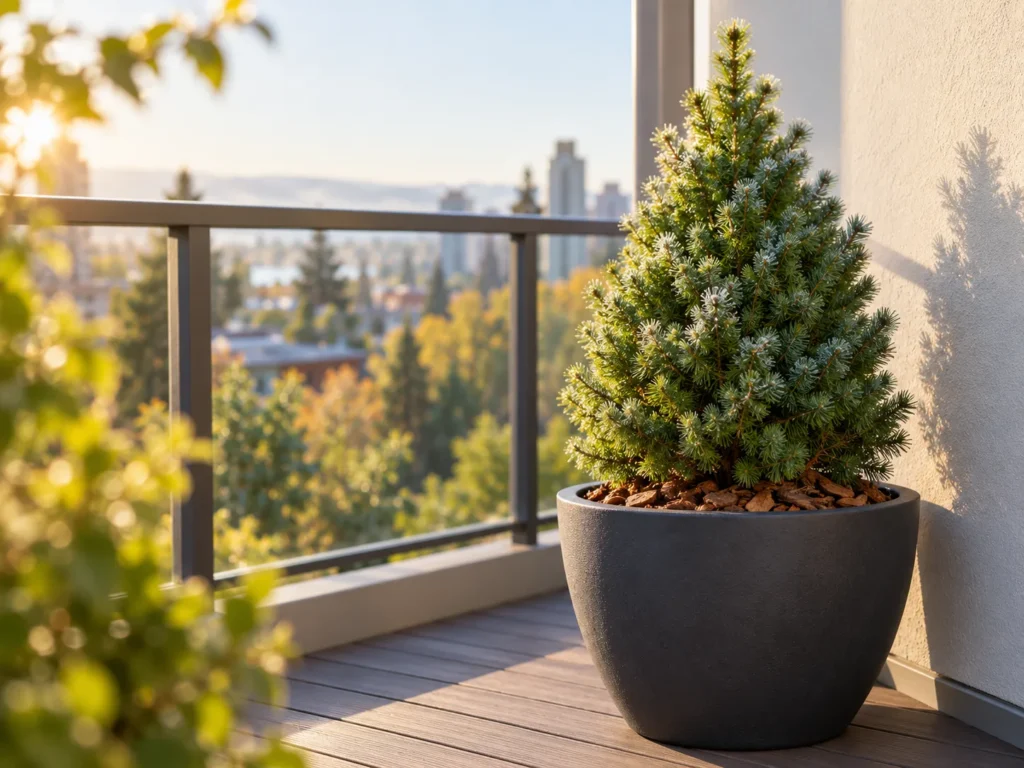
Dwarf Alberta spruce (Picea glauca ‘Conica’) is the plant most people picture when they say “winter porch pot”, and it earns the spot. It’s hardy in zones 3 to 6 in the ground, so it’s a sensible pot plant from zone 5 up, and it only reaches about 3 to 4 feet after ten years, which means a standard pot size holds it for a long time.
Give it full sun to part shade and keep the mix moist but draining. It needs protection from strong wind, so a spot against the wall beats the open edge of a balcony, and in still, sheltered corners watch for spider mites, which show up as fine stippling and webbing on the inner needles.
Best for zone 5 and 6 entries with a wall at their back. Skip it in zone 7 and warmer, where it struggles with summer heat; choose the hinoki or the juniper instead.
Idea 2: Hinoki Cypress ‘Nana Gracilis’ for a Textured Modern Pot
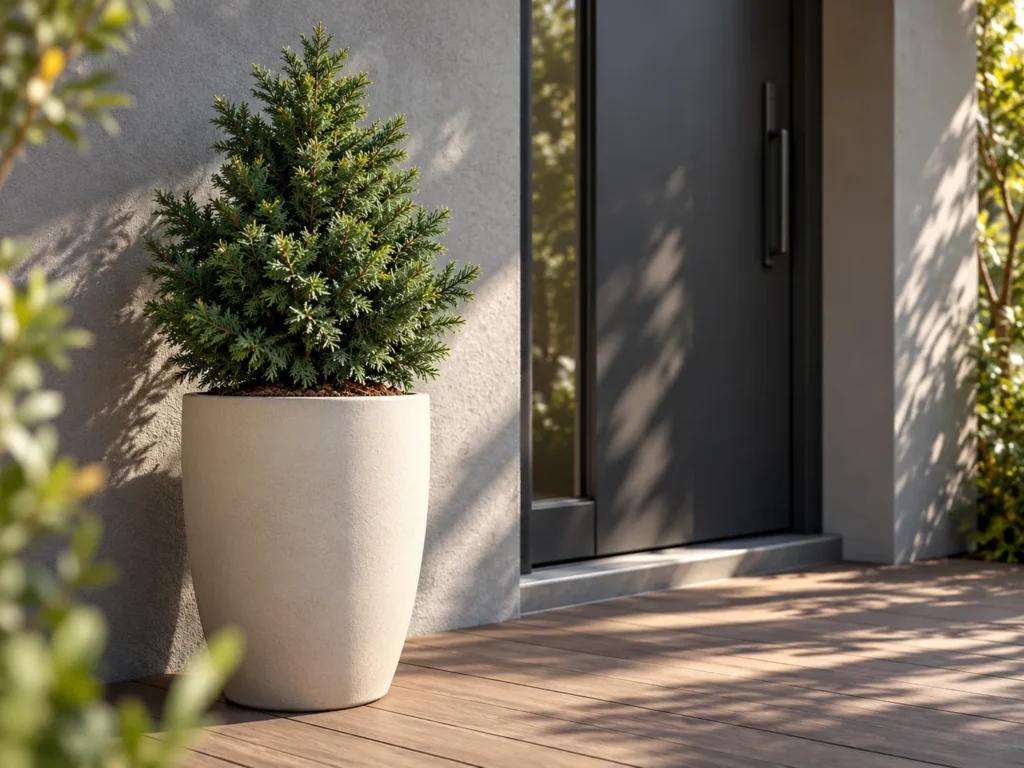
Hinoki cypress ‘Nana Gracilis’ (Chamaecyparis obtusa ‘Nana Gracilis’) gives you texture instead of a plain cone: its foliage grows in cupped, layered sprays that look almost sculpted. It’s rated for zones 4 to 8 in the ground, which makes it a pot plant from zone 6, and it grows slowly to about 3 to 4 feet in ten years with a 2 to 4 foot spread.
It takes full sun or part shade and wants a moist, well-drained mix, so a standard pot size with real drainage holes is all it asks. Because it adds only a few inches a year, one good pot can hold it for years.
Best for a modern entry where one plant has to carry the look alone. Skip it if you’re in zone 5 or colder without a sheltered cluster; the spruce or arborvitae is the safer rating there.
Idea 3: Two Arborvitae Globes Flanking the Door
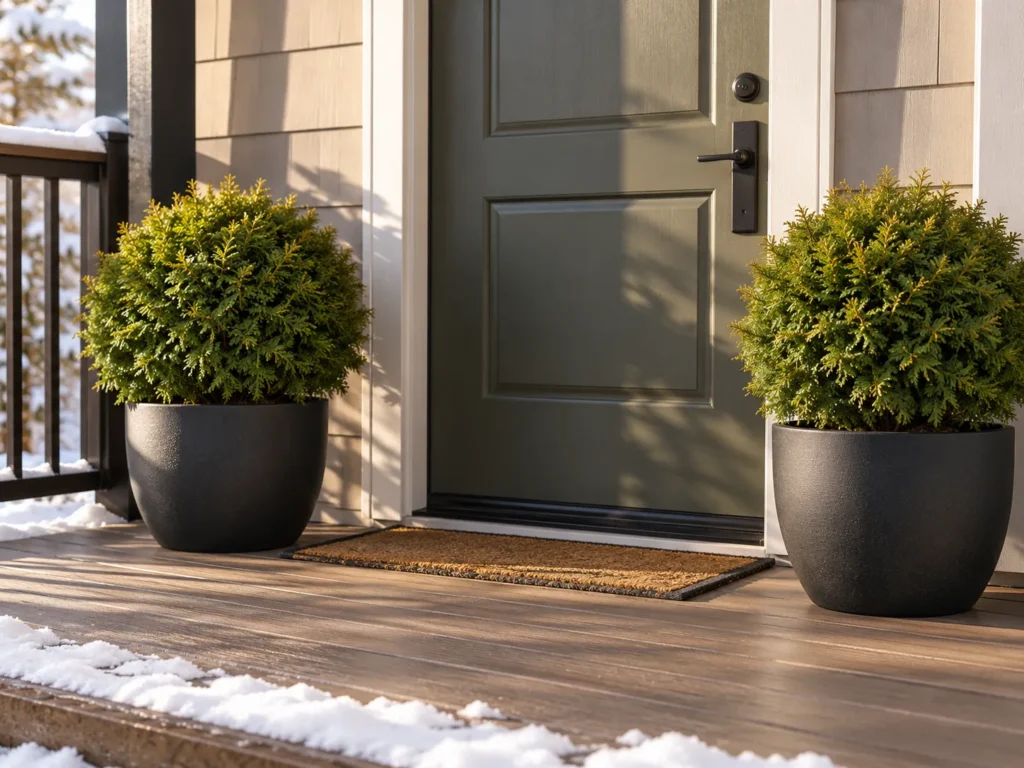
Eastern arborvitae ‘Hetz’s Midget’ (Thuja occidentalis ‘Hetz’s Midget’) is the one for a matched pair, because it grows as a naturally round globe without pruning. Rated for zones 3 to 7 in the ground, it suits a container from zone 5 up, and it reaches only 3 to 4 feet tall and 4 to 5 feet wide over many years.
Give it full sun to part shade and don’t let the mix dry out, because this plant does not tolerate dry, exposed, windy sites. On a balcony that means the pair goes against the wall by the door, not out at the railing, and if deer visit your ground-floor porch, they’ll browse it.
Best for a formal entry in zone 5 to 7 where you want symmetry. Skip it on a windy upper-floor balcony with no wall shelter.
Idea 4: Dwarf Mugo Pine in a Low, Wide Bowl
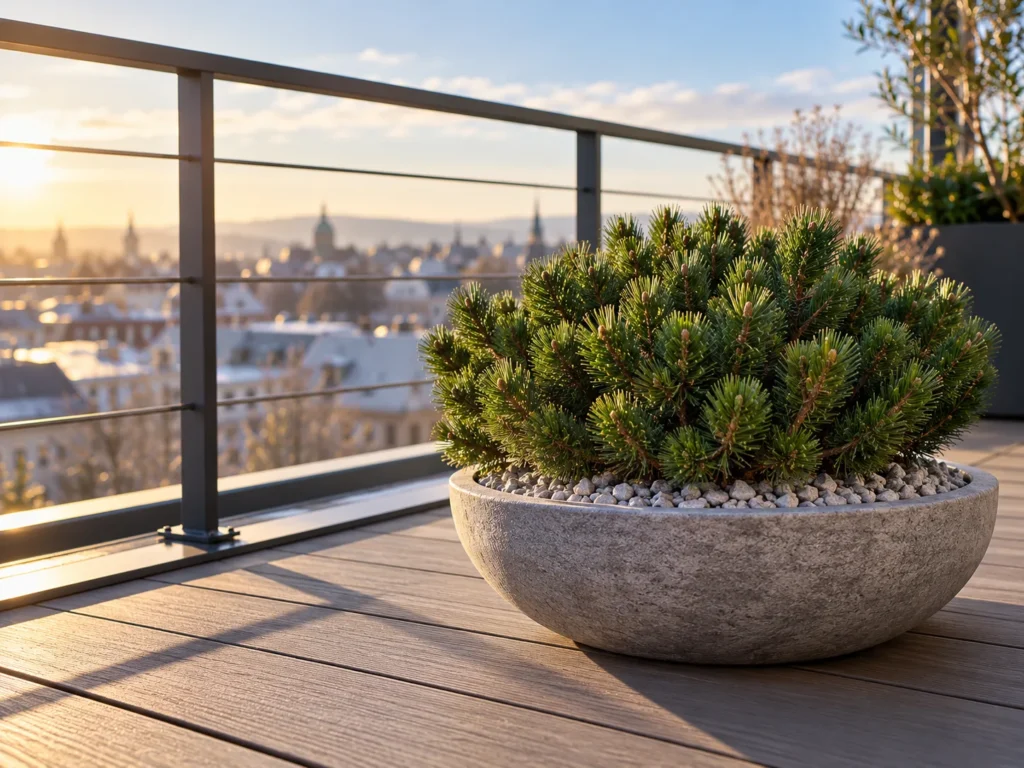
Dwarf mugo pine (Pinus mugo, dwarf cultivars) is the toughest plant in this group. The species is rated for zones 2 to 7 in the ground, so it can winter in a pot from zone 4, colder than anything else on this list, and dwarf cultivars stay in the 2 to 5 foot range.
It wants full sun and a mix that never stays wet, so use a free-draining blend and never let the bowl sit in a saucer of water. The low, wide bowl isn’t just a look: a heavy, broad base resists tipping in gusts, which makes this the pick for a sunny, windy balcony where a tall urn would go over.
Best for cold, exposed, sunny spots in zone 4 to 7. Skip it on a shaded north entry; it will thin out and sulk.
Idea 5: ‘Blue Star’ Juniper with Silver and Stone
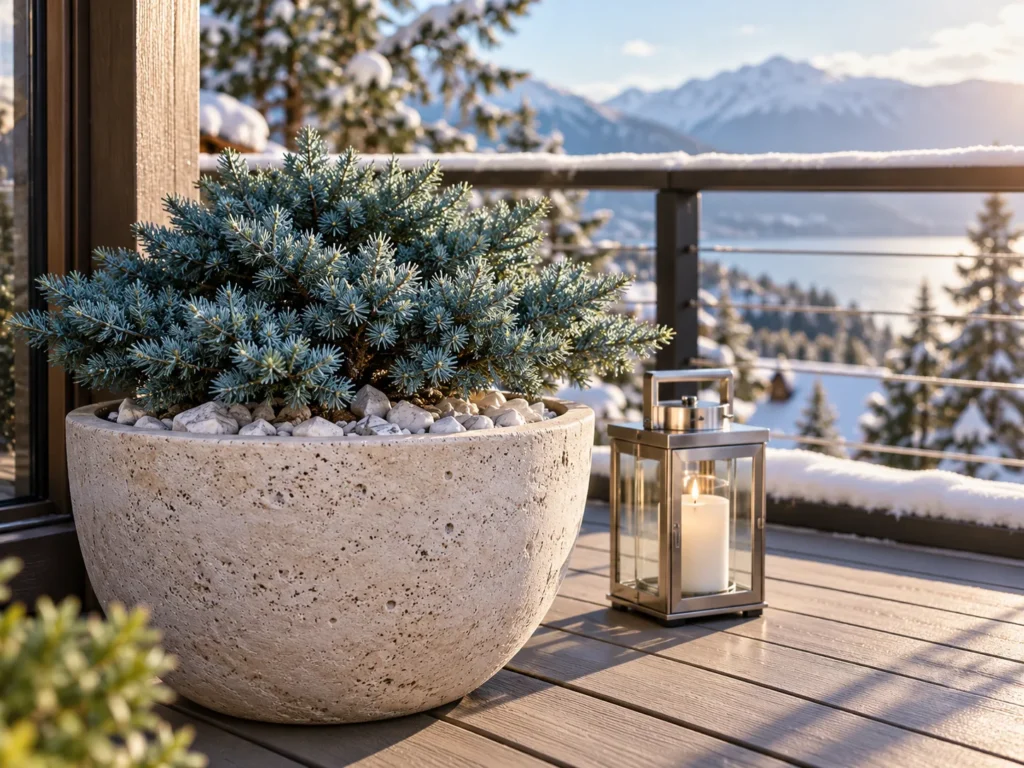
‘Blue Star’ juniper (Juniperus squamata ‘Blue Star’) brings the one colour the rest of the list can’t: a steel blue that looks sharp next to pale stone, white gravel or a brushed metal lantern. It’s rated for zones 4 to 8 in the ground, so pots from zone 6, and it’s slow, about 1 foot tall after five years and 1 to 3 feet at maturity.
Full sun and a mix that drains fast are the two needs; it’s intolerant of wet soil, so treat it like the mugo pine and skip the saucer. Expect the foliage to take on a duller, bronzed tint in cold weather. That’s normal winter colour, not a dying plant, and it clears in spring, which is the moment to switch the pot over to one of our farmhouse spring porch planter ideas.
Best for a sunny zone 6 to 8 porch with a modern, cool palette. Skip it in zone 5 and colder unless the pot sits in a sheltered cluster against the building.
Cut-Greens Porch Pots (One Winter, No Root Worries)
A cut-greens pot is the renter’s friend: nothing has to survive, the stems hold in frozen mix until spring, and you can forage half of it from a friend’s yard or the trimmings bin at a tree lot. You need pruners, a bucket for soaking stems, a pot of moist mix (the old fall mix works), florist wire and, for Idea 10, a set of battery lights.
The greens that last longest in a pot are boxwood, false cypress, holly, eastern red-cedar, spruce, pine, yew and arborvitae; short-needled evergreens, especially eastern hemlock, drop their needles fast and aren’t worth the effort. One warning before you cut: yew is on the ASPCA toxic list for dogs and cats and can cause sudden heart failure, so leave it out of any pot a pet can reach, however nicely it holds its needles.
Don’t strip one shrub bare when you forage, and skip the berries of invasive plants such as oriental bittersweet, which spread when the arrangement is composted. If gusts are your main problem, the heavier, wider pots described in our guide to wind on a high-rise balcony apply to cut-greens pots too.
Idea 6: The Classic Spruce-Tip Porch Pot
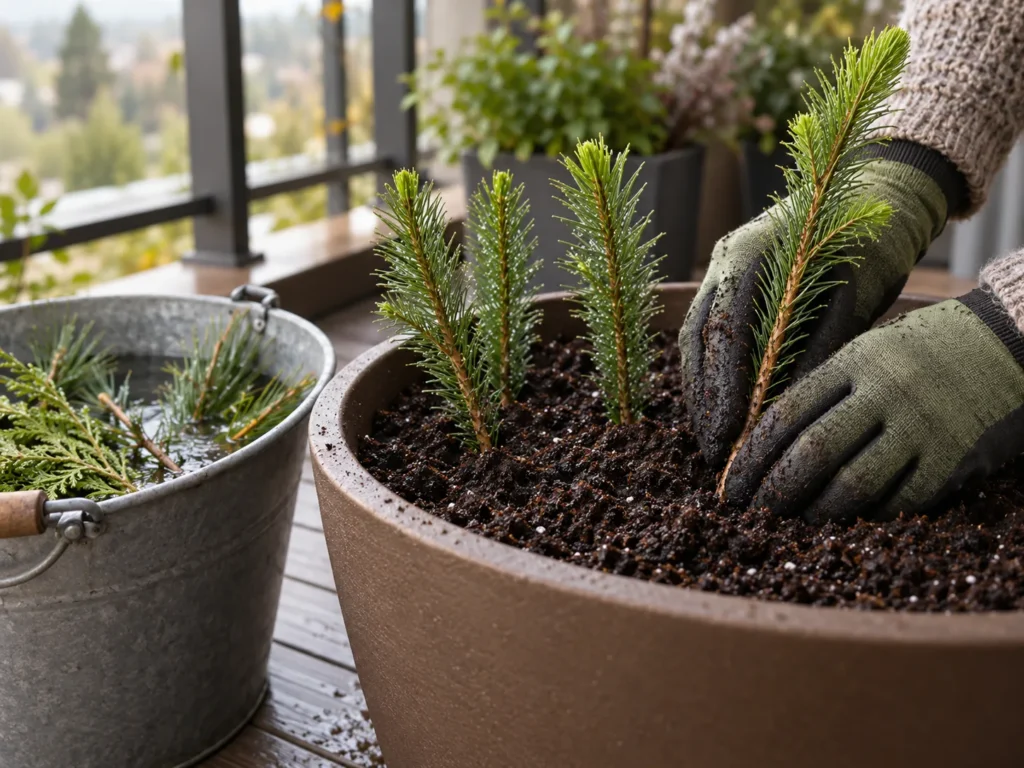
This is the pot every other cut-greens idea builds on, so the assembly order lives here. Spruce tips are simply the top foot or two of young spruce trees or branches, sold in bundles at garden centres from mid-November in cold climates and easy to find at Christmas tree lots.
- Reuse the fall container with its old mix, or fill a new pot (drainage holes required) with a dense potting mix. Water it thoroughly and let it settle. Moist mix freezes slower than dry mix, and once frozen it holds every stem upright, so this watering is the one chore that matters.
- Recut the stem ends and soak everything in a bucket for a few hours so the greens go in full of water.
- Push the tallest spruce tips into the centre, about a third of their length into the mix, for the “thriller” height.
- Angle flat cedar or juniper sprays around the rim so they spill over the edge, then fill the gaps with pine, false cypress and a few pinecones wired to short sticks.
- Water again so the mix seals around the stems, then leave it to freeze. On an open porch, rain and snow do the rest.
A covered porch gets no rain, so check the mix during any thaw and water if it’s dry; the detail is in What Actually Matters. In a mild-winter climate where the mix never freezes, keep watering it like a summer pot and move it into shade on warm days so the tips don’t dry out.
Best for anyone who wants a full pot this weekend. Skip spruce tips if your winter rarely drops below freezing; they brown quickly in warm spells, and Idea 13 is the better route.
Idea 7: Birch Poles and Red-Twig Dogwood with Mixed Greens
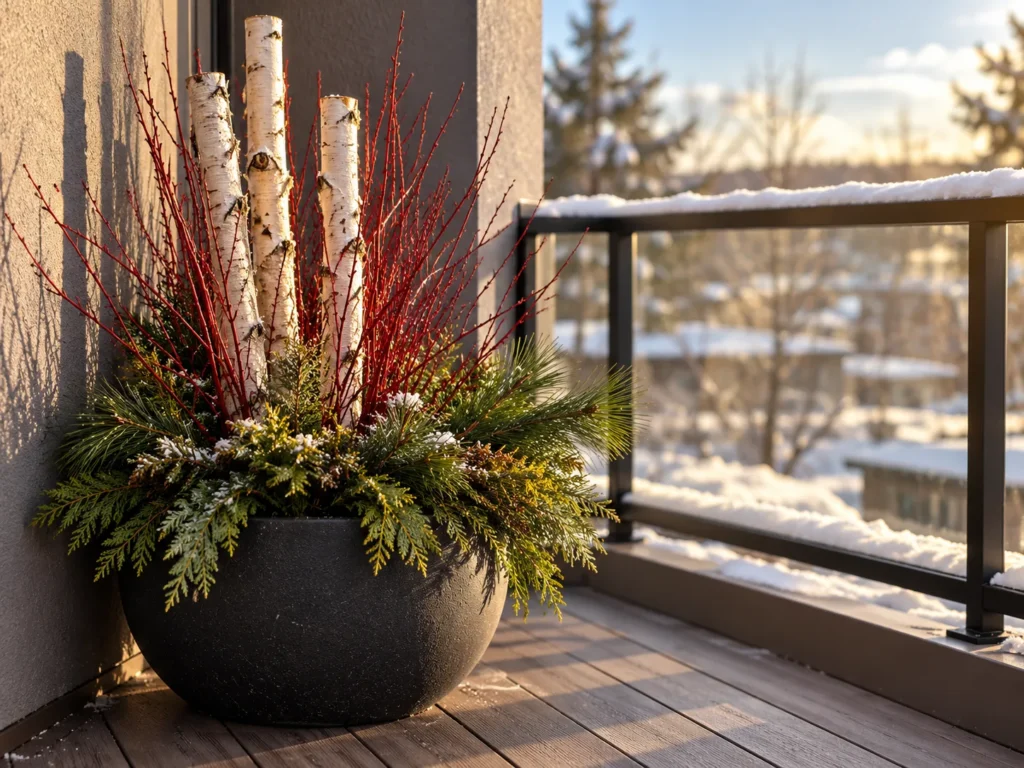
Birch poles and red-twig dogwood (Cornus, the red-stemmed shrub dogwoods) give you height without a tall plant, which is exactly what a renter with a small budget and a windy balcony needs. The white bark and red stems show from the street, and both last all winter in frozen mix.
Wire the poles and dogwood stems to one sturdy stake so they move as a single unit, push the stake deep into the centre of the moist mix, then build the greens around it following the order in Idea 6. Height catches wind, so this one only works in a pot that is heavy and wider than it is tall, set against a wall rather than at the railing.
Best for a visible balcony or entry where you want drama on a low budget. Skip the tall poles if the pot is light or the spot is exposed; use shorter dogwood stems alone instead.
Idea 8: Boxwood and Winterberry, the Holiday Look
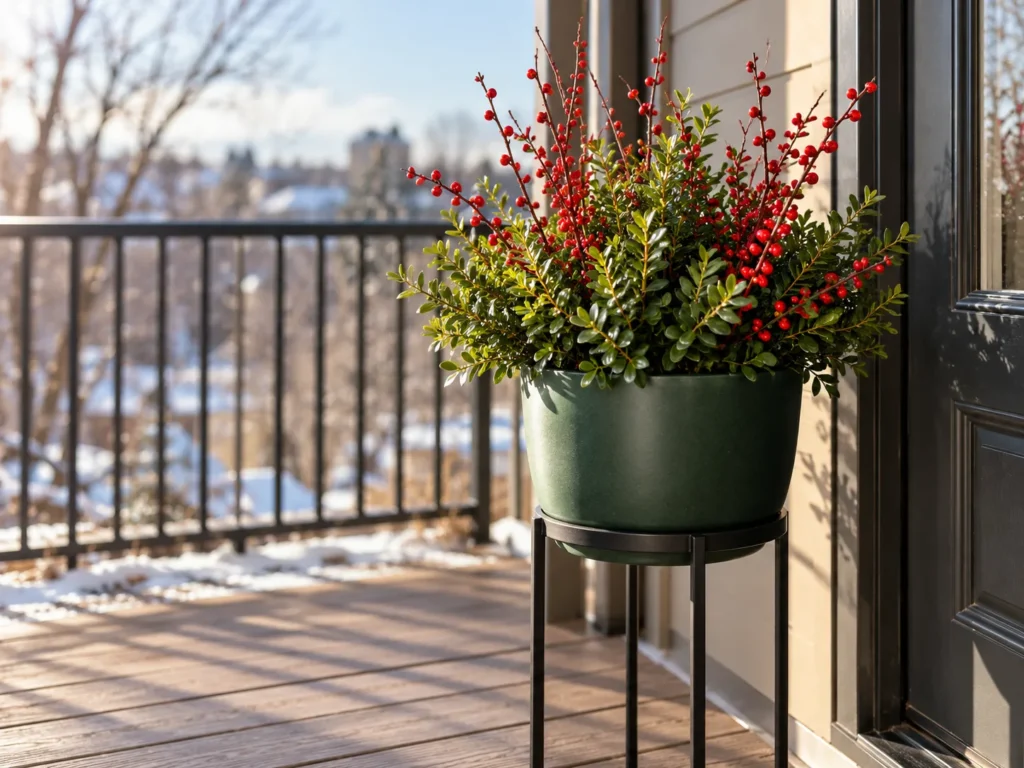
Boxwood (Buxus spp.) and winterberry (Ilex verticillata) are the classic red-and-green holiday pot, and both hold well in frozen mix. Short boxwood sprigs make a dense, glossy filler and a few bare winterberry stems carry the colour.
Pets are the problem here. Boxwood is toxic to dogs and cats, with vomiting and diarrhea the usual signs, and holly and winterberry, berries included, are toxic to both as well. A plant stand lifts the pot above a dog’s nose, but a cat can jump straight onto it, so in a cat household use faux berries for the red and cut greens you’ve checked for pet safety.
Best for a pet-free entry that wants the traditional holiday picture. Skip it, or lift it out of reach, if a cat or dog uses the porch.
Idea 9: A Railing or Window Box of Cut Greens
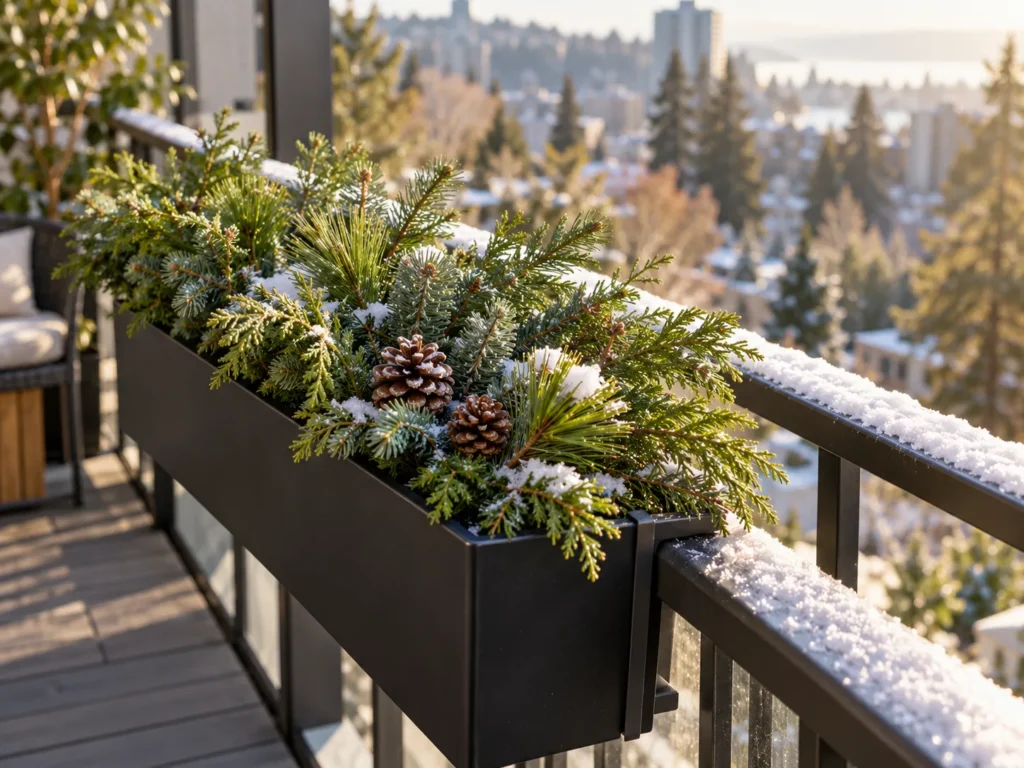
A railing or window box turns the same cut greens into a low horizontal band, which suits a balcony with no floor space at all. Keep stems short, about 8 to 12 inches, so the box doesn’t catch wind like a sail, and pack them tight in moist mix the same way as Idea 6.
A saddle-style bracket that hangs over the rail needs no drilling, which keeps the landlord happy, but check your lease and building rules before anything hangs on the outside of a railing. If you don’t own a box yet, there’s a railing planter box you can build without drilling, and our apartment window box ideas cover the sill version.
Best for narrow balconies and ground-floor window sills. Skip it on a high floor where the box could fall or shed stems onto a neighbour below.
Idea 10: An Evergreen Pot with Lights
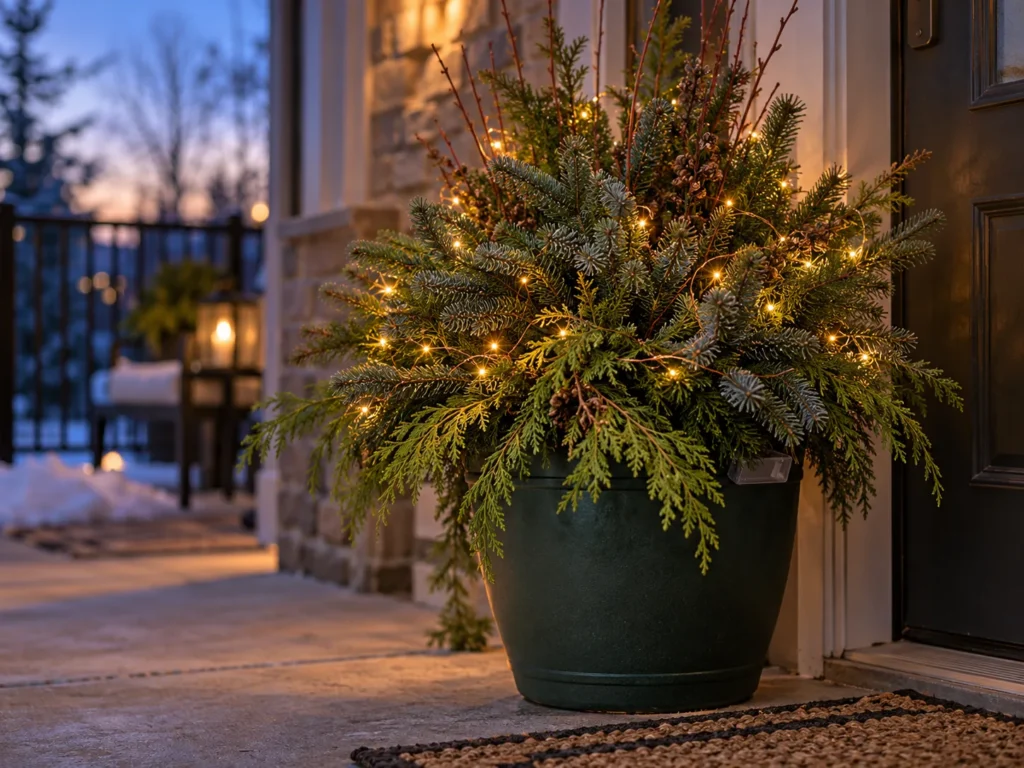
Lights turn any of the cut-greens pots above into the one your neighbours notice, and battery micro lights are the renter’s default: no cord across the deck, no outlet needed, and the pack hides under the lowest sprays. Weave them through the greens before the mix freezes, because once it does you can’t push anything new in.
If you’d rather use plug-in lights, use only sets and extension cords marked for outdoor use, plug them into a GFCI-protected outlet, inspect every strand for cracked insulation first, and switch them off before bed or when you leave. Ornaments and bows wired to a stick can still be swapped after the freeze, since the stick slides into the hole the old one left.
Best for a dark entry where the pot is mostly seen after work. Skip plug-in sets if your balcony has no outdoor-rated outlet; batteries are the safe answer.
Living Evergreens with Companions
Two combos that stay alive together in one pot and give you more than needles to look at. Both companions take part shade, which makes them the right pairings for a porch that only sees sun for part of the day.
Idea 11: Dwarf Conifer with Coral Bells
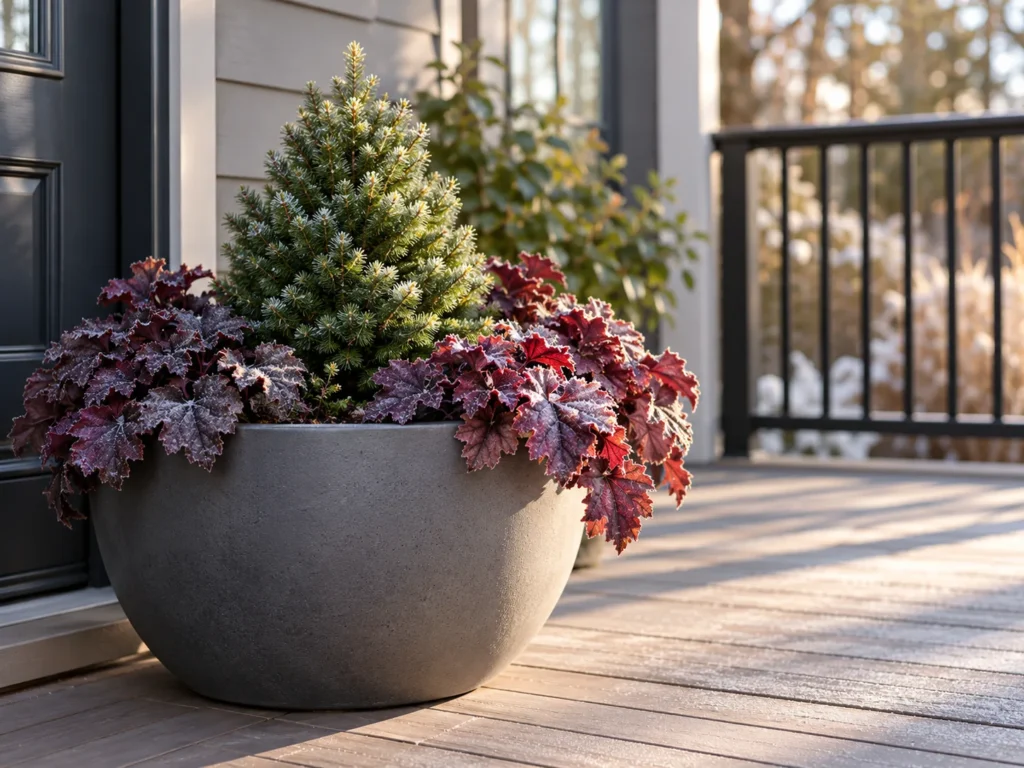
Coral bells (Heuchera) around the base of a dwarf conifer is the pet-household combo. Coral bells are non-toxic to dogs and cats, hardy in zones 3 to 9, and their dark purple, caramel or silver leaves stay evergreen to semi-evergreen depending on how cold your winter gets.
They grow 6 to 20 inches tall and wide, take sun or part shade depending on the variety, and want a moist, well-drained mix, which matches the spruce or arborvitae above them. In a home with a cat and a dog, I’ve learned to check every new plant against the ASPCA list before it comes through the door, and this is one of the few winter-pot companions that passes that check without a caveat.
Best for pet households and part-shade entries in zone 5 and up. Skip the dark-leaved varieties on a fully sunny south balcony, where some scorch; pick a green or silver-leaved one there.
Idea 12: An Evergreen Sedge Skirt
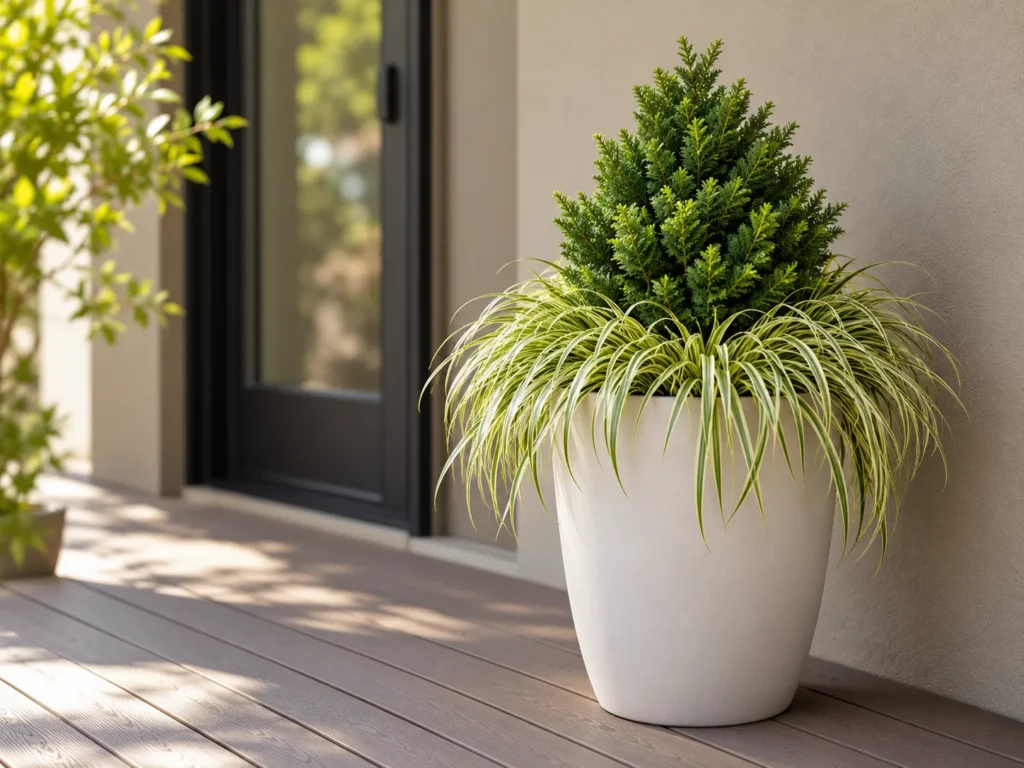
‘Evergold’ sedge (Carex oshimensis ‘Evergold’) is the grassy alternative: a fountain of narrow cream-striped blades that softens the hard rim of a planter around any small conifer. It’s hardy in zones 5 to 9, stays about 12 to 18 inches tall and wide, and takes full sun or part shade.
The one thing it will not forgive is drought. It wants a moist to wet mix, which makes it a better match for a covered porch where you’re already watering during thaws than for an open balcony that freezes solid in November; the thaw-watering routine is in What Actually Matters. If a cat or dog shares the porch, check it for pet safety before buying and keep it out of chewing range.
Best for zone 6 to 9 covered porches with a tall planter that needs softening. Skip it where the mix freezes hard for months; it won’t get the water it needs.
Mild-Winter and Shaded Porch Setups
If your winter rarely drops below the teens, or your entry never sees the sun, these two beat a spruce that browns in a warm spell or thins out in the dark.
Idea 13: Rosemary as the Evergreen
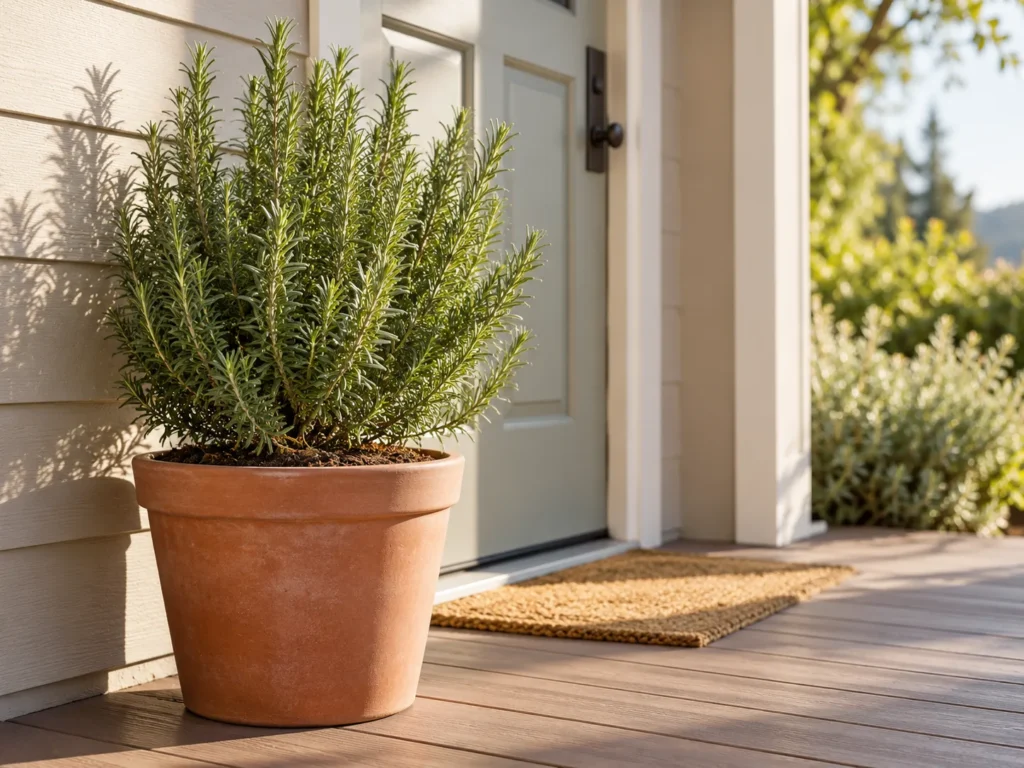
Rosemary (Salvia rosmarinus, still sold under its old name Rosmarinus officinalis) is the evergreen for the warmest porches, where a spruce tip would brown in the first warm week. It’s rated for zones 8 to 10 in the ground, so in a pot it’s a safe bet in zone 10 and a reasonable gamble in zone 9 against a sheltered wall. It’s an upright shrub that can reach 4 to 5 feet in the ground, takes full sun and tolerates part shade, and smells like dinner every time you brush past it on the way in.
Overwatering is the most common way people kill it, so give it a fast-draining mix, a pot with holes and water only when the top of the mix is dry. It’s listed by the ASPCA as non-toxic to dogs and cats, and it’s edible, which makes it the only idea here that earns its keep in the kitchen as well as on the step.
Best for mild-winter, full-sun entries and pet households. Skip it in zone 8 and colder; a hard freeze in a pot can kill it, and you’ll want the sweet box or a conifer instead.
Idea 14: Sweet Box for a Shaded Entry
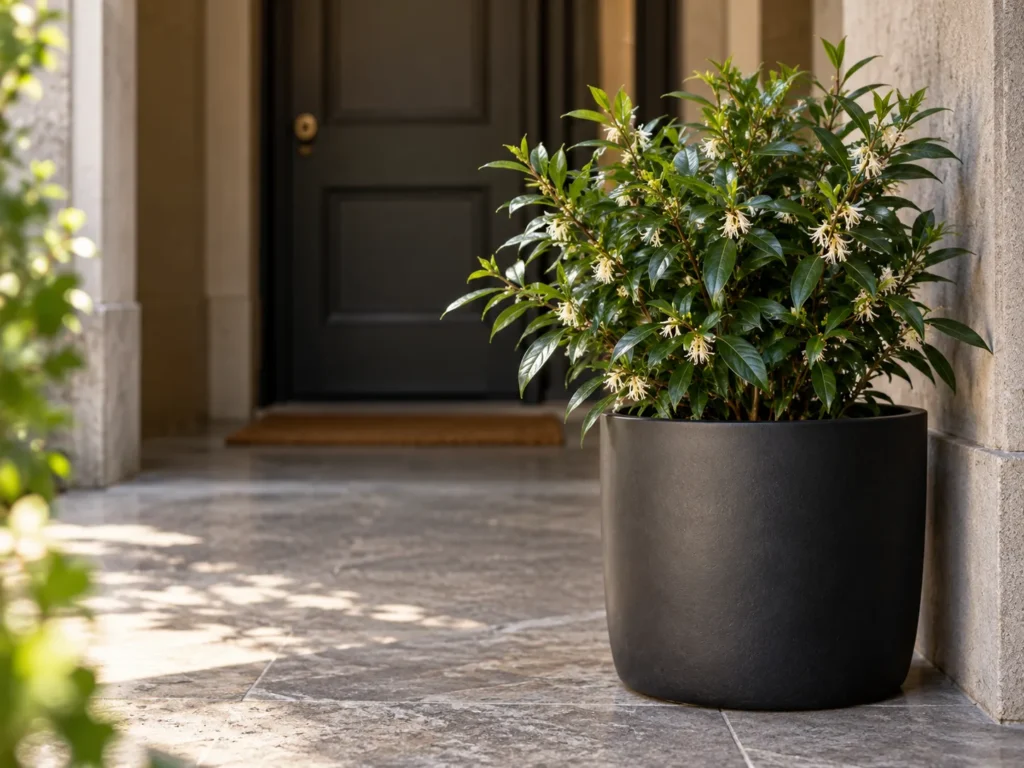
Himalayan sweet box (Sarcococca hookeriana) is the answer for the north-facing entry where every conifer you’ve tried has thinned out. It’s a glossy broadleaf evergreen hardy in zones 5 to 8, cold hardy to about -10 F, and it wants part to full shade; direct sun actually yellows the leaves.
It grows slowly toward about 5 feet high and 6 feet wide in the ground, so a pot keeps it compact for years, and it needs consistent moisture, which again suits a covered porch where you water during thaws. The bonus comes in March to April, when tiny white flowers open with a scent you’ll notice from the sidewalk. If a cat or dog uses the entry, look it up for pet safety before buying and keep it out of chewing range. For more plants that cope with the same conditions, see our shade-loving plants for a north-facing balcony.
Best for shaded, sheltered entries in zone 7 to 8, or zone 6 with a wall at its back. Skip it on a sunny south porch or anywhere colder than zone 6 in a pot.
Budget Winter Porch Planter Ideas with Evergreens
One live plant plus two cut-greens pots, pulled together against the wall, costs less than three live conifers and looks fuller than any one pot on its own.
Idea 15: Three Mismatched Pots Pulled Against the Wall
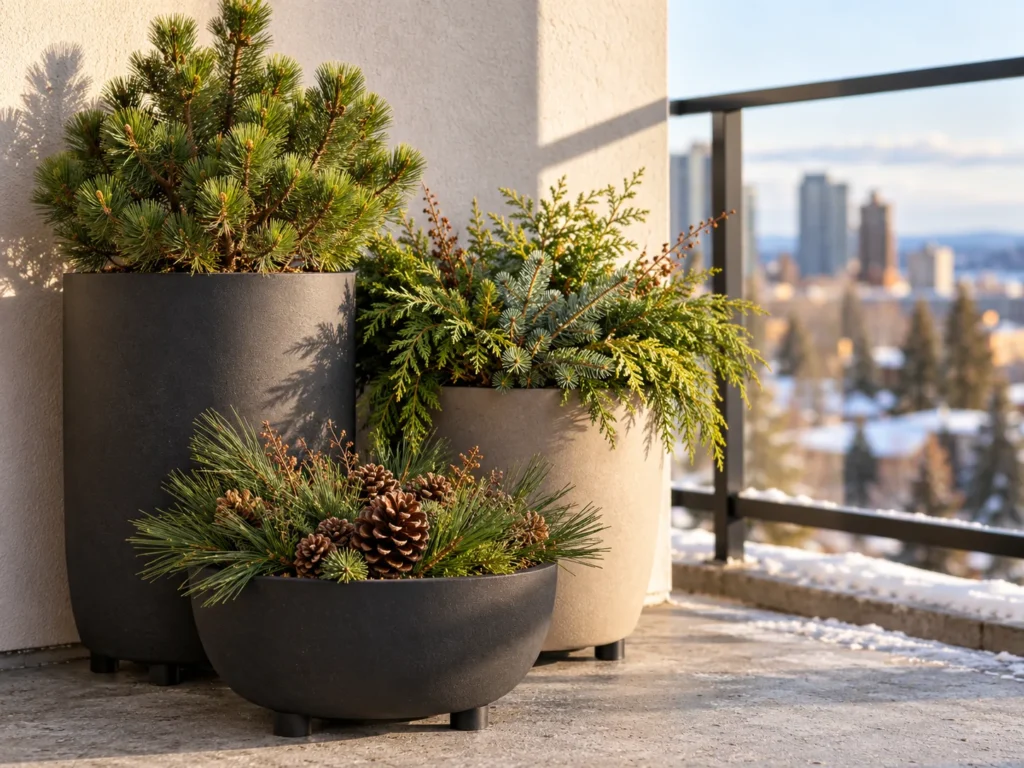
Grouping pots in a sheltered spot does two jobs at once: the pots insulate each other, and the wall cuts the wind that dries evergreens out. Buy one dwarf conifer from the living group, fill two pots you already own with cut greens following Idea 6, and push all three tight against the building, ideally in a corner out of the afternoon sun.
Lift every pot off bare concrete or stone on pot feet, bricks or a scrap of wood, because those surfaces conduct cold straight into the root zone. Reuse the fall mix in the cut-greens pots, put your money into one good plant and one big pot for it, and let the mismatched containers read as a deliberate set by keeping them in one colour family.
Best for renters on a low budget with a sheltered corner. Skip the cluster if your only spot is the open railing edge; the grouping only protects when a wall is part of it.
How to Pick the Right Setup for Your Space
Start with your USDA zone and whether the porch is covered; those two facts rule out half the list before you look at colour. Find your zone on the USDA Plant Hardiness Zone Map (updated in 2023, based on the average annual extreme minimum temperature, in 10 F zones split into 5 F half-zones), then apply the rule that every living idea above already used.
A plant tag’s zone assumes roots underground, insulated by the whole earth. In a pot, the roots can get nearly as cold as the air, which is why extension advice is to choose a plant rated about two zones colder than your map zone, and why a conifer sold as “hardy to zone 3” is the sensible buy for a zone 5 pot. Container roots generally tolerate only about 10 to 15 F before the tissue freezes, and a larger soil mass in a well-insulated pot slows that freeze, so bigger really is safer.
In zone 3 or 4, treat live conifers as a gamble unless the pot sits in a sheltered cluster against a wall; otherwise go cut greens. Container material matters in every zone: clay, ceramic and glazed pots may crack when wet mix freezes and thaws, so winter pots should be resin, fiberglass, wood, metal or thick plastic, and every one of them needs drainage holes so ice inside doesn’t split it.
| Setup type | Survives on | Care after freeze | Cost level | Best for |
|---|---|---|---|---|
| Living dwarf conifer (Ideas 1 to 5) | Plant rated about 2 zones colder than yours; big pot; wall shelter | Water during thaws; shield from wind and sun | Mid-range | Zone 5 to 8 entries you’ll keep for years |
| Cut-greens pot (Ideas 6 to 10) | Nothing; stems sit in frozen mix | None on an open porch; water if thawed and dry under a roof | Low-cost | Renters, first-timers, zone 3 to 6 open balconies |
| Living companion combo (Ideas 11 and 12) | Both plants rated for a pot in your zone; moist mix | Water during thaws; more often under a roof | Mid-range | Part-shade porches, pet households (Idea 11) |
| Mild-winter or shade shrub (Ideas 13 and 14) | Zone 9 to 10 (rosemary) or shaded zone 6 to 8 (sweet box) | Water when the mix is dry; never soggy | Mid-range | Warm climates and sunless entries |
If you have a cat or dog that uses the porch, build around coral bells or rosemary, check any conifer before it goes within chewing range, and leave boxwood, holly and ivy out, as the At a Glance list sets out. That poison-control list isn’t meant to cover every plant, so a plant that isn’t on it is an unknown rather than a safe bet, and non-toxic never means edible or irritation-free. If your pet chews something anyway, call your vet.
Renters have three more checks. Read the lease and building rules before hanging a railing box, running lights or adding hooks; a wet 16 to 20 inch pot of mix is heavy, so group weight near walls and columns rather than at the slab edge; and make sure drainage water and dropped needles don’t land on the balcony below, which is both a courtesy and, in many buildings, a rule. Our year-round front porch container ideas cover what to do with the same pots once spring arrives.
| When | Do this | Why |
|---|---|---|
| Mid to late November in cold climates, before the mix freezes | Assemble, water thoroughly, let it freeze | Moist mix freezes slower, then holds stems and roots steady |
| Any thaw or long spell above freezing | Check the mix; water if dry, especially under a roof | Evergreens keep losing water all winter and frozen or dry mix can’t replace it |
| Cold, sunny, windy weeks | Slide pots to the wall or add a screen; note any one-sided browning | Wind and sun drive most winter water loss from needles |
| Spring, once the mix thaws | Pull and compost cut stems; refresh the mix with compost; move a live conifer back into sun gradually | Sudden exposure after a sheltered winter stresses the plant |
Frequently Asked Questions
Can I move a potted conifer into an unheated garage for the coldest weeks?
Yes. An unheated garage, shed, cold frame or basement keeps the roots out of the worst cold, and it’s a good fallback when a deep freeze is forecast for a plant rated close to your zone. Check the mix now and then, and water only if it’s dry, because overwatering a pot that isn’t drying out can lead to root rot.
Should I wrap the pot in bubble wrap?
It helps on an open balcony, and it’s one of the cheapest ways to give winter porch planter ideas with evergreens a better chance in a cold snap. Wrap the outside of the pot in bubble wrap or another insulating layer, then cover that with plastic. If you’d rather not wrap, group the pots in a sheltered spot and pile straw, shredded leaves, bark mulch or evergreen boughs around them.
How do I stop a tall conifer pot from tipping over?
Add weight at the bottom before you plant. A layer of small stones in roughly the bottom tenth of the planter lowers the center of gravity, which matters because conifers can get top-heavy as they grow. Leave about an inch between the top of the mix and the rim, and on a windy balcony go with a pot that’s wider than it is tall.
Is an anti-desiccant spray worth using on a potted evergreen?
It’s optional. Extension advice lists it alongside a wind screen as a way to cut winter moisture loss from needles. On a balcony, sliding the pot against a wall or putting up a burlap screen does the same job with nothing to apply. If you do spray, follow the product label for temperature and timing.
What Actually Matters
Three things decide whether these pots still look good in March: moisture in the mix before it freezes, a pot that won’t crack, and a plant rated for colder than your zone. Everything else is styling, and styling is the fun part.
If you see brown needles on one side of a live conifer, the cause is almost always wind or sun pulling water the frozen roots can’t replace; the damage faces the weather and may not show until late winter. Slide the pot to the wall, water during the next thaw, and consider a burlap screen on the windward side. If cut greens are browning early under a covered porch while open-porch pots nearby still look fresh, the mix has simply dried out; water it whenever it’s thawed and dry, and keep watering in a mild-winter climate. A cracked pot means clay or ceramic met freeze-thaw, or ice built up in a pot with no drainage; nothing fixes it this winter, so plan on resin or fiberglass with holes next time. A live conifer brown all over by spring usually means the roots froze because the plant wasn’t rated cold enough for a pot, or the mix went bone dry before the freeze, though on an Alberta spruce in a still corner check for mite webbing first.
Your priority this week, if the mix hasn’t frozen, is to get one pot built and watered in. Buy one conifer rated two zones colder than your map, or bundle spruce tips into the old fall container, set it against the wall on pot feet, and water it until it drains. The rest of the balcony garden guides can wait until the thaw, when that same mix, refreshed with compost, is ready for whatever you plant next.
Sources
- Penn State Extension – Overwintering Plants in Containers – the two-zones-colder rule, pot roots matching air temperature, larger pots insulating, clay and glazed pots cracking, watering before freeze and during thaws, dry mix freezing faster, grouping pots in shelter, removing protection gradually in spring
- Penn State Extension – Winter Outdoor Arrangements – mid to late November assembly in cold climates, drainage holes, greens that last and hemlock dropping needles, thriller-filler-spiller order, wiring accessories to a stick, foraging ethics and invasive berries
- University of Minnesota Extension – Fresh-cut greens and winter decor – spruce tips, watering in, frozen mix keeping tips fresh, watering and shading in long warm spells
- University of Vermont Extension – Four-Season Container Gardening – choosing a shrub one to two zones colder, avoiding terracotta, moistening mix so stems freeze in place, freeze-thaw root stress
- Chicago Botanic Garden – Overwintering Evergreens in Containers – container root cold tolerance of about 10 to 15 F, watering during thaws, keeping pots off concrete and stone, sheltered placement
- University of Illinois Extension – Overwintering Plants in Containers – freeze-thaw damage to containers, large soil mass in an insulated pot, winter watering for evergreens
- Iowa State University Extension – How do I prevent desiccation injury to my yews and boxwoods? – wind and sun as the main winter water loss, damage showing late, screens
- New York Botanical Garden LibGuides – Conifers in Containers – container 4 to 6 inches wider than the nursery pot, 1 inch below the rim, slow growers of 1 to 6 inches a year, recommended cultivars
- NC State Extension Plant Toolbox – plant pages for Dwarf Alberta White Spruce, Chamaecyparis obtusa ‘Nana Gracilis’, Hetz’s Midget Eastern Arborvitae, Swiss Mountain Pine, Heuchera, Evergold Striped Weeping Sedge, Salvia rosmarinus and Himalayan Sarcococca – zones, sizes, light, soil, wind and pest notes for each
- Missouri Botanical Garden Plant Finder – Juniperus squamata ‘Blue Star’ – zones 4 to 8, size, full sun, intolerance of wet soil, winter foliage discolouration
- ASPCA Toxic and Non-Toxic Plants – entries for Boxwood, Holly, Winterberry, English Ivy, Yew, Hellebore, Pieris, Coral Bells and Rosemary, plus the list’s note that it is not all-inclusive – every pet-safety status in the article
- USDA Agricultural Research Service – USDA Unveils Updated Plant Hardiness Zone Map (2023) – map basis, 10 F zones and 5 F half-zones
- Electrical Safety Foundation International – Holiday lighting safety tips – outdoor-rated products, GFCI-protected circuits, inspection, switching lights off.