
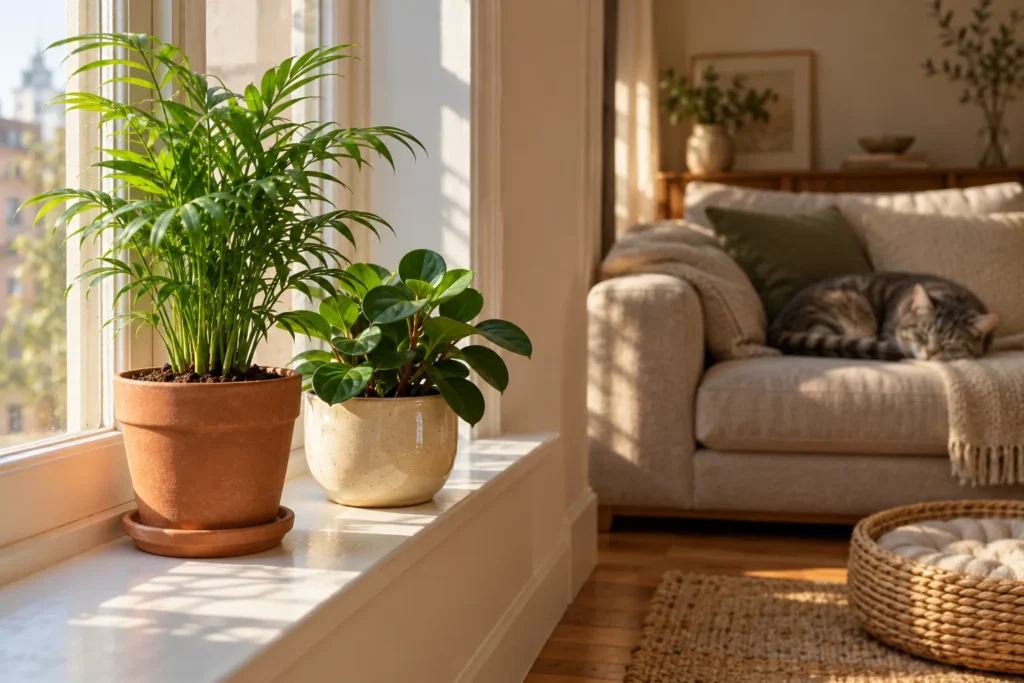
You’re in the garden center with a pot in one hand and your phone in the other. The list on the screen says the plant is fine around cats; the nursery tag says to keep it away from pets. At home, your cat treats every new leaf as a snack bar and your dog sniffs anything at nose height, so “probably fine” isn’t good enough.
This guide to safe houseplants for cats and dogs settles that argument. Every plant here is listed as non-toxic to both species in the ASPCA database and has a care profile from a university extension or botanical garden, so you also learn whether it will survive a dim corner or a furnace-dry winter. I share a small apartment with a cat and a dog, so this is the list I’d shop from myself. If floor space is your tighter limit, our guide to pet-friendly plants that stay under 3 feet covers the compact picks.
Table of Contents
At a Glance
- Non-toxic means the plant isn’t expected to poison your pet. Eating any plant can still cause vomiting or stomach upset, so a chewer may throw up.
- For a dim apartment, start with a cast iron plant or parlor palm; for a sunny sill, a haworthia or ponytail palm.
- True lilies (for cats) and sago palm sit in a different danger class from the irritating, low-severity pothos group. Keep the ASPCA Animal Poison Control number, (888) 426-4435, saved in your phone.
- Dry winter air, not your pet, is what browns the fern and calathea group. A humidifier moves the number; misting doesn’t.
If you want one plant to begin with, we’d choose a parlor palm: it tolerates low light, grows slowly, and copes with low to medium humidity. If you’re hoping for a trailing vine for a dark corner, there’s no pet-safe stand-in for pothos in deep shade, so put a cast iron plant on the floor there instead.
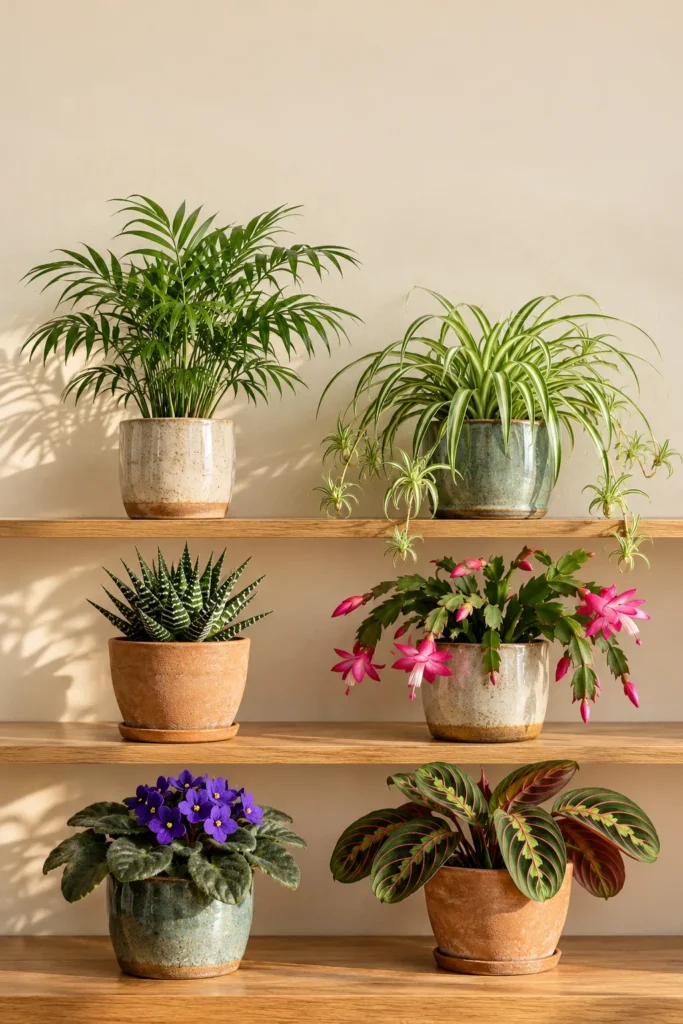
How We Chose These (and What “Non-Toxic” Really Means)
Every plant on this list had to pass two checks: a non-toxic rating for both cats and dogs on the ASPCA plant database, and a care profile from a university extension or botanical garden so we could tell you how it behaves indoors. Plants that cleared only one check stayed off the list.
“Non-toxic” has a narrower meaning than most people assume. The ASPCA list comes with two caveats: it isn’t all-inclusive, and eating any plant material can cause vomiting and gastrointestinal upset. In plain terms, a non-toxic plant shouldn’t damage organs or need emergency treatment, but a cat that eats half a leaf may still bring it back up on the rug.
Plenty of popular plants fail that test, from lilies and sago palm down to the drool-inducing pothos group; How to Pick covers what to leave at the store.
Lists contradict each other for mundane reasons: common names cover several species, Latin names get renamed, and retailers copy one another. Check the Latin name on the tag against the ASPCA entry, and if your pet does eat something you can’t identify, call your veterinarian, the ASPCA Animal Poison Control Center at (888) 426-4435, or the Pet Poison Helpline at 855-764-7661.
| Plant | Light | Water | Mature indoor size | Best spot |
|---|---|---|---|---|
| Cast iron plant | Low to medium | Let dry; sparingly in winter | 1-3 ft tall and wide | Floor, dim corner |
| Parlor palm | Low to medium | When top of mix is dry | 2-3 ft, occasionally 6 ft | Floor near a north or east window |
| Spider plant | Medium, no direct sun | Evenly moist | 1-1.5 ft tall, 2-2.5 ft wide | Hanging, out of reach |
| Boston fern | Medium, east window | Never let dry out | 2-3 ft | Humid bathroom or kitchen |
| Rattlesnake plant | Bright shade | Moist; less in winter | About 1.5 ft | Grouped with other humidity lovers |
| Baby rubber plant | Bright indirect, tolerates low | On the dry side | Up to 2 ft | Desk or shelf in a dry room |
| Chinese money plant | Bright indirect | Moist, well drained | 8-12 in tall and wide | Windowsill or shelf |
| Haworthia | Sun to part shade | Dry out completely between | 2-12 in | Sunny sill |
| Ponytail palm | Full sun | Dry to medium; less in winter | 6-8 ft tall at maturity, slowly | Sunny floor spot |
| Holiday cactus | Bright indirect, no direct sun | Every 1-2 weeks when nearly dry | 6 in to 3 ft | Shelf near an east window |
| African violet | Bright, no afternoon sun | Room-temperature water, moist | Small rosette | Within 3 ft of an east or west window |
| Moth orchid | Bright indirect | About weekly, drain fully | A few inches to 2 ft | East windowsill |
| Hoya | Bright indirect | Dry out between waterings | Climbing vine, needs support | Trellis near a bright window |
| Areca palm | Bright indirect | Moist, never soggy | 6-7 ft | Bright floor corner with tall ceilings |
| Prayer plant | Bright indirect, no direct sun | Evenly moist; drier in winter | 6-12 in tall, to 2 ft wide | Humid shelf out of drafts |
The 15 Safe Houseplants for Cats and Dogs
The list runs from the plants that forgive dim rooms, through the bright-window group, to the ones that bloom. Sizes and light are in the table above; each entry adds what the table can’t show, including when to skip it.
1. Cast Iron Plant (Aspidistra elatior)
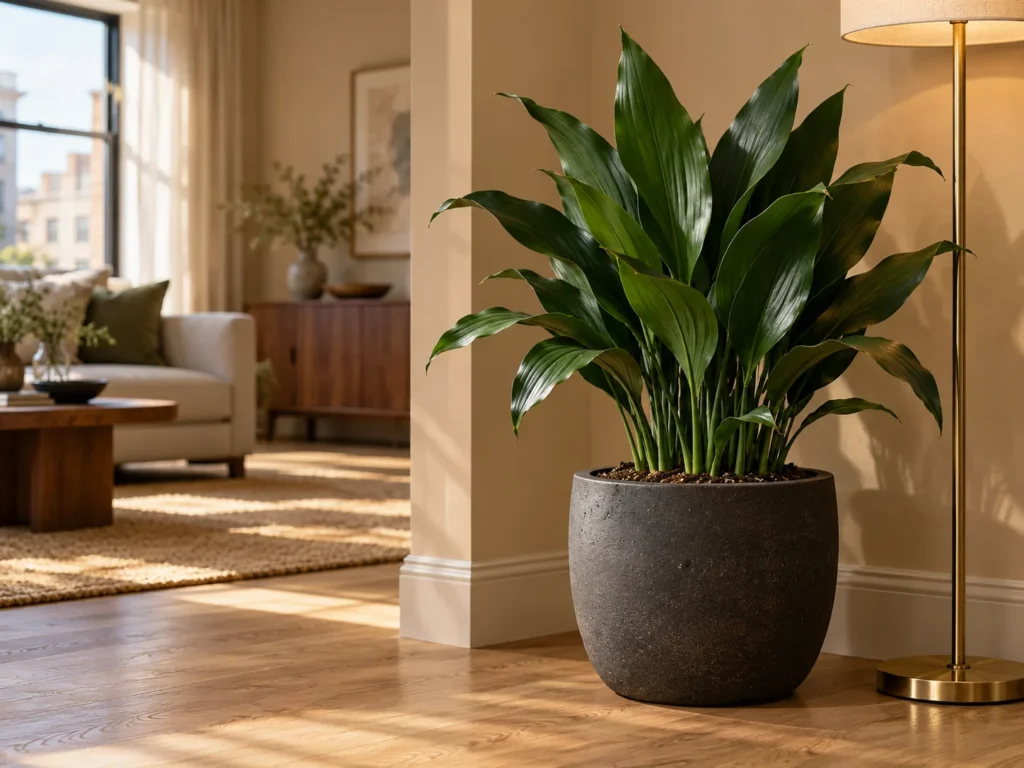
If your apartment has a corner that nothing survives, this is the plant for it. The cast iron plant earned its name by tolerating deep shade, irregular watering and neglect, and it has no serious pest problems to speak of. Its broad, upright leaves give a dark corner some structure without asking for a window.
The trade-off is patience. Growth is slow, so buy the size you want rather than the size you can grow into. Water when the mix has dried, and go lighter still in winter when the plant is barely moving. Skip it if you want something that visibly changes month to month; this one rewards people who forget about it.
2. Parlor Palm (Chamaedorea elegans)
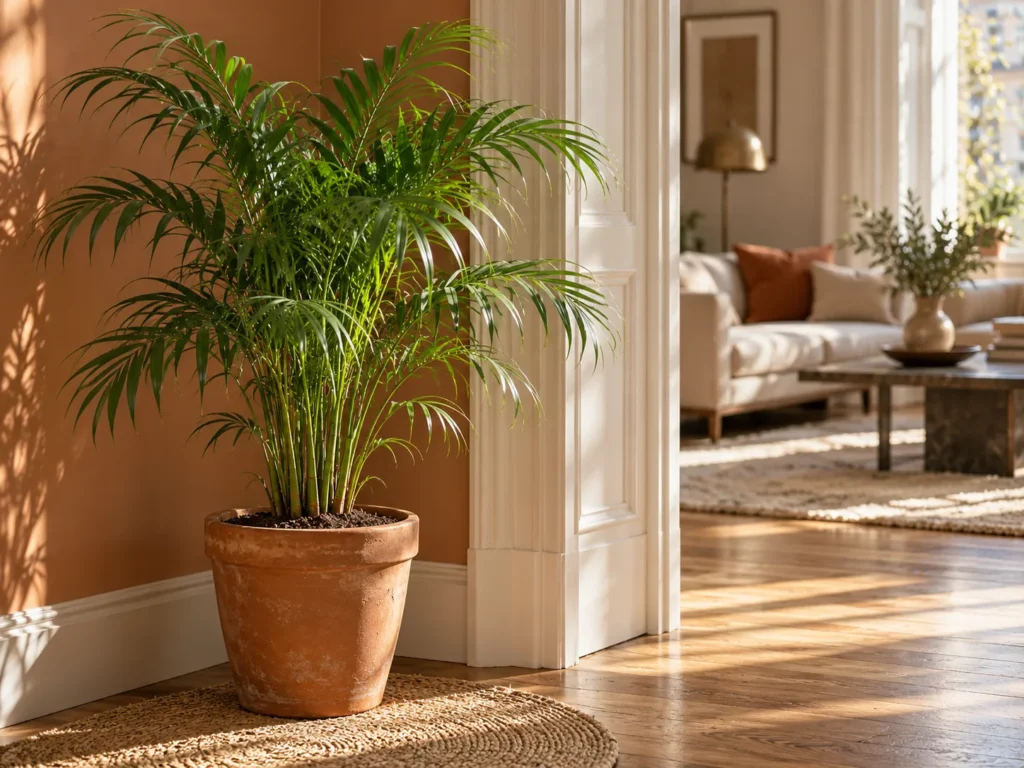
This is the plant we’d hand a nervous first-time owner. It tolerates low light, grows slowly, and handles low to medium humidity, which covers most rentals in winter. Most stay at 2 to 3 feet indoors, and it only occasionally stretches toward 6 feet after years in the same spot.
- Water when the top of the mix feels dry, and keep the room above 60°F in winter; cold damage starts around 45°F.
- Give it at least 10 hours of bright indirect light a day to grow well; it survives on less but sits still.
- Repot roughly every other year into a pot only slightly larger.
- Skip it if your cat shreds grassy leaves. It’s non-toxic, but the fronds are tempting and the mess is real.
3. Spider Plant (Chlorophytum comosum)
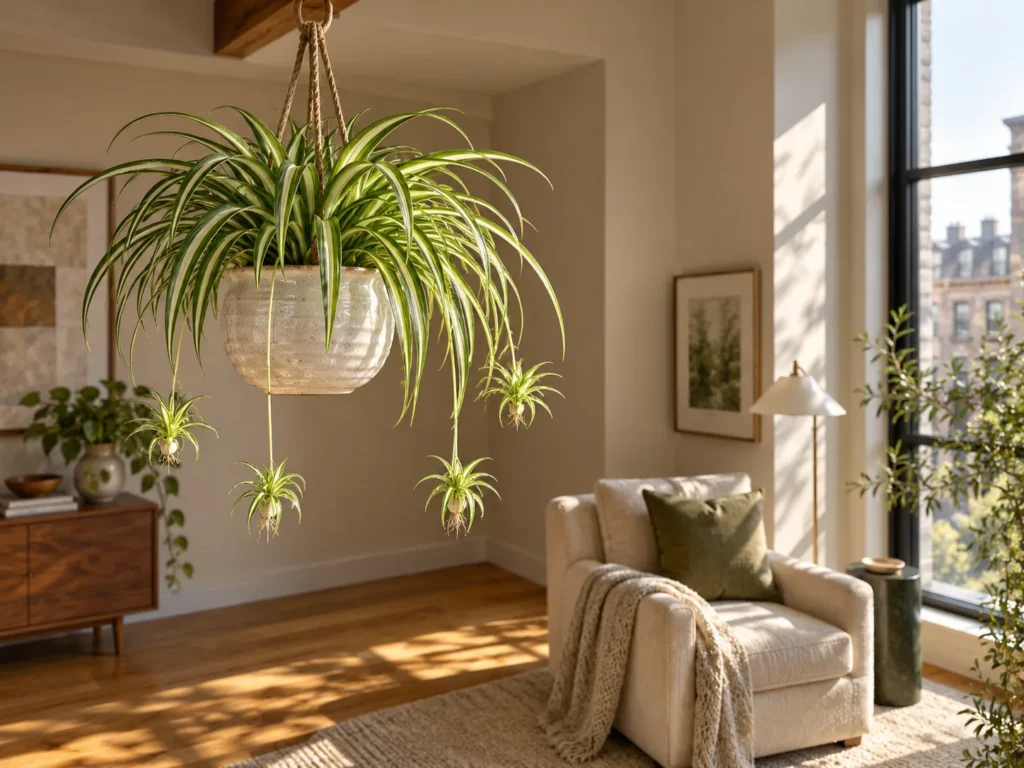
Spider plants are the classic beginner plant and are rated non-toxic to cats and dogs, though small nibbles still carry a risk of mild stomach irritation for cats and dogs. So this one goes in a hanging planter, and the dangling plantlets stay where a determined jumper can’t reach them.
Give it medium light with no direct sun, keep the mix evenly moist, and expect daytime temperatures of 65 to 75°F to suit it. Brown tips are common; the quick diagnoses in Care Basics sort out the causes. Hold off on feeding a freshly potted plant for 4 to 6 months. Plantlets form when the plant gets less than 12 hours of light a day for at least 3 weeks, which happens on its own in autumn. For dividing and rooting those babies, see our spider plant care and propagation guide.
4. Boston Fern (Nephrolepis exaltata)
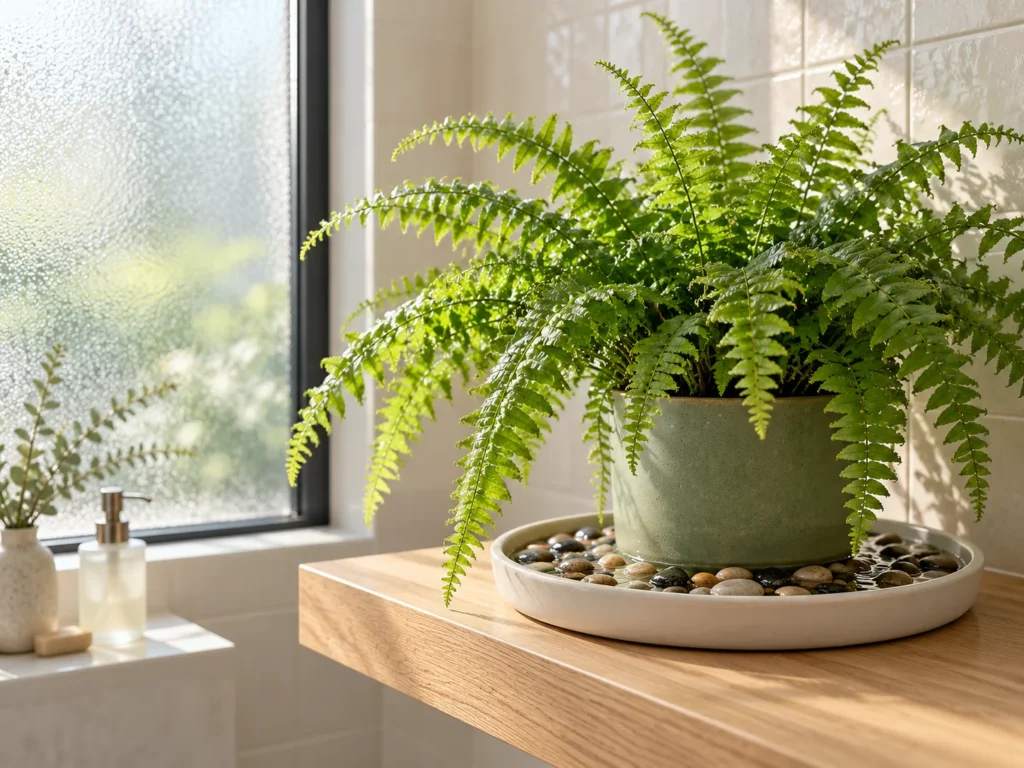
A Boston fern looks soft and harmless, and for pets it is. For the plant, the problem is your apartment’s air. It wants high humidity, medium light from an east window, and soil that never fully dries out, with a lighter hand on water in winter. Temperatures of 60 to 70°F suit it.
From November through February, the weak winter sun means a direct south or west window is fine; move it back once spring light strengthens. Those neat rows of brown dots under the fronds are spore cases, a normal part of the plant, so leave them be. Skip this fern if your winter air runs dry and you won’t run a humidifier; a crisp, shedding fern is one of the most common beginner disappointments, and it has nothing to do with the owner’s skill.
5. Rattlesnake Plant (Goeppertia insignis, sold as Calathea lancifolia)
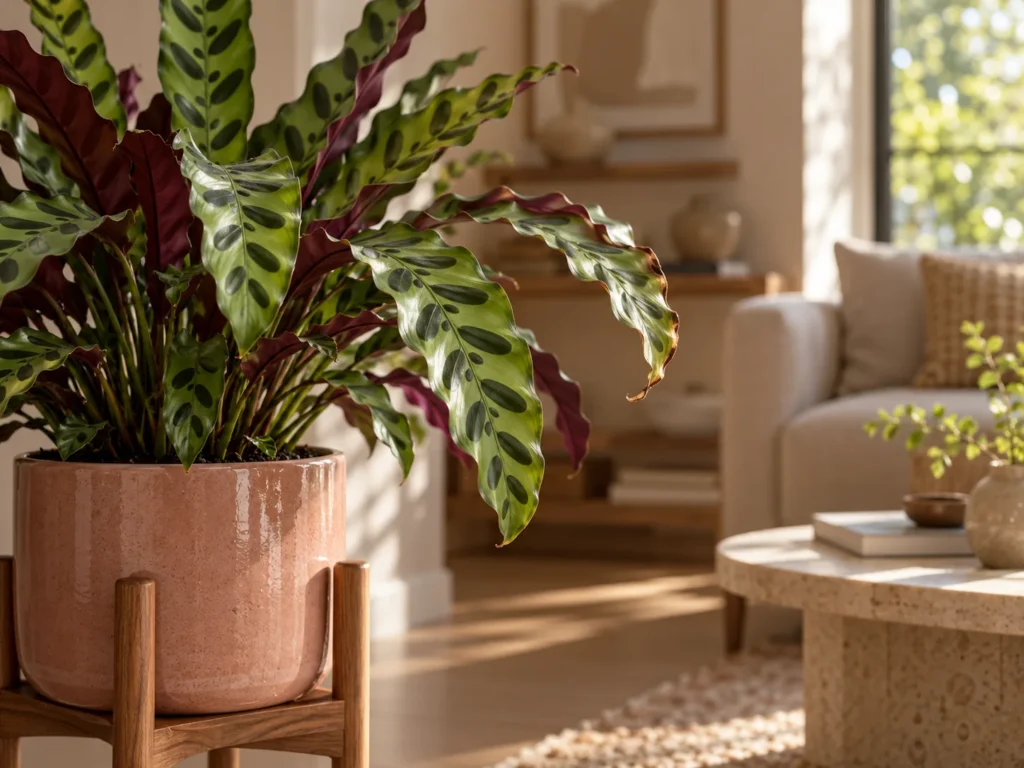
The wavy, spotted leaves make this the showpiece of the list, and like its cousin the prayer plant, it’s rated non-toxic to cats and dogs. It stays around 1.5 feet indoors and likes bright shade, 65 to 75°F, and high humidity, with less water in winter and no cold drafts.
Dry air is the usual villain: edges brown and curl first, then whole leaves follow. Pairing it with the fern and prayer plant near a humidifier solves most of that, and our guide to fixing calathea brown edges walks through the other causes. Skip it if your winter humidity sits below 30 percent and you’d rather not add a humidifier; the baby rubber plant two entries down gives you glossy leaves without the fuss.
6. Baby Rubber Plant (Peperomia obtusifolia)
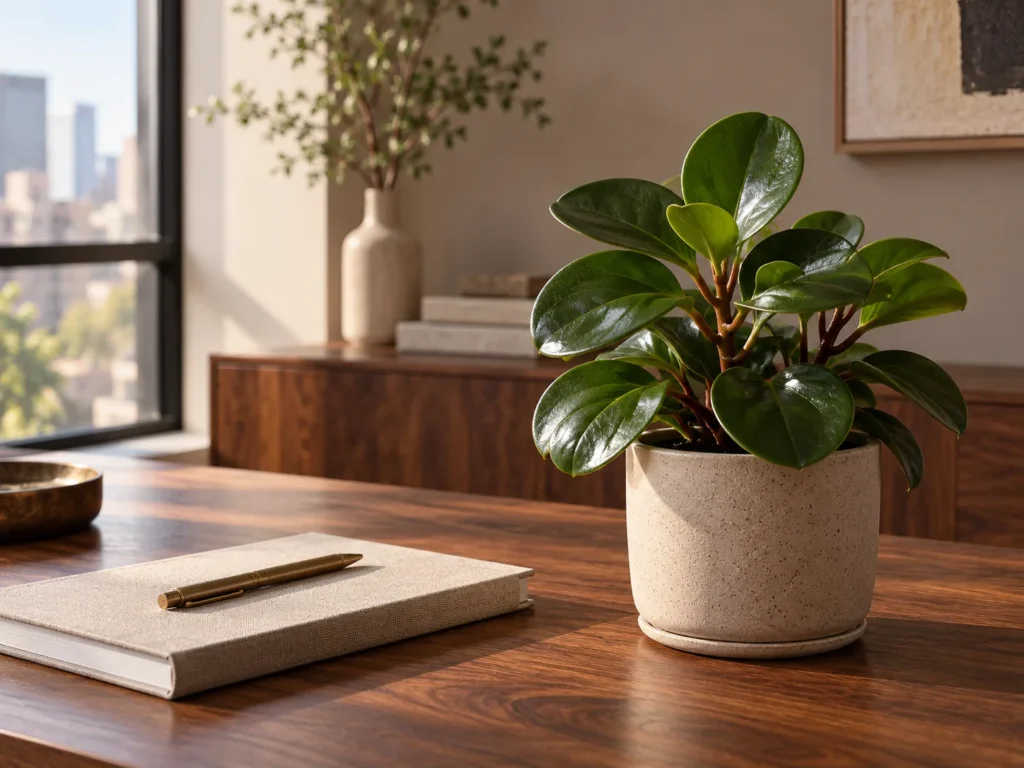
For a furnace-dry apartment, this is our pick, because it prefers medium to low humidity and soil on the dry side. The thick, almost succulent leaves store water, so a missed watering is forgiven, and it tolerates low light for months, though the plain green form does best in dim spots.
Overwatering is the main way people kill it: the stems go soft at the base and the plant collapses. Let the mix dry between drinks, keep it out of drafts, and it will reach up to 2 feet over time. In my own apartment the air gets noticeably parched once the heat comes on, which is exactly the condition these water-storing leaves are built for.
7. Chinese Money Plant (Pilea peperomioides)
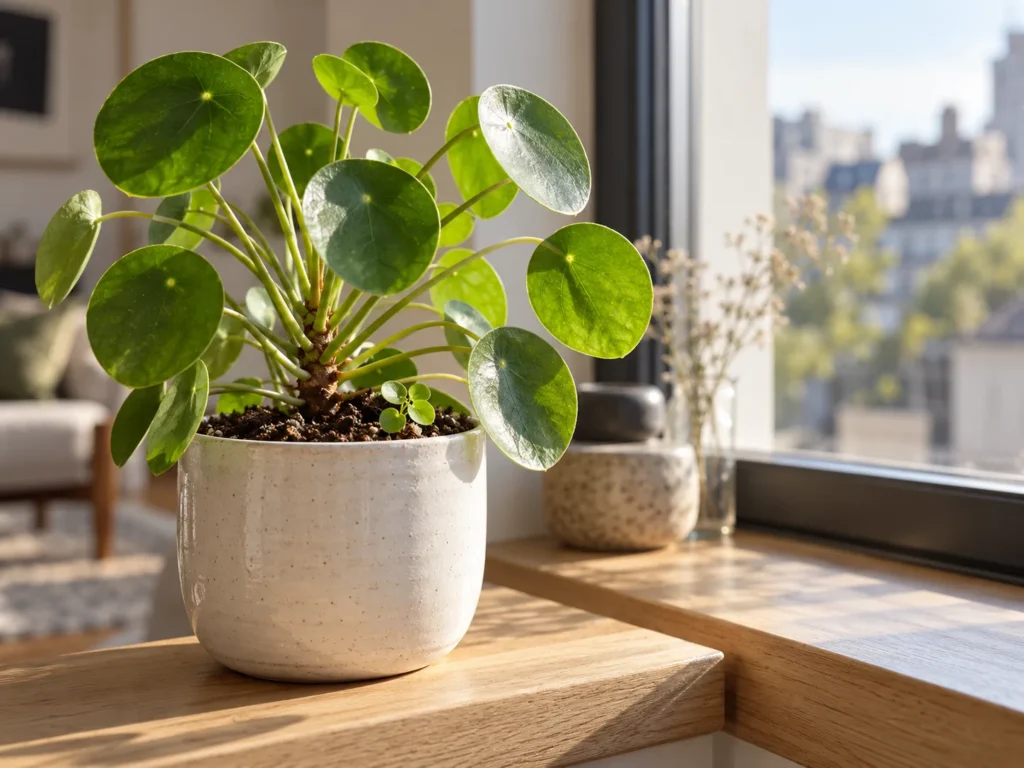
The pilea is the small, fast, cheerful one. It stays at 8 to 12 inches tall and wide, likes bright indirect light and a moist but well-drained mix, and copes with average apartment humidity. Growth is rapid in spring and summer, and small pups appear at the soil line, which you can pot up and hand to friends.
Rotate the pot every week or so, because the leaves lean hard toward the window. Skip it if you want something that fills a floor corner; this one lives on a sill or shelf. Pilea peperomioides is rated non-toxic by name, which matters because several succulents sold on the same shop shelf are not. Our full Chinese money plant (pilea) care guide covers watering, pups and why the leaves curl.
8. Haworthia (Haworthia species)
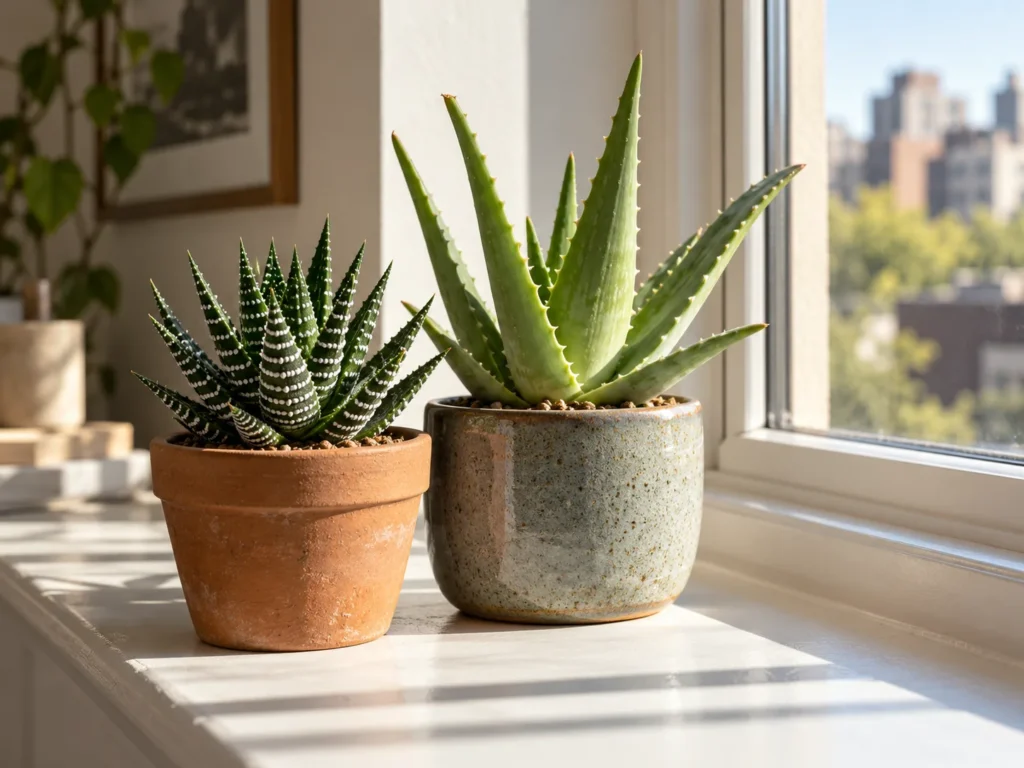
A haworthia is the pet-safe answer for a sunny sill, at 2 to 12 inches depending on the species. It takes sun to part shade and is somewhat tolerant of lower light, average home humidity suits it, and it wants the mix to dry out completely between waterings. Mealybugs are the main pest to watch for in the leaf bases.
The catch is the look-alike. Small haworthias are easy to confuse with young aloes, and aloe is toxic to cats and dogs, causing vomiting, lethargy and diarrhea, so check the exact name on the tag before buying. Use a gritty mix of equal parts potting soil and coarse sand, and keep it off a cold windowsill in winter; it’s frost-sensitive. If you keep a real aloe well out of paw reach, our aloe vera indoor care guide covers its light and watering needs.
9. Ponytail Palm (Beaucarnea recurvata)
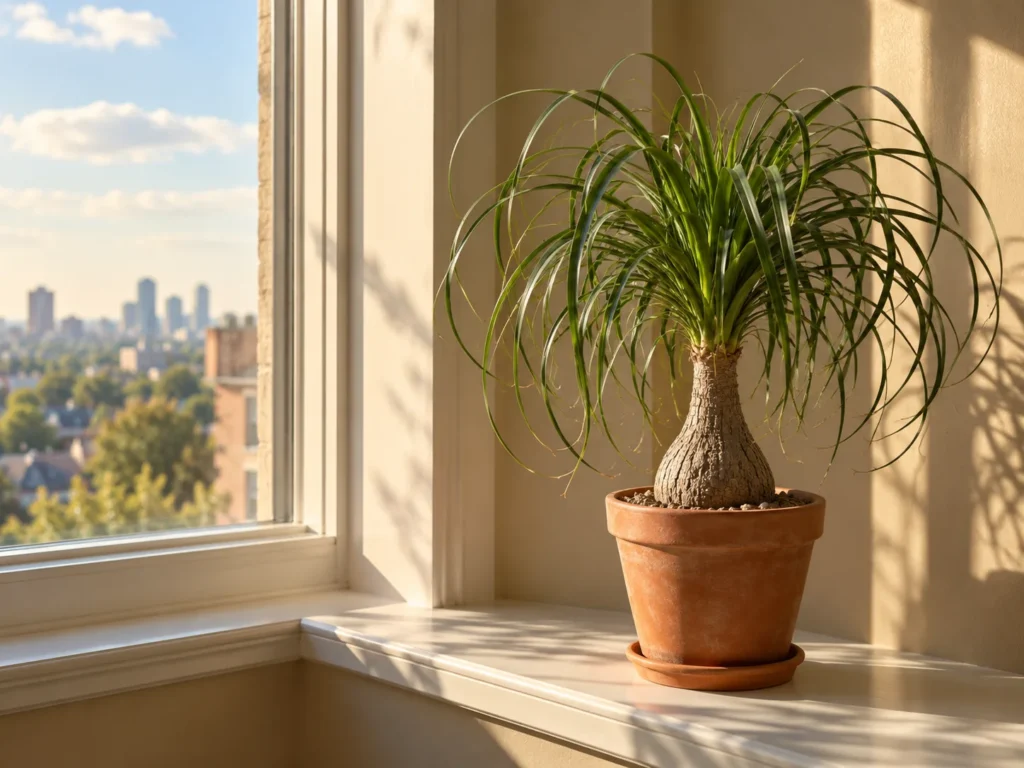
Despite the name, this isn’t a true palm, which is partly why it’s so forgiving. The swollen base stores water, so it wants dry to medium watering, less again in winter, and a small pot with excellent drainage. Give it the sunniest window you have; a north window only will leave it sulking and stretched.
Be realistic about size. At maturity it reaches 6 to 8 feet tall with a spread of 3 to 5 feet, though it gets there slowly indoors, so a young plant will sit on a sill for years. The grassy leaves draw chewing cats, and the plant is non-toxic, but a tattered ponytail isn’t pretty. Watch for spider mites, mealybugs and scale, especially in dry winter rooms.
10. Holiday Cactus (Schlumbergera species)
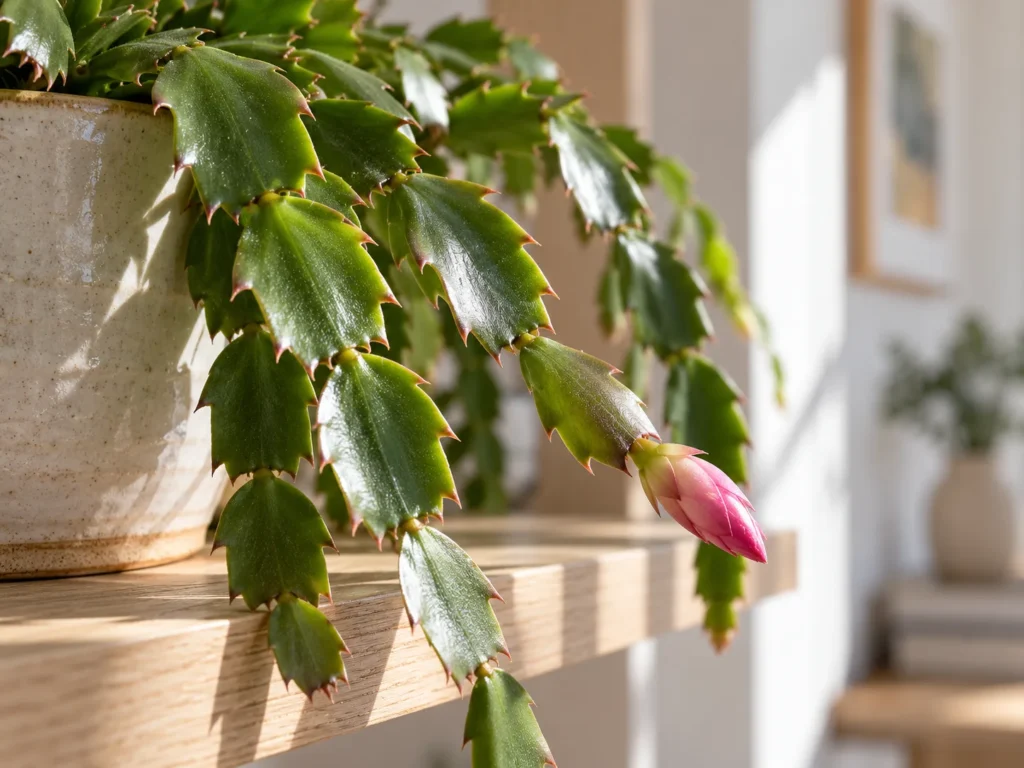
This is the easiest bloomer on the list, and it flowers right when apartments feel dullest. Keep it in bright indirect light with no direct sun, water every 1 to 2 weeks when the mix is nearly dry, and it will live for years at anywhere from 6 inches to 3 feet across. The Thanksgiving type has 2 to 4 saw-toothed points on each segment; the Christmas type has rounder, scalloped edges.
Flowering is a day-length trick. Starting around mid-September, the plant needs 13 to 14 hours of uninterrupted darkness each night for about 6 weeks, with cool nights of roughly 55 to 65°F. A closet or a room nobody switches a lamp on in works; buds show in 3 to 4 weeks. If you’re reading this after mid-September, start the dark period now rather than next year. Once buds form, avoid sudden changes in temperature, light or moisture, because they drop. Flowers can last up to 7 to 8 weeks at 68°F.
11. African Violet (Saintpaulia species)
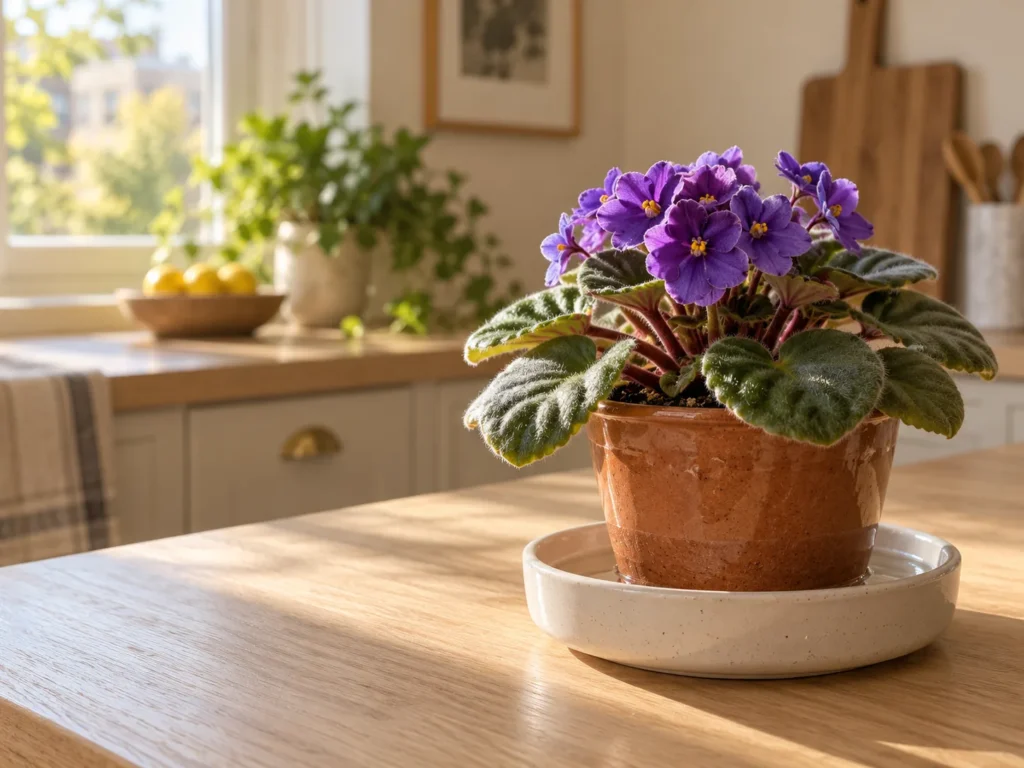
African violets bloom on a sill all year if you give them a steady spot: within 3 feet of a large east- or west-facing window, out of hot afternoon sun. Nights of 65 to 70°F suit them, and days can run up to 80 to 85°F without complaint. Each flower cluster lasts 3 to 6 weeks.
Two habits keep them happy. Water with room-temperature water, because cold water leaves pale spots on the leaves, and never let water sit in the crown; crown rot from overwatering is the number one killer. Thin, dark leaves and no flowers usually mean too little light. Under a grow light, keep the plant 6 to 12 inches below the tubes for 15 to 18 hours a day and it will bloom without a window at all.
12. Moth Orchid (Phalaenopsis species)
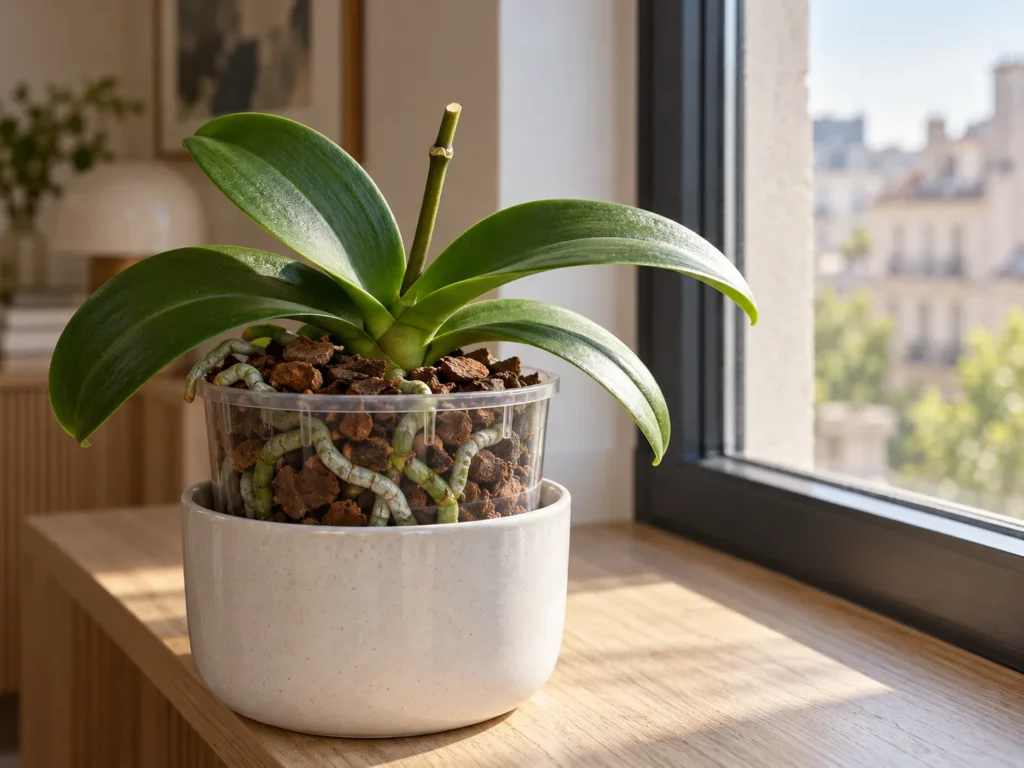
The supermarket orchid is one of the longest-lasting bloomers you can own, and it’s non-toxic to both pets. An east windowsill, a bark medium, and water about once a week (more in summer heat) with the pot drained fully are the whole routine. Blooms last two to four months, sometimes longer, and a healthy plant reblooms about once a year. Our orchid care for beginners guide covers the rest, including how to get it to rebloom.
When the last flower fades, cut the stalk just above the first node below the spent blooms rather than at the base. Large-flowered types also want a week at around 55°F in autumn to trigger a new spike; a cool window ledge in October does it. Plants range from a few inches to 2 feet, so measure your sill. Our guide to getting an orchid to rebloom covers the full cycle.
13. Hoya, or Wax Plant (Hoya carnosa)
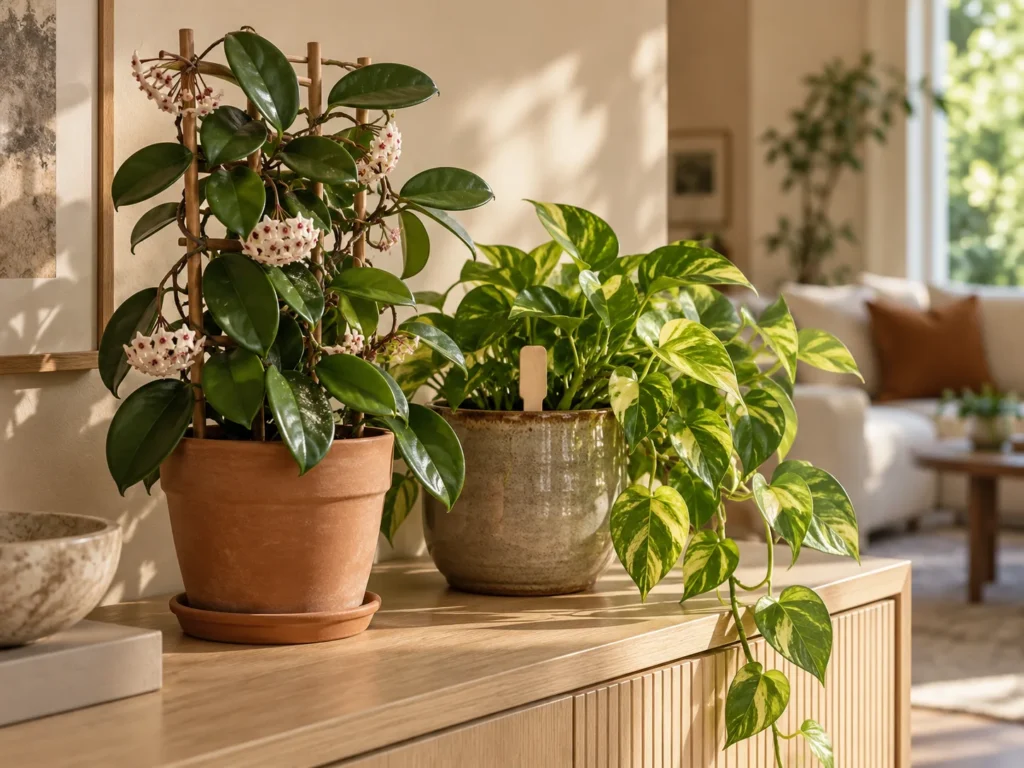
If you want a vine and have pets, this is it. Hoya carnosa climbs or trails, likes bright indirect light near a window, and wants the mix to dry between waterings with room-temperature water. It prefers high humidity but tolerates ordinary rooms. Bring it inside when nights drop below 50°F if it summers on a balcony.
- Most plants don’t flower until their second or third year, so don’t judge a young one.
- Never cut the short, knobby flower spurs after blooming; next year’s clusters come from the same spurs.
- Give it a trellis or hoop, because it will climb anything, including the curtain rod.
- It’s often shelved next to pothos, which has thinner, heart-shaped leaves and belongs in the “leave it” group below.
14. Areca Palm (Dypsis lutescens)
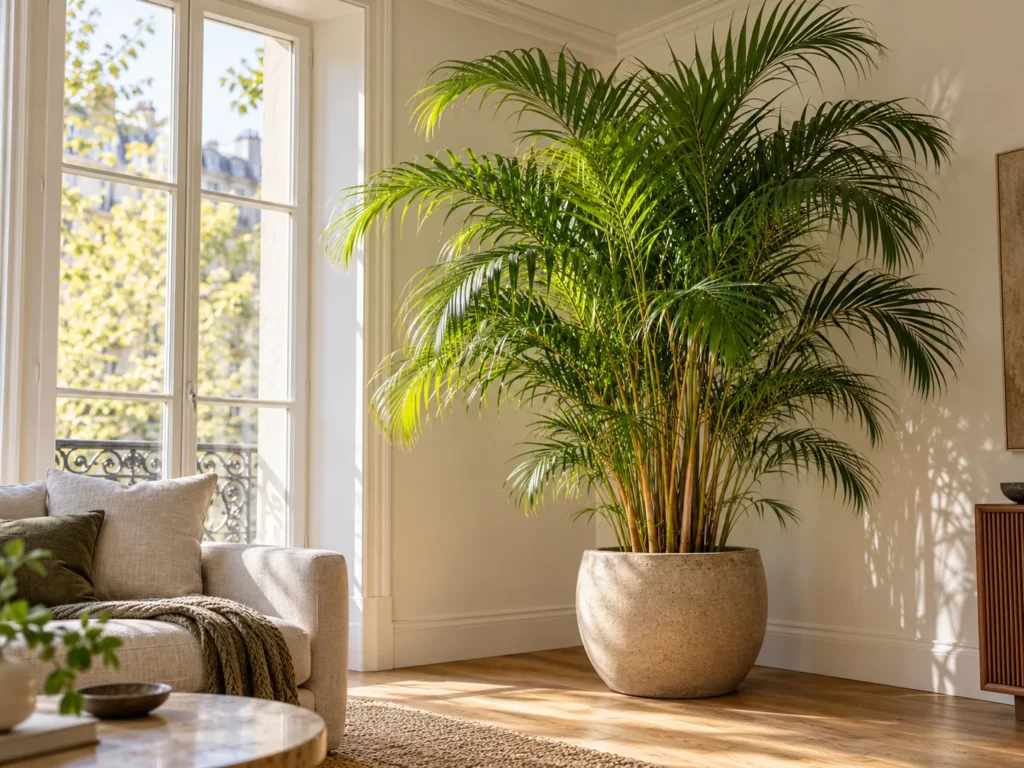
The areca is the plant that turns a bright corner into something that feels like a room with a garden in it. It wants bright indirect light from an east, west or south window, a mix kept moist but never soggy, and warm rooms: nights of 65 to 70°F and days of 75 to 85°F. Expect 6 to 7 feet indoors, growing 6 to 10 inches a year.
It’s also the fussiest of the palms here. Dry air invites spider mites, and arecas are very prone to them, so check the undersides of fronds through winter. Skip it if your ceilings are under 8 feet or your rooms run dry; a parlor palm gives you the same shape in miniature with far fewer demands.
15. Prayer Plant (Maranta leuconeura)
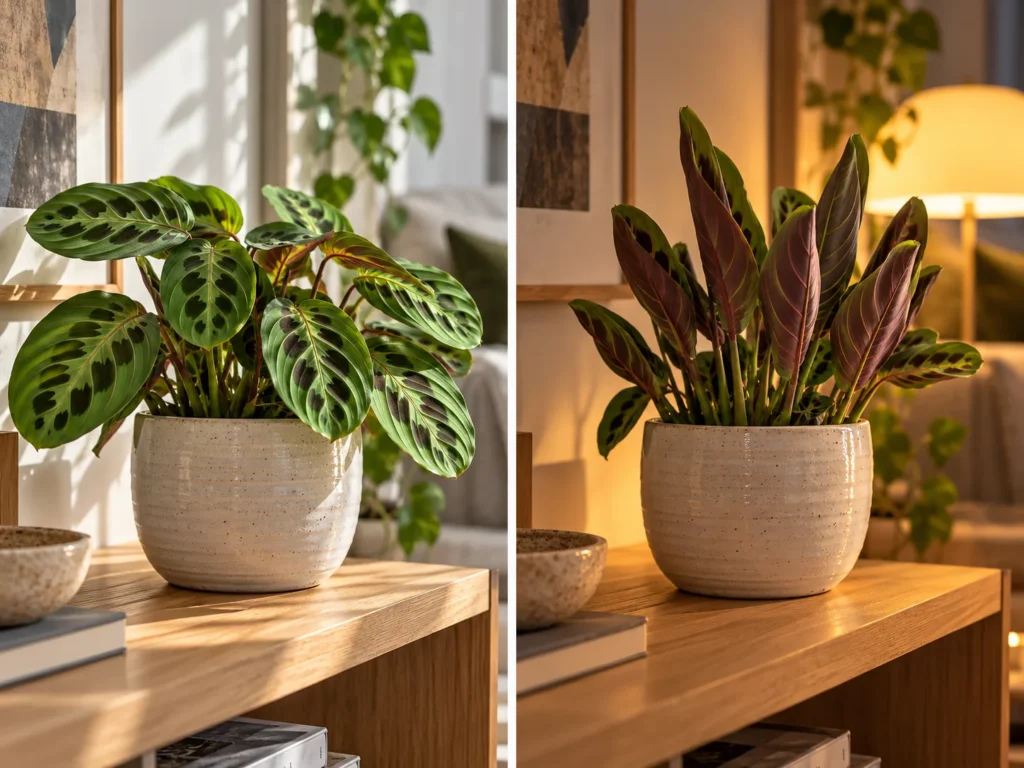
Prayer plants fold their leaves upward each evening and open them again by morning, which startles new owners who think the plant is wilting. It’s a low, spreading plant at 6 to 12 inches tall and up to 2 feet wide, happy in bright indirect light with no direct sun, and ASPCA lists it under its own entry as non-toxic.
Care matches the rattlesnake plant in entry 5: evenly moist in the growing season, drier in winter, high humidity, and shelter from drafts. Two extra triggers for leaf burn are fluoride-heavy tap water and over-fertilizing, so feed lightly and use filtered or rested water if tips keep scorching. The two make a natural pair under one humidifier, and our prayer plant care guide goes deeper on dividing and reviving a tired one.
ASPCA-Listed Safe Plants for Cats and Dogs
Here are all 15 plants from this list in one place, with the botanical name you should match against the nursery tag and their status in the ASPCA toxic and non-toxic plant database. Every one of them is listed as non-toxic to both cats and dogs. Check the Latin name, not just the common one, because shops reuse names like “palm” and “rubber plant” for species that are not safe.
| Common name | Botanical name | Cats | Dogs |
|---|---|---|---|
| Cast iron plant | Aspidistra elatior | Non-toxic | Non-toxic |
| Parlor palm | Chamaedorea elegans | Non-toxic | Non-toxic |
| Spider plant | Chlorophytum comosum | Non-toxic | Non-toxic |
| Boston fern | Nephrolepis exaltata | Non-toxic | Non-toxic |
| Rattlesnake plant | Goeppertia insignis (Calathea lancifolia) | Non-toxic | Non-toxic |
| Baby rubber plant | Peperomia obtusifolia | Non-toxic | Non-toxic |
| Chinese money plant | Pilea peperomioides | Non-toxic | Non-toxic |
| Haworthia | Haworthia species | Non-toxic | Non-toxic |
| Ponytail palm | Beaucarnea recurvata | Non-toxic | Non-toxic |
| Holiday cactus | Schlumbergera species | Non-toxic | Non-toxic |
| African violet | Saintpaulia species | Non-toxic | Non-toxic |
| Moth orchid | Phalaenopsis species | Non-toxic | Non-toxic |
| Hoya (wax plant) | Hoya carnosa | Non-toxic | Non-toxic |
| Areca palm | Dypsis lutescens | Non-toxic | Non-toxic |
| Prayer plant | Maranta leuconeura | Non-toxic | Non-toxic |
Non-toxic does not mean edible. Any plant eaten in quantity can cause mild vomiting or diarrhea, and a pet that keeps chewing the same plant is telling you it is bored, not hungry. If a pet shows symptoms after eating a plant, call your vet or an animal poison control line and take a photo of the plant with you.
Houseplants Safe for Dogs: What Is Different About Dogs
Cats nibble and climb; dogs chew, dig and knock things over. That changes what “dog safe house plants” means in practice. The plant has to be non-toxic, but it also has to survive a dog, and its pot and soil have to be safe too.
- Keep the plant out of the dog zone, not just non-toxic. Anything at floor level in a hallway or by the door will eventually be chewed or dug up. Taller floor plants with a heavy pot, or plants on a sturdy stand, fare best.
- Watch the soil and fertilizer more than the leaves. Bone meal, blood meal and some organic fertilizers smell like food to a dog and can cause serious stomach upset or worse if eaten in quantity, even under a non-toxic plant. Use a plain potting mix and a liquid fertilizer, and skip cocoa-shell mulch entirely.
- Choose plants that recover from a bite. Cast iron plant, parlor palm and areca palm push through a chewed frond and keep growing. Ponytail palm is non-toxic but its grassy leaves get shredded by a chewer, so it suits calmer dogs.
- Puppies are a different case. During the chewing months, keep plants in rooms the puppy cannot reach rather than relying on a safe list, then bring them back out once the habit fades.
- Give the dog something else to chew. A plant that keeps getting eaten is usually a boredom problem. Chew toys and a short walk protect your fern better than moving it another foot.
For plants that handle a busy small apartment with a dog, start with the cast iron plant, parlor palm, areca palm and spider plant from the list above, and keep the orchid, African violet and hoya up on a shelf where they are admired rather than tasted.
How to Pick the Right One for Your Apartment
Match the plant to your worst condition, not your best one: the dimmest month, the driest week of furnace season, and the most determined chewer in the house. A plant that merely survives January will thrive in June.
Start with light, because it’s the hardest thing to change. A north window delivers low light, roughly 50 to 250 foot-candles, which suits the cast iron plant, parlor palm and spider plant. An east window gives medium light of about 250 to 1,000 foot-candles, the sweet spot for ferns, the prayer-plant family, pilea, orchids, African violets and holiday cactus. South and southwest windows pass 1,000 foot-candles and belong to haworthia, ponytail palm, hoya and areca.
Next, be honest about winter humidity and pet habits. If you won’t run a humidifier, choose from the dry-air group: baby rubber plant, haworthia, parlor palm and pilea. A cat that chews grassy leaves rules out a floor-level spider plant; a dog that digs needs heavy floor pots and a top dressing of large pebbles.
| Your situation | Start with | Also works | Skip for now |
|---|---|---|---|
| North window only | Cast iron plant | Parlor palm, spider plant (hung) | Pothos, ZZ plant |
| East window, average humidity | Chinese money plant | Moth orchid, African violet, holiday cactus | Peace lily, philodendron |
| Sunny south sill | Haworthia | Ponytail palm, hoya | Jade, snake plant, string of pearls |
| Furnace-dry winter air, no humidifier | Baby rubber plant | Haworthia, parlor palm | Boston fern, rattlesnake plant, prayer plant |
| A cat that chews everything | Baby rubber plant, placed high | Cast iron plant, haworthia | Spider plant at floor level, any lily |
| Bright corner, tall ceilings | Areca palm | Ponytail palm | Dracaena, lucky bamboo, sago palm |
Some plants should stay at the store no matter how good the light is. True lilies and daylilies are the serious one for cats: even pollen groomed off the fur or a sip of vase water can cause kidney failure. Signs such as vomiting and lethargy start within 0 to 12 hours, kidney damage follows at 12 to 24 hours, and waiting 18 hours or more before treatment generally makes the damage irreversible, so a cat seen near a lily goes to the vet the same day. Dogs get only mild stomach upset from lilies, which is why dog-focused lists often leave them off. Sago palm can cause liver failure in both species, with signs appearing anywhere from minutes to 3 days after chewing.
Below those sit dracaena (sold as corn plant and “lucky bamboo”) and jade, which cause vomiting, weakness and in cats dilated pupils, and the snake plant and string of pearls from the succulent aisle. Then comes the big low-severity calcium-oxalate group: pothos, peace lily, ZZ plant, philodendron, monstera, dieffenbachia, Chinese evergreen and anthurium. These sting the mouth and cause drooling and vomiting, and only rarely anything worse, but they still earn a vet call. If you already own a money tree, ASPCA lists it as non-toxic while NC State reports stomach upset in cats, so keep it out of a chewer’s reach rather than tossing it. (If you already own a jade and keep it out of reach, our jade plant care and pruning guide keeps it compact and healthy.)
Care Basics for Pet-Safe Houseplants
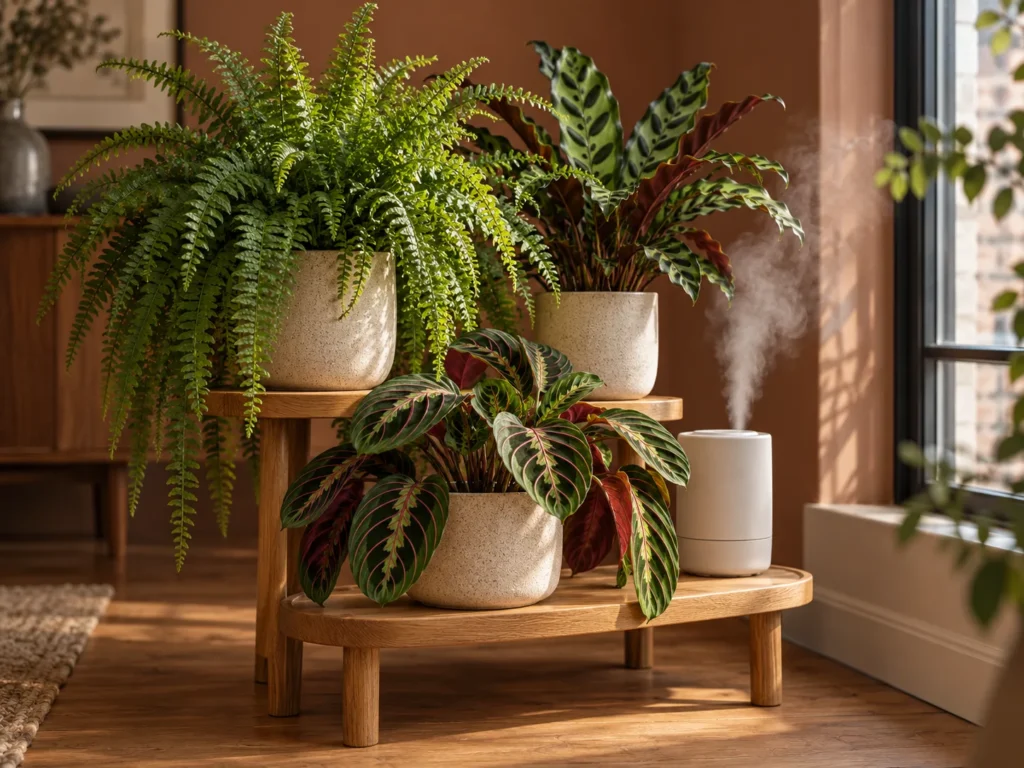
Most of these plants fail for the same three reasons in an apartment: soggy roots, dry winter air and too little light, and none of those has anything to do with your pet. Fix those and the rest is detail.
Roots first. Use a pot with a drainage hole and empty the saucer after watering; a cachepot with no hole is where peperomias and African violets go to rot. A peat- or coir-based mix with perlite suits the foliage plants, along the lines of 2 parts peat or coir to 1 part perlite and 1 part coarse sand, while haworthia and ponytail palm want equal parts potting soil and coarse sand. When you repot, step up only 2 to 3 inches in diameter; a huge pot holds water the roots can’t use. Our watering schedule for beginners turns all this into a weekly routine.
Winter air is the quiet killer. Heated apartments often sit at 10 to 30 percent relative humidity, while many of these plants prefer 40 to 50 percent, and palms start to suffer below 50. A humidifier is the most dependable way to move the number; grouping plants helps a little, while pebble trays and misting barely change it, because the water evaporates within minutes and spreads through the whole room. Succulents, by contrast, are fine at 10 to 30 percent, which is why they appear in the dry-air column.
Light and feeding follow the season. Cut watering back and stop fertilizing in winter, then resume feeding at the label rate once spring growth starts. If a spot is too dark, a grow light held 12 to 24 inches above foliage plants for 12 to 14 hours a day fills the gap. Spring is also the time to repot anything that dried out too fast last summer.
A few quick diagnoses. Brown tips on spider plants, palms and the prayer-plant family point to dry air, dry soil, fertilizer salts or tap-water chlorine and fluoride; check humidity and your feeding history before changing anything else, then water more evenly, flush the pot and pause fertilizer. Yellow leaves can mean too much water or too little, so feel the mix at root depth first. No flowers usually traces to light: a lamp interrupting a holiday cactus’s dark nights, a violet too far from the window, an orchid that never got its autumn chill, or a hoya that’s simply too young.
And the pet question. If a cat chews a non-toxic plant, expect possible vomiting and nothing worse; move the plant up, and call the vet or the poison line if signs go beyond mild upset or you aren’t sure of the plant’s identity. In my apartment, new arrivals get the most attention from both animals in their first few days, so anything new lives on a high shelf until the novelty wears off.
Frequently Asked Questions
Does it cost anything to call pet poison control?
It can, so keep a payment card handy. The ASPCA Animal Poison Control Center at (888) 426-4435 notes that a consultation fee may apply, and your own veterinarian is the other first call. Don’t let the fee slow you down after a lily or sago palm exposure. For cats, waiting 18 hours or more before lily treatment generally leaves kidney damage that can’t be reversed.
Is a plant safe if it isn’t on any toxic plant list?
Treat it as unknown until you can confirm it. The big plant lists cover the plants pets run into most often, and they aren’t complete records, so a missing entry only means nobody rated it there. Keep an unlisted plant out of reach, look it up by its Latin name instead of its common name, and call your vet or a poison line if your pet chews one you can’t identify.
Are safe houseplants for cats and dogs always safe for both species?
Only when the plant has a rating for each species. That’s why every plant in this guide was checked for cats and dogs separately. Cats and dogs can react very differently: cats also seem more sensitive to jade than dogs do. If a tag or a list just says “pet-safe,” look up the entry for your own animal before you buy.
Is a Thanksgiving cactus as pet-safe as a Christmas cactus?
Yes. The Christmas cactus (Schlumbergera bridgesii) is rated non-toxic to cats and dogs on the poison-control plant list, and university plant profiles tag the Thanksgiving cactus (Schlumbergera truncata) as non-toxic for both too. The two need the same care. The segment shape described in the holiday cactus entry tells them apart, and both rebloom with the same routine of long, dark nights.
Can I keep a lily if it’s on a shelf my cat can’t reach?
No. If you have a cat, the safest choice is not to bring true lilies or daylilies into your home at all. Every part of the plant is toxic to cats, including the pollen and the water in the vase, and cats are good at reaching shelves you thought were out of reach. In a dog-only home, a lily is a stomach-upset risk, not a kidney one.
What Actually Matters
Three things carry this whole list. Check the Latin name on the tag against the ASPCA entry before the plant leaves the store, because common names are where the contradictions live. Choose for your dimmest, driest month rather than the bright afternoon you’re shopping on. And keep the poison control number saved, knowing that lilies and sago palm are a different emergency from a cat that nibbled a parlor palm.
If you do one thing this week, pick a spot, note which way its window faces, and match it to the table in How to Pick. Then bring home one plant, put it up high for the first few days, and watch what your pets do with it before you buy the second.
Sources
- ASPCA – Toxic and Non-Toxic Plants (list introduction) – any plant material may cause vomiting; list not all-inclusive; APCC phone number
- ASPCA – Toxic and Non-Toxic Plants species entries for cast iron plant, parlor palm, spider plant, Boston fern, Maranta (Calathea insignis), red veined prayer plant, baby rubber plant, haworthia, pony tail, Christmas cactus, African violet, Phalaenopsis orchid, wax plant, areca palm, aloe, lily, Swiss cheese plant and money tree – non-toxic and toxic ratings for cats and dogs; poison control consultation fee note
- ASPCA – Is That Houseplant Safe for Your Pets? – spider plant stomach irritation; dracaena and jade signs; sago palm liver failure and onset
- ASPCA – These Houseplants Can Cause Trouble for Your Pets – calcium-oxalate group and low severity
- ASPCA – Top 10 Toxic Plants for Pets – lilies, sago palm, peace lily and pothos
- ASPCA – Are Succulents Safe to Have Around Pets? – Pilea peperomioides non-toxic; jade, snake plant and string of pearls toxic
- FDA – Lovely Lilies and Curious Cats: A Dangerous Combination – lily timeline, pollen and vase water, 18-hour window, Pet Poison Helpline number
- Clemson HGIC – Spider Plant; Indoor Palms; African Violet; Thanksgiving and Christmas Cacti; Waxflowers (Hoya); Indoor Plants: Soil Mixes; Pet-Safe Indoor Houseplants – sizes, temperatures, bloom timing, bud set, soil recipes, 10-hour light note
- University of Minnesota Extension – Growing Tropical Ferns Indoors; Winter Houseplant Tips; Lighting for Indoor Plants; Cacti and Succulents – fern winter window, repotting step, foot-candle ranges, grow-light distance, succulent mix and humidity
- NC State Extension Plant Toolbox – profiles for Aspidistra elatior, Chamaedorea elegans, Chlorophytum comosum, Nephrolepis exaltata, Goeppertia insignis, Peperomia obtusifolia, Pilea peperomioides, Haworthia, Schlumbergera, Phalaenopsis, Hoya carnosa, Dypsis lutescens, Maranta leuconeura and Pachira aquatica – sizes, light, water, humidity, pests, money tree note
- Missouri Botanical Garden Plant Finder – Beaucarnea recurvata – mature size, sun, watering, pests
- Penn State Extension – Humidity and Houseplants; Palms as Houseplants – winter humidity, misting and pebble trays, parlor palm size and cold limit
- Iowa State University Extension – How Can I Raise the Relative Humidity Indoors for My Houseplants? – winter indoor humidity range, preferred 40 to 50 percent.