

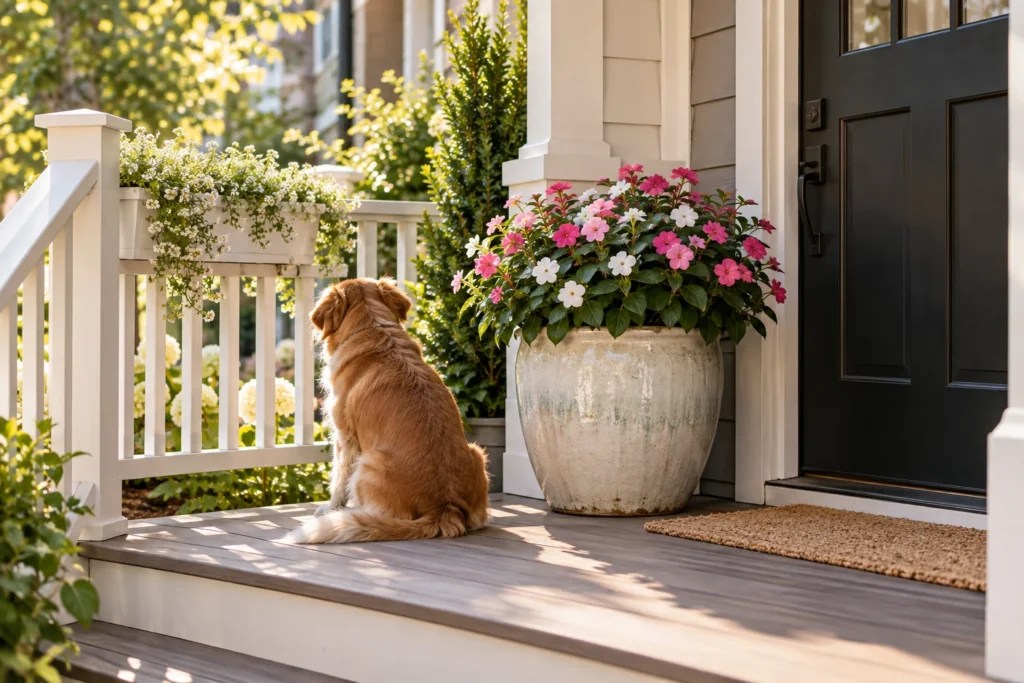
Picture the two matching pots you set either side of the door in April. For three weeks they look like the photo, and then the one on the sunny side goes crisp at the edges while its twin under the roof sits soggy and sulks.
A porch is an odd place to grow anything: half roof, half weather, often a shared walkway, and if you rent, you can’t screw a hook into any of it. Many fail because a plant that wanted six hours of sun landed under a roof that gives two.
These front porch container garden ideas are sorted by the light you actually have, and each one says what size pot it needs, whether it’s safe around a cat or dog, and whether a renter can set it up without a drill. If your porch is really a shared landing, our renter-friendly balcony setup ideas use the same no-drill logic.
Table of Contents
At a Glance
- Count your real sun hours before you buy anything. A covered porch often gives 2 to 6 hours even when it faces south, which is partial shade.
- One large pot with drainage holes beats several small ones on a hot porch, because small pots dry out and overheat fastest.
- Geranium, coleus, begonia, boxwood, lantana and English ivy are all listed as toxic to cats and dogs. Every idea names a pet-safe pick; for anything else, check the ASPCA list for your exact plant first, and remember that non-toxic still doesn’t mean a dog can graze it.
- Renters can do all 16 ideas without drilling: floor pots, railing boxes and freestanding stands only.
- Plant pansies and violas now; ferns, herbs and tender annuals go out after your last frost date.
For a first pot, make it a single 16-inch or larger pot: impatiens for a shaded porch, petunias for a sunny one. Skip geranium and coleus if a cat or dog uses it.
Ideas for Shady and Sunny Porches (Match the Light First)
Start with the roof, not the plant tag. A porch roof can take a south-facing wall down to partial shade, and an open west step can bake a pot by three in the afternoon, so these four ideas are sorted by the light you actually have.
1. Fern pair for a covered, shaded porch
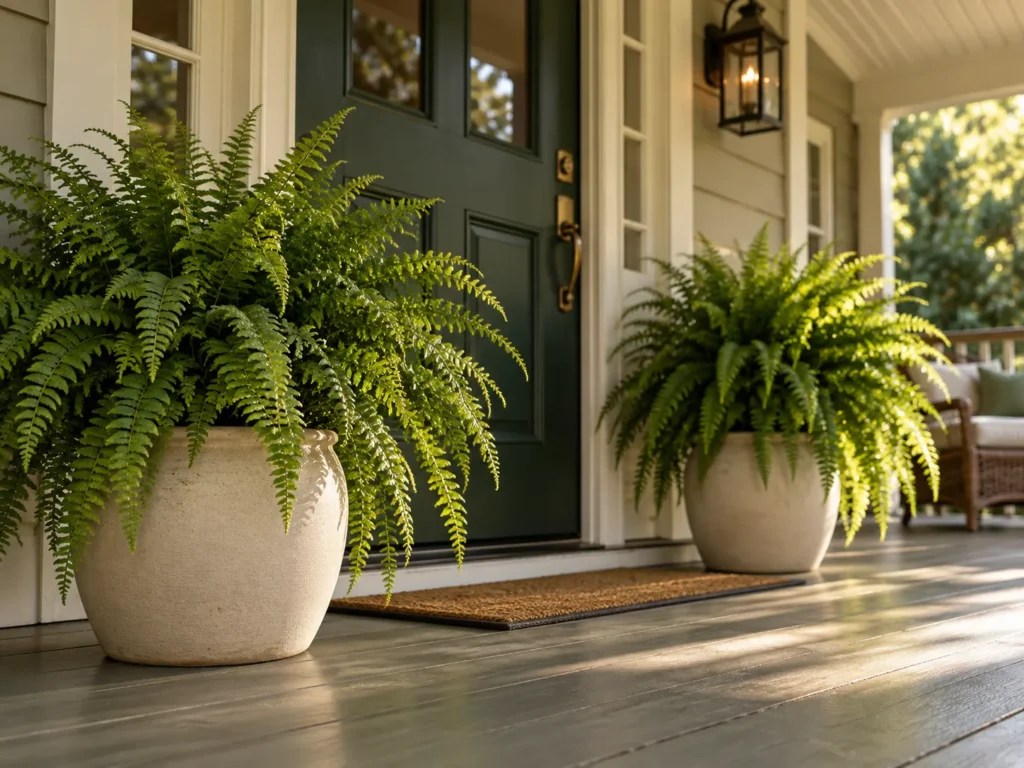
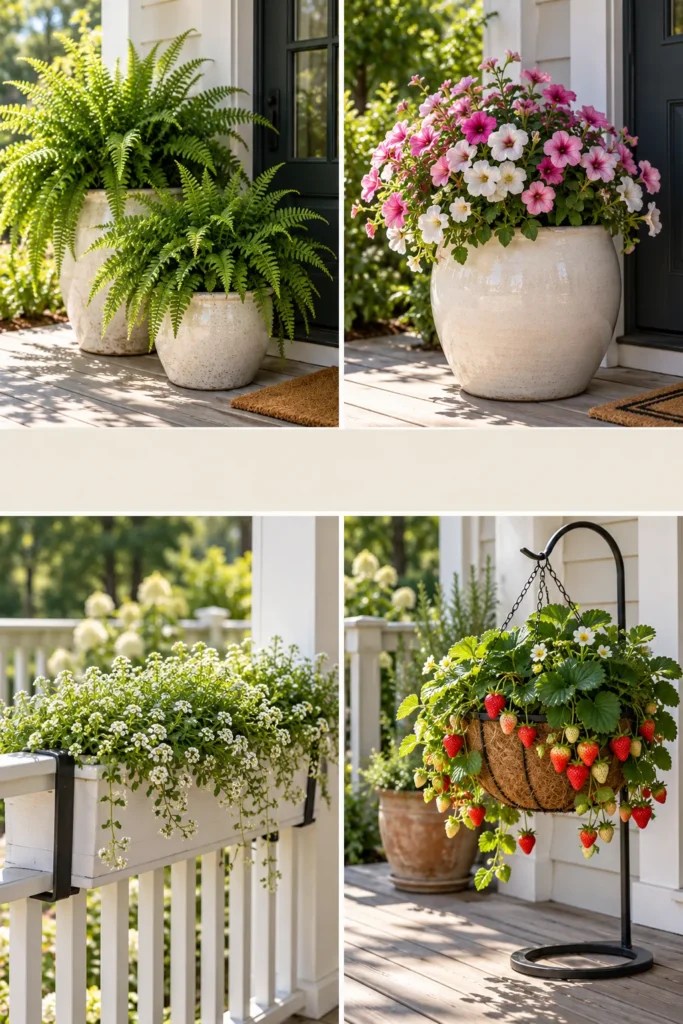
Two matched ferns are the classic covered-porch look, and they suit it because they want shade. Boston fern (Nephrolepis exaltata ‘Bostoniensis’) takes dappled to full shade and burns in direct sun; Kimberly Queen fern (Nephrolepis cordifolia) tolerates a few hours of morning sun.
Both are hardy outdoors only in zones 9 to 11, so they are a spring-to-fall display: out once frost danger passes, and back in before nights drop below 50°F. In the hottest weeks a potted fern can need water daily; feed monthly at half rate in late spring and summer.
Pet note: Boston fern is listed as non-toxic to cats and dogs. Renter note: floor pots, no ceiling hook.
2. Impatiens and sweet alyssum bowl for a north porch

For a porch that never sees direct sun, impatiens (Impatiens spp.) in a low bowl with sweet alyssum (Lobularia maritima) trailing over the rim gives color until frost. Impatiens prefer shade and alyssum takes part shade, so the pair suits the side where petunias would sulk.
A 12- to 14-inch bowl holds 3 to 5 plants; keep it shallow and wide so the alyssum reaches the floor. Our list of plants for a north-facing balcony works for a north porch too.
Pet note: impatiens is listed as non-toxic to cats and dogs. The ASPCA listing is for Alyssum spp., and the sweet alyssum sold in stores is Lobularia maritima, a different genus that the list does not name, so in a pet household check the exact plant first or let it trail from a hanging basket out of reach. Coleus, the usual filler here, is on the toxic list, so leave it out if pets use the porch.
3. Petunia and calibrachoa cascade on sunny steps
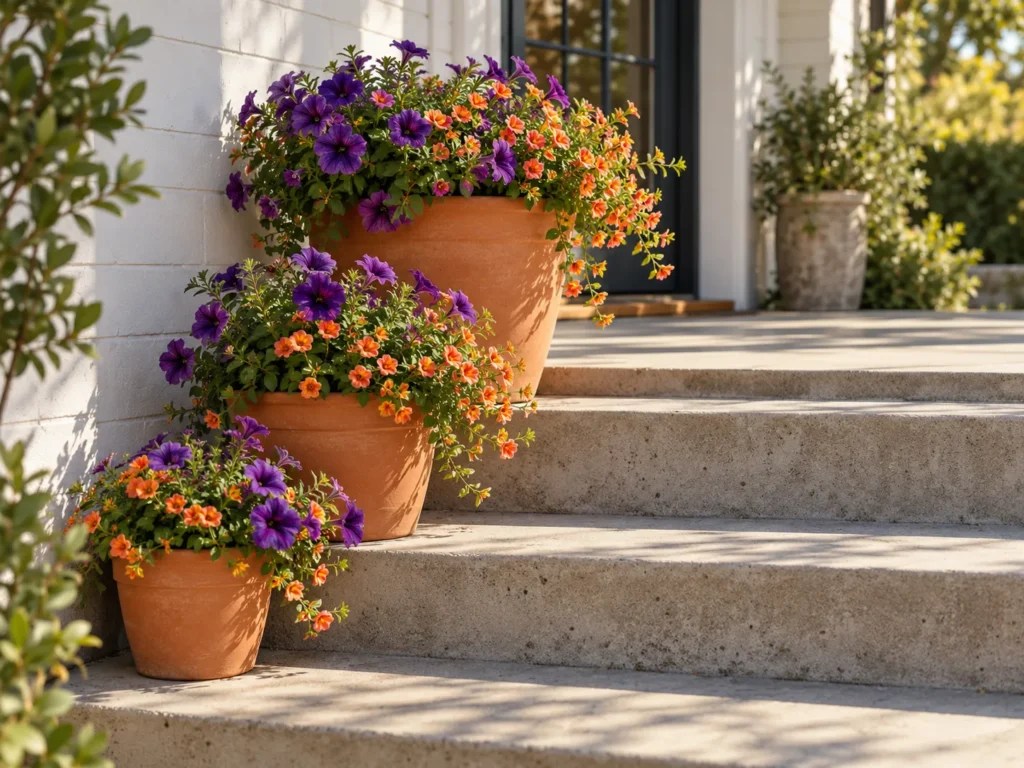
Petunia (Petunia spp.) and calibrachoa (Calibrachoa x hybrida) are the plants for the open, uncovered side of the steps. Both want 6 or more hours of direct sun; calibrachoa flowers noticeably less in partial shade, so with only afternoon light, lean on petunias.
Calibrachoa stays 3 to 9 inches tall but spreads up to 2 feet, so one plant per 12-inch pot is plenty. Use a fast-draining mix, feed as in idea 7, and go easy with the can, because overwatering rots the roots.
Pet note: petunia carries a non-toxic listing. Calibrachoa isn’t on the list, so if pets use the steps, keep this cascade petunia-only or hang the calibrachoa out of reach.
4. Classic geranium urn (and the pet-safe swap)
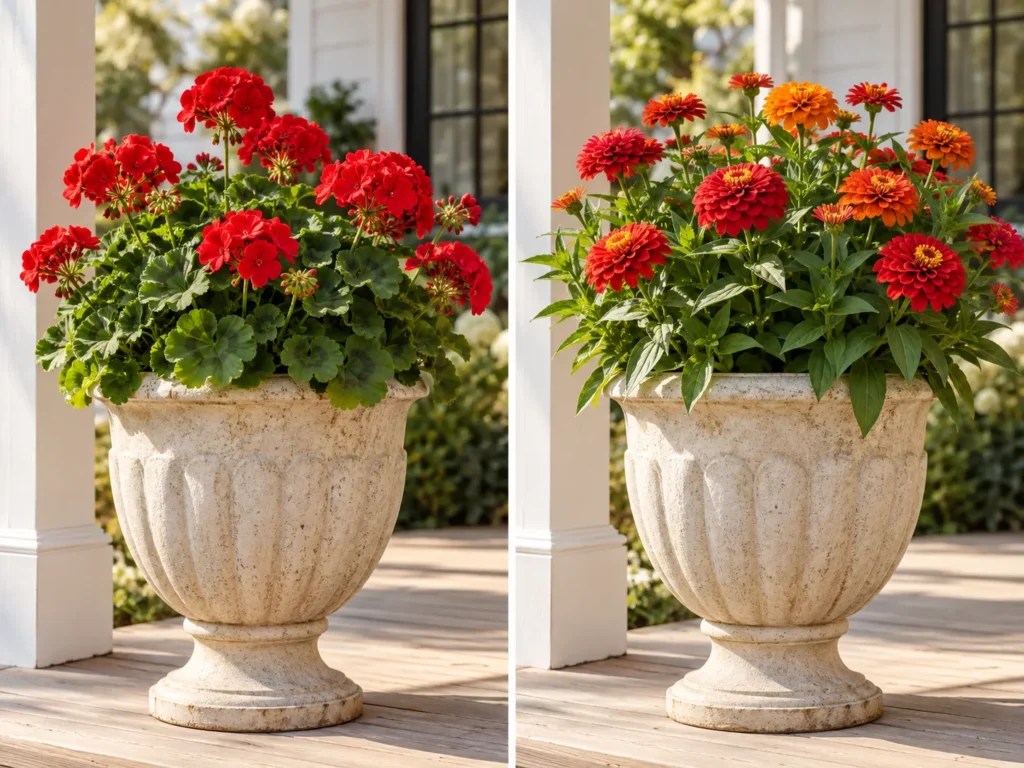
A tall urn of zonal geranium (Pelargonium x hybridum) is the picture most people have in mind, and on a full-sun, uncovered porch it earns it: a 1- to 3-foot mound, drought-tolerant once settled. Under a roof it turns leggy and sparse.
The ASPCA lists Pelargonium as toxic to cats and dogs, with vomiting and skin irritation among the signs; cats are more sensitive. For a pet household, plant zinnia (Zinnia spp.) in the same urn: the same hot color and sun needs, and it is listed as non-toxic. More heat-proof picks are in our guide to plants that handle full sun and heat.
Small-Porch and Renter Layout Ideas (No Drilling)
A narrow porch is mostly a walkway, so the layout matters as much as the plants. These five setups keep the door and steps clear and leave no holes in anything; the lease and HOA checks are in How to Pick.
5. One large statement pot by the door
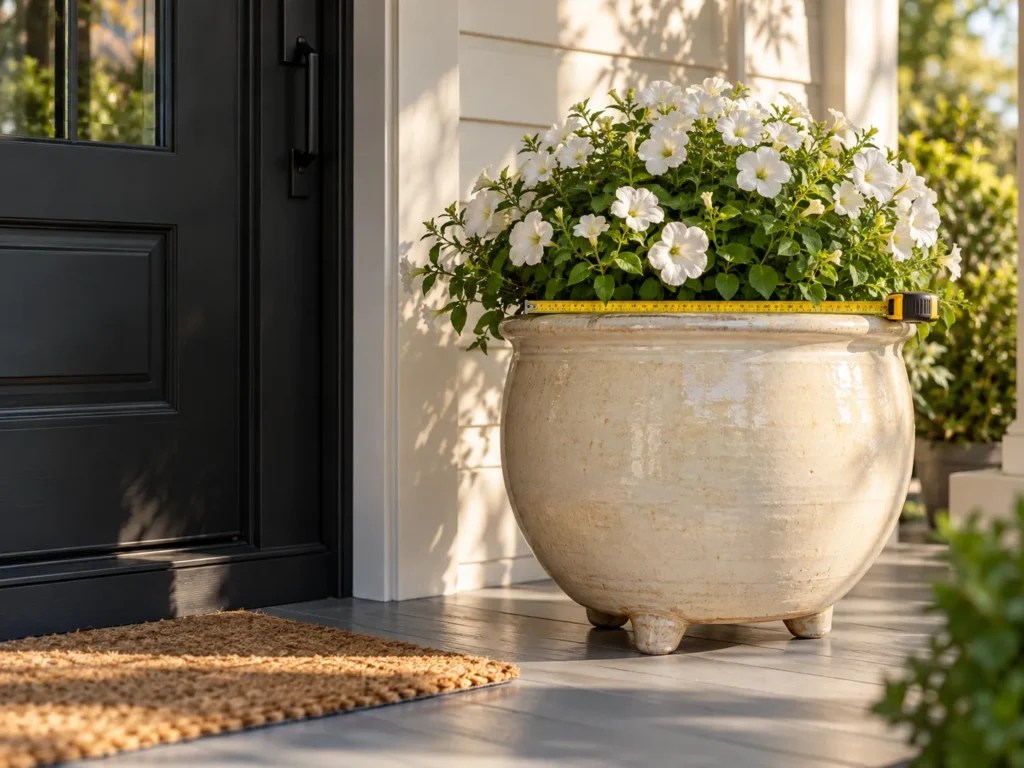
One big pot beside the door reads cleaner than five small ones and is easier to keep alive. For a first pot, we’d go to at least 16 inches wide, because the extension guidance on container size gives medium plants a minimum of 4 to 6 gallons of mix and 8 to 12 inches of depth (1 to 3 gallons for small plants; about 25 gallons for a shrub), and a 16-inch pot clears that while drying far more slowly than a 10-inch one.
Four details decide whether it works: drainage holes, no gravel layer, pot feet so water drains and the boards dry, and a saucer you empty after watering. On a sunny porch choose a pale pot, since a dark one absorbs heat that can injure young roots, and on an older wooden porch set the weight near a post or the house wall rather than mid-span.
6. Stair-step trio in matching pots
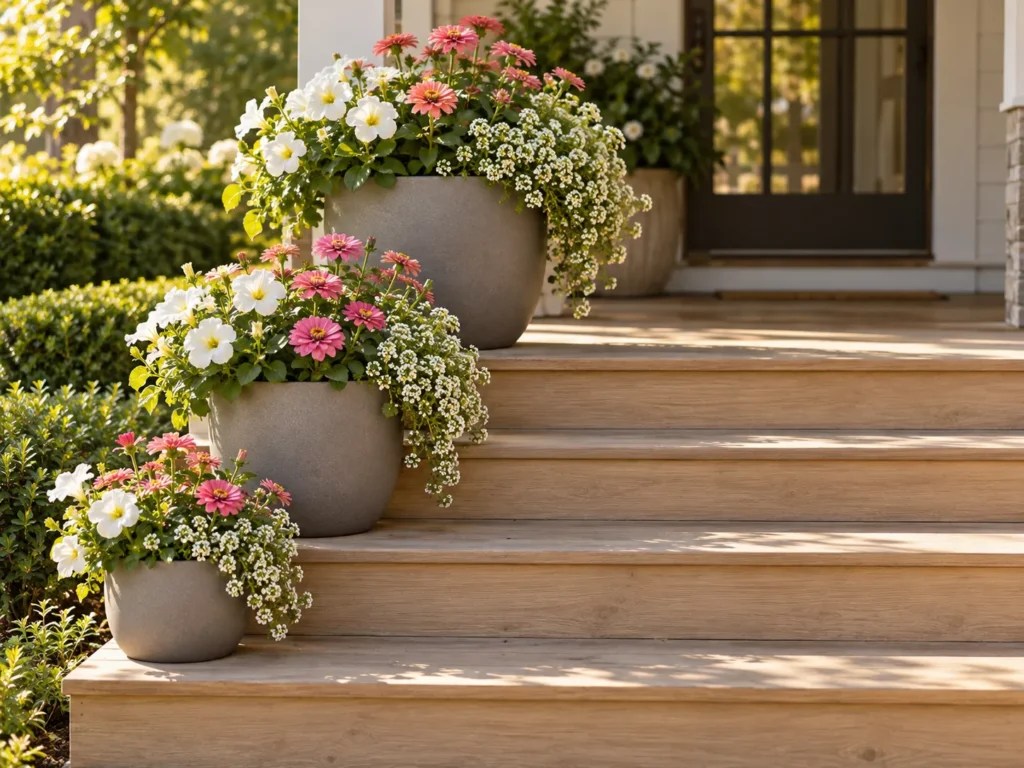
Three pots of the same color and material in graduated sizes, one per step, give height on a porch with no room for a bench. Keep the trio on one side so the stairs stay passable, and give the biggest pot the plant that drinks most.
Material matters more here than in a single large pot, because the smallest of the three dries first. Clay, ceramic, concrete and wood lose water through the pot wall; plastic and glazed pots hold it longer. If you can only water every other day, go plastic or glazed; terracotta suits daily waterers.
7. Over-the-railing planter box
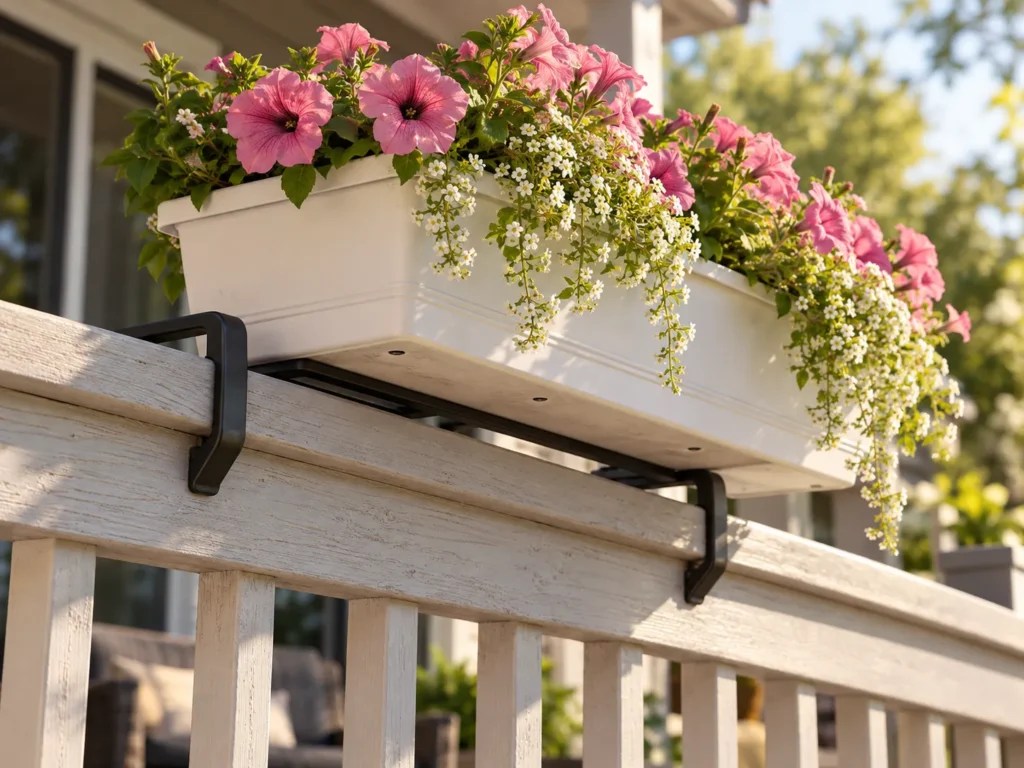
A plastic box on an over-rail bracket puts flowers at hip height without a single screw. The box needs drainage holes, and it gets much heavier once watered, so hang it only on a railing that doesn’t flex, and keep it over your own porch floor rather than a neighbor’s steps where it will drip.
The watering rule for every idea lives here. Push a finger into the mix; if it’s dry 1 inch below the surface, water until it runs out of the holes. In hot weather that can mean daily, and twice a day for small baskets and edibles. Give flowering annuals slow-release fertilizer at planting and a soluble feed every 1 to 3 weeks at the label rate through summer.
8. Freestanding hanging-basket stand or shepherd’s hook
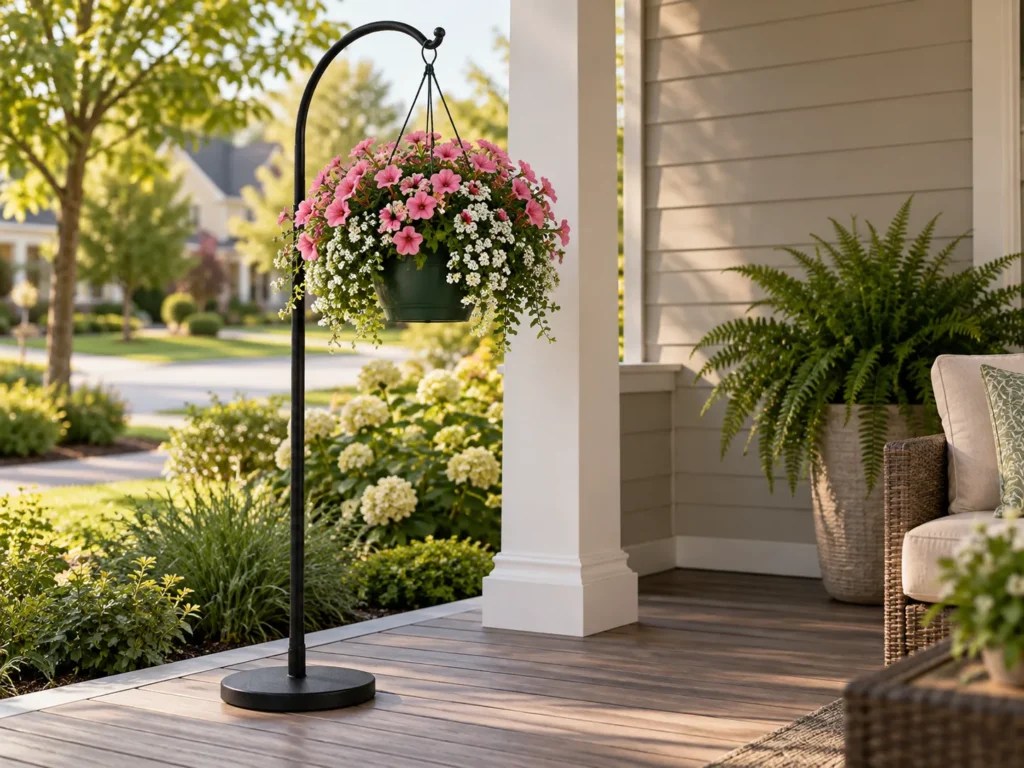
When ceiling hooks aren’t allowed, a freestanding stand or a weighted shepherd’s hook gives the hanging-basket look with nothing attached to the building. Hang the basket near eye level, and weight the base so wind can’t tip it.
Basket size sets the plant count: a 12- to 14-inch basket takes 3 to 5 plants, a 16- to 18-inch basket 5 to 7. Plastic dries more slowly than wire. A basket that has dried right out can stand in a tub of water for an hour or two, no longer.
Pet note: height is the easiest fix for any plant you’re unsure about; a basket above a dog’s reach suits trailing calibrachoa or a spider plant (Chlorophytum comosum, non-toxic).
9. Self-watering planter for the hot, west-facing porch
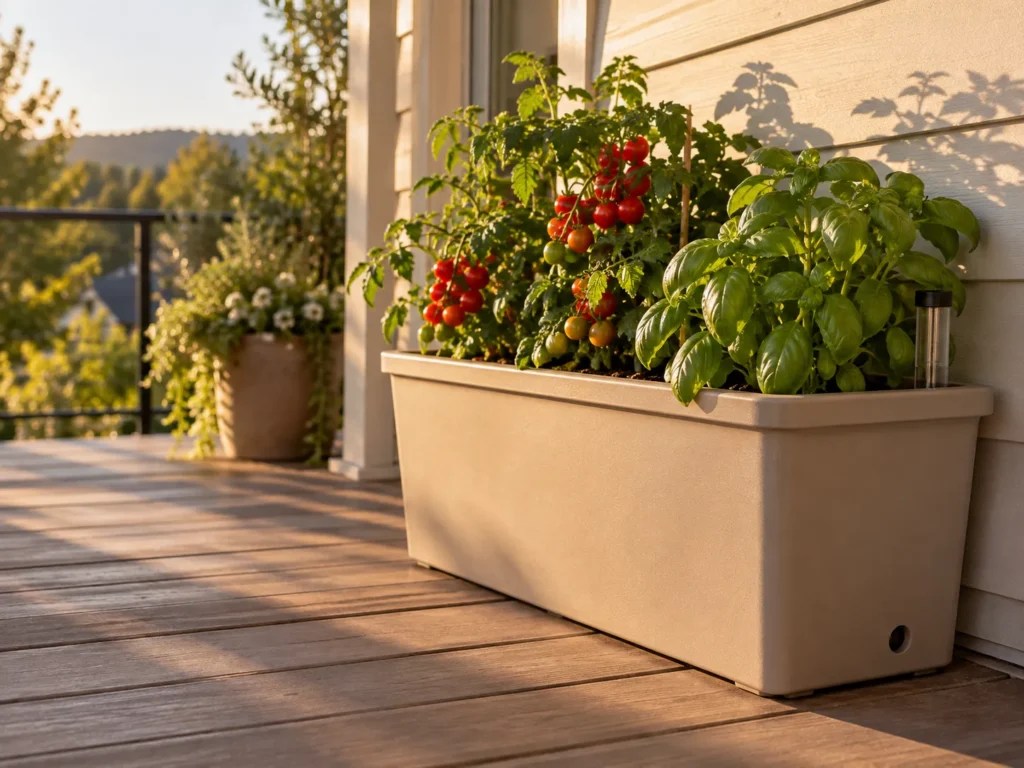
On a west porch that bakes from noon, a self-watering (subirrigated) planter is the kindest option. A reservoir under the mix feeds water upward by capillary action so the root zone stays evenly moist, and an overflow hole stops you drowning it. In heat you still top the reservoir up daily, but one missed morning no longer wilts the pot.
Two rules keep it working: soilless mix rather than garden soil, which packs down and stops the wicking, and no water-soluble fertilizer in the reservoir, where salts build up and burn roots; band granular fertilizer on the surface instead.
We’d keep this planter for the sunny side, since under a roof it holds the mix wetter than ferns and succulents like.
Edible Welcome Ideas (Herbs and Fruit at the Door)
A pot of herbs by the front door gets used more than the same pot on a back balcony, because you walk past it twenty times a day. These three edibles suit a small porch. One rule for all three: spray or feed them only with products labeled for edible crops.
10. Herb pot by the door
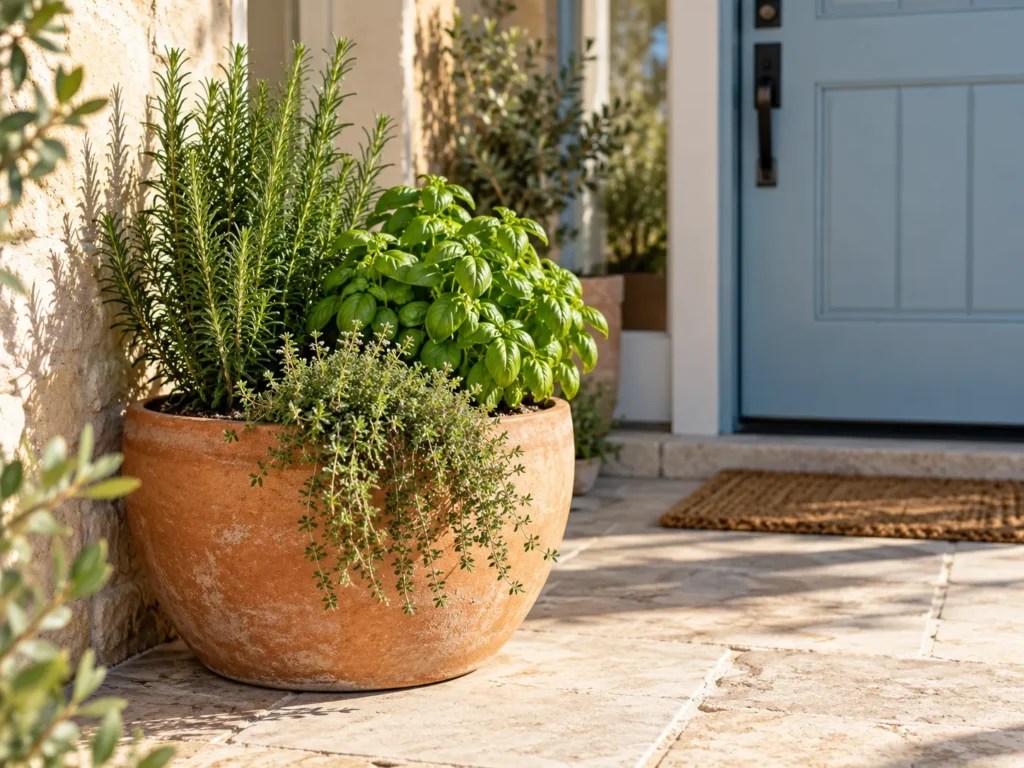
Rosemary (Rosmarinus officinalis), thyme (Thymus vulgaris) and basil (Ocimum basilicum) in one wide pot, or three small ones, cover most weeknight cooking and all want the sunniest spot you have. Let the thyme dry out between waterings; basil wants it steadier and goes out only after frost danger has passed.
Rosemary doesn’t reliably survive a cold-zone winter in a pot, so bring it indoors before the first frost.
Pet note: rosemary, thyme and basil are all non-toxic for cats and dogs. Mint, chives, parsley and oregano appear on the ASPCA toxic list for dogs, and lavender is listed as toxic to both, so keep all five out of a pet household’s door pot.
11. Strawberry pot or hanging strawberries
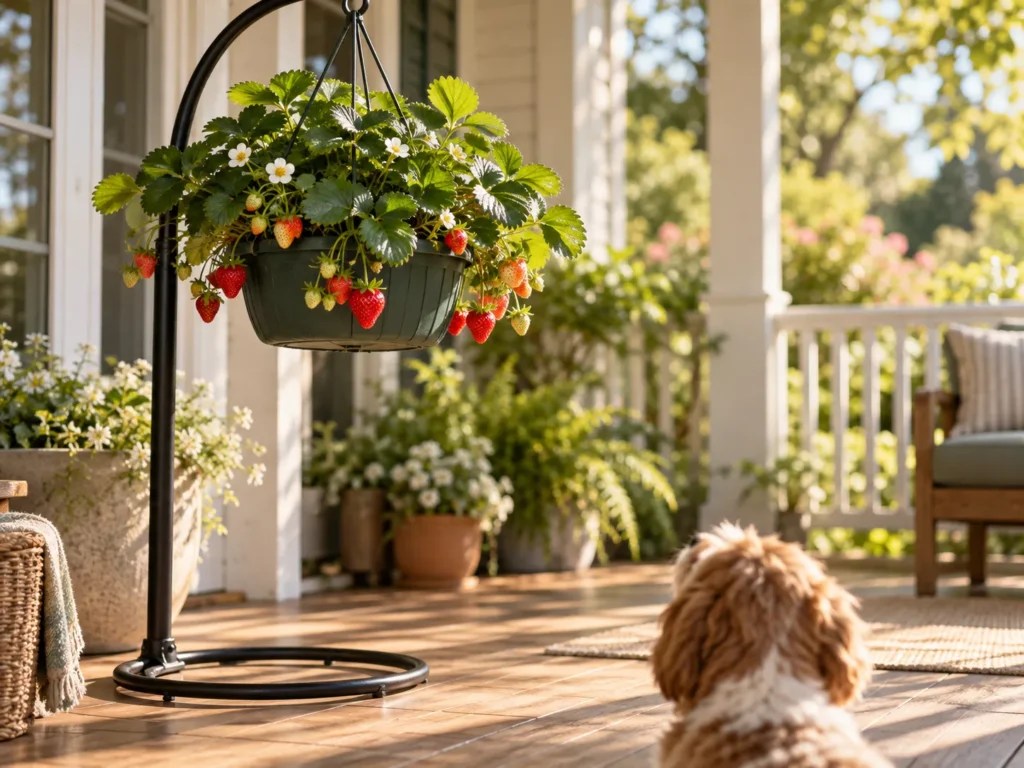
Compact or everbearing strawberries (Fragaria spp.) fruit happily in a pot at least 8 inches deep or a 12- to 14-inch basket, given full sun and mix that never fully dries. A basket on the stand from idea 8 keeps the berries off the floor and above a dog’s nose.
Pet note: strawberry is on the non-toxic list. For varieties, winter care and how many plants fit a pot, see our guide to growing strawberries in pots.
12. Salad greens box for a part-shade porch

Lettuce and kale prefer partial shade, so this is the one edible here that likes the covered side. A box or pot 4 to 6 inches deep is the minimum; 1 to 3 gallons of mix per plant suits small crops like these.
Greens drink fast in warm weather, so expect daily watering in summer, with a soluble feed every 2 to 4 weeks after slow-release fertilizer at planting.
Year-Round Structure Ideas (Pots That Stay Out)
A porch looks bare from November to March if every pot is an annual. One rule decides which of these four survive winter where you live: a potted perennial or shrub needs a hardiness rating two zones colder than your own, because a pot has no ground to insulate it and the roots get as cold as the air. Look up your zone on the USDA Plant Hardiness Zone Map, and use plastic, fiberglass or metal for pots that stay out, since clay, ceramic and glazed pots can crack when the mix freezes.
13. Dwarf Alberta spruce sentinels
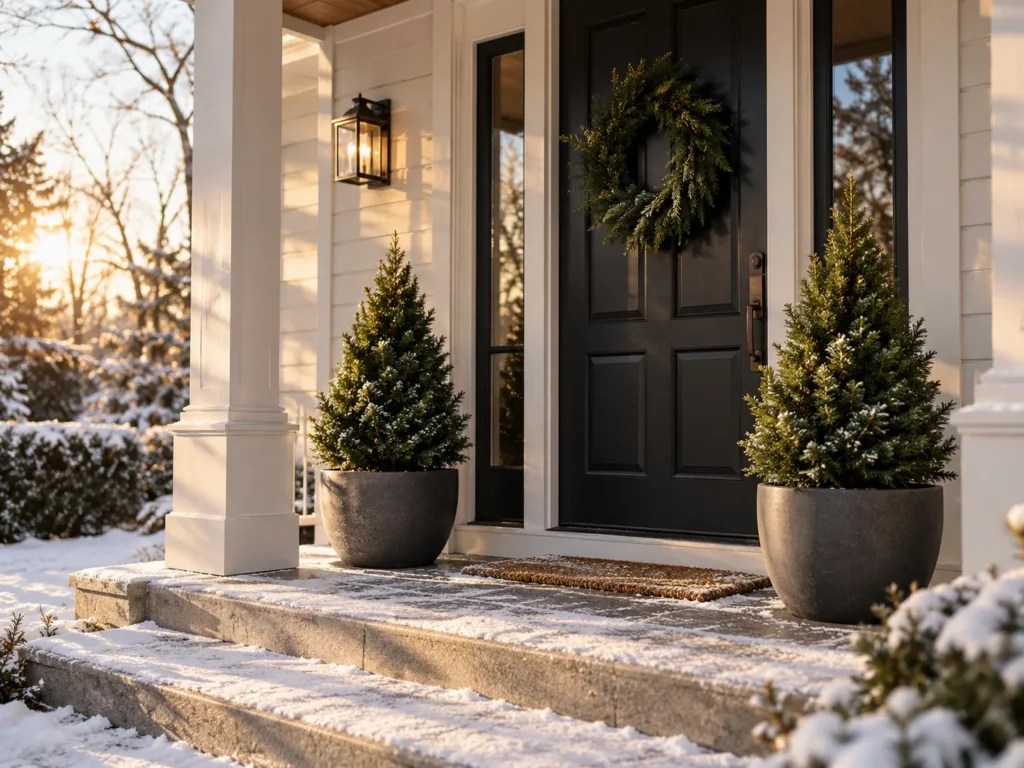
Dwarf Alberta spruce (Picea glauca ‘Conica’; some references list it as P. laxa) is the evergreen most often sold for door pots: slow growth to about 3 to 4 feet after 10 years, full sun to partial shade, a tidy cone. It is rated for zones 3 to 6 in the ground, so by the two-zones rule it stays out reliably only in zones 5 and 6; colder than that, it spends the worst of winter in an unheated garage.
Shelter it from strong wind, and watch for spider mites in a still, hot corner, which show as fine webbing and pale stippled needles; our guide on how to spot and treat spider mites covers treatment. Pet note: this spruce isn’t on the list either way, so ask your vet first.
14. Hardy succulent bowl

Hens and chicks (Sempervivum tectorum) is the easiest plant here to keep alive: full sun or partial shade, a missed week of watering, and winters down to zone 3a (rated 3a to 8b) all leave it unbothered. Give it a shallow, wide bowl of fast-draining mix, afternoon shade in the hottest regions, and let it dry fully between waterings, since constant wet rots the crown.
Rosettes stay 3 to 4 inches across and multiply by offsets. Pet note: the ASPCA’s non-toxic “Hens and Chickens” entry is for Echeveria elegans, a different plant, and Sempervivum isn’t on the list, so keep the bowl on a ledge out of reach, or grow Echeveria elegans in warm zones.
15. Coral bells foliage pot for the shaded side

Coral bells (Heuchera hybrids) give the shaded side something that isn’t green: burgundy, caramel or silver foliage in a 12-inch or larger pot, reaching 12 to 16 inches in bloom. Morning sun and afternoon shade is the sweet spot, which describes the east side of most covered porches.
Keep the mix moist but draining; soggy mix is the one thing coral bells won’t forgive. Water weekly in hot, dry spells, and mulch the pot surface before winter. Varieties range from zones 3 to 9, so pick one that passes the two-zones rule if the pot stays out. Pet note: coral bells is listed as non-toxic for both.
16. Cool-season pansy and snapdragon refresh (plant this now)
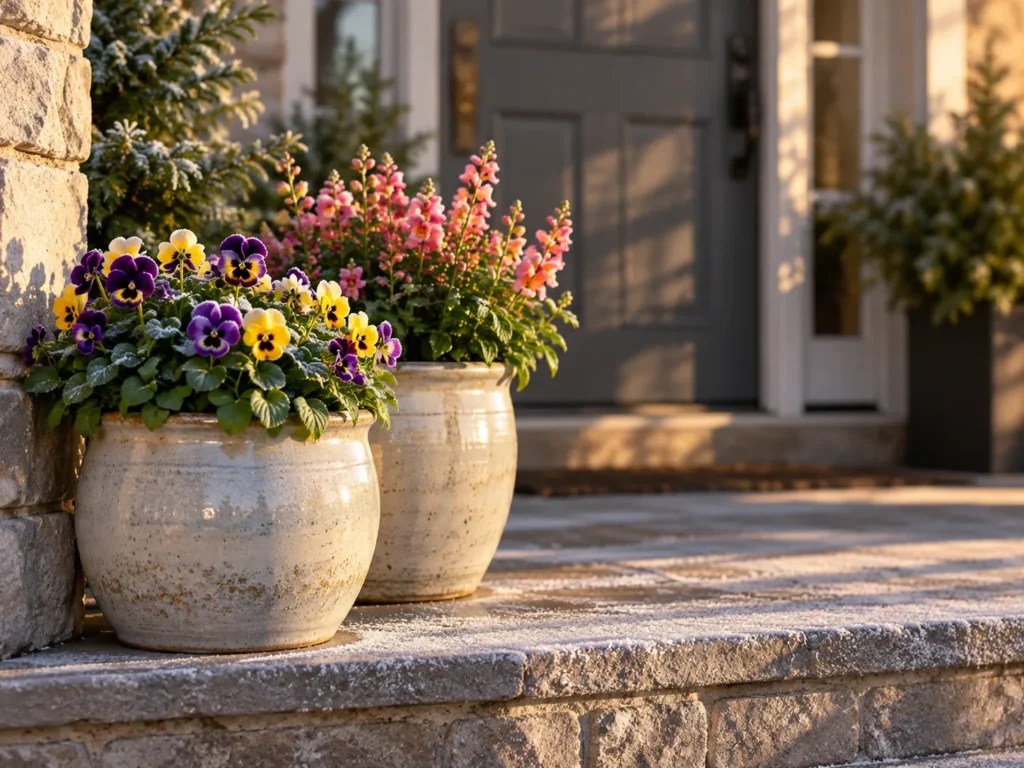
Pansies and violas (Viola spp.) are the plants to buy this week, because they tolerate light freezes. Pair them with snapdragons (Antirrhinum majus), another cool-weather lover for full to part sun; choose a dwarf series for pots, since standard plants reach 2 to 3 feet.
Pansies stand 4 to 10 inches tall and follow the feeding rule from idea 7. Most decline once summer heat arrives, so by late spring you’ll swap them for the petunias or zinnias from the first section. Pet note: neither pansy nor snapdragon is among the pet-safe picks in this guide, so check both before buying if pets use the porch.
How to Pick the Right Front Porch Container Garden Ideas for Your Space
Pick by light first, then by who uses the porch; the table below turns both into a first setup.

Your porch roof is a light filter, so count hours rather than direction. Full sun means 6 or more hours of direct light; partial shade is 2 to 6 hours; full shade is under 2 hours. Check the spot mid-morning, early afternoon and late afternoon on one clear day; afternoon light is stronger than the same hour at dawn. A covered porch with 4 to 6 hours counts as partial shade for ferns and impatiens but as plenty for pansies and coral bells; at 6 or more, it is full sun territory for petunias and herbs.
| Your porch | Real sun | First setup to try | Pet-safe plant picks | Skip if |
|---|---|---|---|---|
| Covered north or east porch | 2 to 4 hours | Fern pair (1) or impatiens bowl (2) | Boston fern, impatiens, coral bells | You can’t water daily in July |
| Uncovered south or west porch | 6 or more hours | Statement pot (5) or self-watering planter (9) | Petunia, zinnia, rosemary, basil | You only own dark pots |
| Covered south porch | 4 to 6 hours | Pansy refresh now (16), coral bells (15) later | Coral bells, strawberry, Boston fern | You want calibrachoa |
| Upper-floor or windy landing | Varies | Succulent bowl (14) or railing box (7) | Petunia, thyme, zinnia | Tall urns or swinging baskets |
| Porch with a dog or cat | Any | Any idea, using its pet-safe pick | Zinnia for geranium, impatiens for coleus | Geranium, coleus, begonia, lavender, ivy |
| Strict lease or HOA | Any | Statement pot (5) or railing box (7) | As the light row above | Anything that drips on shared stairs |
Porch pots die in three ways, and a finger tells them apart. Crisp leaves, mix shrinking from the pot wall and a pot that’s light to lift mean it dried out, usually from a small, dark or porous pot in sun, hot wind or a missed watering; give it the rescue soak from idea 8, then a larger or paler pot. Yellow leaves, a sour smell and mix still wet 1 inch down days after watering mean it drowned, from no drainage holes, a full saucer or a gravel layer; fix the pot and empty the saucer. Long stretched stems leaning toward the open side mean too little light; move the pot to the edge or swap in a shade plant from ideas 1, 2 or 15.
Spring timing goes in stages. Pansies, violas, snapdragons, hens and chicks and coral bells can go out now. Store-bought tender plants need hardening off over 10 to 14 days, a few more hours outside each day, and come back in on nights below 45°F. Ferns, basil, petunias, impatiens, zinnias and strawberries wait until frost danger has passed for your zone, a date your local extension office publishes.
In autumn the sequence runs backwards: ferns come in before nights fall below 50°F and winter at 40°F or above; rosemary comes in before the first frost; perennials and shrubs stay out only if they pass the two-zones rule from the year-round section.
One renter paragraph, because it saves deposits. Read your lease and any HOA rules for what may sit outside the door, keep the walkway and stairs clear enough for two people to pass, drill nothing, and think about where water goes after you pour it; a pot dripping onto a neighbor’s steps is the kind of thing that gets a letter.
Frequently Asked Questions
Can I grow tomatoes in a pot on a front porch?
Yes, on the uncovered side that gets 6 or more hours of direct sun. A tomato needs one plant per container with at least 8 to 10 gallons of mix and 12 to 16 inches of depth, which is bigger than most door pots. Under a covered roof with 4 hours or less, you’ll get leaves and few fruit; put the salad box from idea 12 there instead.
Can I use garden soil in porch pots?
No. Soil dug from a bed packs down in a container, drains poorly and, in a self-watering planter, stops the wicking that the reservoir depends on. Use a bagged soilless potting mix (peat or coir with bark, perlite or vermiculite) for every idea in this guide, and buy it fresh rather than scooping from the yard.
What do I do with the pots in winter?
Empty the annual pots once frost blackens them, scrub them, and store clay, ceramic and glazed pots somewhere dry so trapped water can’t freeze and crack them. Pots that stay out should be plastic, fiberglass, metal, or very large wood or concrete, and only a perennial that passes the two-zones rule in the year-round section should still be living in one. Most of the front porch container garden ideas above are spring-to-fall displays, which is normal.
My porch pots keep blowing over. What helps?
Go wider and lower before you go heavier. A broad, squat pot with a low mound of petunias or hens and chicks has far less sail than a tall urn or a swinging basket, and placing it against the house wall or beside a post takes it out of the wind lane. On an upper-floor or very windy landing, the railing box and succulent bowl rows in the table were chosen for exactly this reason.
My dog nibbled a plant listed as non-toxic. Should I worry?
Usually not, but watch it. Non-toxic on the ASPCA list means the plant isn’t expected to cause poisoning, not that it’s food; a mouthful of petunia or Boston fern can still bring mild vomiting or an upset stomach, and any plant can carry residue from a spray. If the signs last more than a day, or the plant wasn’t on the non-toxic list, call your vet and give them the plant’s botanical name.
What Actually Matters
Most porch pots fail for one of three reasons, and none is the plant’s fault: the light was less than the tag assumed, the pot was too small or too dark for the spot, or the plant was toxic to the pet that lives there. Settle those three, light first, and most of the front porch container garden ideas above look after themselves.
Living with a cat and a dog, I check the ASPCA list before any plant comes home, porch or living room. Our list of pet-safe plants for cats and dogs overlaps with several picks here.
This week: buy one pot at least 16 inches wide with drainage holes, plant it with pansies, and pencil in your last frost date for the swap to impatiens or petunias. The matching pair can wait until the first pot has taught you what your porch really gets.
Sources
- University of Maryland Extension – Types of containers for growing vegetables; Growing herbs in containers and indoors – pot sizes, drainage, pot feet, dark-pot heat, porous pots, strawberry depth, herb care.
- Penn State Extension – Container Vegetable Gardening: Four Keys to Success; Overwintering Plants in Containers; Transplanting Annuals into the Garden – soilless mix, edible feeding, two-zones rule, hardening off, 45°F.
- Iowa State University Extension – Creating and Growing Hanging Baskets; Growing Pansies and Violas – basket plant counts, rescue soak, feeding, pansy freeze tolerance and height.
- Clemson Cooperative Extension HGIC – Hanging Baskets and Window Boxes; How to Grow and Care for Porch Ferns – basket weight, 1-inch check, fern care, 50°F and 40°F.
- University of Georgia Cooperative Extension (Paulding County) – Do you find sunlight terminology for plants confusing? – sun-hour bands.
- Mississippi State University Extension – Subirrigated Containers for the Mississippi Gardener (P2971) – reservoir planters.
- NC State Extension Plant Toolbox and county pages – Calibrachoa x hybrida; Pelargonium x hybridum; Sempervivum tectorum; Picea laxa ‘Conica’; Heuchera (Brunswick County); Snapdragons (Wayne County) – sun, sizes, zones, spider mites.
- USDA Agricultural Research Service – USDA Plant Hardiness Zone Map (2023) – zones.
- ASPCA Animal Poison Control – Toxic and Non-Toxic Plants index, the plant page for every plant named in a pet note, and the printable toxic-to-dogs list – every pet note.
