
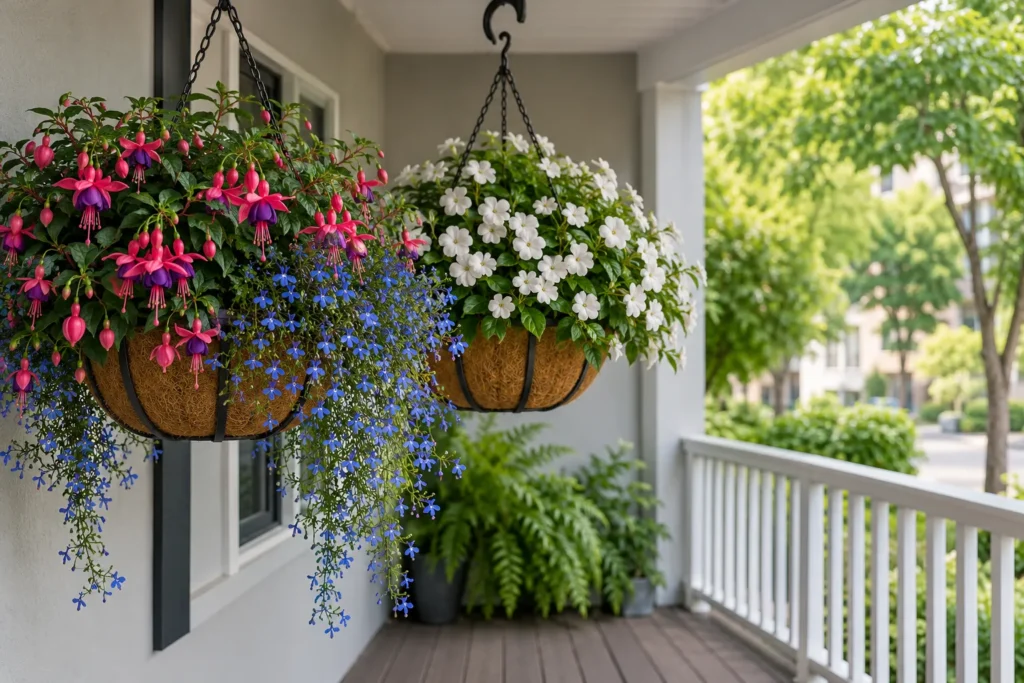
Your porch sits on the shaded side of the building. The basket you hung in May was round and full for a few weeks, and now it’s a tangle of long green stems with a handful of flowers clinging to the tips, while the sunny-side neighbour’s petunias carry on as if nothing happened.
Most of those thin July baskets were planted with plants chosen for “shade” in general, when the real light under a porch roof is a different thing from an east porch with morning sun. The hanging basket flower combinations for a shady porch below are sorted by how much direct sun your porch actually gets and by how hot your summers run, and each one carries a note for cat and dog households.
If your porch gets six or more hours of direct sun, you’re on the wrong page in the nicest possible way; the hanging basket combinations for a sunny porch guide was written for you. Everyone else, read on: twelve recipes, each with the plants, why they work together, the care that keeps them full, and a plain line on who should skip it.
Table of Contents
At a Glance
- Count your real sun hours first. Deep shade (under 2 hours of direct sun a day) and partial shade (2 to 6 hours) call for different plants, and a basket built for the wrong one goes leggy by midsummer.
- Match the combo to your summer. Cool-summer porches get the classics: fuchsia, tuberous begonia and trailing lobelia. Hot, humid summers do better with New Guinea impatiens, torenia, browallia and sweet potato vine.
- Plant fewer than you think. A 12 to 14 inch basket holds 3 to 5 plants and a 16 to 18 inch basket holds 5 to 7; overcrowding is one of the usual reasons a basket thins out.
- Check the pet list before you buy. Fuchsia, impatiens, New Guinea impatiens, Boston fern, coral bells and sweet potato vine are on the ASPCA non-toxic list for cats and dogs; begonia, coleus, English ivy and caladium are not. Non-toxic doesn’t mean chew-proof or free of stomach upset, so hang any basket above nose height anyway.
- Best first basket for most readers: Idea 2, a single colour of downy-mildew-resistant impatiens. If your average summer day sits above the mid-70s°F, skip fuchsia and tuberous begonia (Ideas 1, 5 and 12) and start with Idea 9.
| Light on your porch | Direct sun per day | Ideas that fit |
|---|---|---|
| Deep shade (roofed, north-facing) | Under 2 hours | 1, 2, 3, 4, 11, 12 |
| Partial shade (morning sun, east-facing) | 2 to 6 hours | 1, 2, 3, 4, 5, 6, 7, 8, 9, 10, 12 |
| Full sun | 6 hours or more | None here; see the sunny-porch guide |
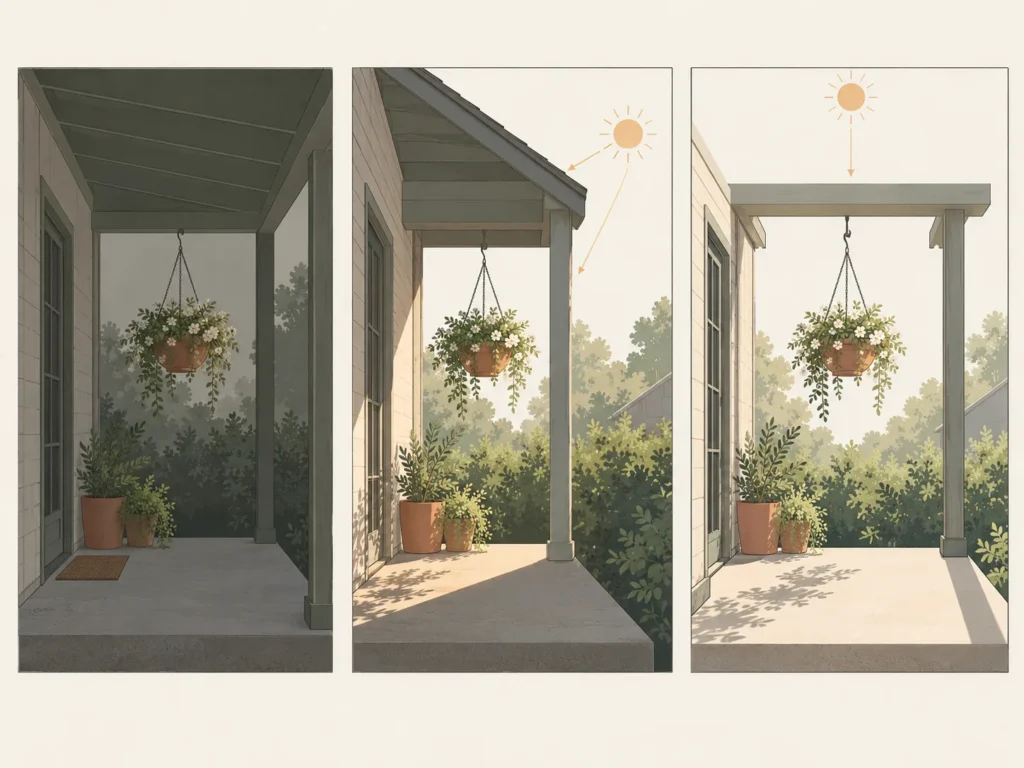
Deep Shade Combos for a Roofed or North-Facing Porch
Under a porch roof or on a north wall the basket may see no direct sun at all, so every plant in this group is one that holds up in deep shade or dappled light. These four are the baskets to reach for when the floor under the hook stays in shadow all day.
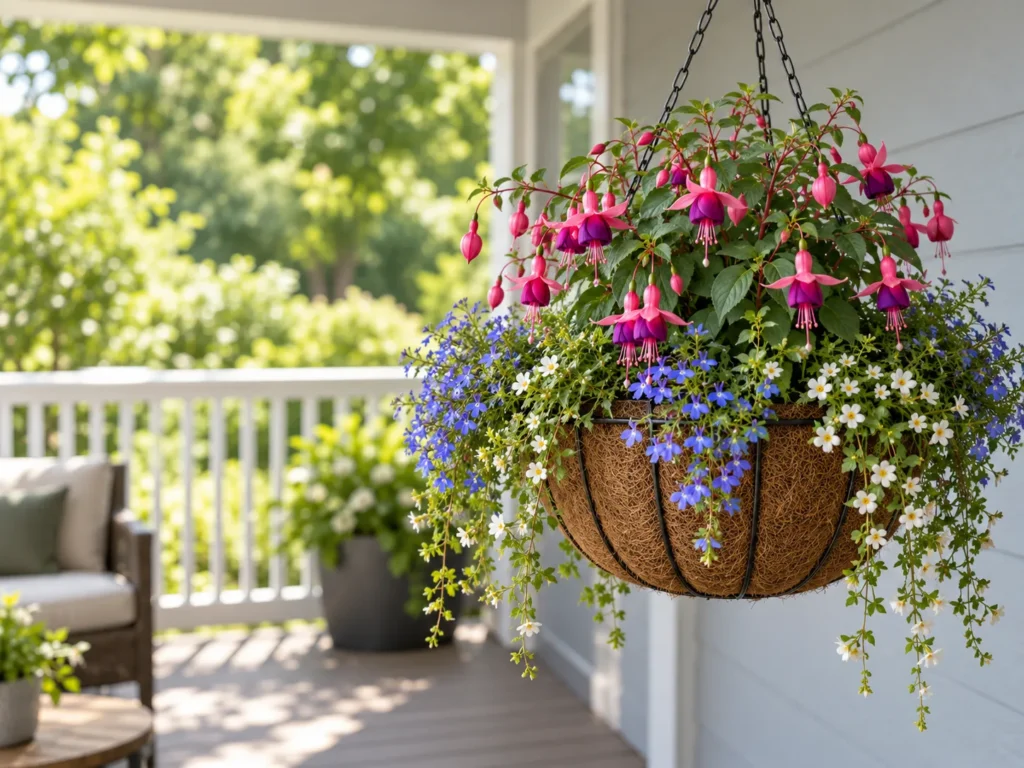
1. Fuchsia, Trailing Lobelia and White Bacopa (the cool-climate classic)
Put one fuchsia (Fuchsia x hybrida) in the centre, with blue trailing lobelia (Lobelia erinus, a trailing form such as ‘Hamburgia’) and white bacopa (Chaenostoma cordatum) around the rim. The fuchsia drapes its dangling flowers over the edge while the two trailers soften the basket outline, and all three keep going from spring into fall.
Fuchsia wants evenly moist mix, a soluble feed every two to four weeks, and a pinch on each new shoot after two full sets of leaves to keep it bushy. It also needs a spot out of the wind, since the stems snap. Lobelia likes consistent water and a feed about every two weeks; bacopa just wants regular water once the weather warms.
This is a cool-summer basket. Fuchsia prefers days of 60 to 70°F with nights about 10 degrees cooler, and flowering stops once the average daily temperature passes 76°F; lobelia is far happier with a cool spring than a hot, humid summer. For a first basket in the Pacific Northwest or New England we’d start here, because that temperature range matches those porches and the show runs for months.
Pet note: fuchsia is non-toxic to cats and dogs. The ASPCA lists lobelia (the cardinal flower species) as toxic and doesn’t list the annual type separately, and bacopa has no entry either, so hang this one out of reach. Lobelia is also rated a medium-severity poison for people if eaten in large amounts. Skip it if your summers are hot and humid or the hook sits on an exposed, windy corner.
2. One-Colour Impatiens Basket (the no-fuss renter basket)
Three to five plants of one colour of garden impatiens (Impatiens walleriana) in a 12 to 14 inch basket, all from one downy-mildew-resistant series such as Beacon or Imara. It fills in quickly, needs no deadheading, and reads from the street as a single clean block of colour, which is why most readers should start here.
Keep the mix constantly moist; impatiens wilt fast in a hot, dry spell, yet soggy mix rots the roots, so water when the surface starts to dry rather than on a fixed schedule. They take partial to full shade, grow 6 inches to 2 feet, and if the basket gets rangy by late summer you can trim off the top third and let it refill.
Buy the resistant series on purpose. All standard garden impatiens are susceptible to downy mildew, a disease that no spray fixes once it’s in the plant, while Beacon, Imara and SunPatiens are bred to resist it and New Guinea types tolerate it. Pet note: impatiens are non-toxic to cats and dogs. Skip it only if you want leaf colour or texture in the mix.
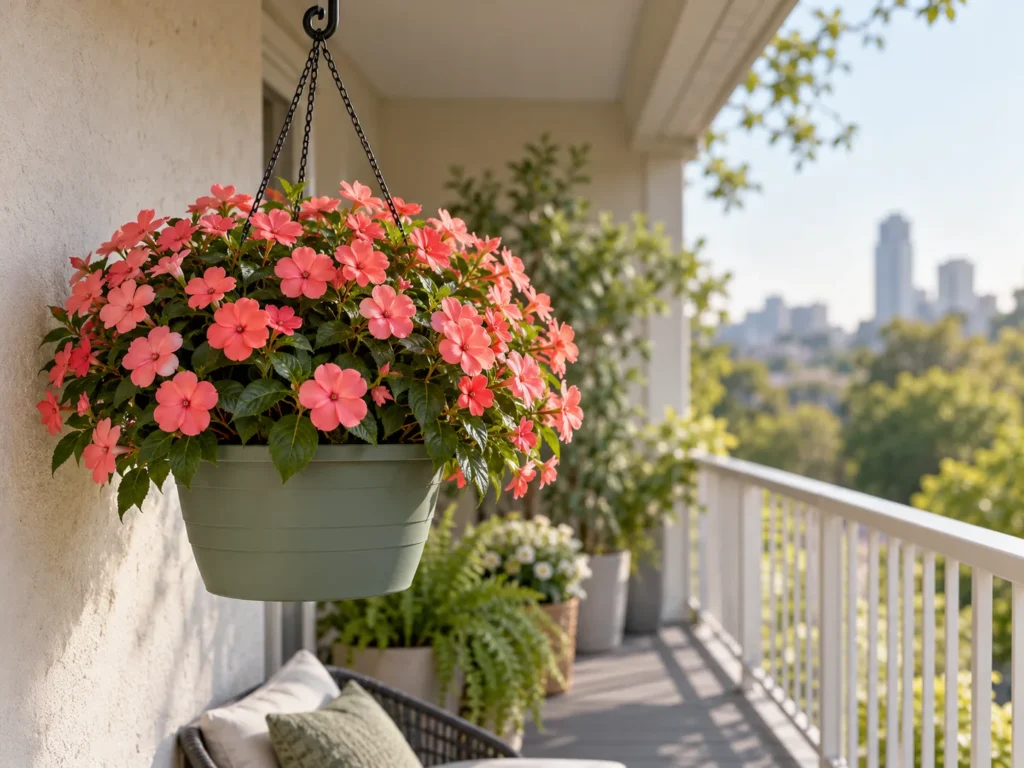
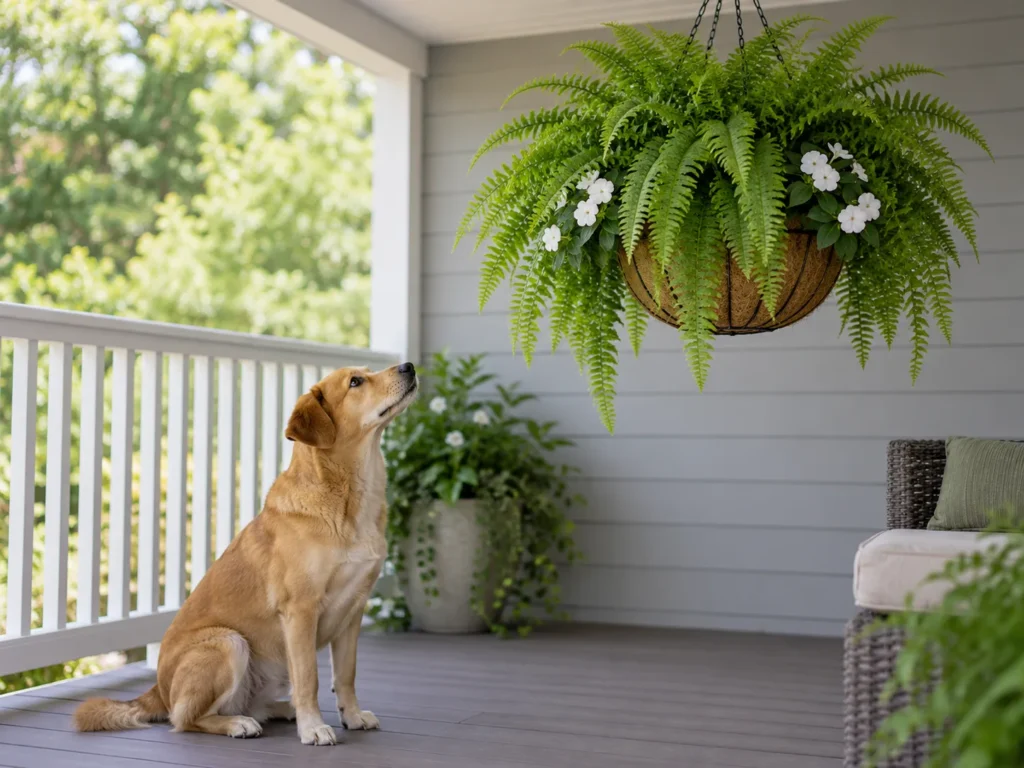
3. Boston Fern With White Impatiens (pet-safe texture)
One Boston fern (Nephrolepis exaltata) in the centre with two or three white impatiens tucked in at the rim. The fern gives you a full, arching silhouette from the day you hang it, which no flowering annual manages in deep shade, and the white flowers show up against the green from across the street.
The fern needs high humidity and mix that never dries out, so a roofed porch that traps a little moisture suits it far better than an open, breezy one. It grows 2 to 3 feet across and is hardy only in zones 10a and up; elsewhere, bring it indoors before frost and treat it as a houseplant. In warm climates it has invasive tendencies, so keep it in the basket.
Both plants are on the non-toxic list for cats and dogs, which matters more than it might seem. In my apartment, the cat and the dog treat anything trailing at nose height as something to investigate, and the same check that applies to safe houseplants for cats and dogs works on a porch: non-toxic list first, then hang it above reach anyway. Skip this one on a dry, windy porch.
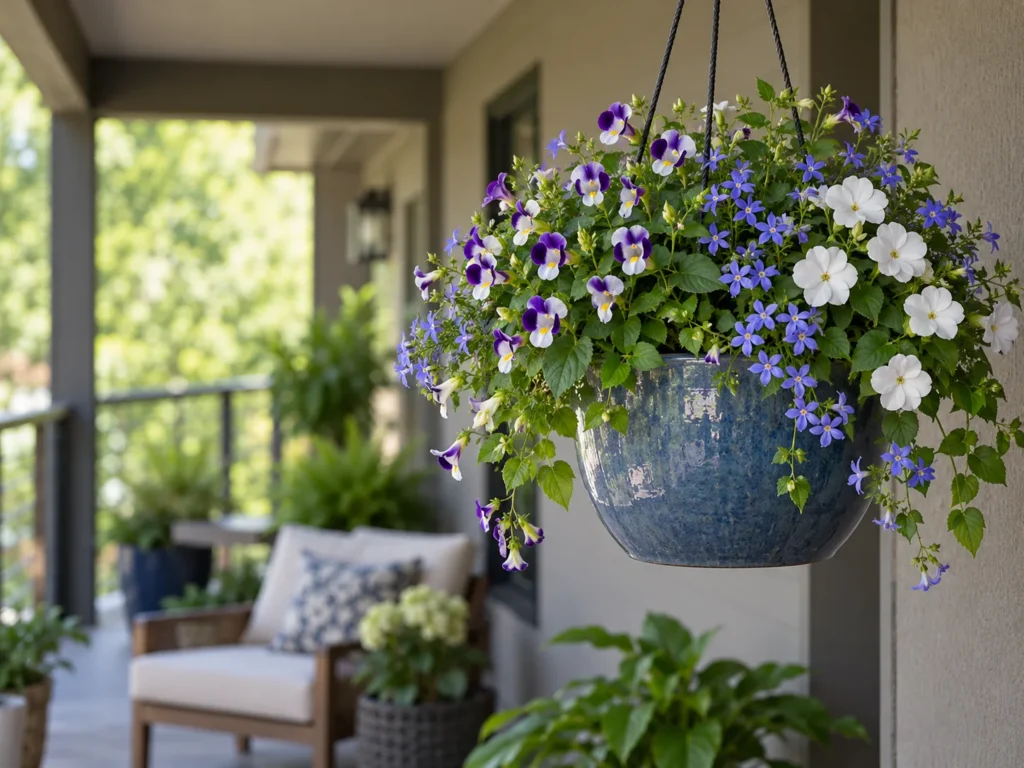
4. Torenia, Browallia and White Impatiens (blue-and-white trio)
Wishbone flower (Torenia fournieri) and bush violet (Browallia speciosa) in blues and violets, with white impatiens for contrast. You get three different flower shapes in one colour family, and all three bloom from early summer until frost.
Torenia grows 6 to 18 inches, takes dappled, partial or deep shade, and actually prefers the shadier end in hot-summer climates; give it rich, moist mix and pinch the tips for a bushier plant. Browallia can reach about 2 feet tall and wide (look for the trailing ‘Bells’ type for baskets), likes warm weather, and flowers best with some sun and afternoon shade, so on a fully roofed porch hang this basket at the brightest edge, nearest the open side.
Pet note: browallia is toxic to cats and dogs if eaten, and torenia has no entry on the pet list, so this is a basket for porches pets can’t reach. Skip it if yours can.
Part-Shade Combos for a Porch With Morning Sun
An east-facing porch that gets a few hours of gentle morning sun opens up begonias, coleus and the foliage trailers that would sulk under a roof. Count those hours honestly, though: the four recipes here lean on 2 to 6 hours of direct light, and if you want more single-plant options for this light level, the shade-loving plants for a north-facing balcony post is the companion list.
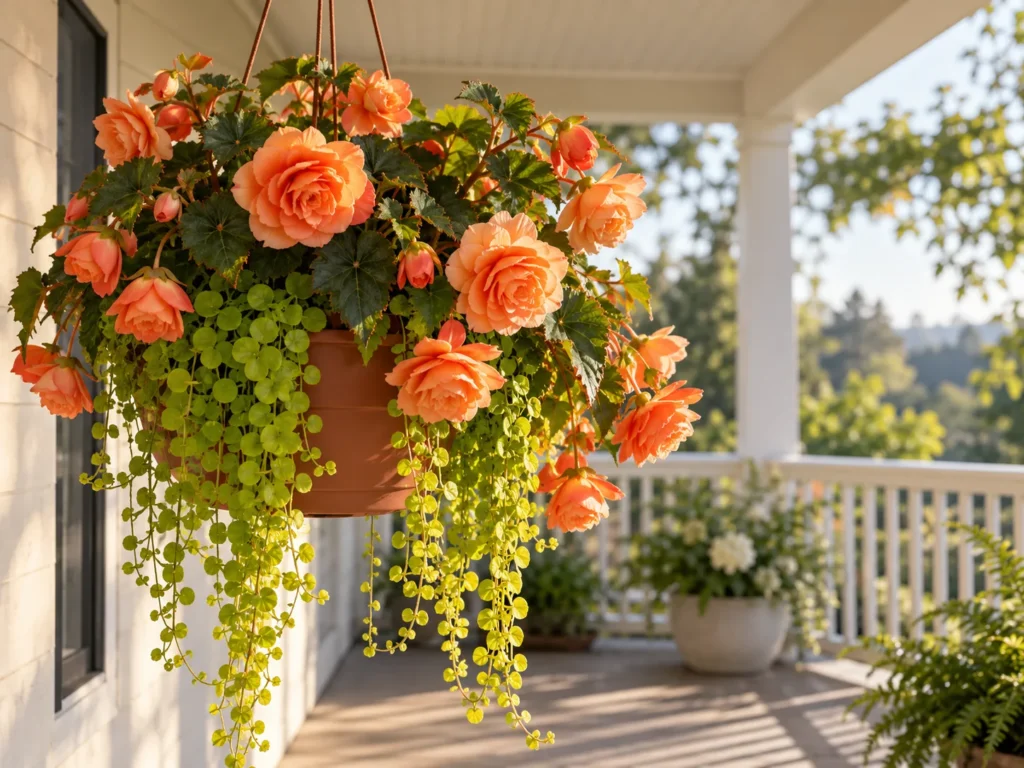
5. Tuberous Begonia With Golden Creeping Jenny
A cascading tuberous begonia (Begonia x tuberhybrida) with golden creeping jenny (Lysimachia nummularia ‘Aurea’) trailing underneath. The begonia’s big flowers run about four months from planting to the first frost, and the chartreuse leaves of the creeping jenny glow in low light where darker foliage disappears.
Tuberous begonias tolerate early morning and late afternoon sun but dislike heat and humidity, and they can struggle through a southern summer. Keep the mix moist without letting it stay wet, since the tubers rot when overwatered, and wear gloves if you’re sensitive, because the sap can irritate skin. Creeping jenny stays 2 to 4 inches tall, spreads 1 to 2 feet, and is hardy in zones 3a to 8b, so it will come back in cold climates; it’s also weedy and considered invasive in some areas, so keep it in the basket and don’t let trailing stems root into a bed below.
Pet note: begonia is toxic to cats and dogs, with the tuber the most toxic part, and creeping jenny has no entry on the pet list. Skip this one if your summers are hot and humid or pets share the porch.
6. New Guinea Impatiens With Sweet Potato Vine
Upright New Guinea impatiens (Impatiens hawkeri) in the centre with ornamental sweet potato vine (Ipomoea batatas, ‘Margarita’ for lime green or ‘Blackie’ for near-black) trailing. Both take more light and heat than the deep-shade picks, and the vine grows so fast that the rim is covered within weeks.
New Guinea impatiens grow 6 to 20 inches, do best in partial shade, and need more water the more sun they get; they’re also tolerant of downy mildew. Sweet potato vine is listed for sun to partial shade, tolerates dry mix, and is frost tender, so the whole basket is a one-season affair outside zones 9a to 11b.
Pet note: both plants are non-toxic to cats and dogs. Skip it in deep shade, where the vine’s colour fades and its growth slows.
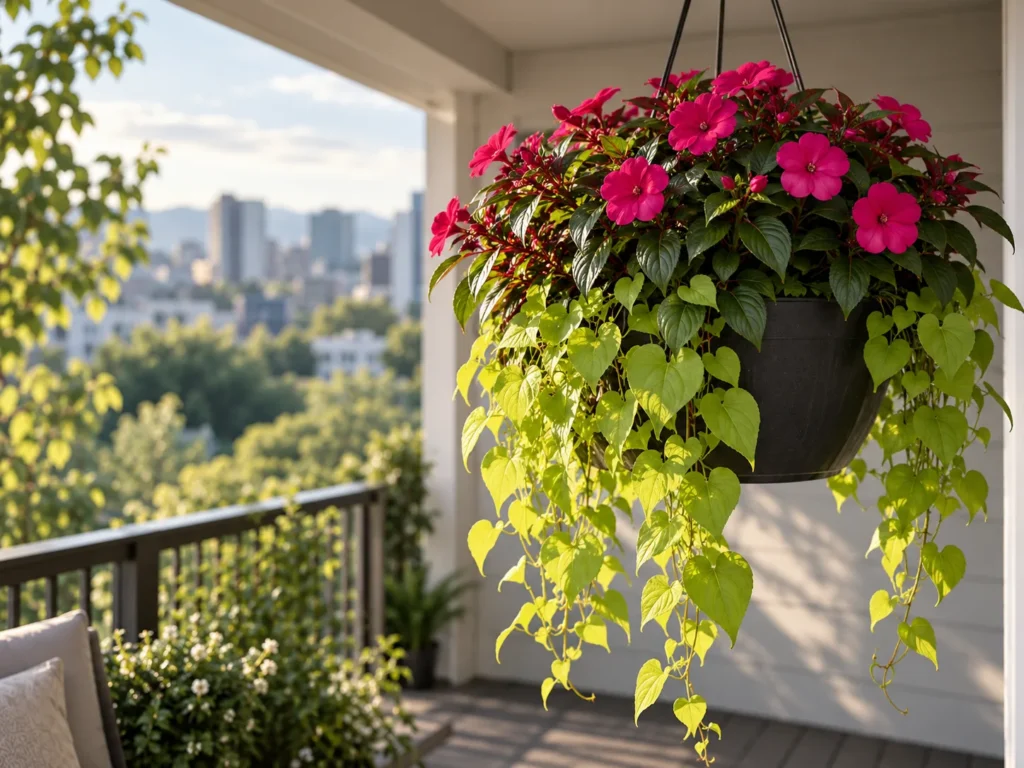
7. Shade Coleus With Torenia (foliage first)
A trailing coleus (Coleus scutellarioides, ‘Trailing Rose’ or ‘Trailing Red’) with torenia tucked around it. Because the colour comes from the leaves, there’s no bloom gap, and the torenia’s small flowers fill in whatever the coleus leaves bare.
Coleus grows best in part shade: it may wilt in full sun and gets leggy in full shade, which is why it sits in this group and not the first one. Pinch the stem tips regularly to keep it dense, and expect anything from 6 inches to 3 feet depending on the cultivar. Torenia care is the same as in Idea 4.
Pet note: the ASPCA lists coleus as toxic to cats and dogs and the ornamental type is flagged as mildly poisonous, so treat it as a hang-out-of-reach plant or choose Idea 2, 3, 6, 11 or 12 instead. Skip it if pets can reach the basket or the porch is in deep shade.
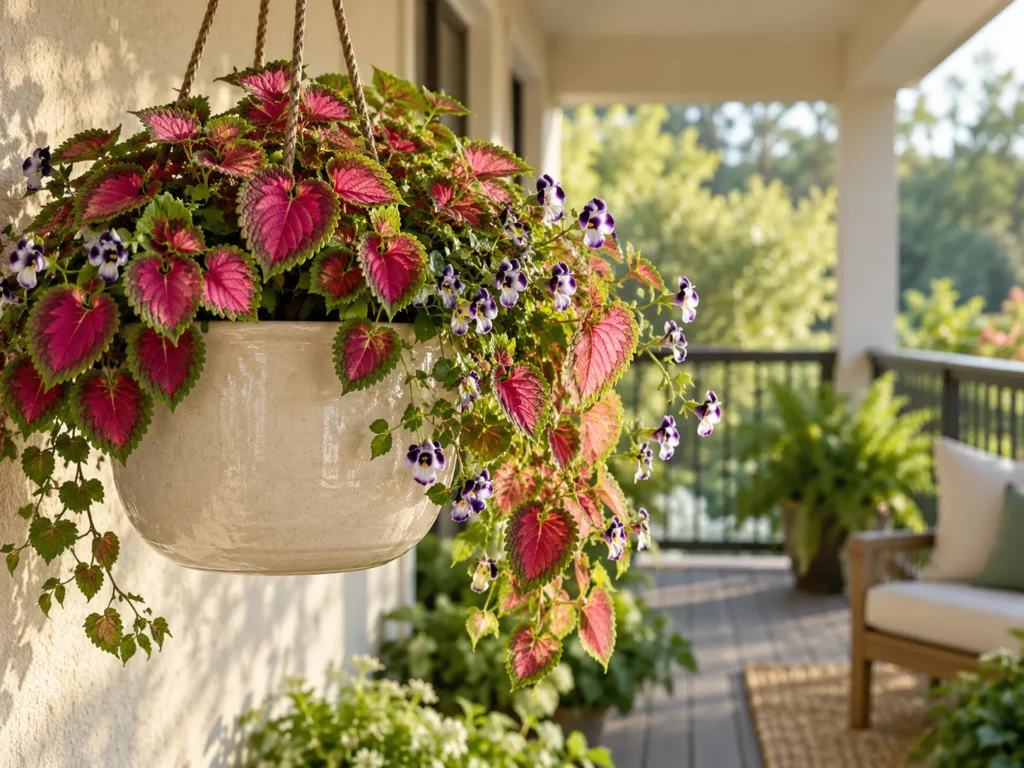
8. Coral Bells, Impatiens and Creeping Jenny (a basket you can plant out in fall)
A perennial coral bells (Heuchera) in the centre, annual impatiens around it and creeping jenny trailing. The coral bells’ leaves hold their colour all season with no flowers required, and after frost you can lift it and plant it in the ground or a larger pot instead of composting the whole basket.
Impatiens want the moist shade described in Idea 2, and the creeping jenny needs the same containment as in Idea 5. Pet note: coral bells (Heuchera sanguinea) and impatiens are both non-toxic to cats and dogs, and creeping jenny has no entry on the pet list. Skip it if you have nowhere to move the coral bells in fall; it still works as a one-season basket, it’s just a shame to waste a perennial.
Shade Combos That Take a Hot, Humid Summer
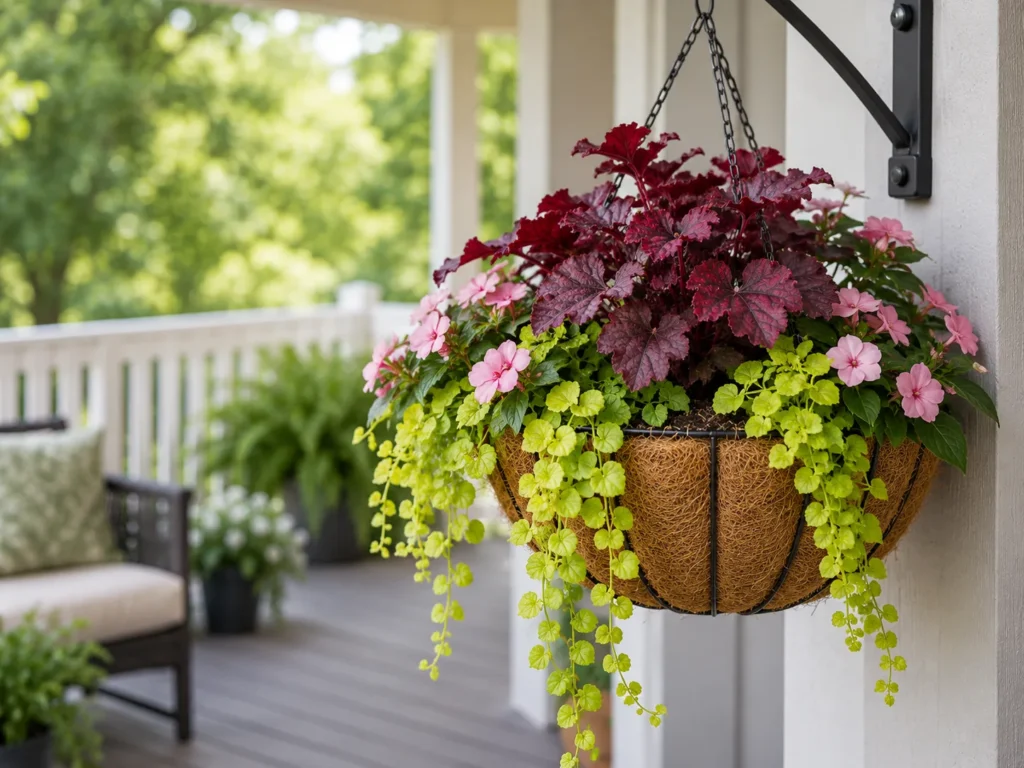
If your shaded porch is in the South or the lower Midwest, the cool-climate classics stall by June, and these two baskets are built from the plants that keep flowering through heat. They also suit anyone whose fuchsia quit last year and who’d rather not repeat it.
9. New Guinea Impatiens With Torenia (heat-tolerant colour)
A ‘Celebration Apricot’ type New Guinea impatiens, a cultivar noted for blooming even in high heat, with torenia at the rim, which prefers the shady end of its range in hot-summer climates anyway. Care for both is as described in Ideas 4 and 6: moist mix, more water on brighter porches, a pinch for the torenia.
Pet note: New Guinea impatiens are non-toxic to cats and dogs; torenia has no entry on the pet list, so hang it above reach. Skip it on a cool coastal porch where fuchsia would do better.
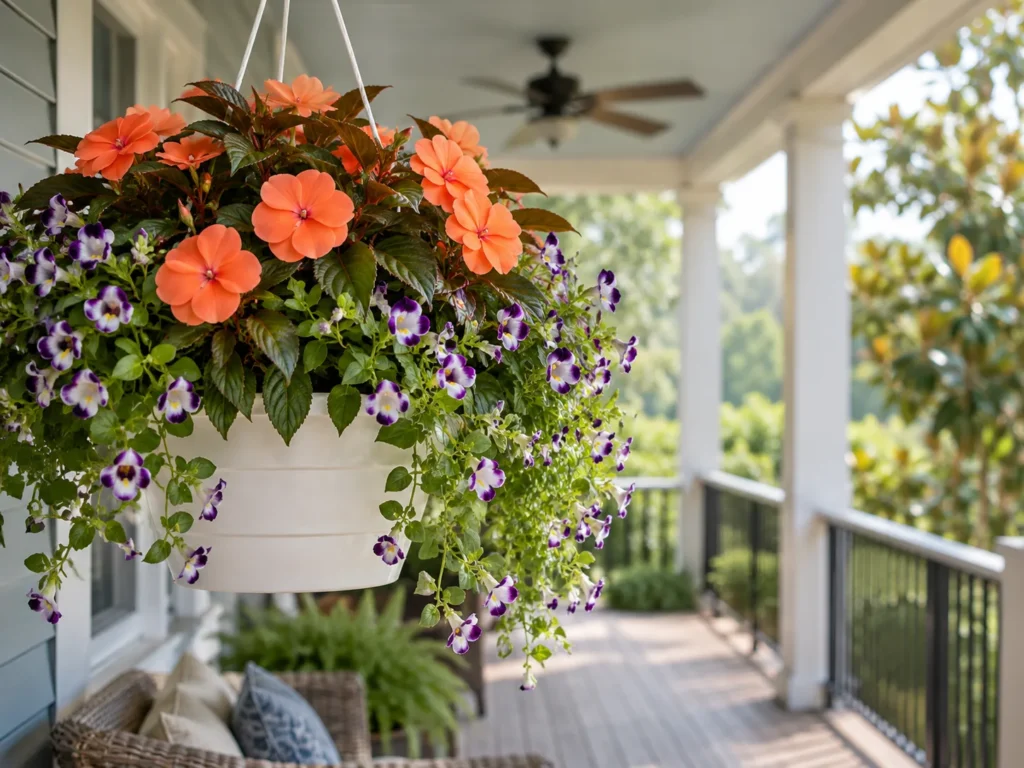
10. Browallia With Chartreuse Sweet Potato Vine
Blue browallia (‘Bells’ trailing type) with ‘Margarita’ sweet potato vine underneath. Browallia is heat resistant and prefers warm weather, the vine shrugs off dry mix, and the lime green under the blue flowers looks cool even when the porch isn’t.
Go easy on fertilizer and water here: overfeeding or overwatering browallia pushes leaves at the expense of flowers, so the slow-release feed at planting and a check of the mix before each watering are enough. Pet note: browallia is toxic to cats and dogs (see Idea 4), and sweet potato vine is non-toxic. Skip it if pets can reach the basket.
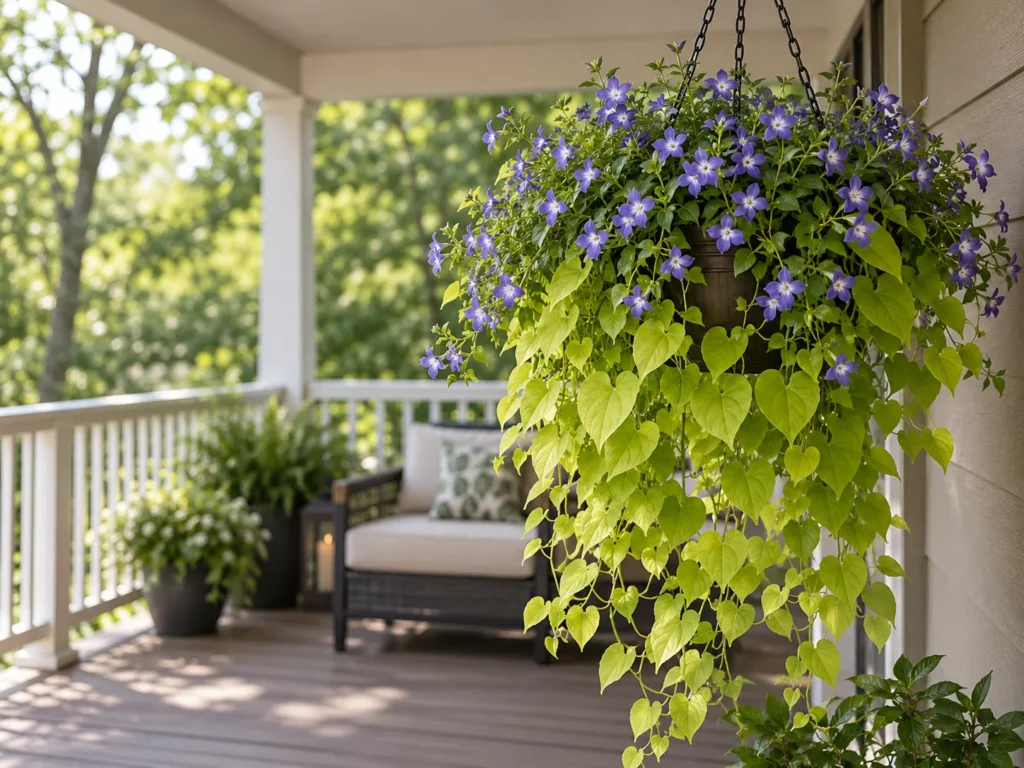
Single-Plant and Pet-Safe Baskets for Renters
Two of the best shady-porch baskets aren’t combinations at all, and both are on the non-toxic list for cats and dogs. One plant per basket also means one watering need, one feeding need and nothing to outgrow its neighbour, which suits a first summer on a rented porch.
A word on hanging them: if your porch ceiling has no hook and your lease forbids drilling, the hanging garden ideas for a tiny balcony post has setups that suit renters. Dim corners are also the spots I’ve learned to take seriously at home, because a plant that’s only coping in low light tells you slowly, through thinner growth, and by the time it’s obvious the season is half gone. Put the fern in the darkest spot and give the fuchsia whatever brighter shade you have.
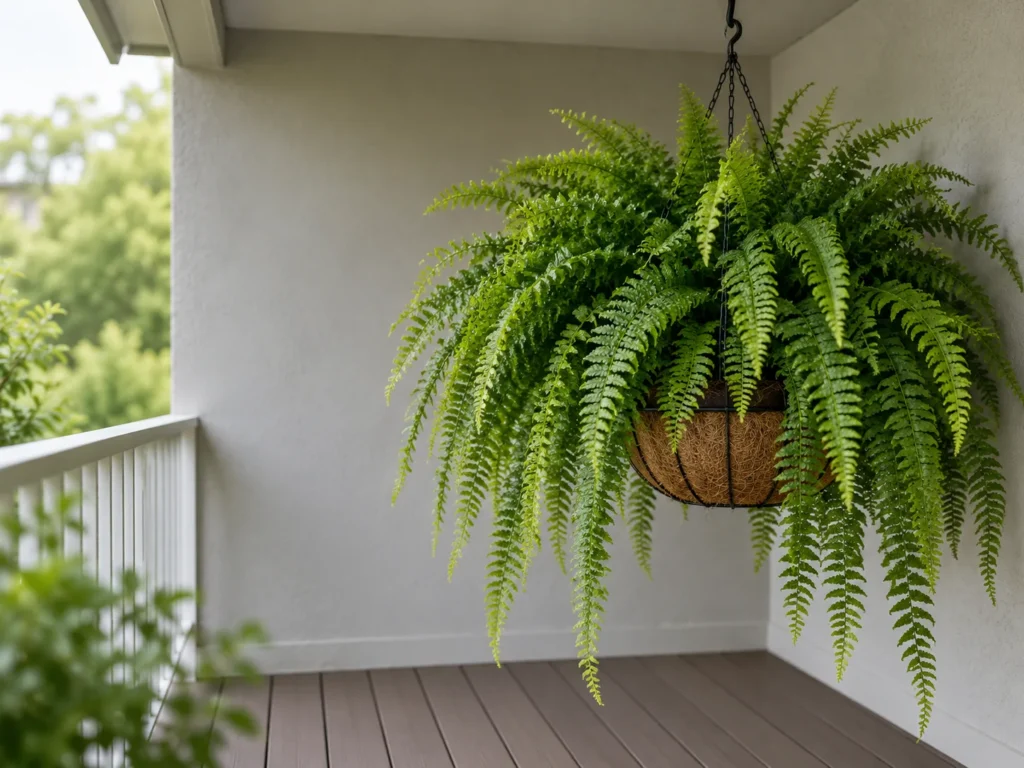
11. Boston Fern Solo (the dark-corner basket)
One Boston fern in a 12 to 14 inch basket for the corner nothing else will fill. It grows fast, takes deep shade and dappled light, and needs the same humidity and never-dry mix described in Idea 3. Bring it indoors before the first frost anywhere below zone 10a and it becomes a winter houseplant. Skip it on a dry, windy porch, where the fronds brown at the tips.
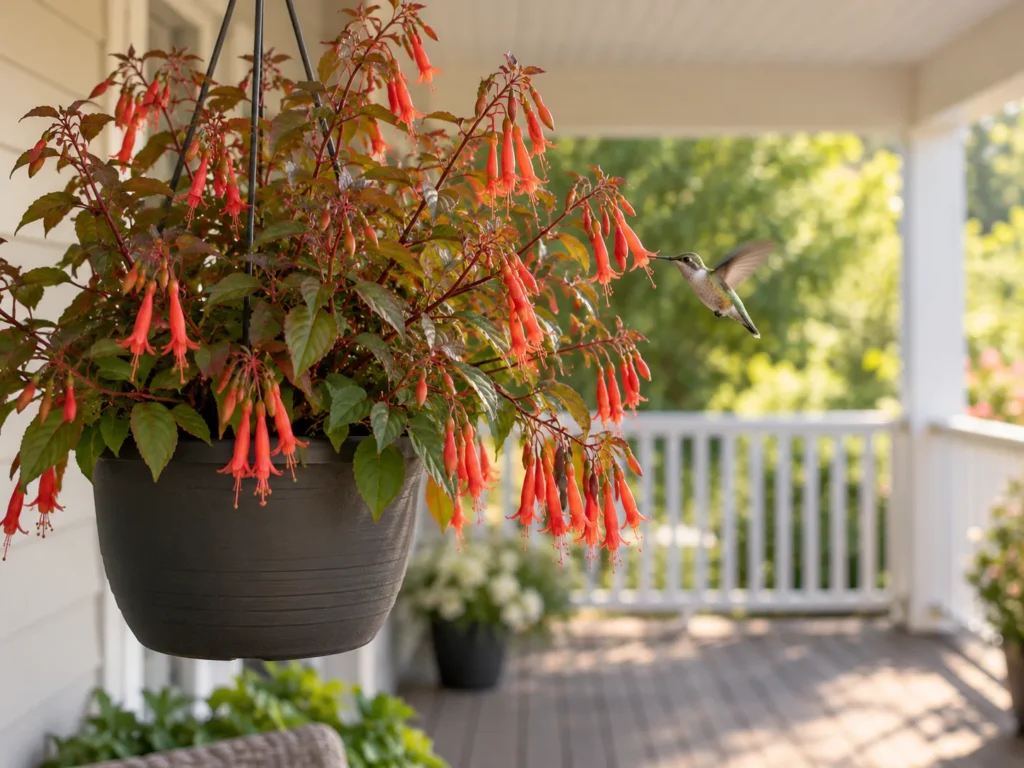
12. Heat-Tolerant Fuchsia Solo (‘Gartenmeister Bonstedt’)
One ‘Gartenmeister Bonstedt’ fuchsia, the cultivar singled out as heat tolerant, in its own basket. Its orange-red tubular flowers run from spring to fall, grow on a plant 1.5 to 3 feet tall, and draw hummingbirds, which is a decent show for a plant that never leaves the shade. Give it the moist mix, feeding and pinching from Idea 1, and shade to partial shade with no hot afternoon sun; it’s hardy only in zones 10 and up, so overwinter it indoors at 45 to 50°F with sparing water or treat it as an annual.
Pet note: fuchsia is non-toxic to cats and dogs. Skip it if the hook gets full afternoon sun.
How to Pick Hanging Basket Flower Combinations for a Shady Porch
Pick by light first, then by your summer temperatures, then by basket size, and only then by colour. Colour is the fun part, which is exactly why it tends to get chosen first at the nursery and why the basket thins out later.
Start with one honest day of counting. Sit on the porch, or glance out every hour, and note when direct sun actually touches the spot under the hook; under 2 hours puts you in the first group, 2 to 6 hours in the second. Then apply the heat rule: if your average summer day runs above the mid-70s°F, drop Ideas 1, 5 and 12 and go to Ideas 9 and 10, and if your summers stay cool, Ideas 1 and 5 will outperform anything in the hot-summer group.
Basket size decides the plant count, and the numbers are lower than most nursery displays suggest: 3 to 5 plants for a 12 to 14 inch basket, 5 to 7 for a 16 to 18 inch one. A basket that went thin by July usually had too many plants fighting for water and root space. Use a soilless potting mix, choose a deep 14-inch basket if you can find one, fill to about an inch below the rim, and prefer plastic or a coir-lined wire frame, since clay and terracotta get very heavy once planted and watered.
Renters have three more checks. Read the lease and building rules before adding any hook, hang only from an existing hook rated for the wet weight, and remember that a basket drains onto whatever sits below it, which on an upper floor may be a neighbour’s porch; a saucer-style basket or a DIY self-watering container solves both the drip and the drying-out problem. On an exposed, windy corner leave out the fuchsia (Ideas 1 and 12) and the Boston fern (Ideas 3 and 11). And if you have pets, two popular shade basket plants not used in any idea here, English ivy and caladium, are both toxic to cats and dogs; check the ASPCA list for any plant you add that isn’t covered above. For more single plants that suit this light, see low-light outdoor plants for a shaded balcony.
Once it’s hung, summer care fits on a short list:
- Every day: lift the basket or push a finger an inch into the mix, and water until it runs out the bottom. Baskets dry on every side, so in heat you may water twice; the smaller the basket and the windier the porch, the closer to twice a day you’ll land.
- If a basket dries to the point of pulling away from the sides, set it in a tub of water for an hour or two, no longer, then go back to daily checks.
- Feeding: slow-release fertilizer at planting, then a water-soluble feed every two weeks at half strength (or every one to three weeks at label rate), choosing a formula with a higher middle number rather than high nitrogen; reapply slow-release around mid-July.
- Weekly: deadhead fuchsia and torenia. Impatiens, begonia and lobelia drop their own flowers.
- Midsummer: cut leggy trailers back by one-third to one-half and feed; they refill within weeks.
- Before the first frost: bring fuchsia and Boston fern indoors, lift coral bells into the ground, and let the annuals go.
| Idea | Light | Climate fit | Basket and plants |
|---|---|---|---|
| 1. Fuchsia, lobelia, bacopa | Deep to partial shade | Cool summers | 14 to 16 in, 3 to 5 |
| 2. One-colour impatiens | Partial to full shade | Most climates | 12 to 14 in, 3 to 5 |
| 3. Boston fern, white impatiens | Deep to partial shade | Humid porches | 14 in, 3 to 4 |
| 4. Torenia, browallia, impatiens | Deep to partial shade | Warm summers | 14 in, 3 to 5 |
| 5. Tuberous begonia, creeping jenny | Partial shade | Cool summers | 14 in, 3 to 4 |
| 6. New Guinea impatiens, sweet potato vine | Partial shade | Warm summers | 14 in, 3 to 4 |
| 7. Trailing coleus, torenia | Partial shade | Most climates | 14 in, 3 to 5 |
| 8. Coral bells, impatiens, creeping jenny | Partial shade | Most climates | 16 in, 5 to 7 |
| 9. New Guinea impatiens, torenia | Partial shade | Hot, humid summers | 14 in, 3 to 5 |
| 10. Browallia, sweet potato vine | Partial shade | Hot, humid summers | 14 in, 3 to 4 |
| 11. Boston fern solo | Deep shade | Humid porches | 12 to 14 in, 1 |
| 12. ‘Gartenmeister Bonstedt’ fuchsia solo | Deep to partial shade | Warm summers | 12 to 14 in, 1 |
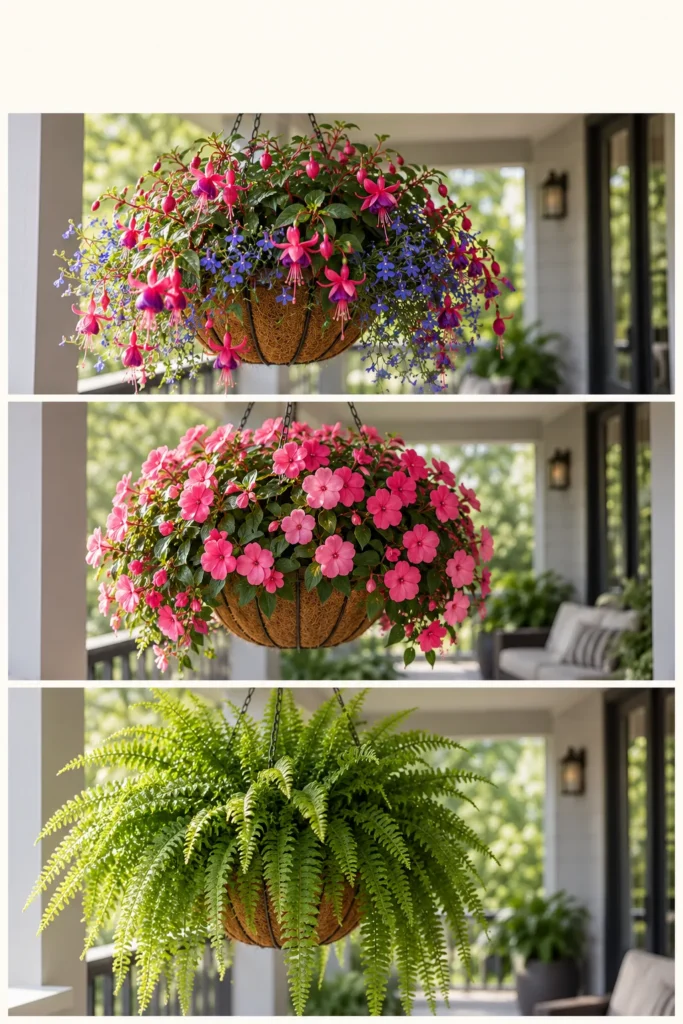
Frequently Asked Questions
How long do hanging basket flower combinations for a shady porch last?
Most of them flower from late spring planting until the first frost, as long as you check the water daily and cut the trailers back once in midsummer. Torenia and browallia bloom from early summer until frost, and tuberous begonias give about four months. Fuchsia and lobelia are the exceptions. They slow down when the heat arrives, so on a hot porch expect fewer flowers in the warmest weeks.
Can I use these baskets on a west-facing porch?
Only the tougher ones. Two to six hours of afternoon sun on a west porch runs hotter than the same hours of morning sun on an east porch. Browallia and the heat-tolerant fuchsia in Idea 12 both want shade in the afternoon, so leave them out. New Guinea impatiens with sweet potato vine (Idea 6) is the better fit, since both take more light. Plan to water more often, because New Guinea impatiens need more water the more sun they get.
Can I mix sun-loving and shade-loving plants in one basket?
It rarely works for long. Every plant in a basket gets the same light, so at least one of them ends up in the wrong conditions. Coleus, for example, may wilt in full sun and gets leggy in full shade. Choose plants that share a light level using the light table in At a Glance, and get your contrast from leaf color and flower shape instead, the way the combinations above do.
What should I do if my impatiens get downy mildew?
Take the plants out as soon as you spot it. Bag them before you carry them through the house, and don’t compost them. The signs are yellowing or mottled leaves, edges curling downward and a white to grayish fuzz on the undersides, followed by leaf drop. Sprays can’t cure an infected plant, and the disease can survive in plant debris. Start again with fresh potting mix and either a resistant series such as Beacon or Imara or New Guinea impatiens.
Will these combinations work on a shaded apartment balcony?
Yes. The light and heat rules are the same, so count the balcony’s direct sun hours just as you would on a porch. Height adds two things to think about: wind and whatever sits below you. On a windy upper floor, skip the fuchsia and the Boston fern. Before you hang anything, go through the renter checks in How to Pick.
What Actually Matters
A shady-porch basket succeeds on three choices made at the nursery rather than on anything you do later: plants that match your real light, plants that match your summer heat, and no more plants than the basket can hold. Get those three right and the watering and feeding routine above just keeps a good basket good.
When something still goes wrong, the symptom usually points back to one of those choices. Long bare stems often mean too little light or too many plants (see How to Pick), and healthy leaves with no flowers in a heat wave usually mean a cool-climate plant on a hot porch, which makes Ideas 9 and 10 the better bet next year. Yellowing impatiens with white fuzz under the leaves are covered in the FAQ.
This week, count your porch’s sun hours for one day, then buy three to five plants for a single basket. For most readers that’s one colour of resistant impatiens; for a cool-summer porch, make it the fuchsia trio. One basket done well beats three half-filled ones, and the street-side view will tell you so by August.
Sources
- Iowa State University Extension – Creating and Growing Hanging Baskets – plant counts by basket size, soilless mix, fill level, daily watering, soaking a dried basket, fertilizer ratio and frequency, midsummer cut-back.
- Clemson Cooperative Extension – Hanging Baskets and Window Boxes (HGIC 1154) – half-strength feeding every two weeks, keeping impatiens constantly moist and fuchsia evenly moist.
- Clemson Cooperative Extension – Fuchsia – 60 to 70°F preference, flowering cutoff above an average daily 76°F, feeding, pinching and overwintering at 45 to 50°F.
- NC State Extension Plant Toolbox – plant pages for Fuchsia x hybrida, Impatiens walleriana, Impatiens hawkeri, Nephrolepis exaltata, Torenia fournieri, Browallia speciosa, Lobelia erinus, tuberous Begonia, Coleus scutellarioides, Lysimachia nummularia, Ipomoea batatas and Chaenostoma cordatum – light categories, sizes, zones, heat and humidity notes, wind protection, invasive notes, cultivar names and the browallia and coleus poison notes.
- University of Maryland Extension – Downy Mildew – Impatiens – susceptibility of garden impatiens, resistant series, symptoms and disposal.
- ASPCA Animal Poison Control, Toxic and Non-Toxic Plants – entries for fuchsia, impatiens, Boston fern, coral bells, sweet potato vine (non-toxic) and begonia, coleus, lobelia, English ivy, caladium (toxic).
- UConn Home and Garden Education Center – High Five for Hanging Baskets – deep 14-inch basket, mid-July slow-release reapplication, plants that need no deadheading.
- Colorado State University Extension PlantTalk – Hanging Baskets – baskets drying on all sides, higher-middle-number fertilizer.
- Oregon State University Extension – Hanging Baskets (10-Minute University) and Add color and lift with hanging baskets – weight of clay containers, lift test, weekly deadheading.