
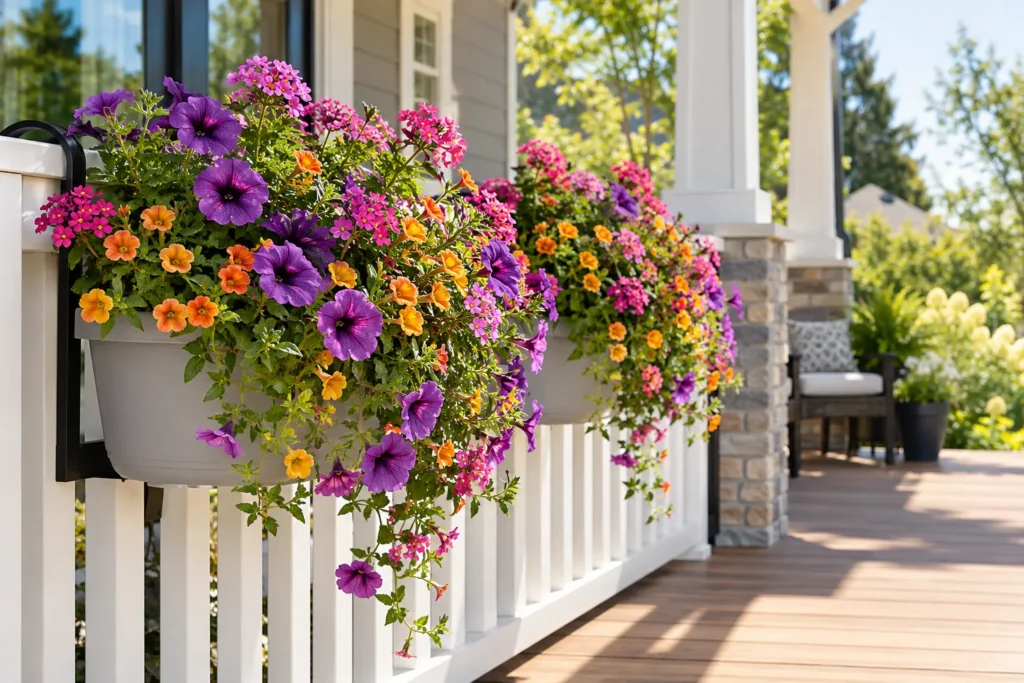
The basket by the front door looked full and bright when it came home from the nursery in May. Then the second heat wave rolled through, and now it’s a ring of crispy stems around three stubborn flowers in the middle, with a coir liner that drains faster than you can fill it.
That basket usually fails for one of three reasons: a shade lover was mixed in with sun lovers, the basket was too small or dried out too fast for an afternoon-sun porch, or nobody cut it back in July. The hanging basket flower combinations sunny porch owners keep going until frost are built around plants that want the same light and the same watering rhythm, in a basket big enough to hold a day’s water.
Below are 11 combinations for a porch that gets six or more hours of direct sun, each with a plant count, a pet-safety note and a plain “skip this if” line. If you’re planning the rest of the entry too, our front porch container ideas cover the pots on the floor; this guide is only about what hangs.
Table of Contents
At a Glance
- Full sun on a plant tag means six or more hours of direct sun. South and west porches usually qualify; an east porch with only morning light is borderline.
- A 12 to 14 inch basket holds 3 to 5 plants and a 16 to 18 inch basket holds 5 to 7. Cramming in more doesn’t make it fuller, it makes it thirstier.
- Plastic baskets hold water longer than coir-lined wire. On a hot west porch, that difference decides whether you water once or twice a day.
- Keep sun lovers with sun lovers. One shade plant in a sun basket is the most common reason half a basket dies.
- Pet household: petunia, sweet alyssum, sweet potato vine, thyme, rosemary and strawberry are on the ASPCA non-toxic list; lantana, ivy geranium and Portulaca are not.
If you want one answer: plant petunia, calibrachoa and verbena in a 14 inch plastic basket. If your porch bakes in afternoon sun above 90°F and you travel in summer, choose the moss rose and fan flower basket instead.
Classic Hanging Basket Flower Combinations Sunny Porch Owners Rely On
These three are the baskets nursery benches are built around, and they earn it: every plant in them wants six or more hours of sun and the same watering rhythm, so nothing in the basket is quietly suffering while its neighbor thrives.
1. Petunia + Calibrachoa + Verbena (the all-trailer trio)
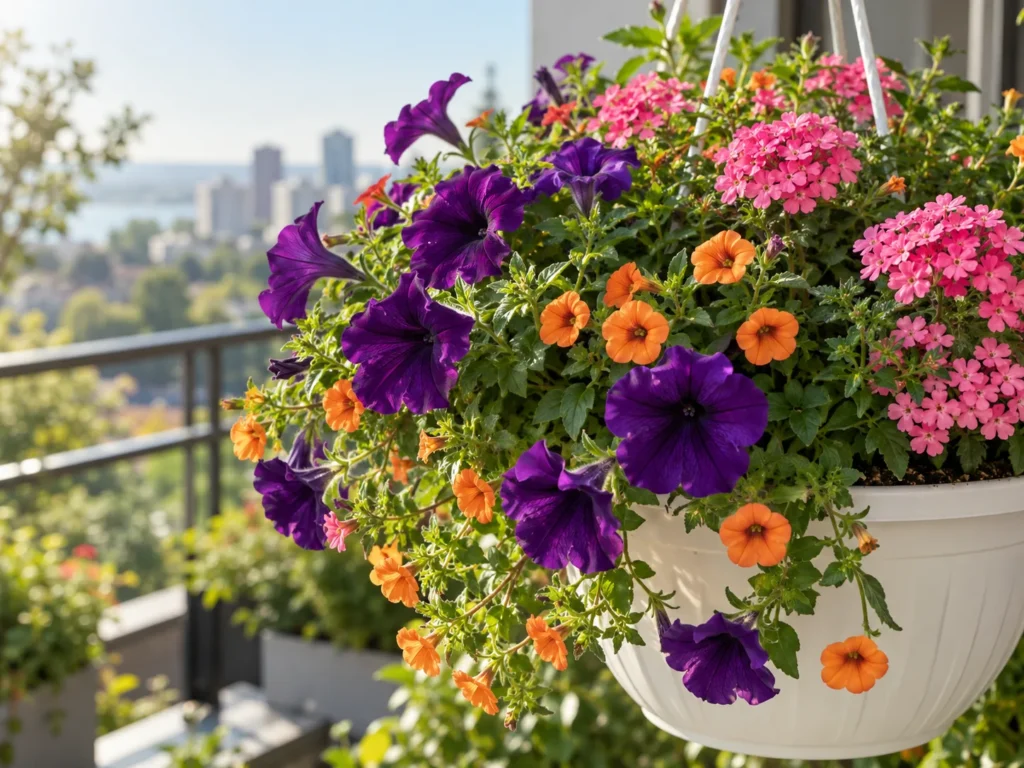
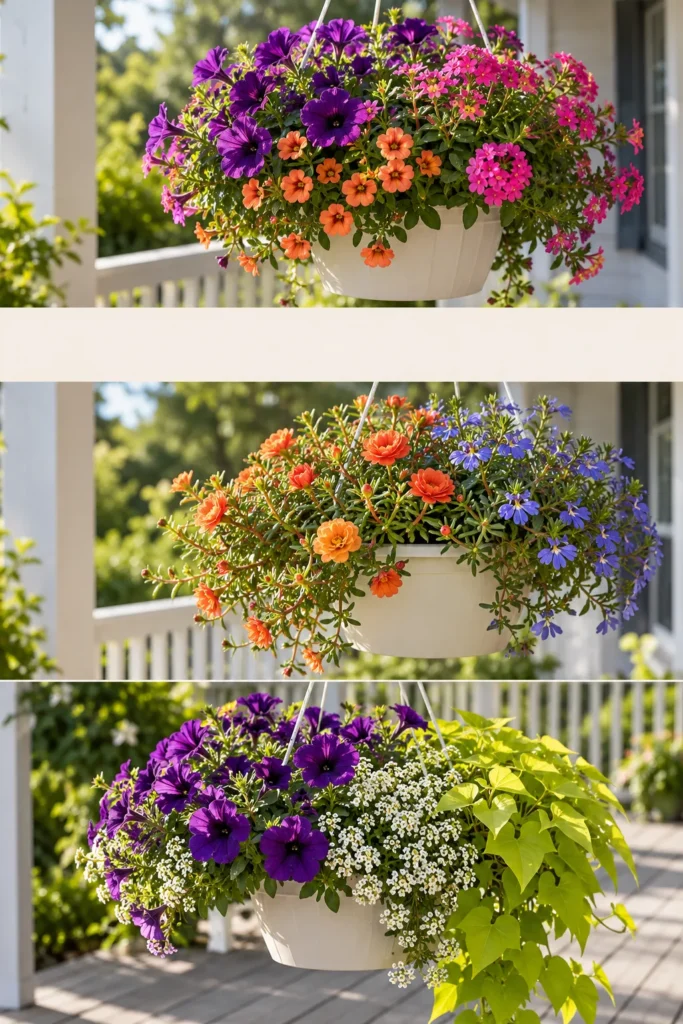
Three trailers, three flower sizes: large petunia (Petunia x hybrida) trumpets, thumbnail-sized calibrachoa (Calibrachoa hybrids) bells, and tight clusters of garden verbena (Verbena x hybrida). For a first sunny-porch basket we’d start here, because all three want full sun and the same daily drink, and calibrachoa drops its spent flowers on its own while you deadhead the other two.
Calibrachoa does best with eight or more hours of sun, so if your porch sits right at the six-hour edge, lead with petunia and verbena and use calibrachoa as the smaller player. In hot climates, look for heat-tolerant series such as Easy Wave or SuperCal (a petunia and calibrachoa cross) and verbena series such as Tuscany or Lascar.
Five plants fill a 14 inch plastic basket, and that basket on an over-railing bracket needs no drilling at all, which matters on a rented porch. Pet note: petunia is ASPCA non-toxic to cats and dogs; there is no ASPCA entry for calibrachoa or garden verbena, so hang this one where a chewer can’t reach it.
Skip this if you can’t water daily in July. All three plants wilt fast in a small basket, and verbena in particular sulks after repeated drying.
2. Ivy Geranium + Sweet Alyssum + Silver Falls Dichondra (silver and white)
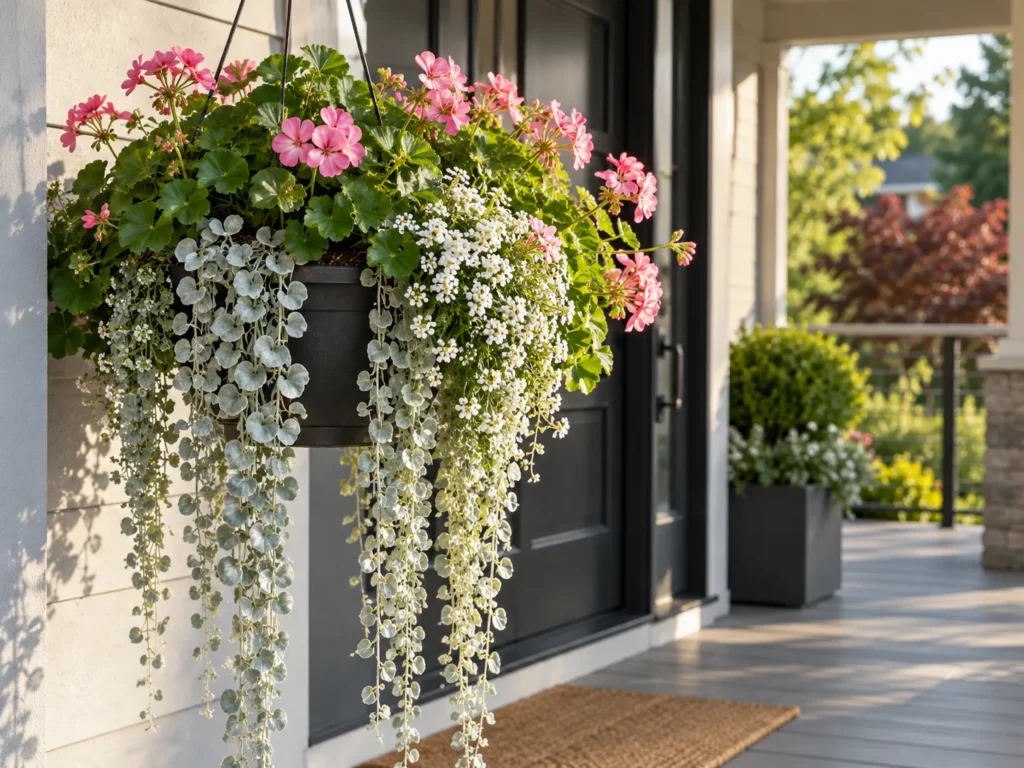
This is the basket for a porch that wants to look expensive. Ivy geranium (Pelargonium peltatum) gives it bulk and color, sweet alyssum (Lobularia maritima) adds a honey scent right at the door, and Dichondra argentea ‘Silver Falls’ pours over the rim and can cascade 3 to 6 feet in a single season.
Ivy geranium needs the full six hours or it turns leggy, though in the hottest climates it welcomes some afternoon shade. Deadhead and pinch it through summer. Alyssum may stop blooming in peak heat; a trim brings it back once nights cool, and heat-tolerant selections such as the Princess Group hold on longer.
Pet note: Pelargonium is toxic to cats and dogs, and dichondra can irritate sensitive skin, so plant it with gloves on. Skip this if cats or dogs use the porch; build idea 7 instead.
3. One Plant, One Basket (the single-variety statement)
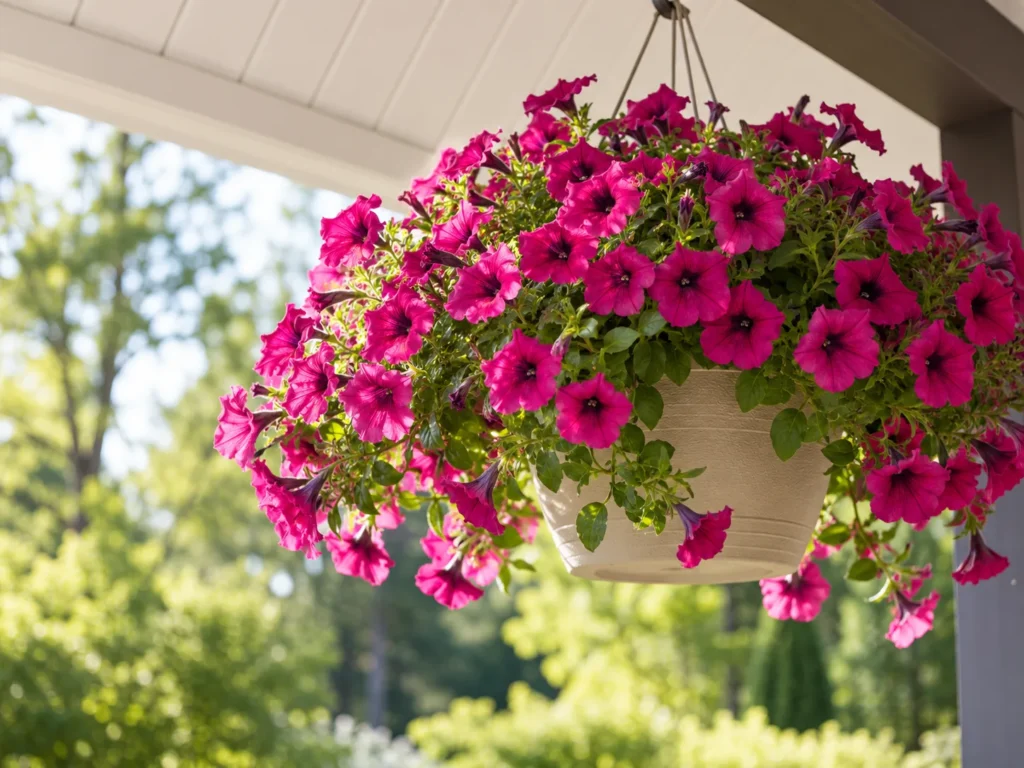
Three plants of the same trailing petunia or calibrachoa cultivar in a 12 inch basket. No plant competes with another, every stem wants the same water and feed, and it’s the lowest-cost basket on this list because you buy one six-pack and nothing else.
It also reads cleanly from a distance, so it suits a high hook. A spreading petunia reaches 1 to 3 feet wide, so three plants fill a 12 inch basket without crowding. Petunia is ASPCA non-toxic, which makes this the simplest pet-household choice if you don’t need contrast.
Skip this if you want texture or a second color; the mixed baskets above do that job.
Heat and Drought Baskets for Hot Afternoon Sun
A west-facing porch in July is a different place from a south porch in May, and these three combinations use the plants that keep blooming there. They pair well with the full-sun plants that survive heat you might already have in floor pots.
4. Moss Rose + Fan Flower + Silver Falls Dichondra (the forgetful-waterer basket)
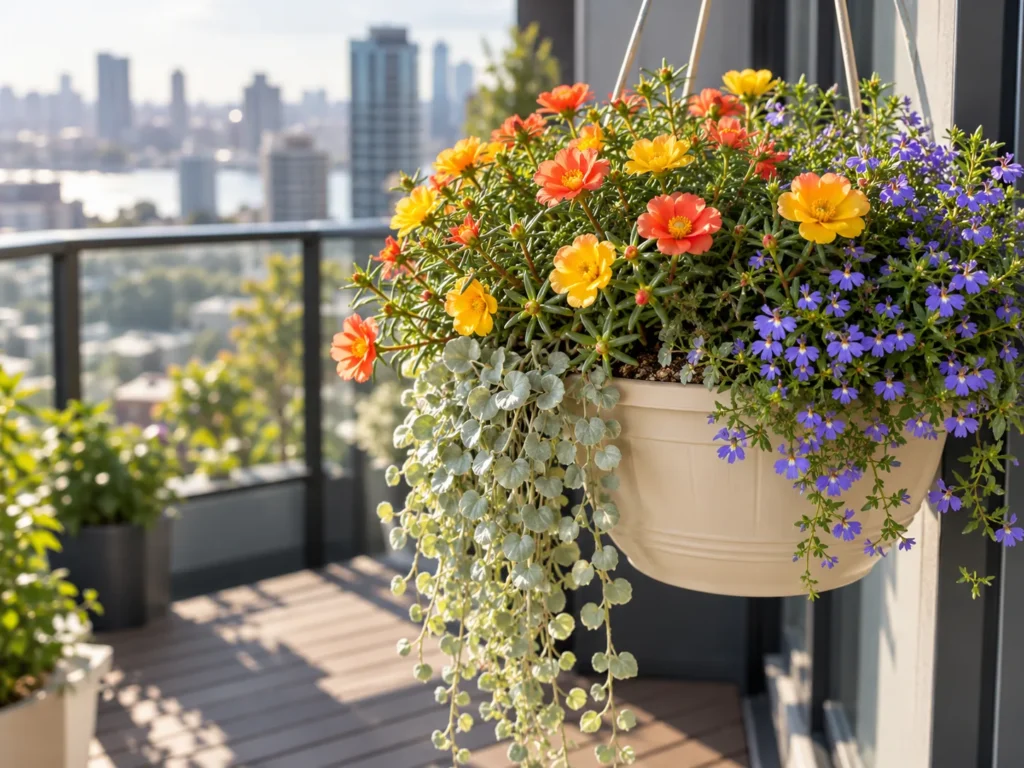
Moss rose (Portulaca grandiflora), fan flower (Scaevola aemula) and Silver Falls dichondra are all rated highly for heat and drought, which makes this the basket for a porch that bakes after 2 p.m. and an owner who sometimes forgets the watering can. Moss rose stays 3 to 8 inches tall and spills over the rim; fan flower spreads 2 to 3 feet and blooms from summer to first frost.
Two honest caveats. Moss rose flowers close at night and on cloudy days, so this is a daytime basket, and it rots fast in soggy mix, so use a basket with good drainage and skip the saucer. Use a light-colored plastic basket here for the reasons in How to Pick.
Pet note: the ASPCA lists Portulaca as toxic to cats and dogs, and there is no entry for scaevola, so pet households should pass on this one. Skip it as well if your porch is mostly shaded by early afternoon; these plants want the heat.
5. Lantana + Verbena + Calibrachoa (the pollinator basket)
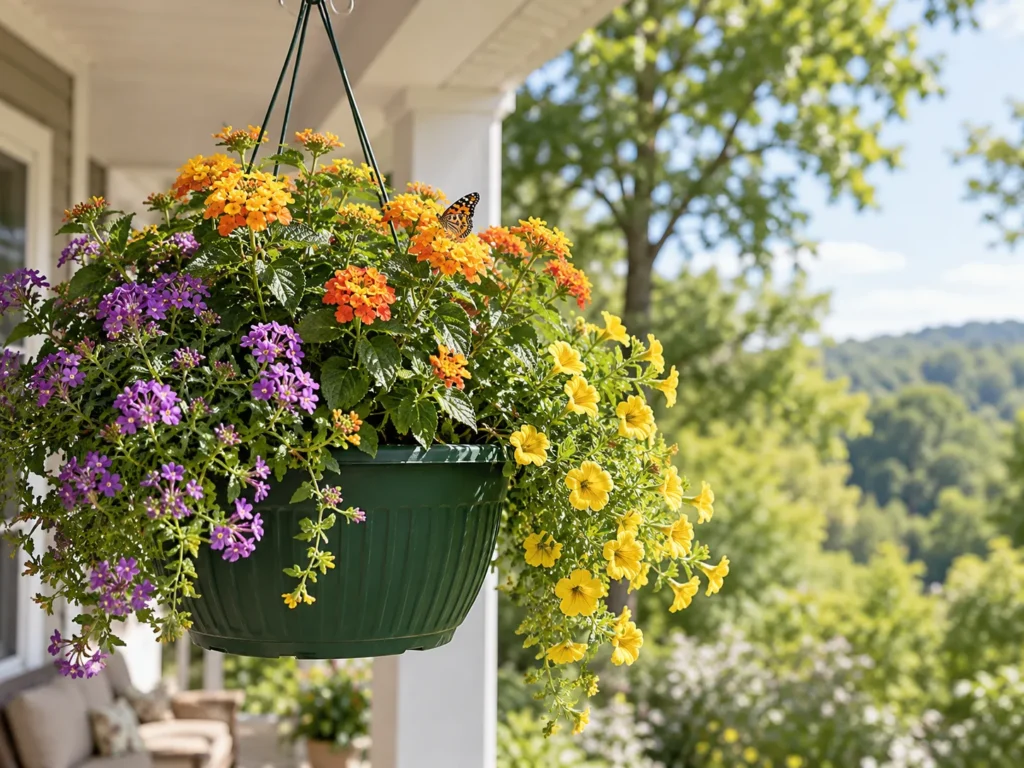
Lantana (Lantana camara) and verbena pull in butterflies and hummingbirds all summer, and both shrug off heat and dry spells once established. Calibrachoa fills the gaps with color at the rim. Use one lantana per basket and nothing more: it grows quickly and can sprawl 3 to 5 feet wide, so in a 16 inch basket it will cover anything planted too close.
Lantana can also seed itself around in warm regions, where it’s considered weedy, so keep it in the basket and deadhead before berries form. Those berries are part of the problem for pets.
Pet note: lantana is toxic to cats and dogs, with flowers, fruit, leaves and sap all involved, and the sap can irritate skin. Skip this if pets or small children can reach the basket or the ground beneath it.
6. Angelonia + Trailing Verbena + Sweet Potato Vine (the eye-level basket)
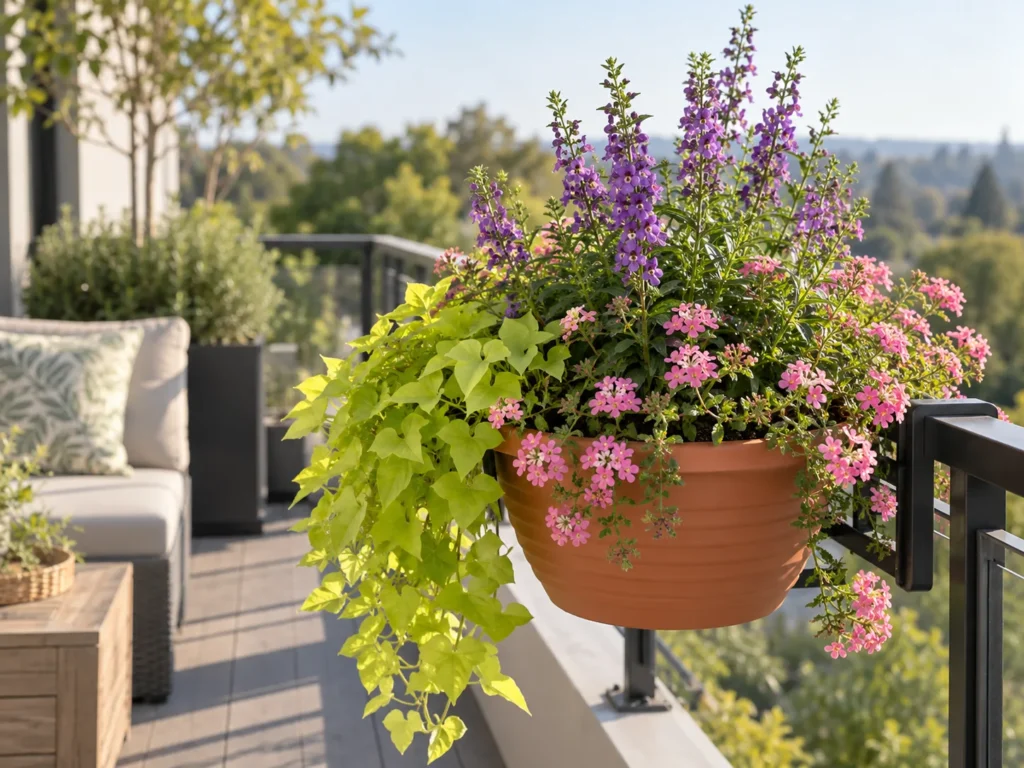
Summer snapdragon (Angelonia angustifolia) is the upright center that gives a basket height, and like calibrachoa it needs no deadheading. It grows 12 to 18 inches tall and takes heat and dry spells well. Trailing verbena and ornamental sweet potato vine (Ipomoea batatas) cover the sides.
The catch is placement. An upright center only works when the basket hangs at or below eye level, because a high basket shows you only its underside; How to Pick explains the rule. Sweet potato vine grows fast, so trim it whenever it starts to swallow the verbena.
Pet note: sweet potato vine is ASPCA non-toxic; angelonia and garden verbena have no ASPCA entry. Skip this if the basket will hang above eye level, and use all trailers instead.
Pet-Safe and Edible Baskets for a Sunny Porch
If a cat naps on the porch rail or a dog greets everyone at the door, these three baskets use only plants the ASPCA lists as non-toxic to cats and dogs. If a pet uses the porch, we’d build the whole basket from that list rather than hanging a lantana basket “out of reach”; a dropped flower is in reach. Non-toxic still doesn’t mean chew-proof, so discourage nibbling, and our pet-safe plant guide covers the indoor side of the same problem.
Two popular basket plants are left out on purpose: tomato foliage is ASPCA-toxic even though ripe fruit is not, and coleus is toxic to cats and dogs.
7. Petunia + Sweet Alyssum + Sweet Potato Vine (the all-non-toxic color basket)
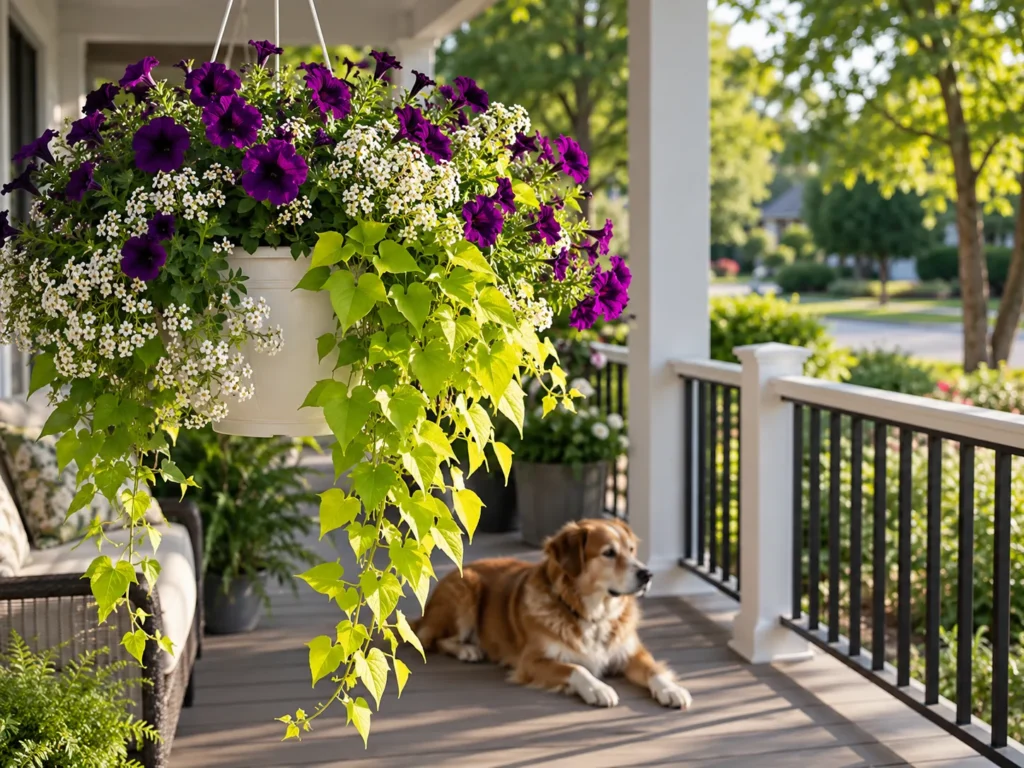
All three plants here are on the ASPCA non-toxic list, and together they look like any nursery mixed basket. Petunia brings the color, alyssum the scent and the fine white edge, and a lime or black sweet potato vine shades the mix and hides the basket itself by midsummer.
Care is the same daily-water, full-sun routine as idea 1. Trim the sweet potato vine back whenever it covers the petunias, and give the alyssum a haircut if it stalls in heat; both recover within a couple of weeks of cooler nights. Five plants fill a 14 inch basket.
Skip this if your porch gets scorching afternoon sun and you can’t water daily; the heat group handles that better, just not with a pet-safe list.
8. Thyme + Trailing Rosemary (the dry-side herb basket)
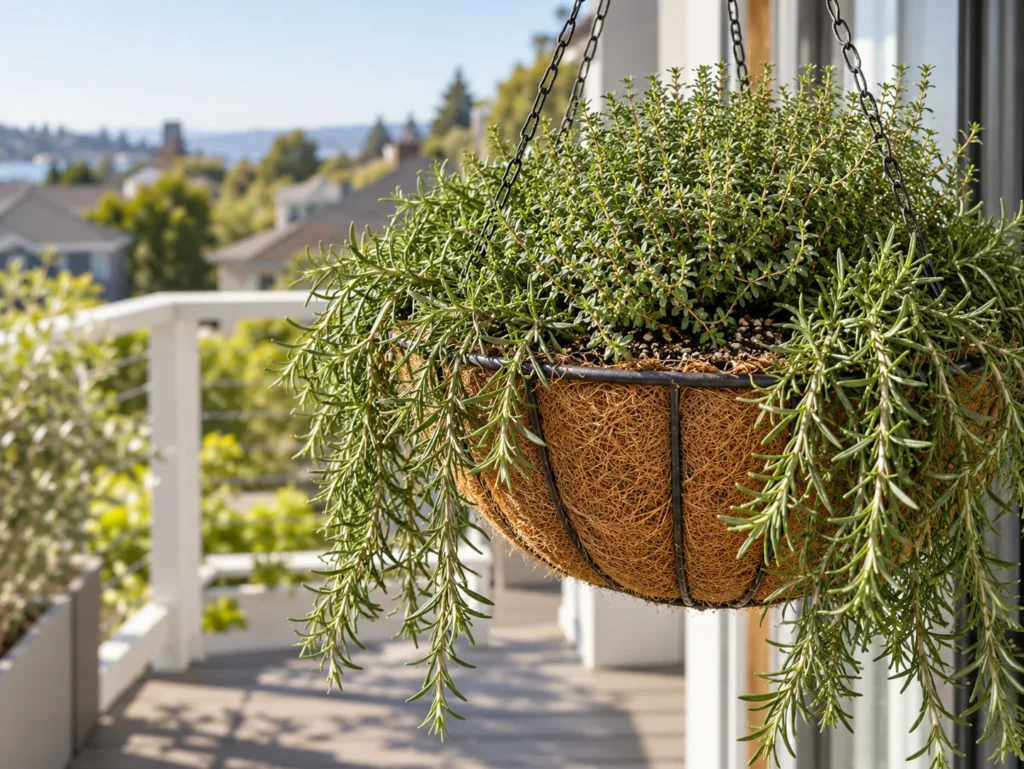
Common thyme (Thymus vulgaris) and rosemary (Salvia rosmarinus) both want full sun, free-draining mix and soil that dries between waterings, which is why they belong together and away from the petunias. Choose a trailing rosemary such as ‘Prostratus’ or ‘Irene’ so it drapes over the rim instead of standing up like a shrub.
Do not water this basket on the petunia schedule. Overwatering is the usual reason rosemary declines, so let the mix dry an inch down, then soak. A coir liner is fine here because fast drying is the point. Trim thyme when it gets leggy, and cook with the trimmings.
Both herbs are ASPCA non-toxic. If you want basil (Ocimum basilicum) too, give it its own basket: it needs six or more hours of sun as well but wants moist soil and regular pinching, so it fights with the dry-side herbs.
9. Strawberry + Sweet Alyssum (edible and pet-safe)
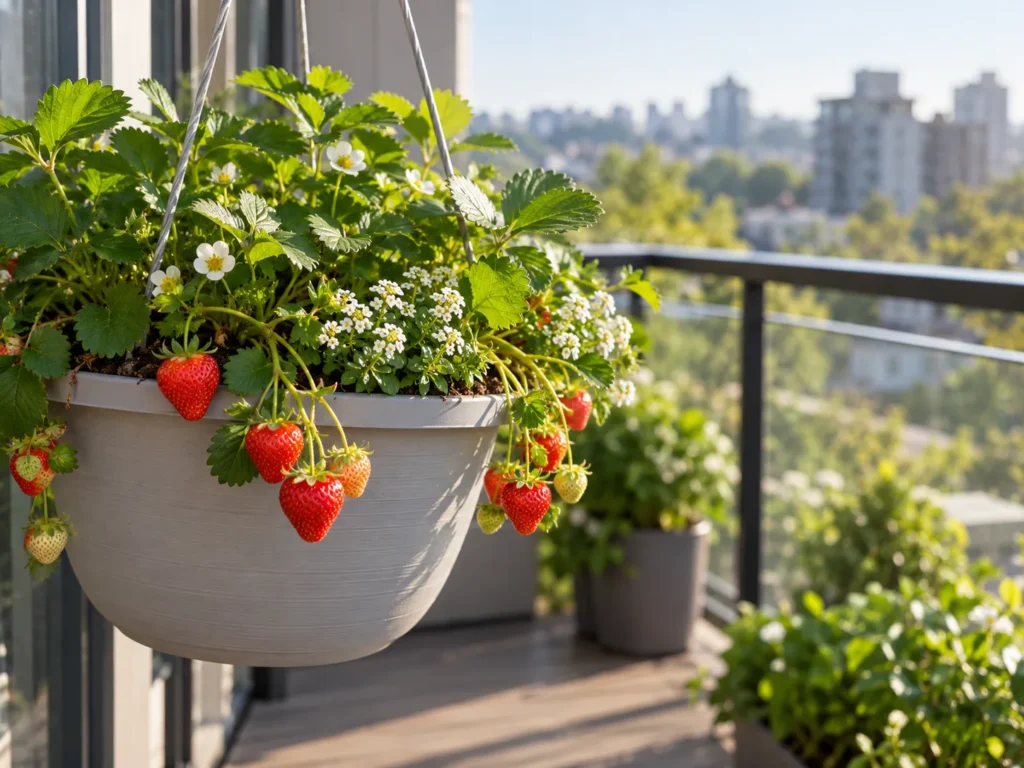
Day-neutral or everbearing strawberries (Fragaria x ananassa) do well in a sunny hanging basket, and fruit hanging over the rim stays cleaner and drier than fruit on the ground. Sweet alyssum tucked between the plants adds scent and draws pollinators. Strawberry is ASPCA non-toxic, and so is alyssum, so the dog can hover under it all it likes.
Keep this basket evenly moist in sun, and feed it like the flower baskets. Our guide to growing strawberries in pots covers variety choice and how to keep the plants producing.
Skip this if squirrels or birds already own your porch; they’ll find the fruit before you do, and netting a hanging basket is a daily annoyance.
Style Baskets: Evening White and Foliage-First
Two baskets for readers who care more about how the porch looks at 8 p.m. than how many colors it holds.
10. White Petunia + Bacopa + Sweet Alyssum (the evening basket)
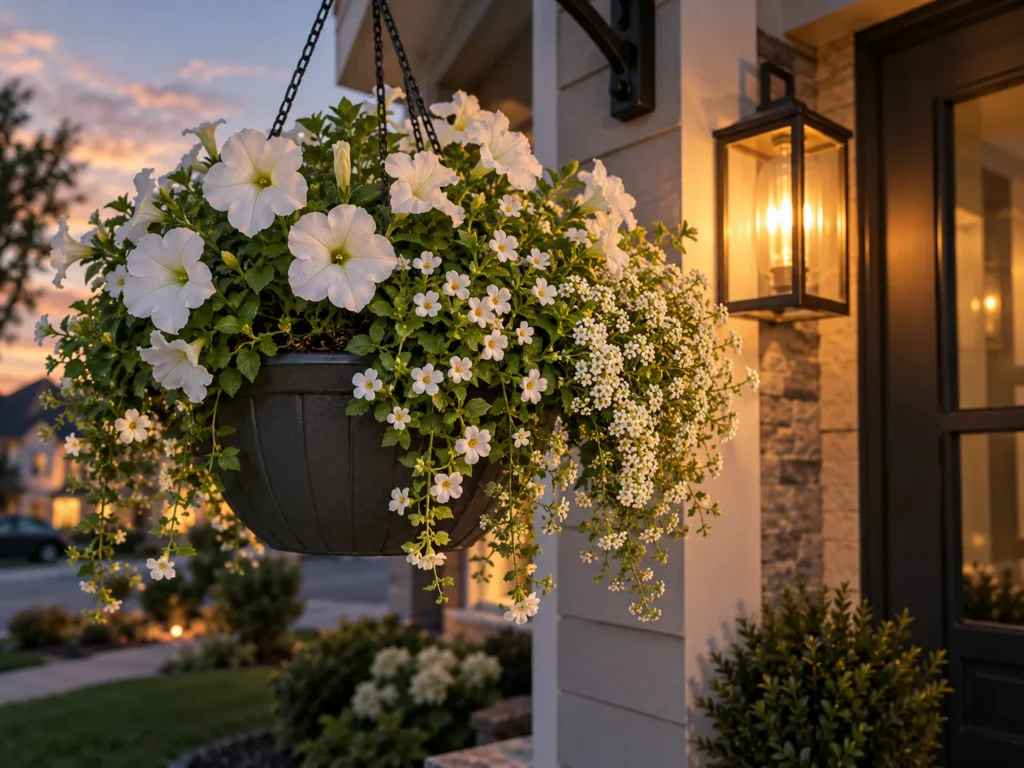
White flowers are the ones you can still see from the sidewalk after sunset, and this basket is built entirely from them. White petunia carries the bulk, bacopa (Chaenostoma cordatum, sold for years as Sutera) adds a sheet of tiny blooms, and sweet alyssum fills the rim.
Bacopa is the odd one out on a sunny porch: it does best with two to six hours of direct sun and moderate temperatures, and it wants regular water in hot weather. So hang this basket at the morning-sun end of the porch, or use it in a cooler climate. If your porch faces west, swap the bacopa for extra alyssum or dichondra and keep the white theme.
Pet note: petunia and alyssum are ASPCA non-toxic; there is no ASPCA entry for bacopa. Skip this on a hot west exposure.
11. Sweet Potato Vine + Silver Falls Dichondra + One Calibrachoa (foliage-first)
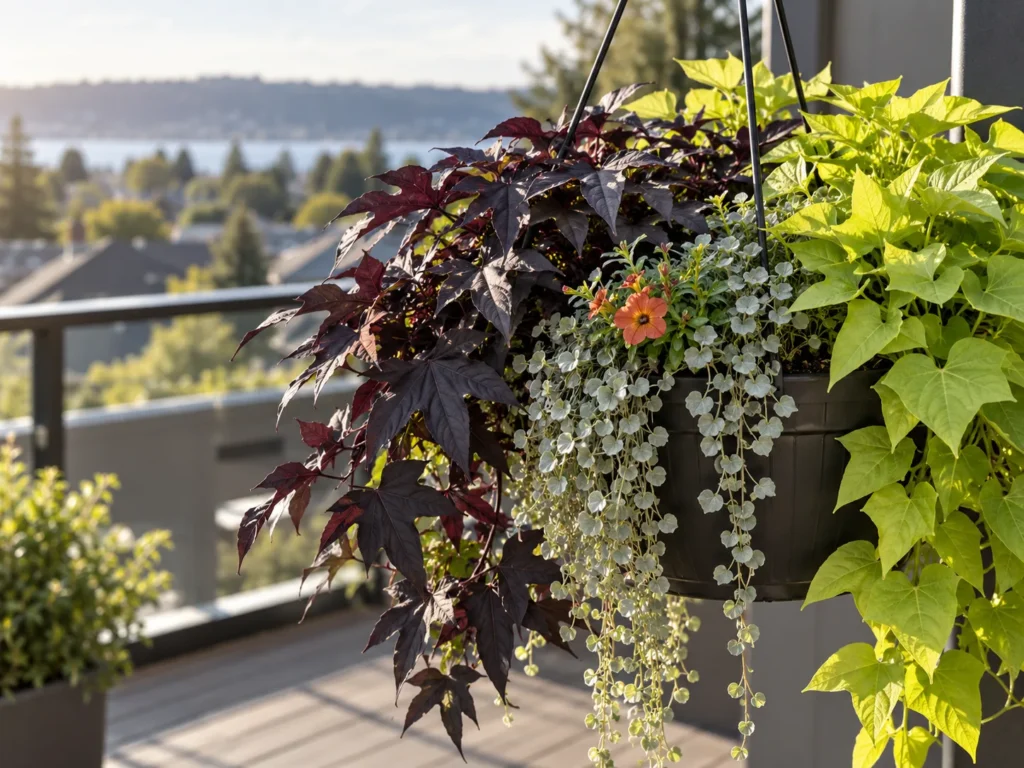
When flowers pause in a heat wave, foliage doesn’t. A black ‘Blackie’ or lime ‘Margarita’ sweet potato vine and a Silver Falls dichondra are both fast, drought-tolerant trailers that look finished within weeks, and one calibrachoa gives a single point of color rather than a riot.
Trim the vine when it reaches the floor or crowds the dichondra, and that’s most of the care. Pet note: sweet potato vine is ASPCA non-toxic and calibrachoa has no entry; wear gloves when planting the dichondra.
How to Pick the Right Setup for Your Space
Your porch’s afternoon picks the basket: sun hours, heat, wind, pets and who waters decide more than color does.
Start with the light. Full sun on a plant tag means six or more hours of direct sun, counted on your porch in midsummer, and partial sun is two to six hours. South and west porches usually clear six; an east porch may only reach it near the summer solstice. Count on a clear day, and remember that a porch roof or a neighboring building can cut an hour or two off the tag’s promise.
Then match the basket to the plant count. The plant counts per basket size below are worth respecting, because an overplanted basket runs out of water fast.
| Basket diameter | Plants per basket | Notes |
|---|---|---|
| 12 to 14 inches | 3 to 5 | Right size for a railing bracket; water daily in sun |
| 16 to 18 inches | 5 to 7 | Holds more water; heavy when wet, so needs a solid hook |
Material matters as much as size. We’d skip coir-lined wire on a west porch: plastic baskets dry out more slowly than coir or moss liners, and that is the difference between watering once and twice a day. If you love the coir look, slip a plastic liner with a few holes punched in it inside the coir. Fill with a soilless potting mix, never garden soil, to about an inch below the rim.
Color matters too. In direct sun, the mix inside a dark container can run 20 to 30°F hotter than the air, and roots can be badly injured when the mix stays above 100°F for about five hours. On a south or west porch, choose a light-colored plastic basket and let trailing plants shade its sides.
Next, the height rule. A basket at or below eye level can take a taller center plant with trailers at the edge, because you see the whole thing. A basket hung high shows only its underside, so drop the upright center and use trailers only. This is why idea 6 is pinned to eye level and idea 3 goes on the beam.
Renters have a few extra checks. Over-the-railing brackets and existing ceiling hooks avoid drilling; if you do install a hook, it belongs in a joist, not in soffit board, because a watered 14 inch basket is heavy. Hang baskets where drip won’t land on a neighbor’s porch or walkway below, and read the lease for rules on porch fixtures before you buy hardware. For more mounting options, see our hanging garden ideas for a tiny balcony. On a windy upper floor, favor the heat and drought group, since drought-tolerant plants cope better with wind.
Since it’s already summer, here’s what to do now. Buy a grown basket and move it up one size into a plastic basket with fresh mix, cut back any leggy growth, and resume feeding. Fan flower and verbena keep blooming to first frost, and a repotted basket usually picks up within a few weeks. Most flowers here are grown as summer annuals in most USDA zones, so your zone mainly decides when frost ends the season; thyme, and rosemary in mild-winter areas, can carry on as perennials.
| Combination | Sun it needs | Heat and drought | ASPCA pet status | Best for | Skip if |
|---|---|---|---|---|---|
| 1. Petunia, calibrachoa, verbena | Full sun; calibrachoa best with 8+ hours | Good with daily water | Petunia non-toxic; no entry for calibrachoa or verbena | First basket | Can’t water daily |
| 2. Ivy geranium, alyssum, dichondra | Full sun | Moderate; alyssum stalls in heat | Pelargonium toxic | Silver and white entry | Pets use the porch |
| 3. Single-variety petunia or calibrachoa | Full sun | Good with daily water | Petunia non-toxic; no entry for calibrachoa | Low cost, high hooks | You want contrast |
| 4. Moss rose, fan flower, dichondra | Full sun, hot | High | Portulaca toxic; no entry for scaevola | West porch, travel | Shaded by early afternoon; pets |
| 5. Lantana, verbena, calibrachoa | Full sun | High | Lantana toxic | Butterflies | Pets or children can reach it |
| 6. Angelonia, verbena, sweet potato vine | Full sun | High | Sweet potato vine non-toxic; no entry for angelonia or verbena | Eye-level basket | Hung above eye level |
| 7. Petunia, alyssum, sweet potato vine | Full sun | Good with daily water | All three non-toxic | Pet households | Scorching west sun, no daily water |
| 8. Thyme, trailing rosemary | Full sun | High | Both non-toxic | Dry-side care, cooking | You water generously |
| 9. Strawberry, alyssum | Full sun | Moderate; even moisture | Both non-toxic | Edible and pet-safe | Squirrels or birds |
| 10. White petunia, bacopa, alyssum | Morning sun end; bacopa 2 to 6 hours | Low for bacopa | Petunia and alyssum non-toxic; no entry for bacopa | Evening display | Hot west exposure |
| 11. Sweet potato vine, dichondra, calibrachoa | Full sun | High | Sweet potato vine non-toxic; no entry for calibrachoa | Foliage look | You want lots of flowers |
Where the table says “no entry”, the plant simply isn’t on the ASPCA list either way, so keep that basket out of reach and ask your vet before buying if your pet chews plants.
Frequently Asked Questions
What if my porch only gets morning sun?
Choose the white evening basket (idea 10) or a petunia mix, and skip the heat group. Petunias grow in full sun to partial shade, which means two to six hours of direct sun, though they flower less as the light drops. Calibrachoa wants eight or more hours, and moss rose and lantana are built for hot afternoons, so they’re the first to struggle on a porch that’s shady by noon.
Does rain water a basket on a covered porch?
Rarely, so treat a covered-porch basket as if it never rains. The roof keeps most rain off the mix, and wind can dry a basket out even on a cloudy day. Do the lift test every morning, even after a storm, and when the basket feels light, water until it runs out the bottom.
Do I have to deadhead every basket?
No. Calibrachoa drops its spent flowers on its own and angelonia doesn’t need deadheading, so baskets built around them need little more than a midsummer trim. Petunia, verbena and ivy geranium bloom longer if you pinch off faded flowers about once a week. If a basket gets away from you, the midsummer cut-back resets it.
Can I keep my basket plants through winter?
Mostly no, so plan to start fresh each spring. In most of the US the flowers in these baskets are grown as summer annuals, and roots in a hanging basket are more exposed to cold than roots in the ground. Thyme is the best one to keep: in fall, move it into a pot or a garden bed so its roots sit in more soil.
When should I hang baskets outside in spring?
Wait until your area’s average last frost date has passed and the nights have warmed. Petunia, calibrachoa and the other flowers here are tender, and calibrachoa in particular sulks in cold soil. If a late cold night is forecast after you’ve hung them, bring the baskets into a garage or indoors overnight. A basket is easier to move than a railing planter, which helps here.
What Actually Matters
Four habits keep a sunny basket alive, and water is the first. Lift the basket every morning: if it feels light, water until it runs out the bottom, and in hot, windy weather expect to do it again in the evening. A basket that has shrunk away from the sides has a dry root ball that sheds water; set it in a tub to soak for a couple of hours, no longer, then hang it back up.
Second, feed. Mix slow-release fertilizer into the potting mix at planting, then add a water-soluble feed every one to three weeks at the label rate; slow-release pellets run out faster in hot soil, so a second dose in midsummer is normal. Avoid high-nitrogen formulas, which give leaves instead of flowers. Third, cut back: in midsummer, shear trailing growth by one-third to one-half and feed, and the basket fills back in with fresh growth and more flowers. Fourth, keep light needs matched, which is the rule the whole article is built on.
When something goes wrong, the symptom usually points to one of those four. A basket that wilts every afternoon and recovers overnight is out of water capacity: too many plants, a coir liner in afternoon sun or a dark basket, so repot into a larger light-colored plastic basket and water morning and evening. Half a basket thriving while half dies means mixed light needs or a thug like sweet potato vine or lantana smothering a neighbor; trim the thug or replace the shade lover with a sun plant. Long bare stems with flowers only at the tips mean no cut-back, leached nutrients or too little sun; shear, feed and confirm six hours. Lots of leaves and few flowers point to high-nitrogen feed, too little light, or alyssum and bacopa stalled in heat; switch to a balanced feed, move to a sunnier hook, trim and wait.
Of all the hanging basket flower combinations sunny porch gardeners try, the ones that last were matched to the porch and the pets, then planted in a basket big enough for a full day’s water. Pick one from the group that fits yours. If you do that this weekend, the basket by the door will still be flowering when the crispy one from May is a memory, and the self-watering container build can take over the daily lifting next year.
Sources
- Iowa State University Extension and Outreach – Creating and Growing Hanging Baskets – plant counts, liners, fill level, watering, feeding, cut-back, edibles for sun baskets
- University of Illinois Extension – Hanging Baskets – eye-level vs high basket placement, plastic liner inside coir, watering until it drains
- University of Illinois Extension – Containers – dark containers overheating, trailing plants shading container sides, wind and drought-tolerant choices
- Oregon State University Extension – Add color and lift with hanging baskets – lift test, keeping sun and shade lovers apart, weekly deadheading
- Missouri Botanical Garden – How do I plant a hanging basket? – twice-daily watering in hot weather, complete fertilizer at label rate
- NC State Extension Gardener Plant Toolbox – plant pages for each basket plant named above – sun definitions, sizes, heat and drought ratings, cultivars, poison and skin irritation notes
- NC State Extension, Swain County Center – Hot Pots – What?!? – dark-container soil temperatures, root damage near 100°F, faster slow-release fertilizer release in hot soil
- University of Minnesota Extension – Calibrachoa – eight or more hours of sun, self-cleaning habit, feeding, soil temperature at planting
- Oklahoma State University Extension – Fan Flower – heat tolerance, spread and continuous bloom
- University of Maryland Extension – Basil – six hours of sun, moist soil, pinching
- ASPCA Animal Poison Control – Toxic and Non-Toxic Plants – pet toxicity status for each plant in the pet notes and comparison table
- USDA Agricultural Research Service – 2023 Plant Hardiness Zone Map – zone basis for annual vs perennial behavior.