

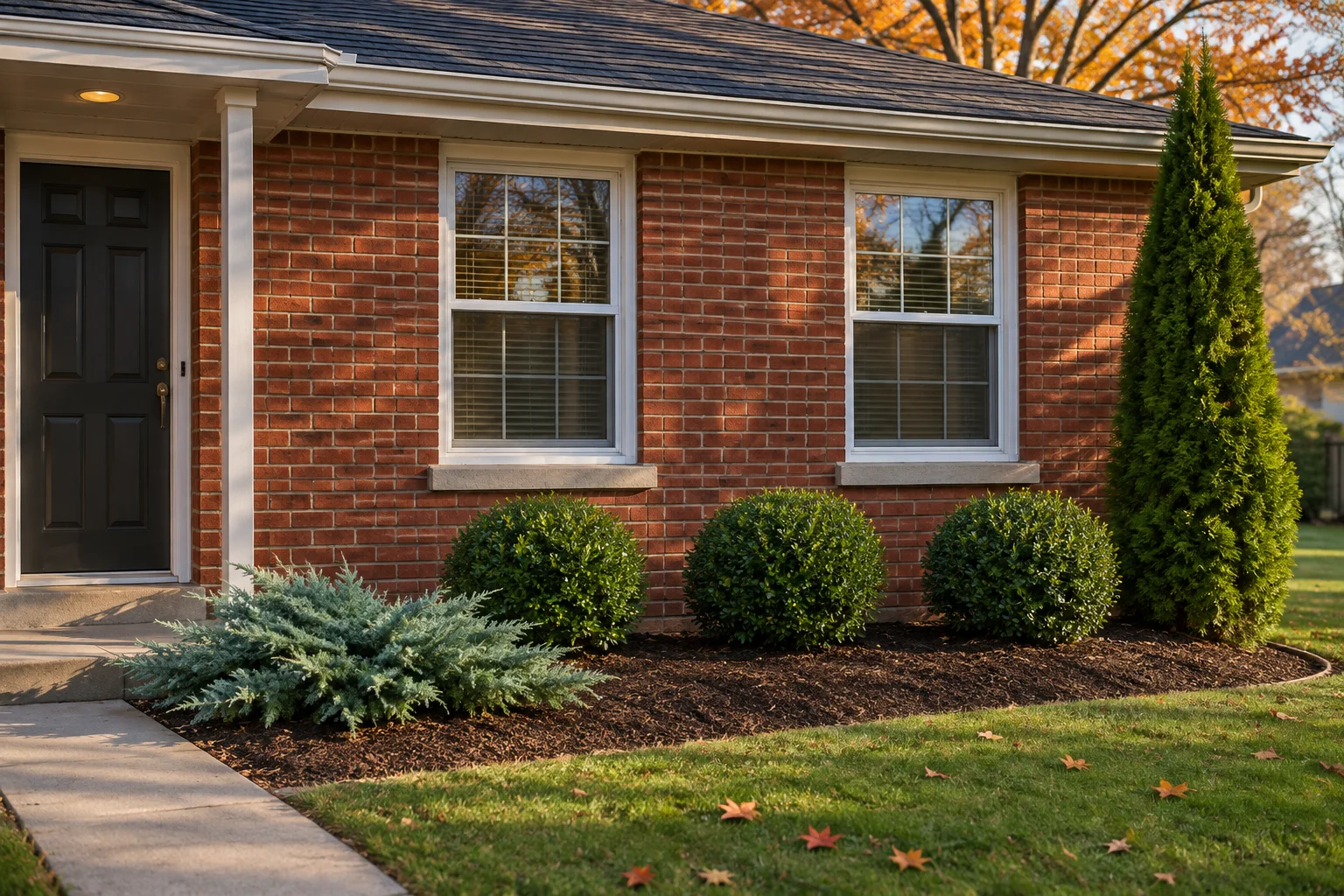
Late fall strips the front yard down to its bones. The perennials are cut back, the maple has dropped everything, and the bed along the house is suddenly just mulch, siding and two windows staring at the street.
The right evergreen shrubs for the front of the house fix that for all twelve months, as long as they still fit the space years after you plant them. This list gives you 14 low-maintenance foundation plants from 6 inches to 15 feet tall, each with its mature size, zone range and light needs, plus a pet-safety note wherever a trusted source has one. If you want color in the same bed, pair them with the ideas in our low maintenance front yard flower garden guide.
Table of Contents
At a Glance
- Measure before you shop: note the window sill height and how far the bed runs out from the wall, then choose a mature size that fits both.
- Under windows, stick to shrubs that top out at 2 to 5 feet, such as ‘Green Velvet’ boxwood, dwarf yaupon, ‘Shamrock’ inkberry or a dwarf mugo pine.
- For a north-facing front, look at Himalayan sweetbox, ‘Otto Luyken’ cherry laurel and yew; all handle shade.
- With dogs or cats, rule out yew first. Boxwood, holly, azalea, mountain laurel and cherry laurel are toxic too; see How to Pick for the comparison.
Short on time? For most yards in zones 5 to 8, a row of ‘Shamrock’ inkberry is the easy, native boxwood swap, and ‘Green Velvet’ boxwood is the tidier option if no pets chew on the garden.
How We Chose These Shrubs
Every shrub here keeps its leaves or needles through winter and has a published mature size and hardiness range from a university extension service or arboretum. We left out plants that only look small in the nursery, cultivar repeats (four boxwoods that differ by a few inches) and anything that needs constant shearing to stay in bounds.
The list runs roughly from lowest to tallest, so you can read it the way you would plant a bed: groundcovers at the front edge, mid-size mounds under windows, columns and larger shrubs at the corners. Several picks are also deer resistant, which helps if your front yard doubles as a deer buffet; our deer resistant flowers list covers the bloom side of the same problem.
| Shrub | USDA zones | Mature size (H x W) | Light | Best spot |
|---|---|---|---|---|
| Creeping juniper | 3 to 9 | 6 to 18 in x 4 to 10 ft | Full sun | Front edge, slopes |
| Himalayan sweetbox | 6 to 8 | 1 to 2 ft x 2 to 4 ft | Part to deep shade | Shady entry |
| ‘Green Velvet’ boxwood | 5 to 8 | 2 to 3 ft x 2 to 3 ft | Morning sun, part shade | Under windows |
| Dwarf mugo pine | 2 to 7 | 2 to 5 ft tall (dwarf cultivars) | Full sun | Sunny, dry bed |
| Dwarf yaupon holly | 7 to 9 | 3 to 5 ft x 3 to 6 ft | Sun to part shade | Under windows, South |
| ‘Otto Luyken’ cherry laurel | 6 to 8 | 3 to 4 ft x 6 to 8 ft | Sun to shade | Long, deep bed |
| ‘Shamrock’ inkberry | 4 to 9 | 3 to 5 ft tall | Sun to part shade | Under windows, hedges |
| Dwarf Hinoki cypress | 4 to 8 | 3 to 4 ft in 10 years, about 6 ft x 2 to 4 ft later | Sun to part shade | Entry accent |
| Loropetalum | 7b to 9 | 6 to 8 ft x 6 to 8 ft | Sun, afternoon shade | Corners, between windows |
| Rhododendron | 4 to 8 | 6 to 10 ft x 5 to 8 ft | Dappled shade | Shady corner |
| Sasanqua camellia | 7 to 9 | 6 to 14 ft x 5 to 7 ft | Sun to part shade | Corners, blank walls |
| Mountain laurel | 4 to 9 | 4 to 15 ft x 4 to 8 ft | Part shade | Woodland-style corner |
| Foundation yew | 4 to 7 | 2 to 20 ft x 2 to 12 ft by cultivar | Sun to part shade | Shady walls, hedges |
| ‘Emerald Green’ arborvitae | 3 to 7 | 10 to 15 ft x 3 to 4 ft | Sun to part shade | House corners |
Quick Picks: Sun, Shade, Small Beds and Low Maintenance
If you already know your conditions, start here and jump straight to the shrubs that match.
- Full sun: creeping juniper and dwarf mugo pine need it; dwarf yaupon holly and ‘Emerald Green’ arborvitae are happy in it.
- Shade or a north-facing front: Himalayan sweetbox, ‘Otto Luyken’ cherry laurel, yew and, in dappled shade, rhododendron.
- Small beds and low windows: ‘Green Velvet’ boxwood (2 to 3 feet), ‘Shamrock’ inkberry, dwarf yaupon holly and a dwarf mugo pine all stay at 5 feet or less.
- Lowest maintenance: creeping juniper and dwarf yaupon holly shrug off drought once settled, ‘Shamrock’ inkberry needs very little pruning, and dwarf Hinoki cypress grows so slowly it rarely outgrows its spot.
- Cold winters (zones 3 and 4): creeping juniper, dwarf mugo pine and ‘Emerald Green’ arborvitae are the hardiest picks here.
- Warm zones (8 and 9): dwarf yaupon holly, loropetalum and sasanqua camellia.
- Deer nearby: creeping juniper, dwarf mugo pine, inkberry and loropetalum hold up best; arborvitae and rhododendron are the ones deer damage most.
- Homes with pets: sasanqua camellia is the flowering pick with a non-toxic listing; cross yew off first.
The 14 Best Evergreen Shrubs for the Front of the House
Each pick below covers what it looks like, who it suits and when to pass on it. Sizes and zones sit in the table above, so the notes here focus on the details that table can’t show.
1. Creeping Juniper (Juniperus horizontalis)
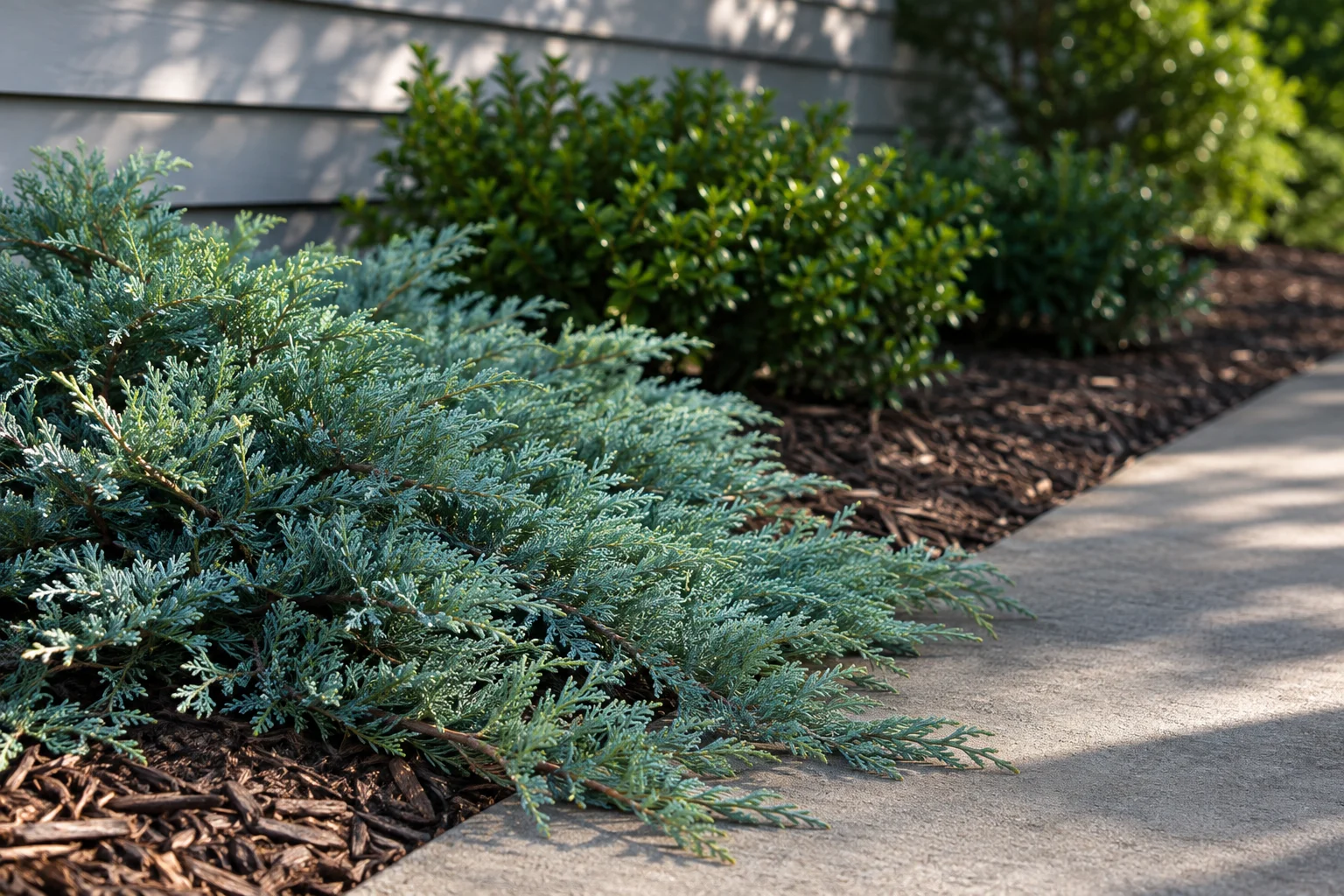
Picture a silvery blue mat flowing over the bed edge and softening the line of the walk. Creeping juniper hugs the ground at 6 to 18 inches but can spread up to 10 feet, so give it the front of the bed or a sunny slope where nothing else wants to grow.
- Soil: any well-drained soil, including sandy or rocky spots; drought tolerant once settled.
- Cultivars to look for: ‘Blue Chip’, ‘Bar Harbor’ and ‘Blue Pacific’, which stays about 6 to 12 inches tall.
- Bonus: deer tolerant, and plants can be set 6 to 12 feet apart to cover a slope.
Skip it if the spot is shady or stays wet; it needs full sun and sharp drainage.
2. Himalayan Sweetbox (Sarcococca hookeriana var. digyna)
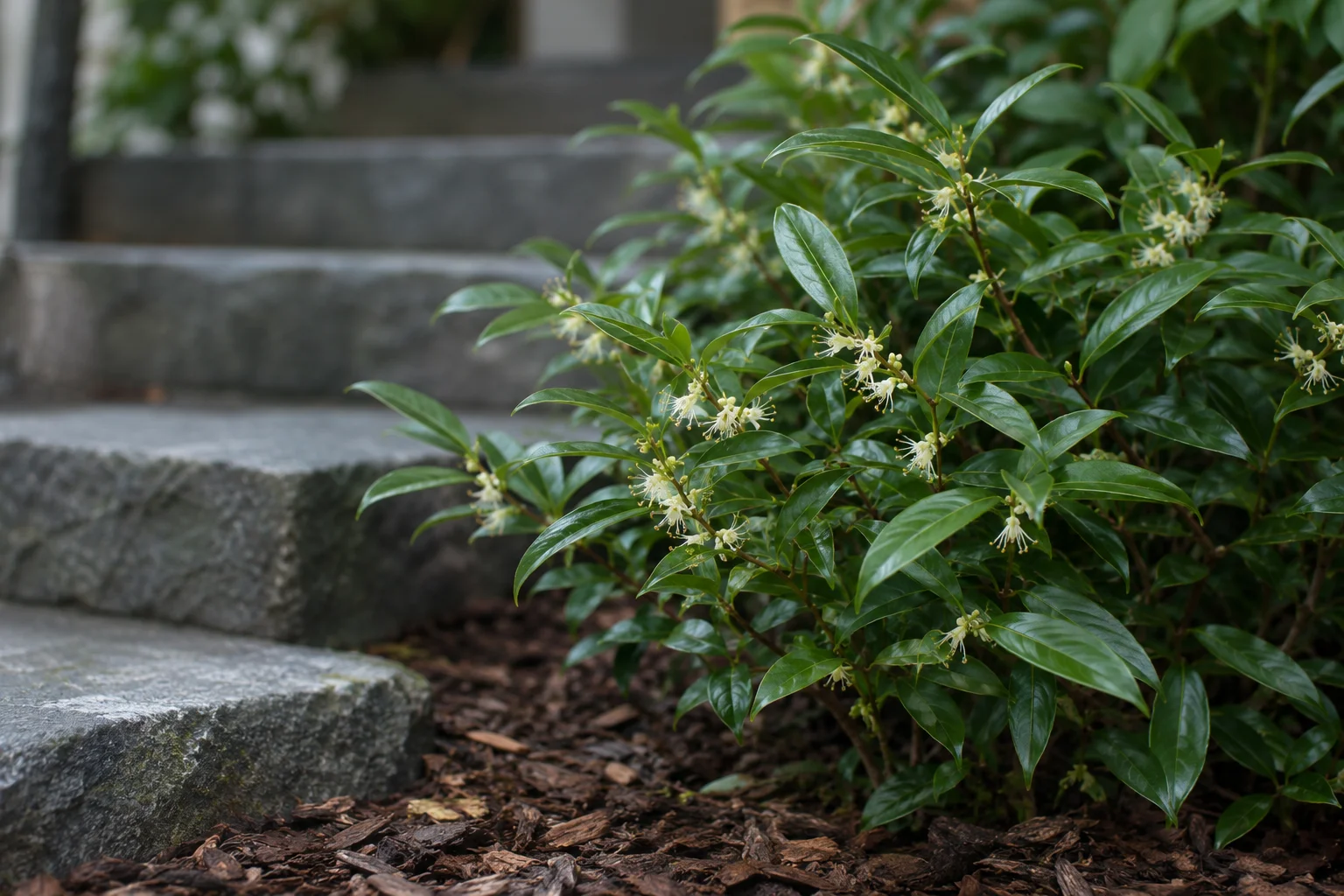
This one rewards anyone who walks past in late winter: tiny creamy flowers, easy to miss with your eyes, impossible to miss with your nose. Himalayan sweetbox stays 1 to 2 feet tall and slowly spreads by underground stems into a low, glossy carpet, which makes it a natural fit for a north-facing entry.
- Light: part to deep shade; full sun dulls the leaves unless the soil stays moist.
- Soil: rich, moist and slightly acidic, with good drainage.
- Watch for: it can be susceptible to boxwood blight, so don’t tuck it right against infected boxwoods.
Skip it if your front gets hot afternoon sun. For shade-loving bloom partners, see our shade flower garden ideas.
3. ‘Green Velvet’ Boxwood (Buxus ‘Green Velvet’)
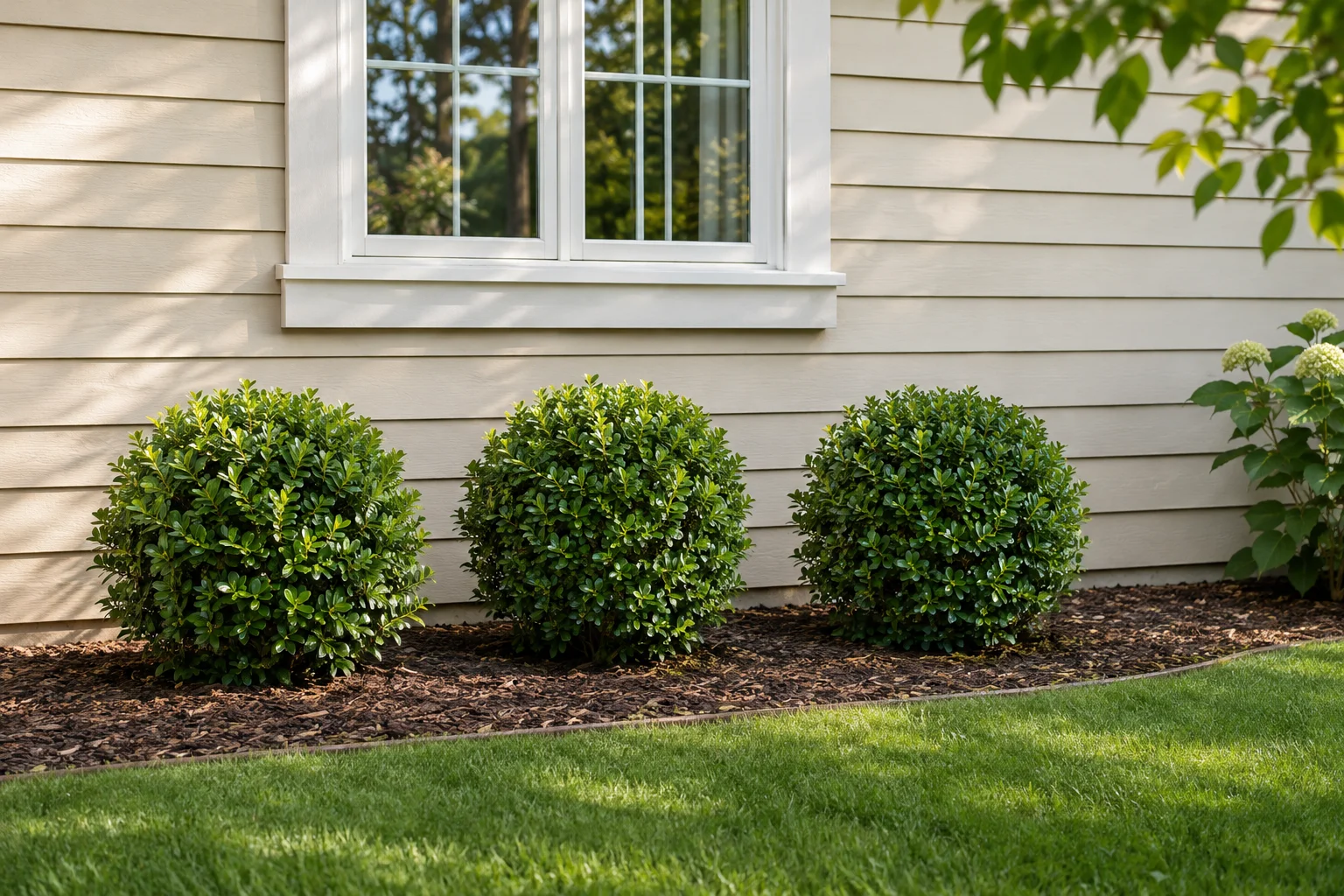
The classic tidy mound. ‘Green Velvet’ grows into a soft, rounded shape about 2 to 3 feet tall and wide, small enough to sit below most window sills without a fight. Repeating three or five of them along a wall gives the front of the house a calm, finished rhythm.
- Light: morning sun is best; full sun can scorch it and winter sun and wind can bronze the leaves.
- Roots: shallow, so mulch over them and avoid digging close by.
- Watch for: boxwood blight and leaf spot, plus leafminers and mites.
Skip it if you have a dog or cat that chews plants: the ASPCA lists boxwood as toxic to dogs and cats, causing vomiting and diarrhea. Inkberry (number 7) is the usual stand-in.
4. Dwarf Mugo Pine (Pinus mugo)
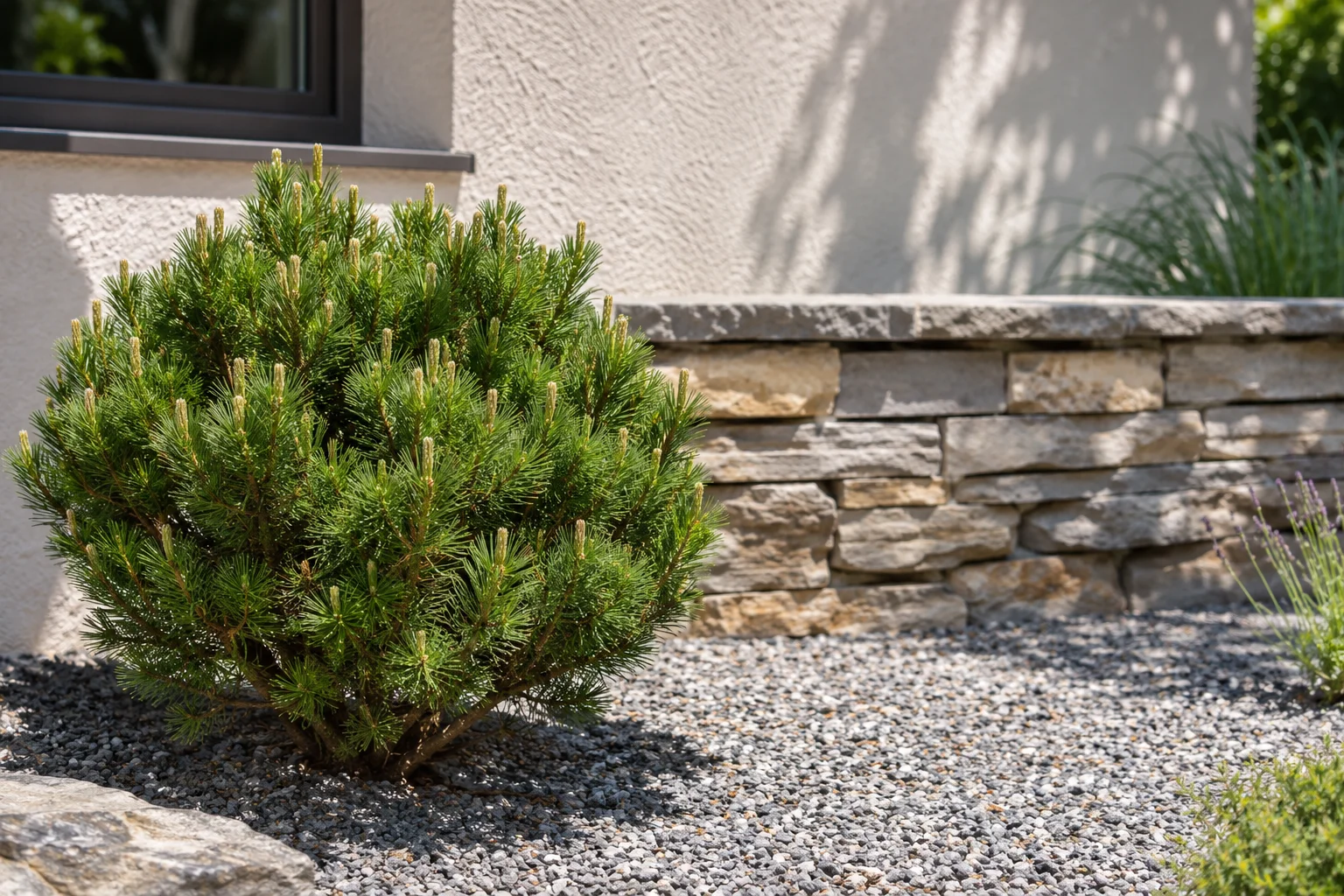
Mugo pine brings a different texture to a front bed: dense, dark needles and a rugged mound shape that looks good against stone or stucco. The species itself can reach 25 feet, so buy a named dwarf cultivar such as ‘Ophir’ (about 2 feet), ‘Compacta’ (about 3 feet), ‘Slowmound’ or ‘Mops’.
- Light and soil: full sun, moist but well-drained loam or sand; it dislikes wet ground.
- Upkeep: an annual trim in late winter keeps it compact.
- Extra: deer tend to leave it alone, and it handles cold down to zone 2.
Skip it in a shady bed or in the hot, humid South, where its zone range runs out.
5. Dwarf Yaupon Holly (Ilex vomitoria ‘Dwarf’)
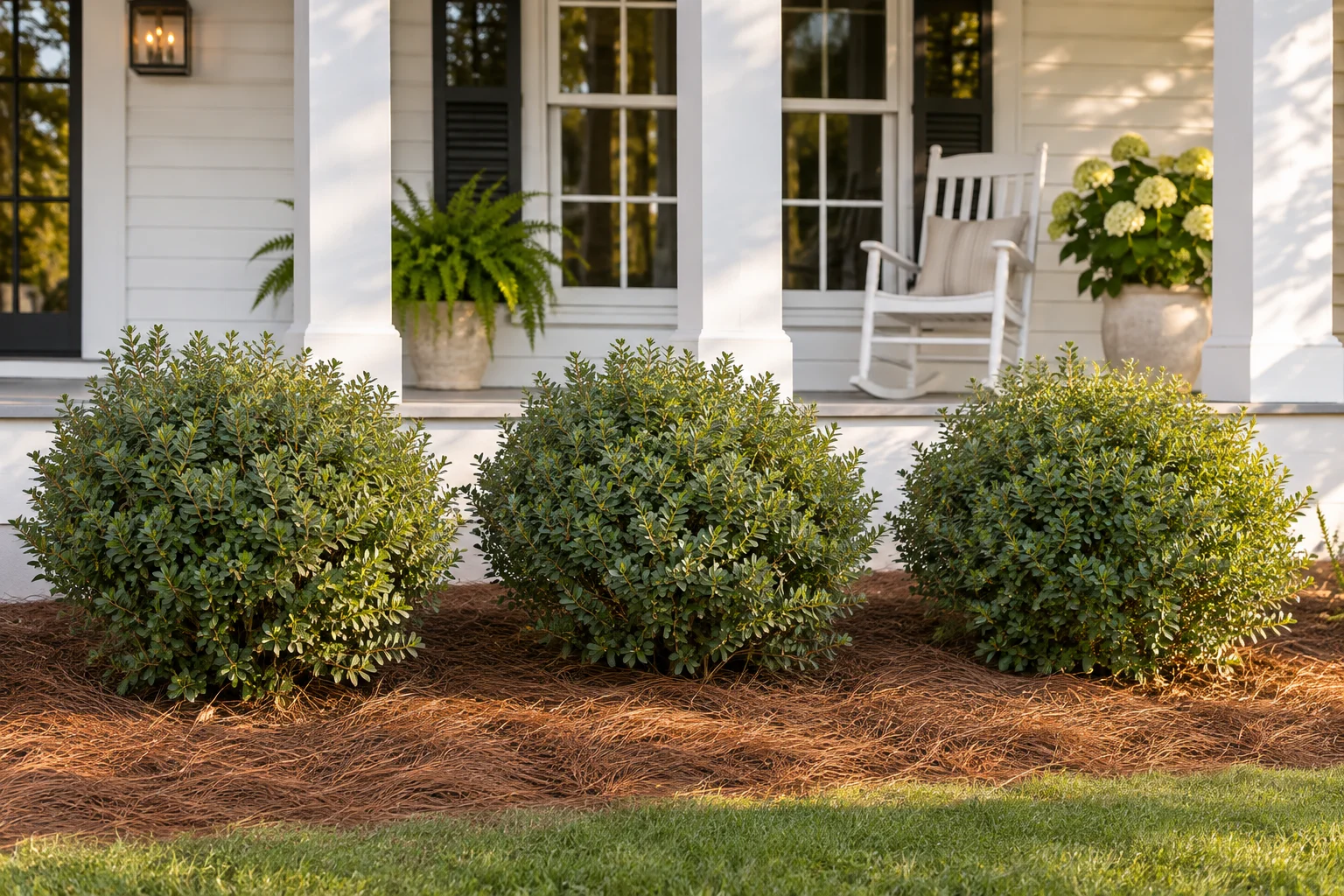
In the South, dwarf yaupon fills the low, tidy role boxwood plays farther north, and the species tolerates drought and salt spray. It forms dense mounds 3 to 5 feet tall and up to 6 feet wide, flowers more in sun, and rarely produces berries, so there’s little fruit mess on the walk.
- Soil: average, well-drained, neutral to acidic; clay, loam and sand all work.
- Pets: hollies contain saponins and are rated low toxicity (vomiting, diarrhea).
- Fire note: rated highly flammable (see How to Pick).
Skip it north of zone 7, where it isn’t reliably hardy.
6. ‘Otto Luyken’ Cherry Laurel (Prunus laurocerasus ‘Otto Luyken’)
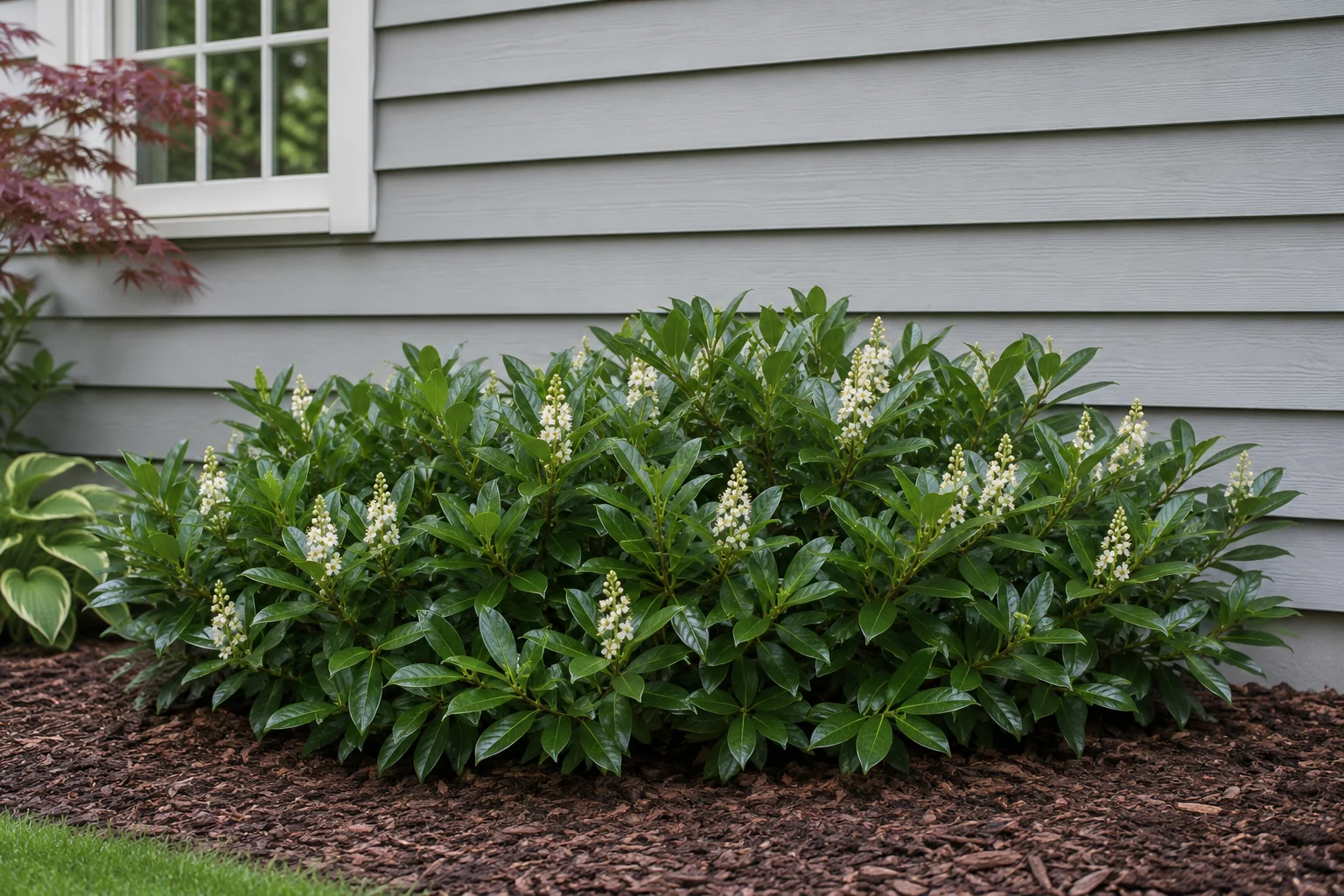
Glossy, dark leaves held at an upward angle make ‘Otto Luyken’ look polished even in shade. Plan for its width: it grows 3 to 4 feet tall but spreads 6 to 8 feet, and over many years it can reach 6 to 10 feet tall.
- Light: sun to part shade, and it prefers shade in hot climates.
- Care: water at the soil line to limit shot-hole disease and powdery mildew, and go easy on fertilizer.
- Pets and kids: the fruits, leaves and stems are poisonous if eaten.
Skip it in a narrow strip under windows; it needs a long, deep bed.
7. ‘Shamrock’ Inkberry Holly (Ilex glabra ‘Shamrock’)
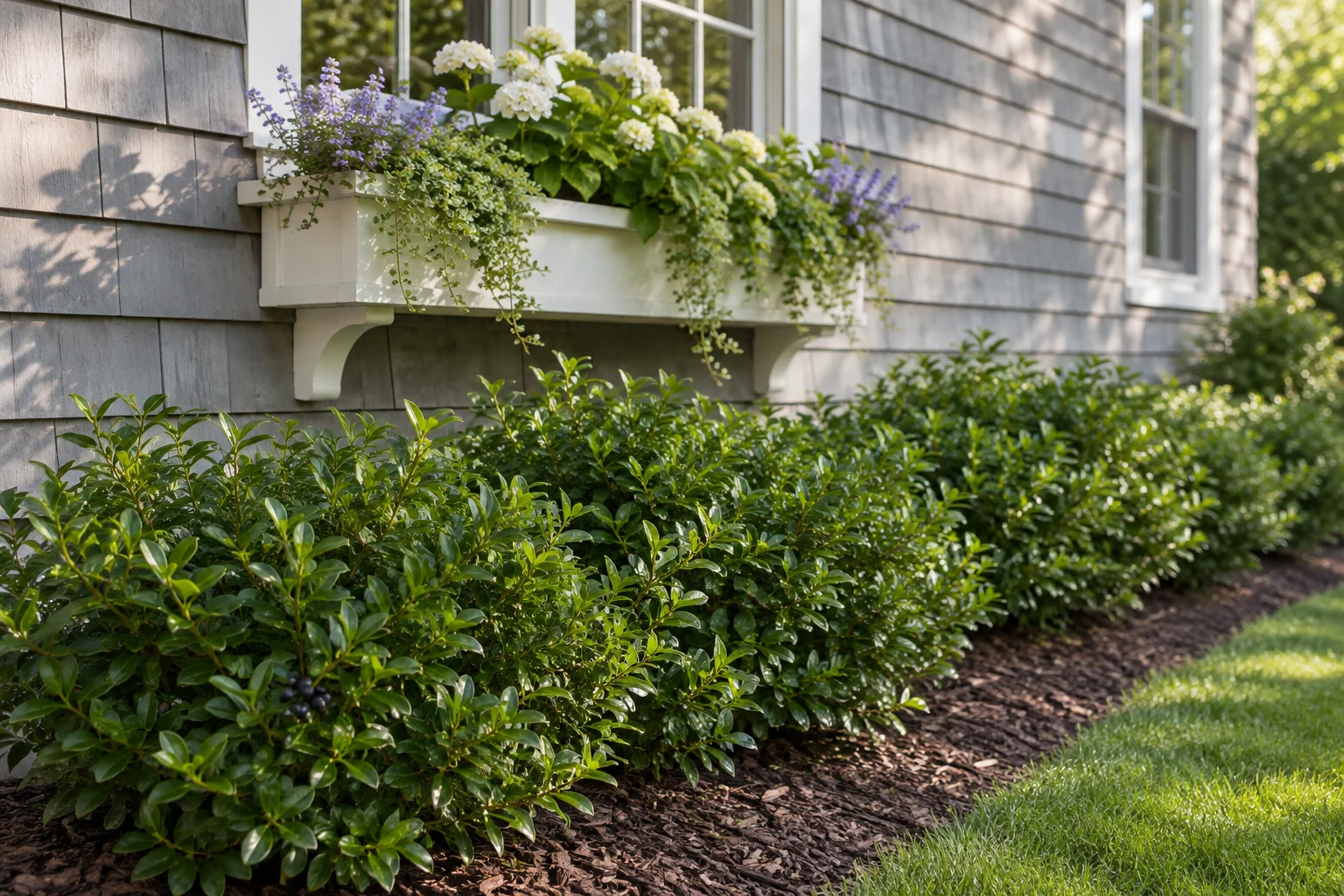
Inkberry is a native broadleaf evergreen with small, glossy leaves that read like boxwood from the sidewalk. The species can reach 5 to 10 feet, so choose the compact ‘Shamrock’, which stays about 3 to 5 feet, and you get a soft, rounded hedge with very little pruning. The related Strongbox selection is also sold as a boxwood alternative.
- Light and soil: full sun to part shade, in acidic soil (pH below 6.0); it tolerates moist and occasionally wet spots.
- Berries: you need male and female plants for fruit, which is mildly toxic (holly saponins).
- Extra: deer and rabbit resistant, and hardy from cold zone 4 winters to the warm South.
Skip it next to a new concrete foundation or in alkaline soil; see the pH note in How to Pick.
8. Dwarf Hinoki Cypress (Chamaecyparis obtusa ‘Nana Gracilis’)
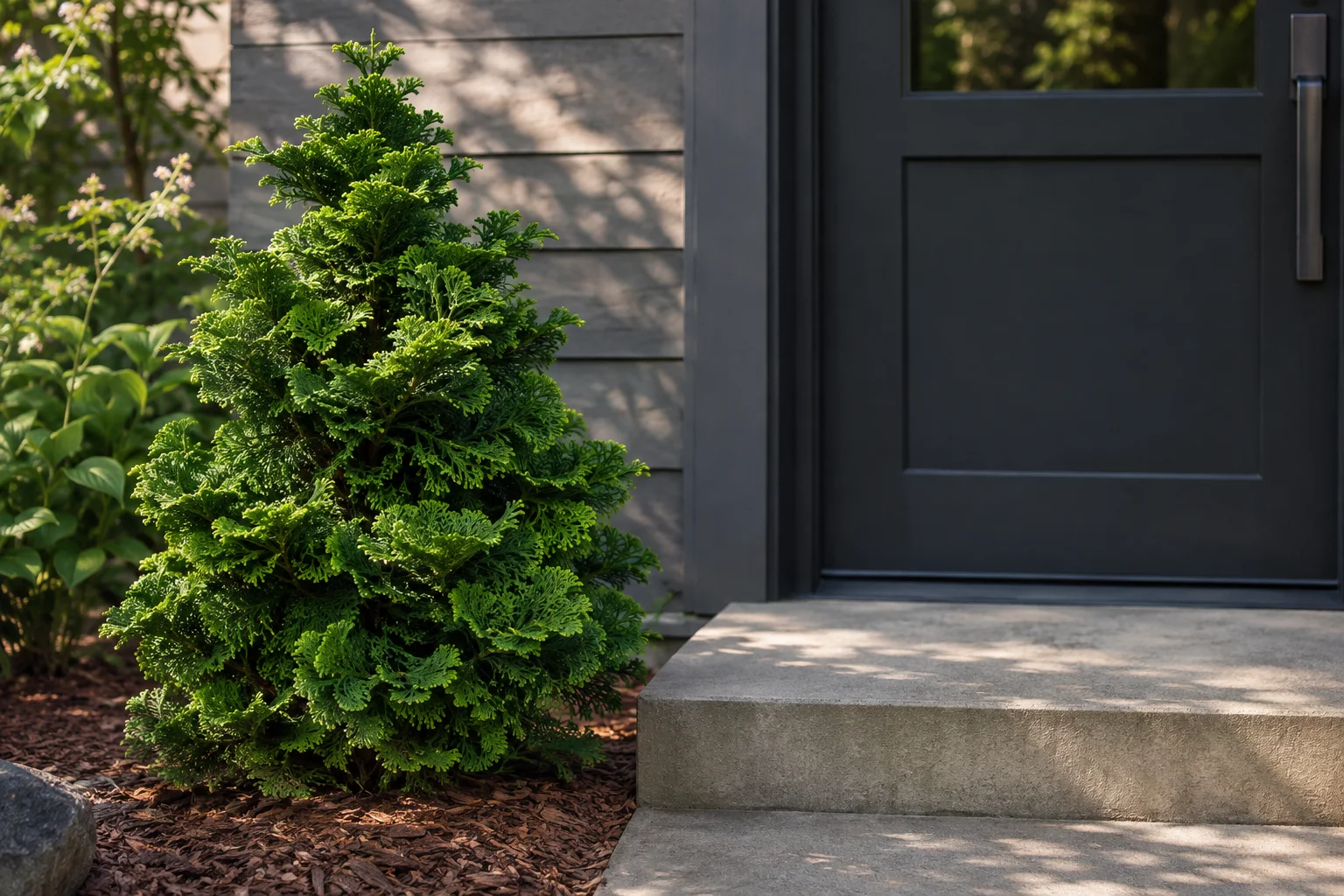
The foliage of dwarf Hinoki grows in cupped, shell-like sprays that catch the light in layers, which is why it works so well as a single accent by the door. It’s slow: about 3 to 4 feet in 10 years, eventually 6 feet or more with a 2 to 4 foot spread, so the plant you buy will look right for a long time.
- Light and soil: full sun or part shade, in average, moist, well-drained soil.
- Siting: protect it from harsh winds.
- Watch for: root rot in heavy soil and the occasional bagworm.
Skip it if you need fast cover. It also looks good in a large pot by the step, like the ones in our winter porch planter ideas with evergreens.
9. Loropetalum (Loropetalum chinense)
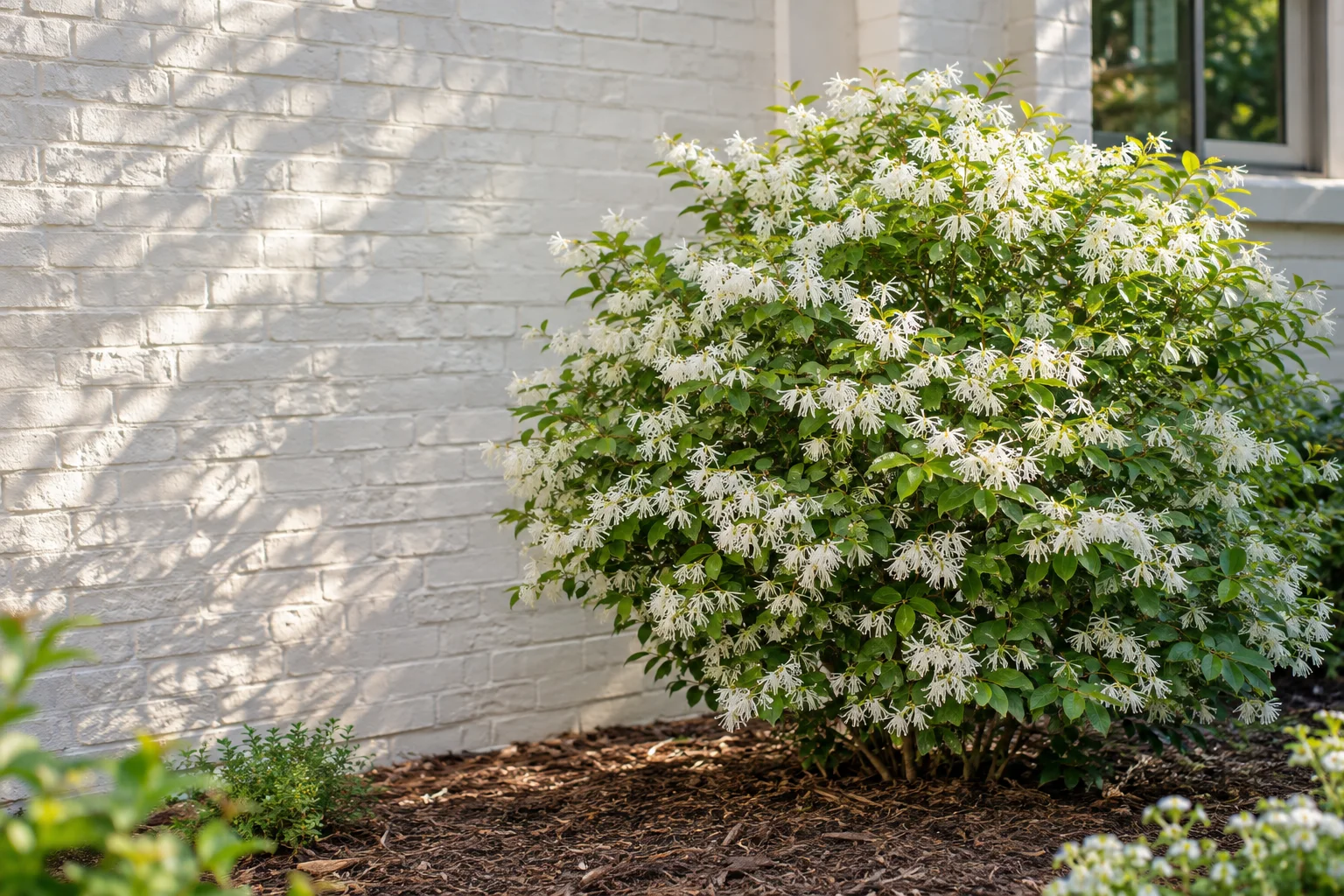
In spring, loropetalum covers itself in thin, strap-like petals that look like loose ribbon. The shrub matures at roughly 6 to 8 feet tall and wide (older plants can get much taller), so give it a corner or the wall space between windows.
- Light: full sun with some afternoon shade is ideal.
- Soil: rich, moist, well-drained and acidic; leaves can yellow (chlorosis) at neutral to high pH.
- Extra: deer resistant; evergreen or semi-evergreen depending on winter.
Skip it in zones colder than 7b, and check the label of the cultivar you buy for its own mature size.
10. Rhododendron and Evergreen Azalea (Rhododendron)
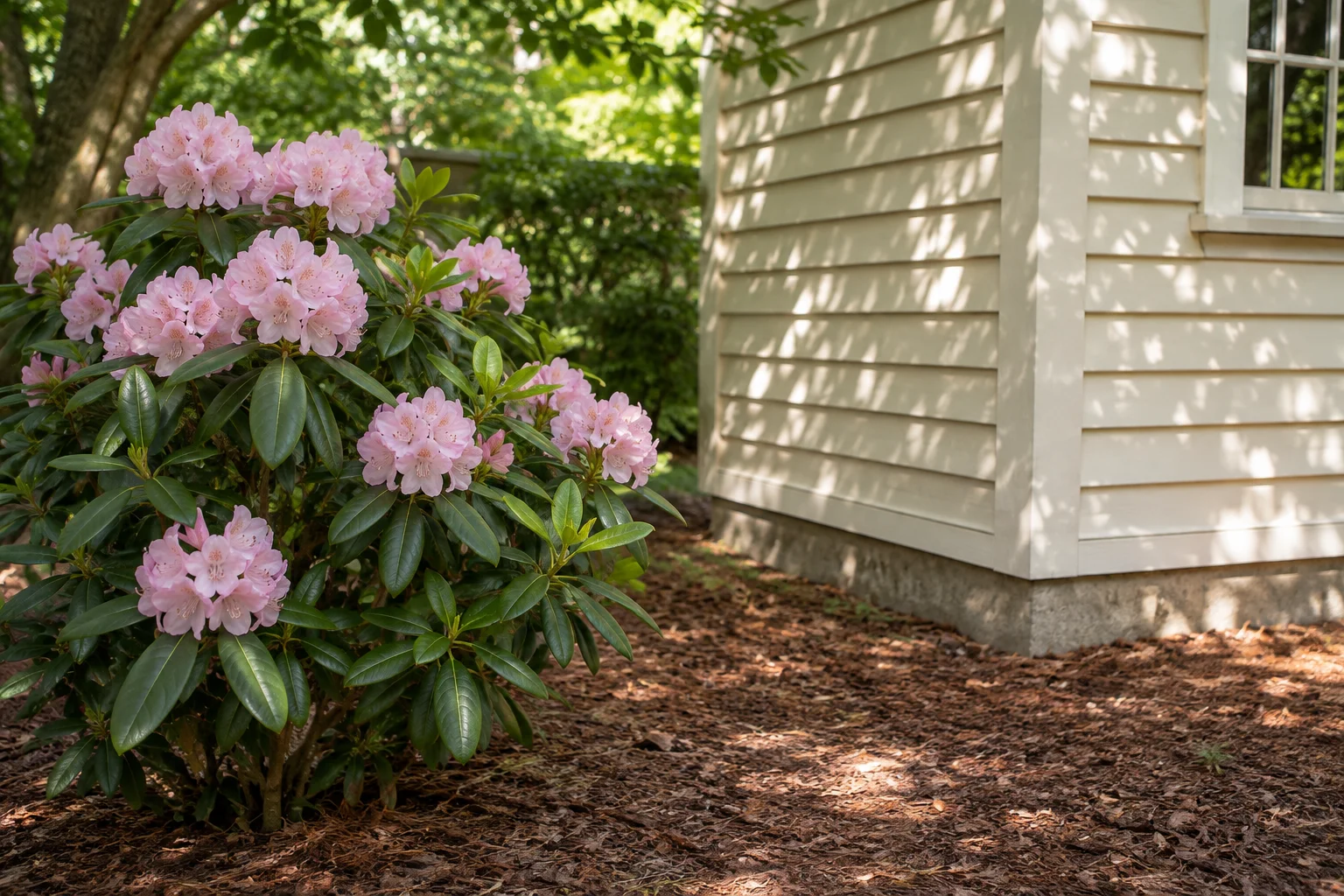
Big leathery leaves all winter and a burst of flower trusses in spring make rhododendrons a favorite for shady fronts. Typical plants grow 6 to 10 feet tall and 5 to 8 feet wide; many azaleas are deciduous, so check the tag says evergreen.
- Light: dappled shade, with protection from afternoon sun, which can scorch the leaves.
- Soil: moist, well-drained and acidic; dense clay and wet spots invite Phytophthora root rot.
- Pets: azaleas and rhododendrons are toxic to dogs and cats (grayanotoxin), with signs from vomiting to cardiac failure.
Skip it if deer visit often, since they frequently damage it, or if the only open spot is tight against a brick or concrete wall.
11. Sasanqua Camellia (Camellia sasanqua)
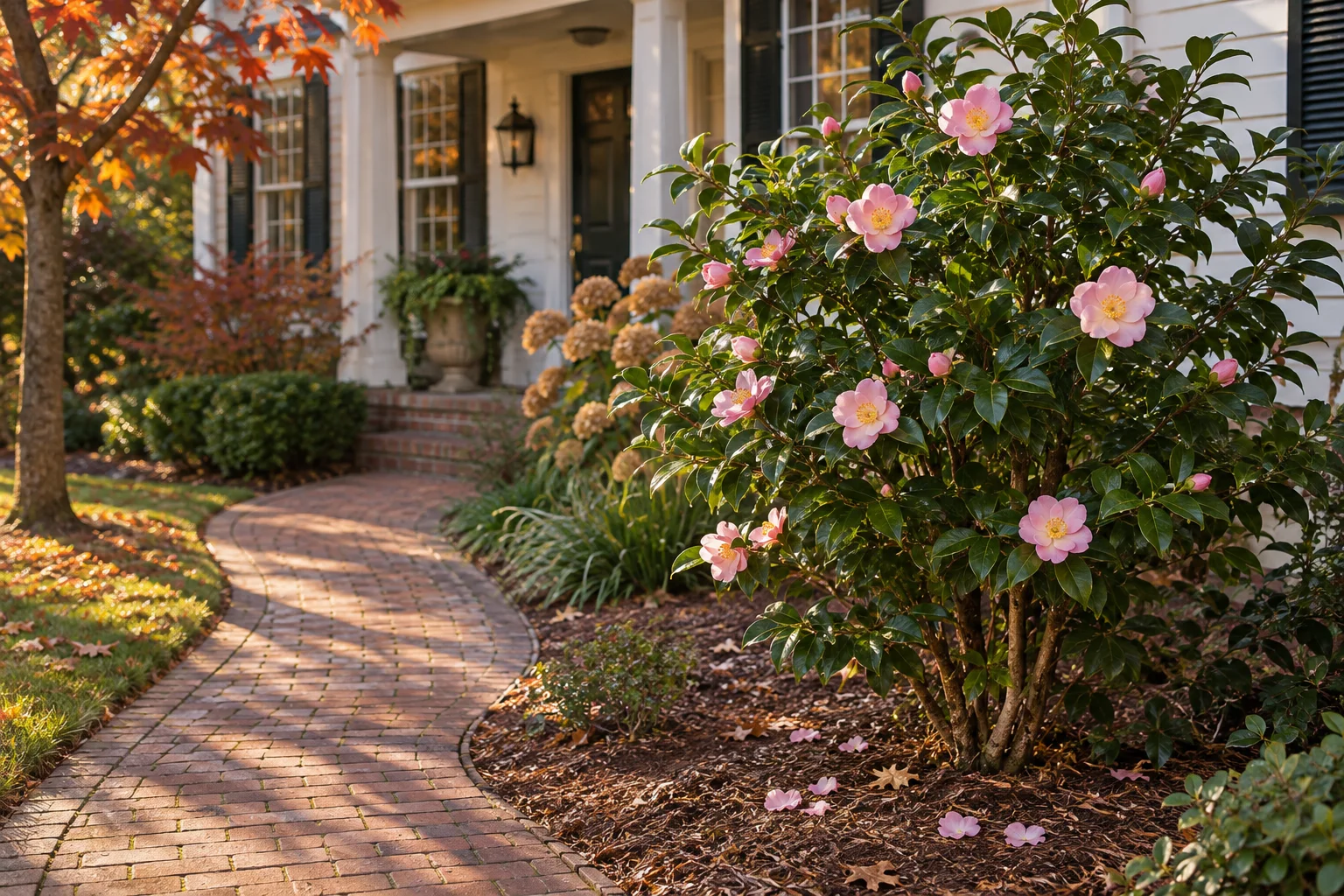
Fall is when a sasanqua camellia earns its place: fragrant flowers open against glossy leaves while the rest of the yard is winding down. It grows 6 to 14 feet tall and 5 to 7 feet wide, so it suits a corner or a long blank wall.
- Light and soil: full sun to part shade, in well-drained, neutral to acidic soil; it won’t tolerate alkaline soil.
- Upkeep: drought tolerant once established; scale insects are the usual pest.
- Pets: camellia is listed as non-toxic to dogs and cats (the listing covers Camellia japonica, a close cousin), so this is the friendliest flowering pick here for pet households.
Skip it in zones colder than 7 and right against masonry, where lime can push the soil pH up.
12. Mountain Laurel (Kalmia latifolia)
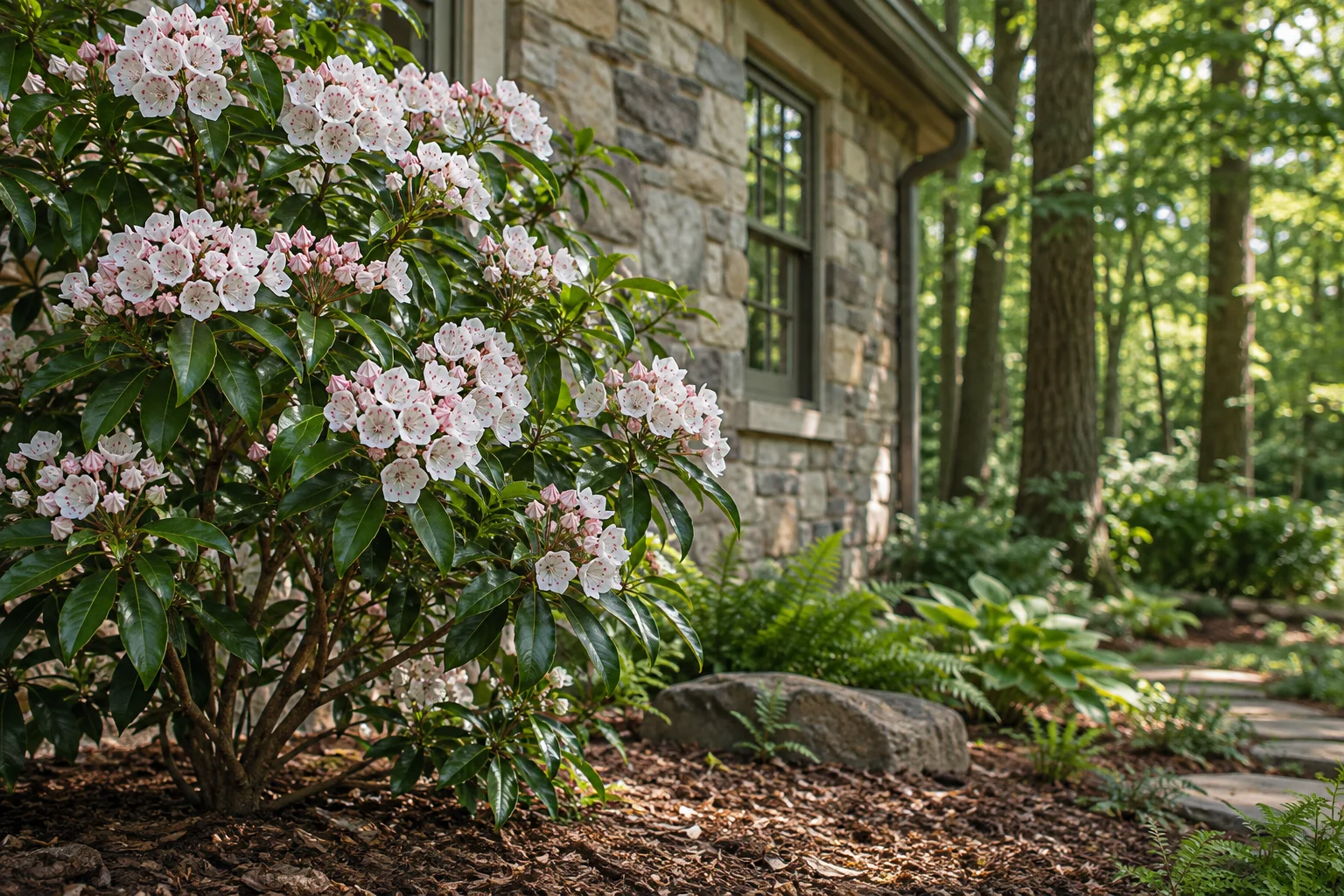
Mountain laurel’s flowers look piped from icing: clusters of small cups with pink markings, set against glossy leaves that stay all year. It’s a native shrub that grows best in part shade with morning sun, and it usually settles in as a dense, rounded plant around 6 to 10 feet tall.
- Soil: cool, moist, acidic and rich in organic matter; it struggles in heavy clay or wet soil.
- Safety: its toxicity is rated high, so keep it away from where children and pets play.
- Fire note: also rated highly flammable (see How to Pick).
Skip it if your front is hot, sunny clay or you live in a wildfire-prone area.
13. Foundation Yew (Taxus x media)
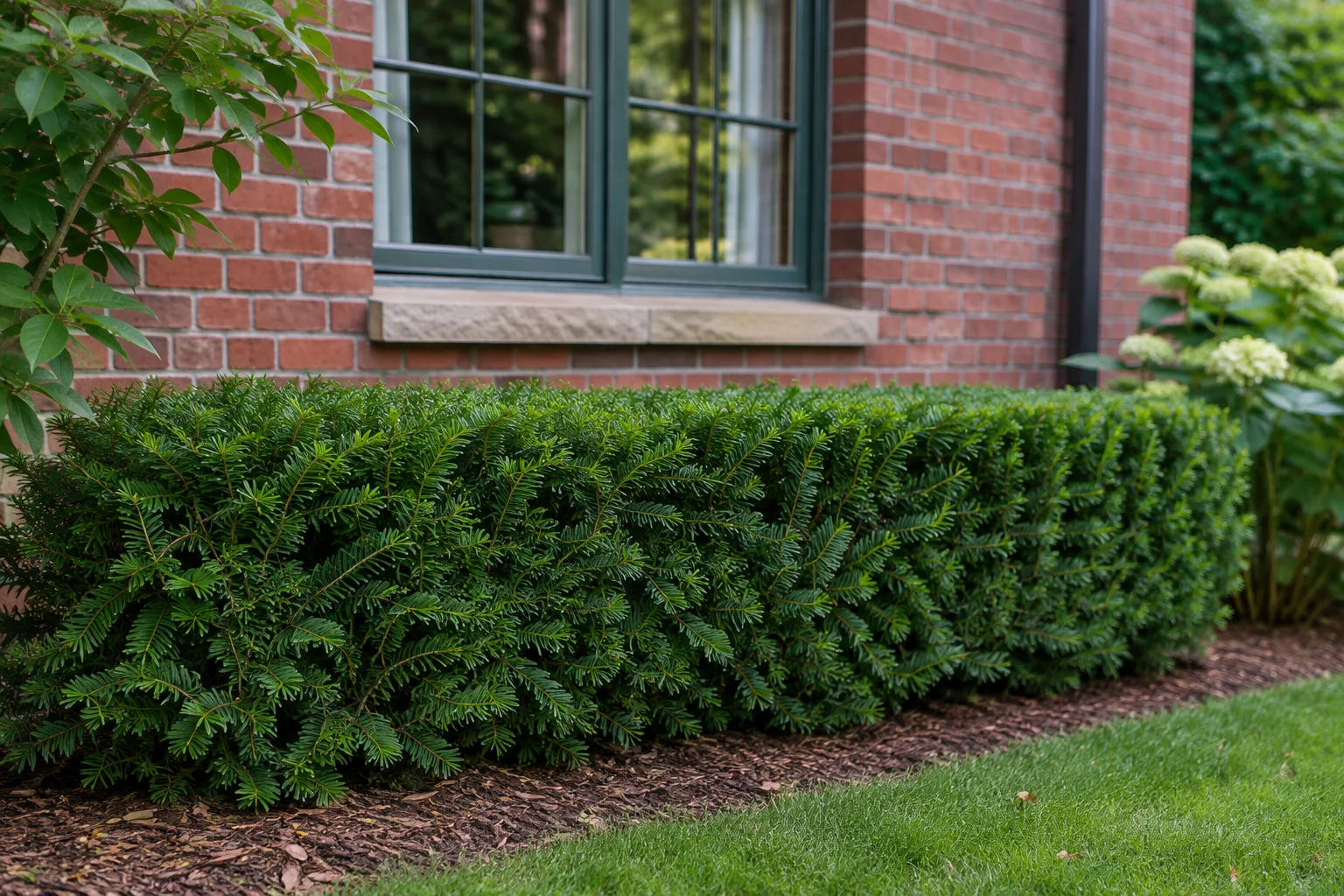
Yew is a long-standing foundation shrub for good reason: soft, dark needles, tolerance of shade and shearing, and cultivars from 2 feet to tree-size. Choose the cultivar by its mature size, because Taxus x media ranges from 2 to 20 feet tall.
- Light and soil: sun to part shade, in well-drained soil; it won’t tolerate wet conditions and gets root rot in poor drainage.
- Upkeep: drought tolerant once established and easy to keep compact by pruning.
Skip it entirely if dogs, cats or small children use the yard. The ASPCA warns that yew can cause sudden death from acute cardiac failure in pets, with tremors, breathing trouble and seizures as early signs; the bark, leaves and seeds are all poisonous.
14. ‘Emerald Green’ Arborvitae (Thuja occidentalis ‘Smaragd’)
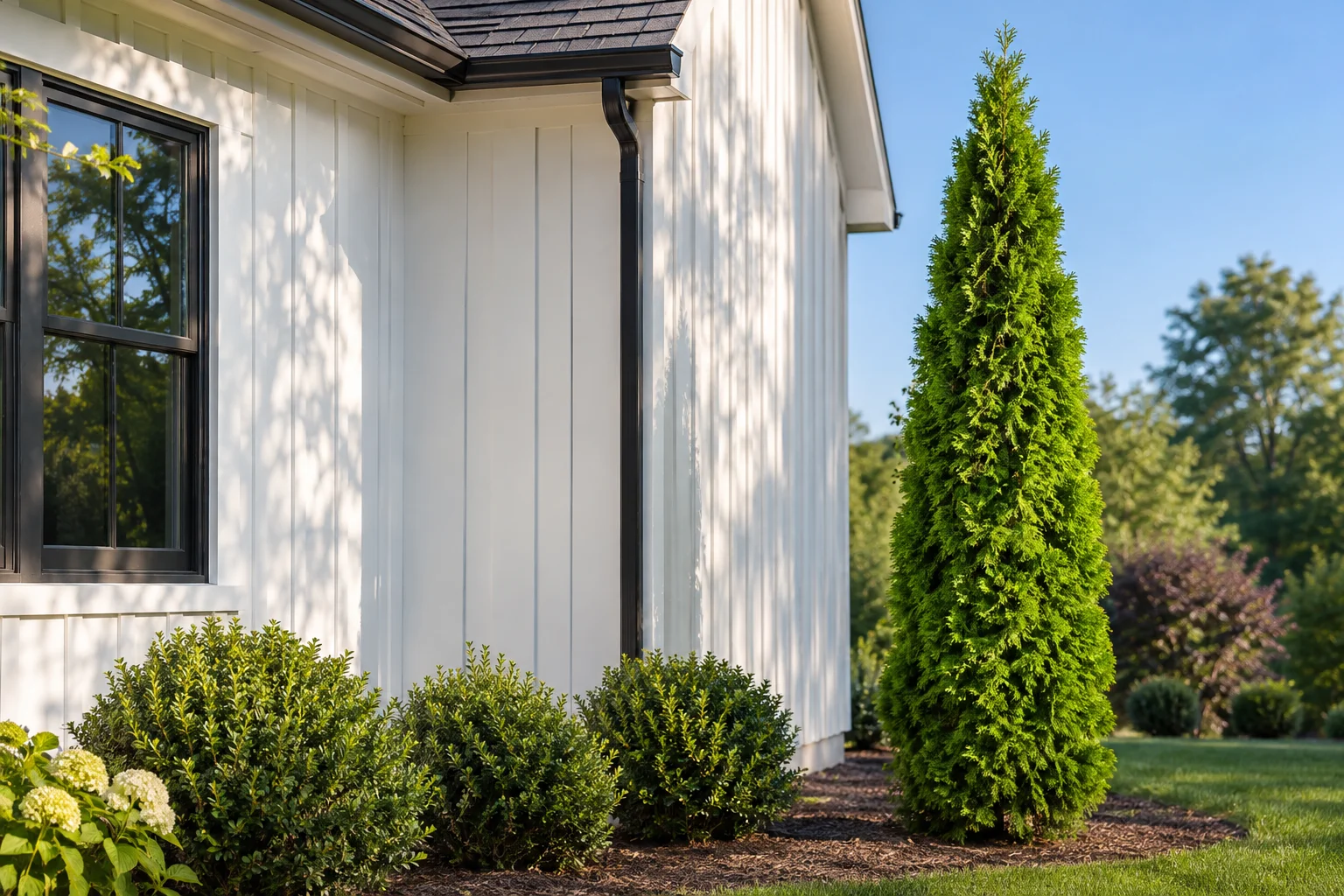
When a corner needs height without width, ‘Emerald Green’ is the classic answer: a narrow column 10 to 15 feet tall and just 3 to 4 feet wide that holds its bright color through winter. One at each corner frames the house and draws the eye toward the door.
- Light: full sun to part shade; deep shade thins the foliage.
- Siting: it dislikes dry, exposed, windy spots, and heavy snow or ice can bend stems.
- Watch for: bagworms, and deer browsing, which is a serious problem for this species.
Skip it under a window or where deer pressure is heavy. In mild-winter zones above 7, look at the other tall picks instead.
How to Pick the Right Shrub for Your Front Bed
Choosing evergreen shrubs for the front of the house starts with a tape measure. Measure the window sill height, the corner height and the depth of the bed, then pick shrubs whose mature size fits all three.
Distance from the wall. Plant each shrub so its center sits slightly more than half its mature spread away from the foundation, and never closer than 2.5 feet. A shrub that will be 4 feet wide works out to a little over 2 feet, so round it up to 2.5 feet; an ‘Otto Luyken’ cherry laurel goes 3 to 4 feet out. The 2.5 foot minimum matters even for small shrubs: the soil right against the house stays dry, and crowding cuts airflow and invites fungal problems.
Height. Under windows, choose a mature height below the sill. At the corners, a common extension guideline keeps the tallest plants at no more than two-thirds of the corner height, so the house still looks anchored.
The foundation micro-climate. The strip along a house is harsher than the open yard. Brick, stone and dark siding radiate heat on south and west walls, and lime leaching from masonry can raise the soil pH, which is why acid lovers like camellia, mountain laurel and azalea do better set well away from the wall. On a hot west wall, the sun lovers (juniper, mugo, dwarf yaupon in the South) cope best; on a north wall, look at sweetbox, cherry laurel, rhododendron or yew.
Pets. Here is the one place to compare toxicity. Yew is the serious one and the first to rule out. Boxwood, the hollies, azaleas and rhododendrons, mountain laurel and cherry laurel are toxic in varying degrees. Camellia is listed as non-toxic. For any plant not covered here, check the ASPCA list or ask your vet before planting where pets roam.
Fire risk. If you live where wildfire is a real risk, NC State Extension advises keeping highly flammable shrubs such as yaupon and mountain laurel out of the defensible space around your home. Ask your local extension office what that space means in your area.
For most readers we’d build the bed in three layers: one tall column at each corner, three to five matching mid-size mounds under the windows, and a groundcover at the front edge. Repeating one shrub under the windows looks calmer from the street than mixing many.
Planting and Winter Care
By mid-November it’s late to plant evergreens in most cold-winter zones. If that’s when you’re reading this, use the time to measure and choose, then plant in spring or in late summer.
Timing by region. In the Upper Midwest, mid-August through September is the best window for evergreens, and plants set out in late October or November may not root in before winter and can dry out. In Massachusetts, UMass Extension suggests waiting until spring for broadleaf evergreens such as rhododendron and for yew. In Florida and other warm, wet-summer regions, avoid hot, dry spells and plant at the start of your rainy season instead.
Planting.
- Dig a hole at least 1.5 to 2 times as wide as the root ball and no deeper than it.
- Set the shrub so the top of the root ball sits 1 to 2 inches above the surrounding soil, with the root flare visible.
- Backfill with the soil you dug out, so roots grow out into the surrounding bed.
- Water slowly until the root ball and surrounding soil are soaked.
- Spread about 3 inches of mulch, keeping it 2 inches back from the stems and off the root ball’s top.
The first year. Water new shrubs often in the first weeks, then deeply every 7 to 10 days in dry weather, and keep going until the ground freezes. Evergreens keep losing moisture through their leaves all winter, so going into the cold well watered matters. Also make sure downspouts and air conditioner lines drain away from the bed.
Quick fixes for common problems.
- Boxwood turning bronze in winter: often winter sun and wind; next time choose a spot with morning sun and shelter. Browning can also come from diseases such as boxwood blight, so ask your local extension office to confirm before replacing plants.
- Yellowing leaves on loropetalum, camellia or azalea near the house: high soil pH from masonry is one likely cause, though poor drainage can look similar; test the soil pH before moving the plant farther from the wall.
- Arborvitae splayed open after snow: gently knock heavy snow off after storms; if deer have stripped the lower foliage, protect it with netting in winter.
Frequently Asked Questions
What is the best low-maintenance evergreen shrub for the front of the house?
For most yards, ‘Shamrock’ inkberry is the easiest: it stays 3 to 5 feet tall, keeps a rounded shape with very little pruning and tolerates moist soil. In the South, dwarf yaupon holly does the same job and handles drought. In a hot, dry, sunny bed, creeping juniper needs almost nothing once it has settled in.
Which evergreen shrubs stay under 3 feet tall?
Creeping juniper (6 to 18 inches), Himalayan sweetbox (1 to 2 feet) and ‘Green Velvet’ boxwood (2 to 3 feet) all stay low at maturity. Among the pines, the dwarf mugo ‘Ophir’ sits around 2 feet. These suit low windows, the bed edge and narrow strips along a walk; check the cultivar tag, because sizes change from one selection to the next.
How far from the house should I plant evergreen shrubs?
Set the center of each shrub slightly more than half its mature width away from the foundation, and at least 2.5 feet out even for small plants. A shrub that matures at 6 feet wide goes a little over 3 feet from the wall. That gap keeps the plant out of the dry soil under the eaves and lets air move behind it.
Which evergreen shrubs do well in full sun in front of the house?
Creeping juniper and dwarf mugo pine need full sun, and dwarf yaupon holly, ‘Shamrock’ inkberry, sasanqua camellia and ‘Emerald Green’ arborvitae all grow well in it. Be careful with ‘Green Velvet’ boxwood, which can scorch in full sun, and keep Himalayan sweetbox and rhododendron for the shady side.
How fast do these evergreen shrubs grow?
Most of the compact picks are slow, which is part of why they stay in scale. Dwarf Hinoki cypress, for example, reaches only about 3 to 4 feet in 10 years. Buy a plant close to the size you want in the next few years, and space it for its mature width from day one.
What can I plant instead of boxwood if blight is a problem nearby?
Compact inkberry such as ‘Shamrock’ is the easiest look-alike in most zones, and dwarf yaupon holly does the same job in zones 7 to 9. Avoid Himalayan sweetbox as a replacement in that spot, since it can also be susceptible to boxwood blight. Inkberry tolerates moist soil, while dwarf yaupon wants good drainage; both fit under most windows.
Do evergreen foundation shrubs need regular pruning?
Very little, if you choose by mature size. Dwarf mugo pine benefits from an annual trim in late winter, and ‘Green Velvet’ boxwood is best pruned after the last frost. A narrow column like ‘Emerald Green’ arborvitae needs little or no pruning when it has room to grow. Heavy, repeated shearing is usually a sign the shrub is too big for its spot.
Can I plant evergreen shrubs in front of a rental?
Ask your landlord first, in writing, because planting shrubs in the ground changes the landscaping you don’t own. If the answer is no or you expect to move, a dwarf Hinoki cypress or a small boxwood in a large container by the door gives you winter green you can take with you.
What Actually Matters
The best evergreen shrubs for the front of the house are the ones that still fit in ten years. Read the mature size on every tag, compare it with the window sill and the bed depth, and give each plant slightly more than half its spread from the wall.
Then match light and soil: sun lovers on hot walls, shade lovers on the north side, acid lovers away from brick. If pets share the yard, cross yew off first.
Before you buy anything, measure the sills and corners and sketch the three layers on paper. If you want something green by the door while you wait for planting season, try a dwarf evergreen in a pot from our front porch container garden ideas.
Sources
- NC State Extension Gardener Plant Toolbox – profiles for Juniperus horizontalis, Sarcococca hookeriana var. digyna, Buxus ‘Green Velvet’, Buxus sempervirens, Pinus mugo, Ilex vomitoria and ‘Dwarf’, Prunus laurocerasus ‘Otto Luyken’, Ilex glabra, Chamaecyparis obtusa ‘Nana Gracilis’, Loropetalum chinense, Rhododendron, Camellia sasanqua, Kalmia latifolia, Taxus x media, Thuja occidentalis – zones, sizes, light, soil, toxicity, flammability, pests
- Purdue Arboretum Explorer – Thuja occidentalis ‘Smaragd’ – mature height and spread, hardiness, light
- ASPCA Animal Poison Control – Yew, Boxwood, Holly, Azalea, Camellia – pet toxicity and clinical signs
- University of Wisconsin-Madison Extension – Selecting Landscape Plants – distance from foundation, not blocking windows
- University of Illinois Extension – Update Your Home with New Foundation Plants – dry soil near the foundation, corner plant height
- UGA Cooperative Extension – Foundation plants must tolerate hot conditions and hard soil – reflected heat, lime and pH near masonry, planting depth, mulch, drainage
- UF/IFAS Gardening Solutions – Planting and Establishing Shrubs – minimum distance for airflow, hole size, mulch placement, planting season in Florida
- Iowa State University Extension – Is late summer/early fall a good time to plant trees? – evergreen planting window, watering until the ground freezes
- UMass Extension – Fall Planting for Trees and Shrubs – spring planting for broadleaf evergreens and yew