
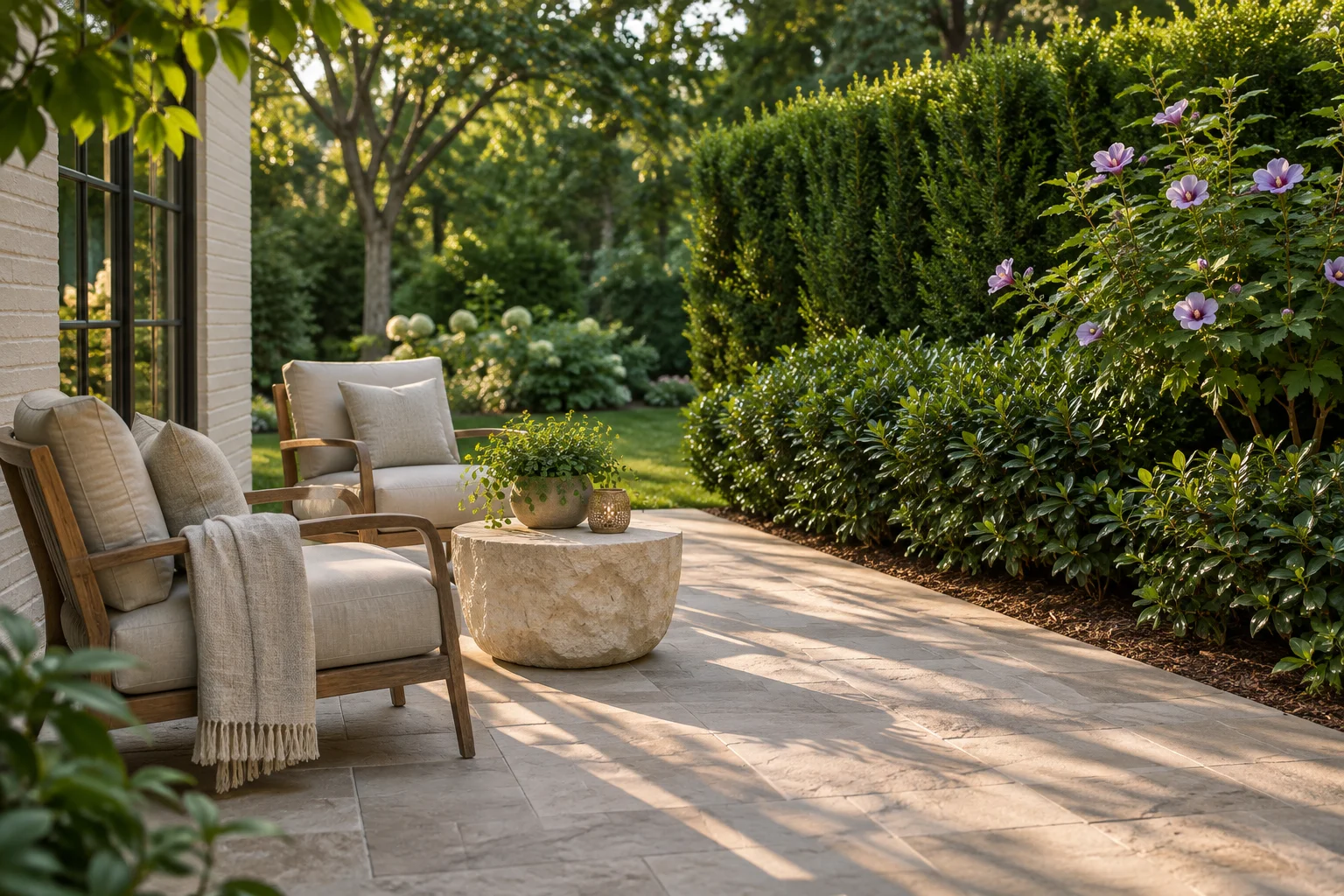
You’re standing at the kitchen window with a fence quote on the counter, looking straight across the lawn into the neighbor’s deck. The number is bigger than you hoped, and the cedar boards would block the one slice of evening light the yard gets.
Privacy plants instead of a fence can solve both problems, but only if you know what each plant really delivers: how tall, how fast, how much clipping, and whether the dog can safely sniff it. This guide sorts 12 living screens by the fence job they replace, with the spacing numbers and pet checks most lists skip. If your “yard” is a balcony, start with our apartment balcony privacy plants instead.
Table of Contents
At a Glance
- A living screen can cost less than a fence to install and maintain, but it takes several growing seasons to close; a fence is private on day one.
- Narrow side yard: ‘Sky Pencil’ holly or Hicks yew. Wide, sunny lot: lilac, rose of Sharon or serviceberry.
- Summer-only privacy often suits a patio: massed switchgrass or coral honeysuckle on wire panels.
- Dog or cat household: yew, holly and apple foliage are on the ASPCA toxic lists; rose of Sharon and star jasmine are listed non-toxic.
- Check HOA and city rules first: the two city codes we read cap front-yard fences at 3 to 4 feet and side or rear fences at 6 to 8 feet, and some towns apply limits to hedges too.
For most yards we’d plant an informal mixed hedge of two or three species. Skip plants entirely if you need privacy this year or a dog-proof boundary: build the fence, then soften it with vines.
Living Screen or Fence? An Honest Comparison
A fence is private the day it goes up; a hedge earns its privacy over several seasons and then keeps improving. That trade-off decides almost everything else, so settle it before you fall for a plant.
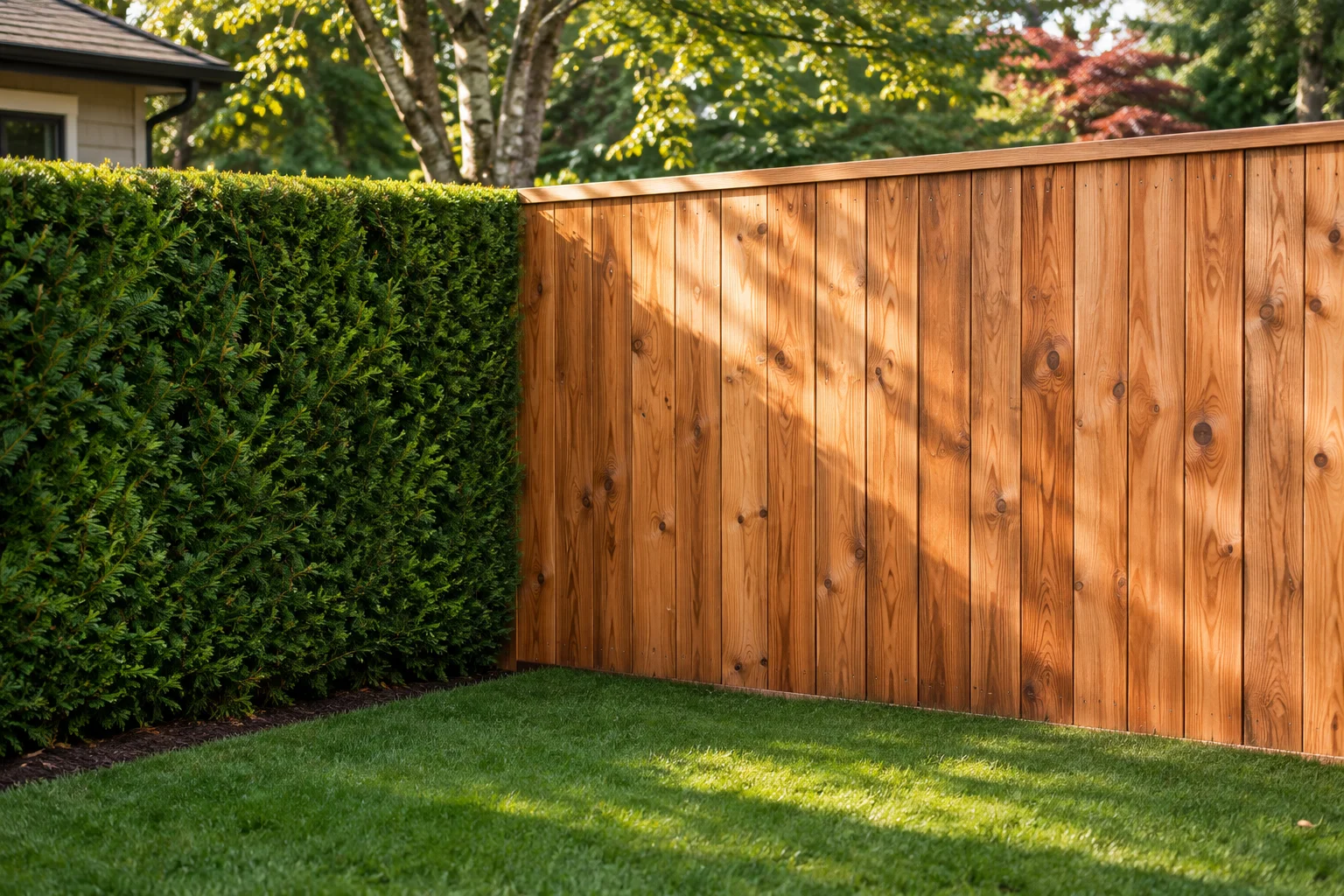
Washington State University Extension makes the case for plants plainly: a living fence can be less expensive to install and maintain, and it also cuts noise, breaks wind and moderates heat and cold in a way boards cannot. The same guide admits the limit: in a narrow strip, a built fence may be more practical.
| Option | Private on day one? | Time to full screen | Upkeep | Extras |
|---|---|---|---|---|
| Built fence | Yes | None | Staining or repairs every few years | Dog-proof; no shade or noise benefit |
| Clipped evergreen hedge | No | Several growing seasons | Shearing two or more times a year | Year-round screen; cuts wind and noise |
| Informal mixed hedge | No | Several growing seasons | Light pruning; cannot be sheared flat | Flowers, berries, birds; easier to repair one lost plant |
| Vine on wire panels | Partly (the panel) | One to three seasons | Tying in and trimming each year | Fits a strip under 2 feet wide; renter-friendly |
| Tall grass screen | No | Summer and fall each year | One cut-back in late winter | Movement and sound; bare from late winter to early summer |
Rules are the part people forget until a letter arrives. Alameda, California caps front-yard fences at 3 feet and side or rear fences at 6 feet, lower near corners; Tempe, Arizona allows 4 feet in front and up to 8 feet behind the front setback for single-family homes. Neither code mentions hedges, and some towns do regulate them, so ask your planning office and HOA how they treat plants before you order, and keep any screen clear of driveway sight lines and buried utilities.
A fence still wins in three cases: privacy needed this summer, a dog to keep in, or a pool code to meet. There, build the fence and let a vine from this list soften the boards, using the panel ideas from our no-drill trellis build.
The 12 Privacy Plants Instead of a Fence
The best privacy plants to grow instead of a fence are Hicks yew, inkberry holly and ‘Sky Pencil’ holly for a year-round evergreen wall; European hornbeam for a clipped deciduous hedge; lilac, rose of Sharon and serviceberry for a flowering boundary; switchgrass for a summer patio screen; coral honeysuckle, star jasmine and espaliered apple where the strip is too narrow for a hedge; and podocarpus in warm zones.
Each plant below replaces a different kind of fence: a formal wall, a skinny side-yard screen, a flowering boundary, a summer curtain. Zones are USDA hardiness zones, sizes are mature in-ground sizes unless noted, and the pet column follows the same poison-control lists as the At a Glance note; if a plant is not listed, ask your vet before planting.
| Plant | Zones | Height x width (ft) | Evergreen? | ASPCA pet listing |
|---|---|---|---|---|
| Hicks yew | 4-7 | About 10 tall as a hedge; 2-12 wide | Yes | Toxic |
| Inkberry holly | 4-11 | 5-10 x 5-8 | Yes | Toxic (low) |
| ‘Sky Pencil’ holly | 5-8 | 4-10 x 1-3 | Yes | Toxic (low) |
| European hornbeam | 4-8 | Clipped to size; 40-60 x 30-40 unpruned | No | Not listed |
| Common lilac | 3-7 | 8-16 x 6-12 | No | Not listed |
| Rose of Sharon | 5-9 | 8-12 x 6-10 | No | Non-toxic |
| Serviceberry | 3-8 | 15-25 x 15-20 | No | Not listed |
| Switchgrass | 5-9 | 3-7 x 2-3 | No (cut back yearly) | Not listed |
| Coral honeysuckle | 4-9 | 10-20 x 3-6 on a support | Semi (South only) | Not listed |
| Star jasmine | 8-10 | 3-20 x 3-4 on a support | Yes | Non-toxic |
| Espaliered apple | Varies by variety | Trained to the wires | No | Toxic |
| Podocarpus | 7-9 | 6-8 as a clipped hedge; 6-8 wide | Yes | Toxic (low, seeds) |
1. Hicks Yew (Taxus x media ‘Hicksii’)
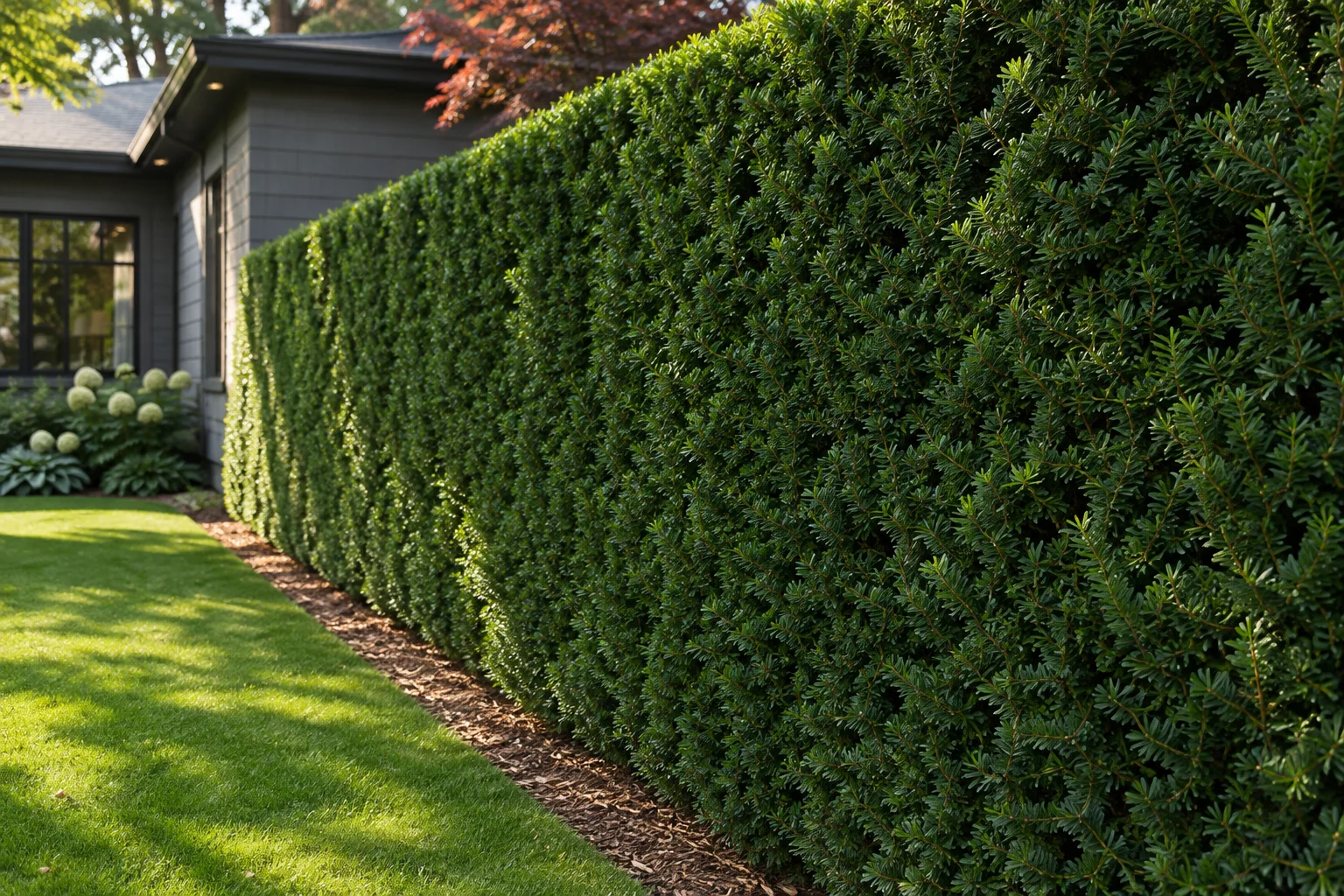
This is the plant for a true green wall: dense, dark, and happy to be sheared into a flat face year after year. Yews take full sun or part shade and tolerate the hardest pruning of anything on this list. Expect about 10 feet in a hedge, and growth is slow, so buy the biggest plants your budget allows.
Yew is also the one plant here I’d keep away from a pet household. Every part except the red aril is toxic to dogs and cats, and the ASPCA lists sudden cardiac failure among the signs. With a cat and a dog at home, I check the ASPCA list before anything new comes through the door, and this one does not pass.
- Soil: well drained only; wet ground brings root rot.
- Skip it if: pets or small children use the yard, or the soil stays soggy.
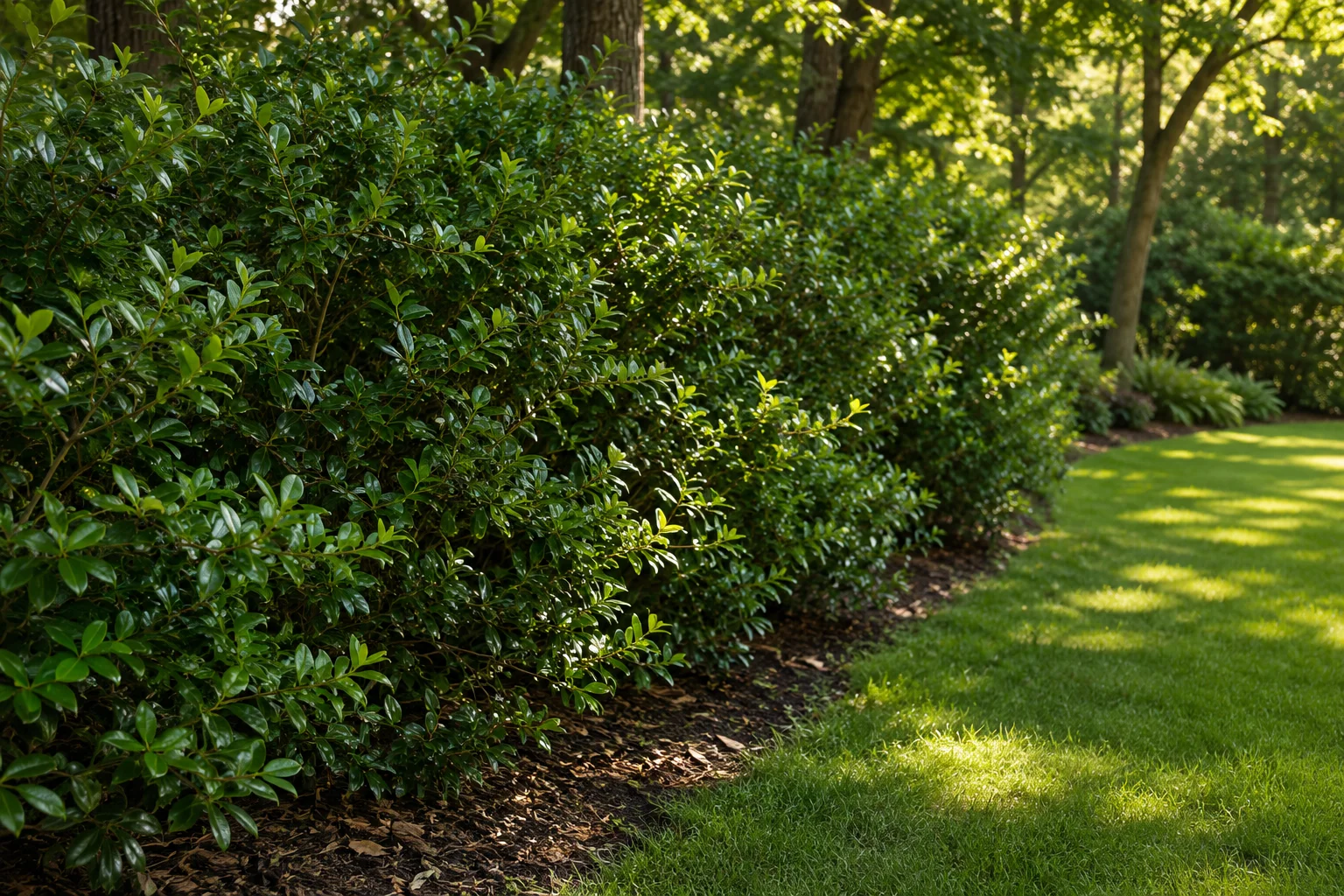
2. Inkberry Holly (Ilex glabra)
Inkberry is the native holly that looks like boxwood from ten feet away and shrugs off the wet corner where yew would die. It reaches 5 to 10 feet tall and 5 to 8 feet wide, takes sun or part shade, tolerates moist and occasionally wet soil, and is hardy from zone 4 through 11. It makes an effective hedge, windbreak or privacy screen and needs little pruning unless you want a tight line.
Two quirks matter. Plants are male or female, so you need both nearby for black fall berries, and it suckers into colonies, a bonus in a hedge and a chore beside a path. Hollies carry saponins, listed as low-toxicity for dogs and cats: vomiting and diarrhea rather than an emergency.
- Placement: rated highly flammable, so keep it out of the defensible space against the house in wildfire regions.
- Skip it if: you need a screen taller than 10 feet.
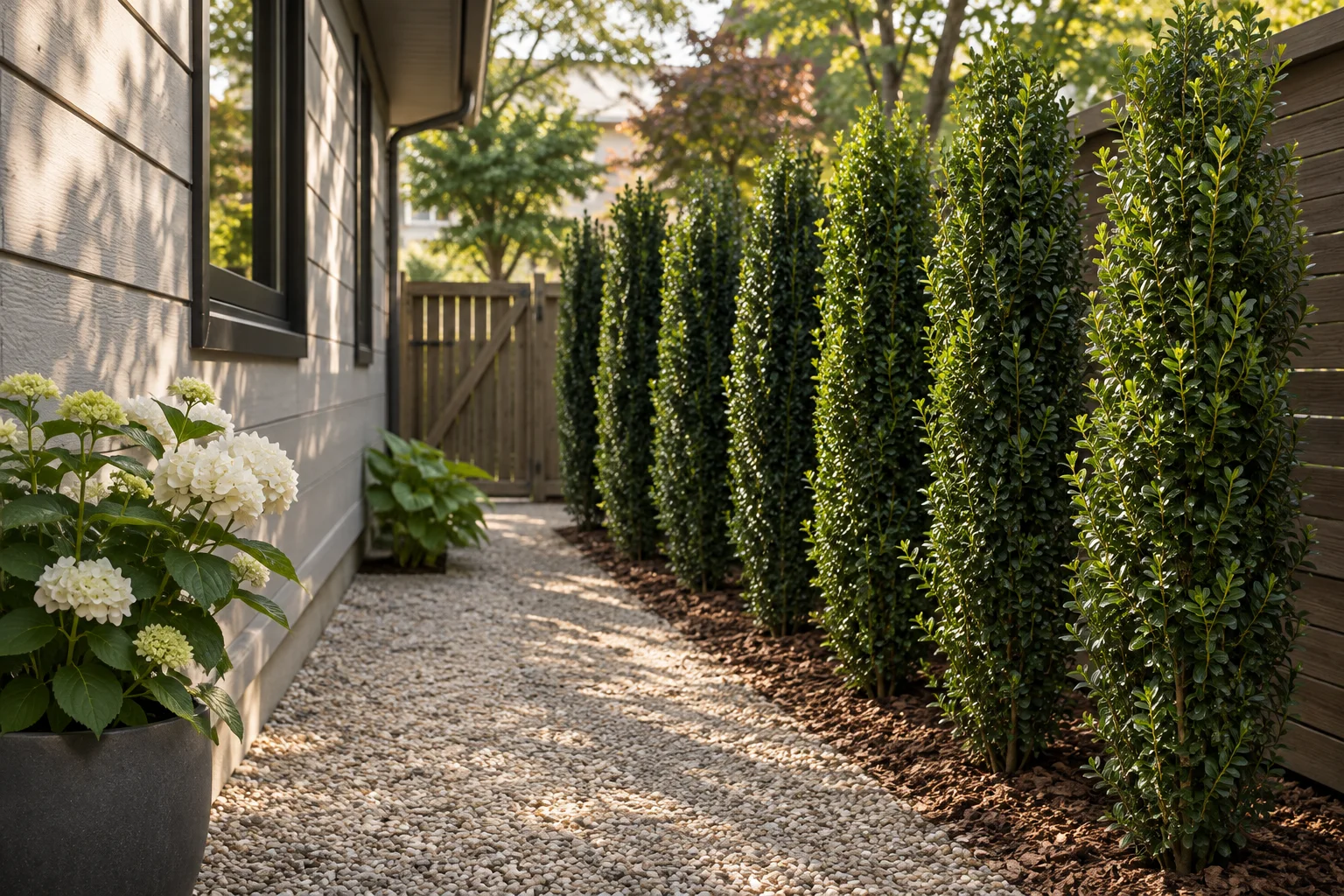
3. ‘Sky Pencil’ Japanese Holly (Ilex crenata ‘Sky Pencil’)
When the strip between your house and the neighbor’s is barely wide enough for a wheelbarrow, this is the plant. ‘Sky Pencil’ grows 4 to 10 feet tall but only 1 to 3 feet wide, a living fence post you plant in a row. It is hardy in zones 5 through 8, takes sun or part shade, and works in large containers, which makes it the renter’s pick for a patio edge.
It is slow and a little fussy: it wants acidic, well-drained soil, turns yellow in alkaline ground, and it needs wind protection and mulch. Like inkberry, it is a holly, so the same low-toxicity pet note applies.
- Berries: all plants are female, so you only get the hidden black fruit with a male Japanese holly nearby.
- Skip it if: your soil tests alkaline or the site is windy and exposed.
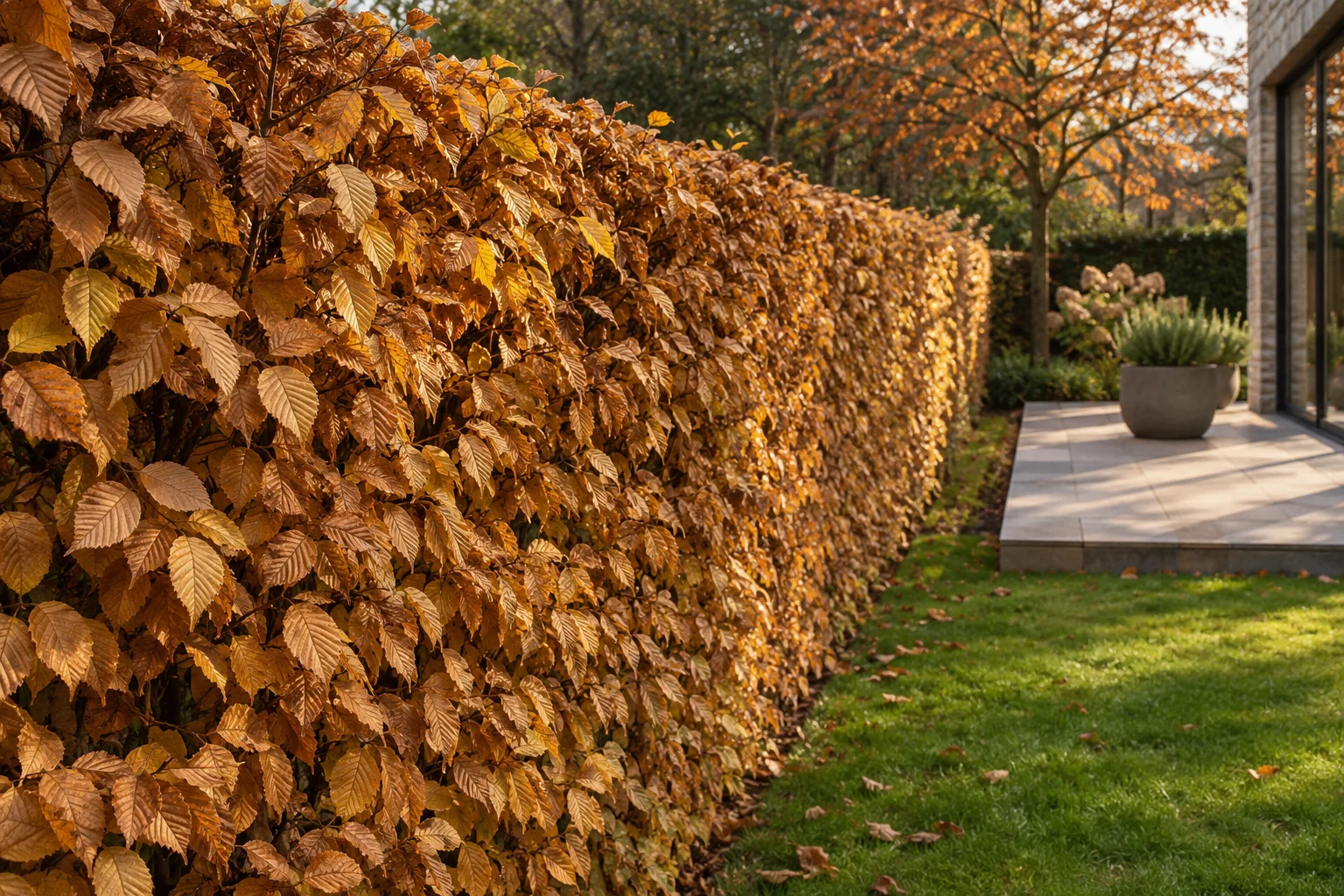
4. European Hornbeam (Carpinus betulus ‘Fastigiata’)
Hornbeam is the hedge you see in formal European gardens, and it is the deciduous answer to a clipped wall. The tree tolerates heavy pruning as a hedge, grows in sun or part shade across zones 4 through 8, and the upright ‘Fastigiata’ form is the one recommended for screening. Left alone it becomes a 40 to 60 foot tree, so a hornbeam hedge is a commitment to a yearly clip.
Picture a crisp, pale-green wall in summer that turns tan in fall and often holds its dry leaves well into winter, more cover than bare twigs. It is not widely sold, so call nurseries early and expect to order it.
- Soil: moist, well-drained loam or sand; tolerates clay and a wide pH range.
- Skip it if: you want a screen without an annual trim, or you cannot source plants.
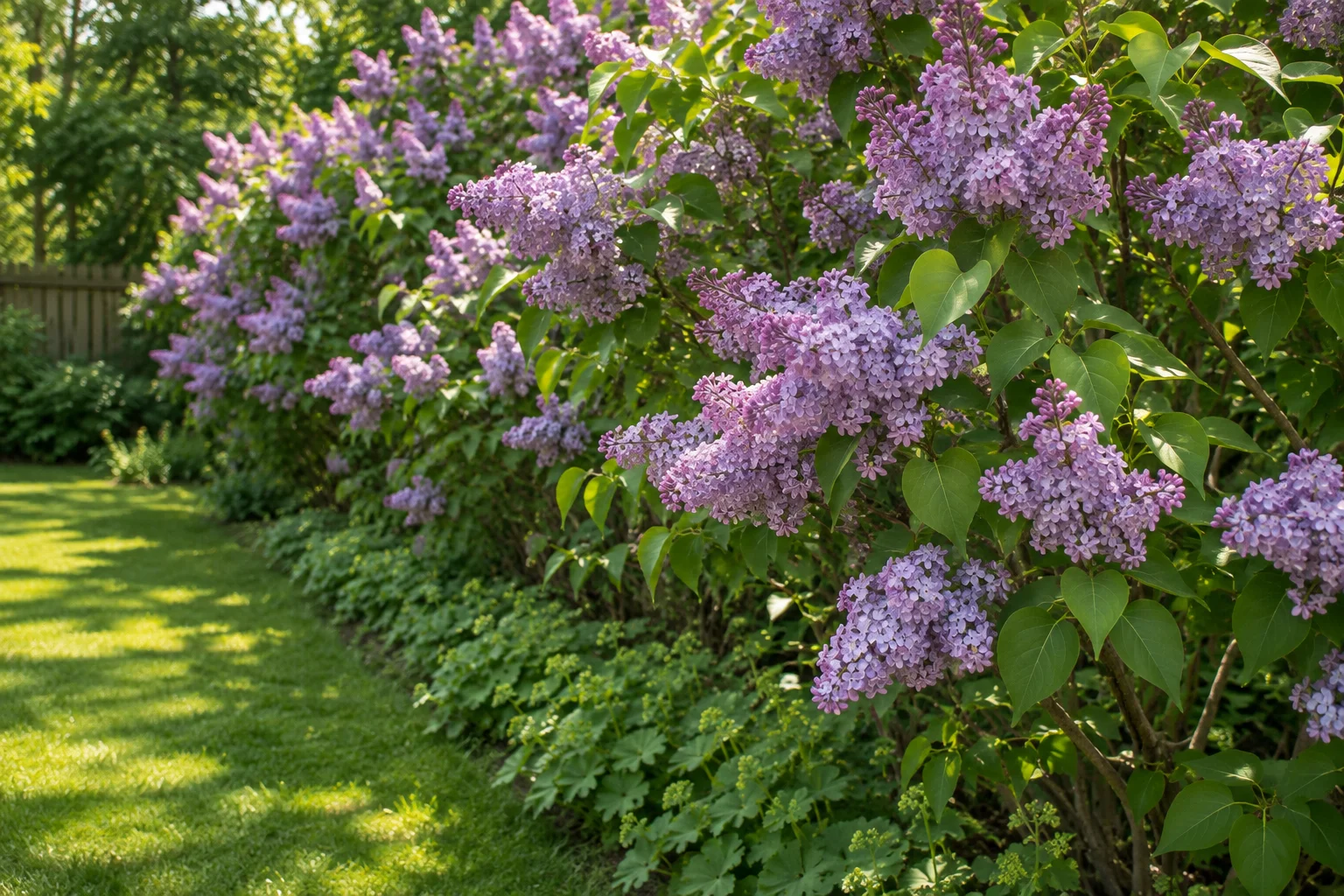
5. Common Lilac (Syringa vulgaris)
A lilac hedge trades winter privacy for two weeks of scent that drifts into every open window. Plants reach 8 to 16 feet tall and 6 to 12 feet wide in zones 3 through 7, and they grow fast to fill their space. Give them full sun and soil that drains; they resent acidic or soggy ground.
Lilacs get leggy at the base, so plan a lower shrub in front if you want cover to the ground. Powdery mildew whitens leaves in late summer but does little lasting harm, and the plants are deer resistant.
- Flowers: listed as edible for people.
- Skip it if: you need year-round cover, or you live in zone 8 or warmer.
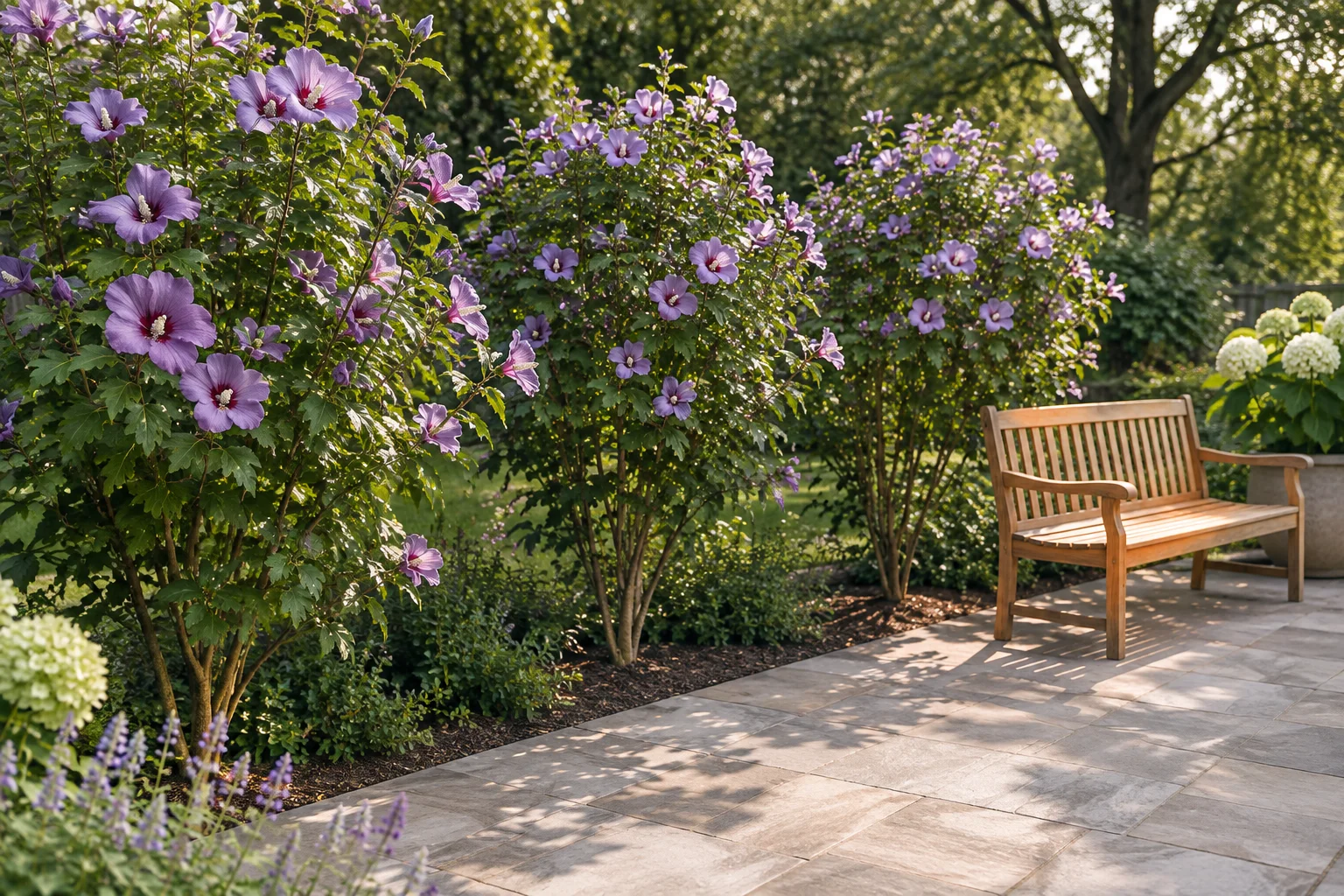
6. Rose of Sharon (Hibiscus syriacus)
If you want height fast and flowers from midsummer to frost, rose of Sharon is the quickest shrub on this list. It grows rapidly to 8 to 12 feet tall and 6 to 10 feet wide in zones 5 through 9, in sun or part shade, and the extension advice is to plant them 6 to 12 feet apart for a hedge; stay at the close end of that range if the goal is a screen rather than a row of separate shrubs. The 2 to 4 inch blooms come in white, pink, violet and purple, and the plant is listed non-toxic to dogs and cats.
The honest warning is seed. Rose of Sharon has been reported invasive in some states, including Virginia and Kentucky, because seedlings pop up wherever the capsules drop. Check your state’s invasive plant list before buying, and if it is allowed, choose a low-seed cultivar and deadhead what you can reach.
- Upkeep: rated high maintenance for the pruning and seedling pulling it asks for.
- Skip it if: your state lists it as invasive, or you need winter cover.
7. Serviceberry (Amelanchier canadensis)
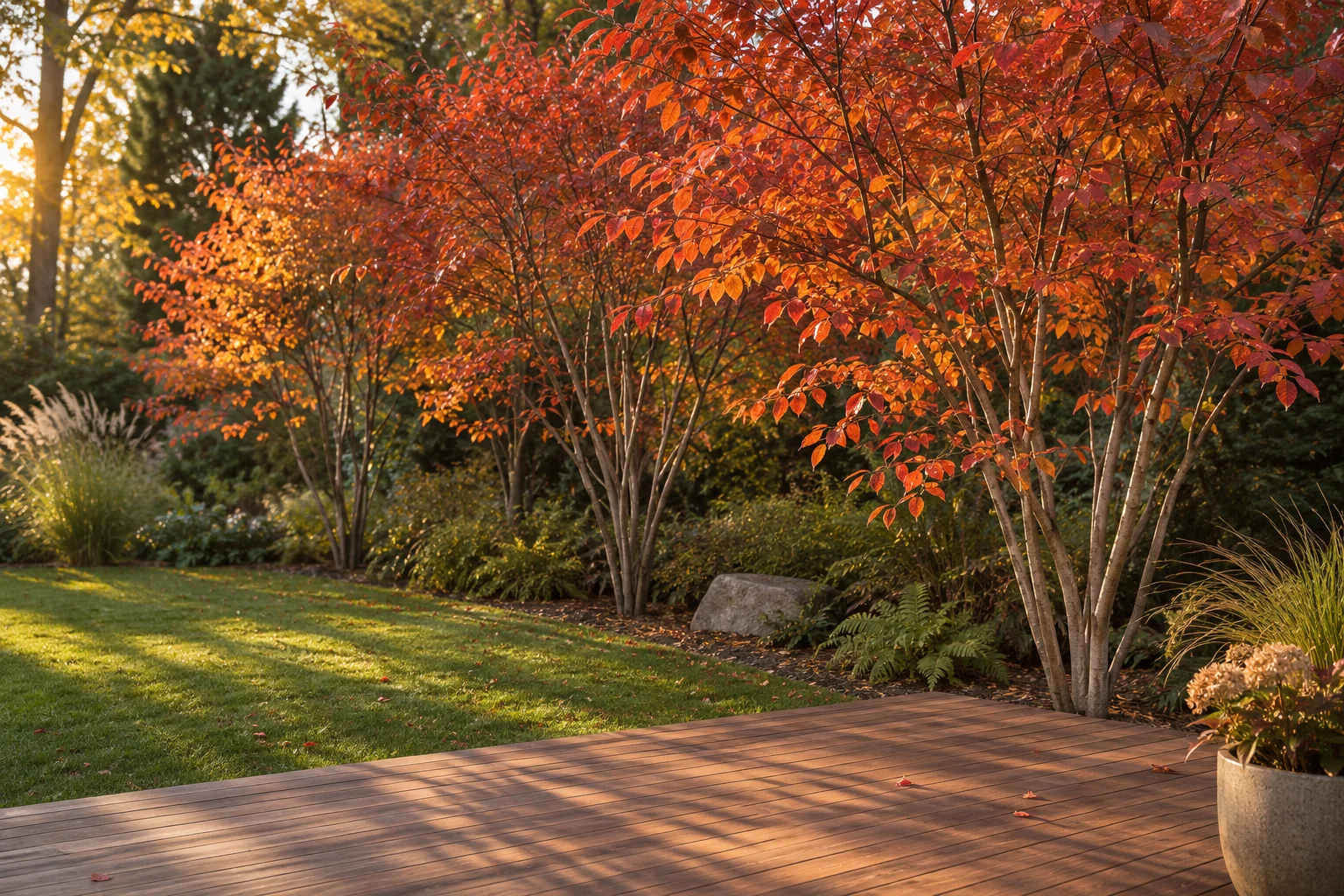
Serviceberry gives you a screen with a calendar: white flowers in early spring before the leaves, edible berries in early summer, and orange-red leaves in fall. The species grows 15 to 25 feet tall and nearly as wide in zones 3 through 8, so for a hedge choose the upright cultivar ‘Rainbow Pillar’, which stays narrow enough to plant in a line.
It prefers part shade, with afternoon relief in the South, and moist, well-drained sandy loam; it is not a plant for a hot, paved urban strip. Birds take most of the fruit, which is fine if you wanted the birds more than the pie.
- Skip it if: your site is full sun on compacted urban soil, or you need cover in winter.
8. Switchgrass (Panicum virgatum)
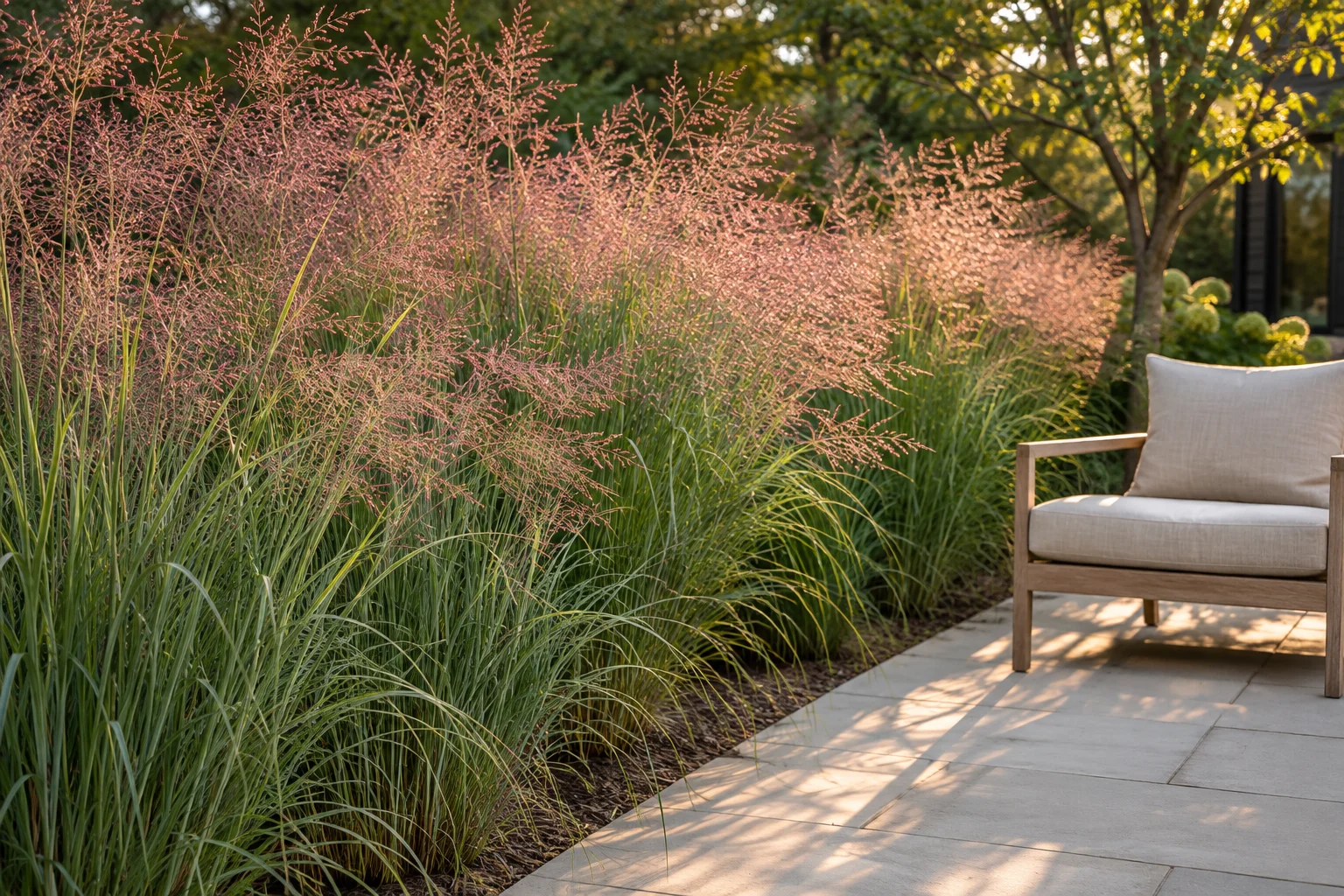
A patio only needs privacy when you are sitting on it, mostly summer evenings, which is exactly when switchgrass stands 3 to 7 feet tall. Massed in a double row it reads as a soft, moving curtain, pink seed plumes catching the low sun, and it is recommended specifically as a screen. This native prairie grass is hardy in zones 5 through 9 and happy in moist clay or sand that floods or dries out now and then.
Give it full sun; in part shade it flops. Cut the whole stand to the ground in late winter, which means the screen is gone from then until early summer, so pair it with an evergreen if you need cover in May.
- Fire: rated highly flammable, so keep it away from the house wall in dry regions.
- Skip it if: the spot gets less than full sun, or spring privacy matters.
9. Coral Honeysuckle (Lonicera sempervirens) on Wire Panels
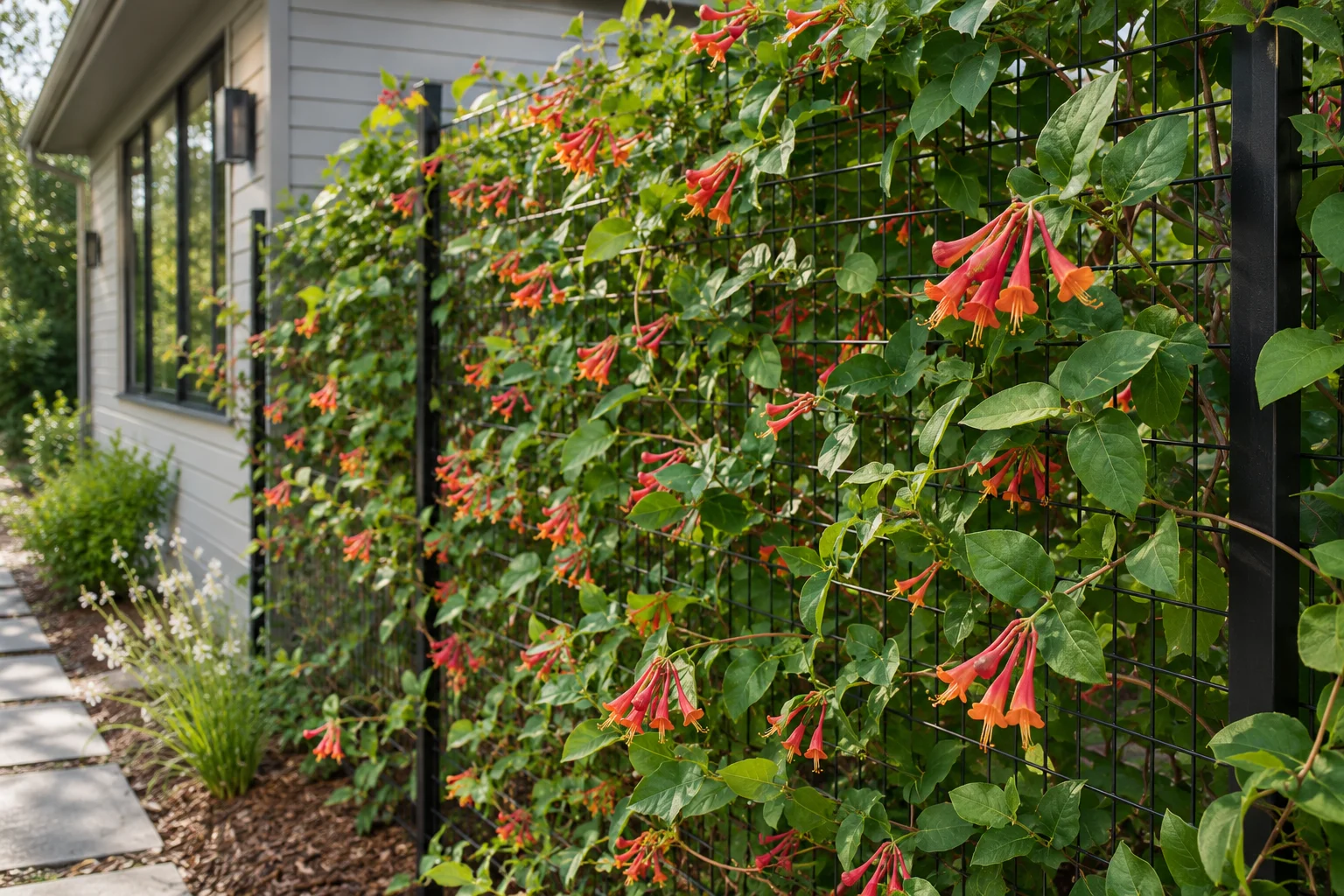
For a strip under 2 feet wide, grow the fence instead of the hedge: posts and welded-wire panels with a vine that covers them in a season or two. Coral honeysuckle is the native, well-behaved one. It climbs 10 to 20 feet, grows fast, flowers red-orange from spring into July for hummingbirds, and is hardy in zones 4 through 9. In the Deep South it keeps its leaves through winter; elsewhere it drops them.
Flowers are best in full sun, though it grows in some shade, in medium-moisture, well-drained soil. Powdery mildew and leaf spots show up in hot, humid summers. The small red berries are inedible.
- Fire: rated highly flammable, so this is a boundary vine, not a house-wall vine, in wildfire country.
- Skip it if: you want a leafy screen in a northern winter.
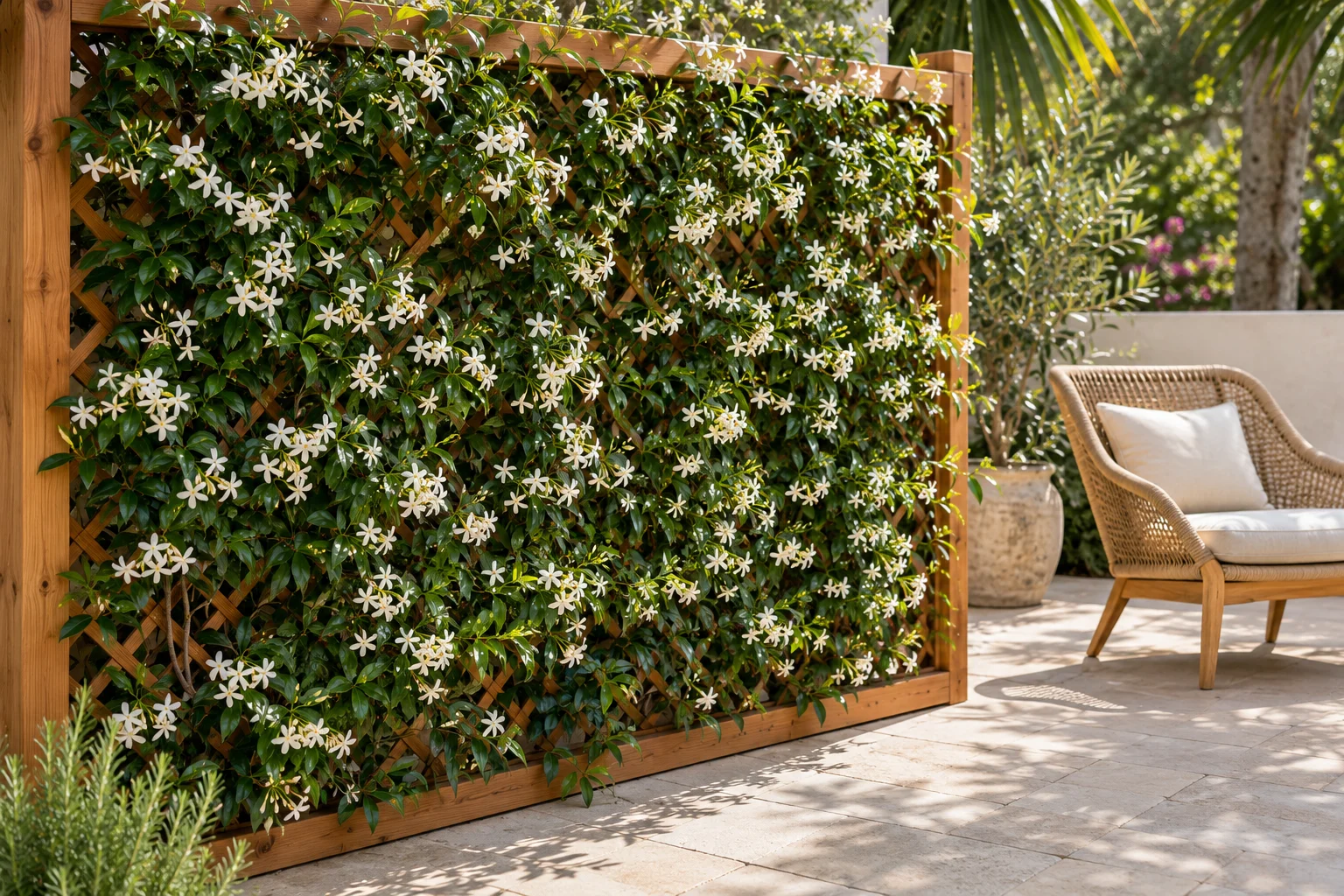
10. Star Jasmine (Trachelospermum jasminoides) on a Trellis
In zones 8 through 10 this is the evergreen vine that turns a trellis panel into a scented green wall. Star jasmine climbs 3 to 20 feet, grows fast, keeps its glossy leaves all year, and covers itself in creamy, fragrant flowers in late spring with a few through summer. It is recommended for screens on a trellis or fence, in sun or part shade, with the best flowering in a sheltered, sunny spot.
It is listed non-toxic to dogs and cats. The stems bleed a milky sap when cut, so wear gloves and clean your pruners after the trim that follows flowering. Colder than zone 8, grow it in a large container and bring it in for winter, or pick coral honeysuckle instead.
- Soil: fertile, moist and well drained; drought tolerant once established.
- Skip it if: you garden in zone 7 or colder and do not want to move pots.
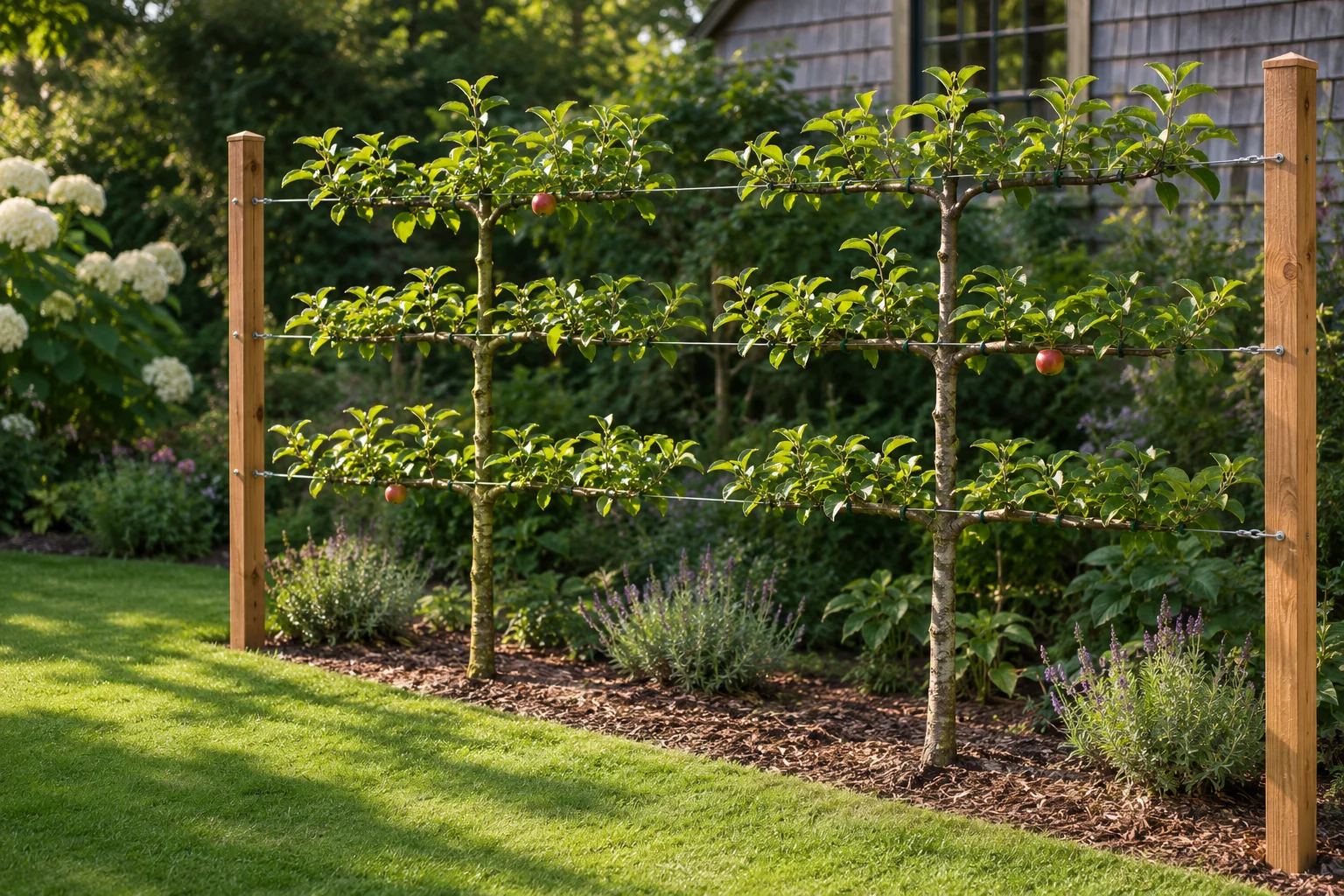
11. Espaliered Apple (Malus domestica)
An espalier is a fruit tree trained flat along horizontal wires, and a row of them makes a living fence that hands you apples. Apple and pear are the easiest trees to start with, and the setup is simple: posts with 12 or 14 gauge wire and turnbuckles, the first wire 15 to 18 inches above the soil and later wires 12 to 18 inches apart, with trees 6 to 8 feet apart. Three tiers is the usual pattern, and a simple design takes three or four years to form.
Be realistic about height. With those wire spacings the top tier of a three-tier espalier sits roughly 3 to 4.5 feet above the soil, which screens a seated view in the growing season, not a standing one. Add a fourth wire if you need more, and remember the branches are bare in winter.
Start with a bare-root tree no older than a year, keep it 6 to 8 inches off any wall, and make the structural cuts in late winter while it is dormant. Most apples need a second variety nearby for fruit, so plan the row as two kinds, and dwarf cultivars are easier to keep at wire height.
- Pets: apple stems, leaves and seeds contain cyanide-producing compounds that are toxic to dogs and cats, wilted prunings most of all, so bag the clippings.
- Skip it if: you want a screen with no yearly pruning, or the strip gets less than full sun.
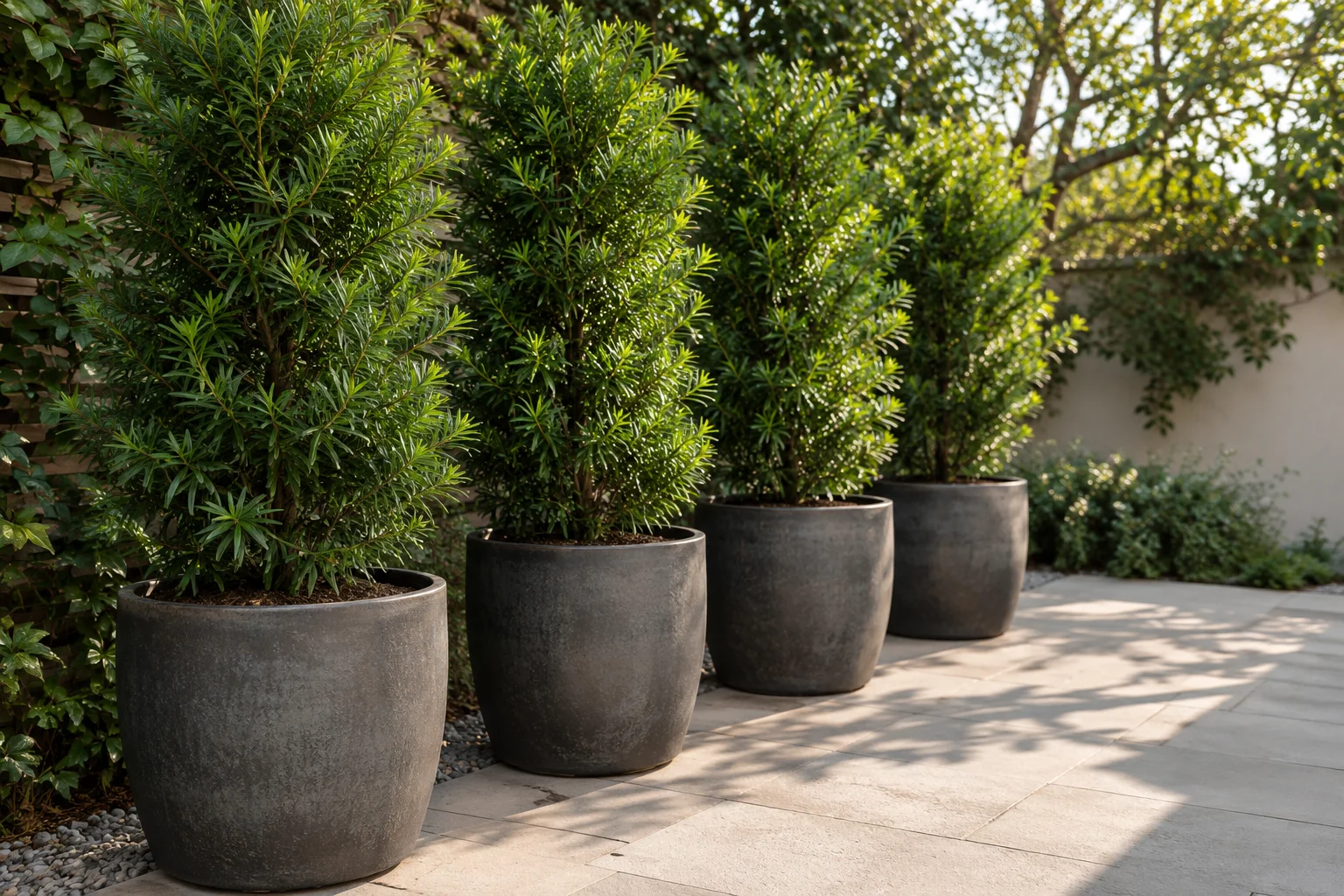
12. Podocarpus (Podocarpus macrophyllus)
Gardeners in zones 7 through 9 have a yew-like evergreen that is far less dangerous around pets: podocarpus, sold as yew pine or Buddhist pine. It suits large hedges, screens and containers, in sun or shade, and tolerates salt and drought once settled. Unpruned it becomes a tree; as a clipped hedge 6 to 8 feet tall it makes a soft, fine-textured wall, and in big planters it is the warm-climate renter’s screen.
It grows slowly, so start with larger plants, and it will not tolerate wet soil. The fleshy purple aril is edible but the seed inside is listed as a low-severity poison for cats and dogs, with vomiting and diarrhea as the signs, so rake up fallen fruit in a pet yard.
- Soil: rich, slightly acidic and well drained; leaves yellow in alkaline ground.
- Skip it if: you garden colder than zone 7, or the bed stays wet.
Privacy Plants to Skip
Privet is the hedge plant to leave at the nursery. Non-native privets (Ligustrum species) sit on invasive lists in a dozen states from Massachusetts to California, including Virginia, Kentucky and Georgia, because the seedlings form thickets that crowd out native understory. Fast and cheap, yes; also a plant your county may be paying to remove.
Leyland cypress and red-tip photinia are the other usual suspects. Both are overused, with a high chance of pest problems, which in a single-species screen means a brown gap you cannot fill. Barberry, burning bush and Tatarian honeysuckle are flagged as potentially invasive hedge plants too.
How to Pick the Right One for Your Yard
Measure the width you can give the screen, then count the hours of direct sun it gets, and most of the list falls away on its own. A strip under 3 feet wide takes ‘Sky Pencil’, a clipped yew or a vine on panels; a bed 6 feet or wider can hold lilac, rose of Sharon or serviceberry at full size.
- Soggy corner: inkberry or switchgrass. Dry, well-drained bank: yew or podocarpus.
- Year-round cover: yew, inkberry, ‘Sky Pencil’, podocarpus or star jasmine. Summer cover is enough: lilac, rose of Sharon, serviceberry, switchgrass or honeysuckle.
- Zone 8 or warmer: star jasmine and podocarpus join the list. Zone 4: Hicks yew, inkberry, hornbeam and coral honeysuckle still work, along with lilac and serviceberry. Zone 3: lilac and serviceberry only.
- Dogs or cats: for a pet household we’d start with rose of Sharon or star jasmine, both listed non-toxic, and leave yew off the plan.
- Renting: ‘Sky Pencil’ or podocarpus in large planters, or a vine on freestanding panels you can take with you.
Mix species unless you want a formal sheared line. A mixed hedge is more resilient to insects and disease, and it is easier to repair when one plant dies; the cost is that you cannot shear it flat. In deer country, start from our deer resistant plants and put a low shrub they ignore in front of anything they browse. A street-facing screen pairs well with the plants in our low maintenance front yard ideas.
One fire note covers three plants: inkberry, coral honeysuckle and switchgrass are rated highly flammable, so in wildfire regions plant them along the boundary, never against the house.
Planting and Care Basics
Spacing decides whether your screen closes in three seasons or eight, and the extension numbers are simpler than most nursery tags. Iowa State’s hedge guide puts formal sheared hedges at 1 to 2.5 feet apart, informal medium shrubs (6 to 8 feet tall) at 2 to 4 feet, and large shrubs (8 to 12 feet) at 4 to 6 feet. Big evergreen trees go 10 to 12 feet apart; if that looks thin, plant closer and cut out every other one in about five years, which is the extension trick for a dense screen sooner.
- Mark the line inside your property boundary, away from utilities and sidewalks, and confirm the height rules from the comparison section.
- Plant container or balled-and-burlapped shrubs in spring or in late summer to early fall, early enough for the roots to settle before the ground freezes. Bare-root stock goes in while it is still dormant, late March to mid-May in Iowa State’s guide, and gets cut back to 4 to 6 inches at planting if deciduous.
- Water deeply through the first one to two years. A soaker hose or drip line under 2 to 3 inches of mulch does this with the least effort.
- Shape every hedge slightly wider at the base than the top so light reaches the lower leaves; a hedge clipped narrower at the bottom goes bare there.
- Shear formal hedges two or more times a year. Informal and mixed hedges get a light prune after flowering, and grass gets its one cut in late winter.
Gaps are the common first-year problem. A dead plant in a single-species line is hard to match, so replace it with the largest matching plant you can find, or weave neighboring branches across the hole and tie them, the pleaching method extension guides suggest for thin spots. In a planter screen, roots freeze faster than in the ground; the winter steps in our evergreen porch planter guide apply to a ‘Sky Pencil’ or podocarpus in a pot.
Frequently Asked Questions
What is the fastest-growing privacy plant to use instead of a fence?
On this list, rose of Sharon is the fastest shrub: it grows rapidly to 8 to 12 feet. For a narrow strip, coral honeysuckle or star jasmine on a wire panel is quicker still, covering the panel in one to three seasons, and switchgrass returns to full height every summer. Fast is not always better: quick growers ask for more pruning, and two of the fastest hedge favorites, privet and Leyland cypress, are in the skip section for good reasons.
How far from the property line should I plant a privacy hedge?
Set each trunk back at least half the plant’s mature width, so the hedge fills out on your side of the line rather than your neighbor’s. A lilac that spreads 6 to 12 feet goes 3 to 6 feet inside the boundary; a ‘Sky Pencil’ holly at 1 to 3 feet wide can sit within 2 feet of it. Check for buried utilities before digging, and ask your planning office whether a local setback applies.
Do hedges count as fences under height rules?
Sometimes. Neither of the two city codes in this guide mentions hedges, but other towns and many HOAs do limit plant height along front yards and corners, and all of them care about sight lines at driveways. One call to the planning office before you order plants settles it, and it is far cheaper than removing a 10-foot hedge later.
Can a renter grow privacy plants instead of a fence?
Yes, with two routes that leave with you. ‘Sky Pencil’ holly in zones 5 through 8, or podocarpus in zones 7 through 9, lives for years in a large planter and lines up into a movable evergreen screen. In colder zones, or for a wider gap, stand freestanding wire or lattice panels in weighted bases and grow coral honeysuckle or star jasmine over them. Planter roots freeze faster than ground roots, so follow the winter steps in the care section.
How long until a hedge gives real privacy?
Several growing seasons for most shrubs, one to three for a vine on panels, and every summer from the first year for a grass screen. The slow plants here, yew, ‘Sky Pencil’, inkberry and podocarpus, take the longest, which is why the care section suggests planting closer and removing every other plant after about five years. Buying the largest plants you can afford shortens the wait more than any fertilizer will.
Which privacy plants on this list are safest for dogs and cats?
Rose of Sharon and star jasmine are the two that the ASPCA lists as non-toxic to dogs and cats. Lilac, serviceberry, switchgrass, coral honeysuckle and hornbeam are not on its lists, which means no listing either way, so ask your vet if your pet chews plants. Yew is the one to leave out of a pet yard entirely, and holly, apple foliage and podocarpus seeds all carry listed warnings.
Can I plant a privacy hedge in the fall?
Yes, for container-grown or balled-and-burlapped shrubs: late summer to early fall is one of the two recommended windows. If the ground where you live is already close to freezing, hold the order until spring instead. Bare-root plants go in from late March to mid-May. Water deeply after planting and keep 2 to 3 inches of mulch over the roots through winter, then start the shaping cuts next year.
What Actually Matters
A fence buys privacy today; privacy plants instead of a fence buy it over a few seasons and then give you flowers, birds, wind protection and a boundary that never needs staining. Choose by the width and sun you actually have, keep yew out of a pet yard, and plant a mix rather than a single clone.
The priority this week is the rules check: one call to the planning office and one look at the HOA documents, before a single plant is ordered. Then plant in the next window, spring or late summer to early fall, with the spacing from the care section, and let the hedge do the rest. More yard-scale ideas live in our garden design section.
Sources
- Washington State University Extension – Privacy Screens – living fence versus built fence, base-wider shape, pleaching, rules check, Hicks yew height
- Iowa State University Extension and Outreach – Selecting and Planting Hedges – spacing by hedge type, planting windows, water and mulch, shearing, mixed hedges, invasive hedge plants
- Colorado State University Extension – Hedges – property line and utility checks, first-season irrigation, lilac mildew
- NC State Extension, Polk County – Privacy Matters: Screening Plants to Consider – evergreen spacing, overplant-and-thin, Leyland cypress and photinia, grasses as screens
- NC State Extension Gardener Plant Toolbox – pages for Taxus x media, Ilex glabra, Ilex crenata ‘Sky Pencil’, Carpinus betulus, Syringa vulgaris, Hibiscus syriacus, Amelanchier canadensis, Panicum virgatum, Lonicera sempervirens, Trachelospermum jasminoides, Podocarpus macrophyllus – zones, sizes, sun, soil, hedge use, flammability, toxicity
- UC Marin Master Gardeners – How to Espalier – wire heights and spacing, tree spacing, pollination, pruning
- University of Wisconsin-Madison Extension – Espalier – tiers, wall distance, years to form
- ASPCA Animal Poison Control – Toxic and Non-Toxic Plants (Yew, Holly, Apple, Rose of Sharon, Star Jasmine, alphabetical lists) – pet listings
- University of Illinois Extension – Invasive Privet – state lists for Ligustrum
- City of Alameda, CA – Fence Regulations; City of Tempe, AZ – General Fence and Wall Height Standards – example fence height limits.