
You’ve got a railing, one sunny corner and a lease that says no holes in the walls. Meanwhile the packet of pea seeds on your kitchen counter promises vines that climb past your head. Something has to give, and it doesn’t have to be your security deposit.
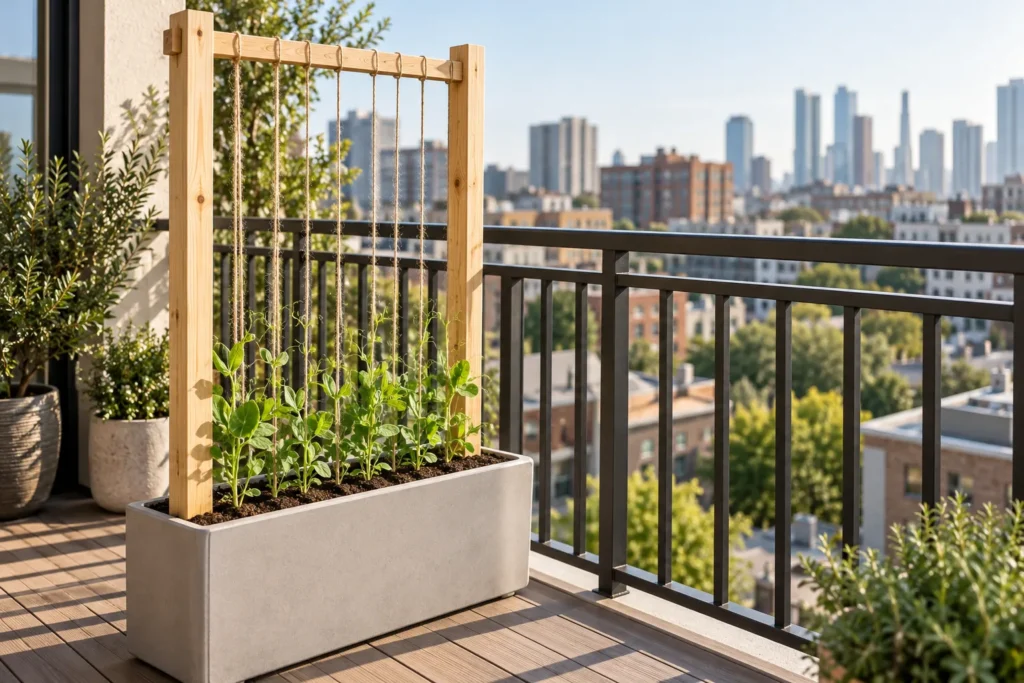
These DIY trellis ideas for small balcony setups all stand on their own, so the plant gets a ladder and your walls stay untouched. The main build is a two-post frame anchored in its own planter: the soil does the holding, and you can finish it in an afternoon. If you want more no-drill projects after this one, browse these balcony garden ideas for renters.
Below you’ll find the materials, seven build steps, which climbers suit which support, when to plant each one this spring and four alternative builds for awkward spaces.
Table of Contents
At a Glance
- Anchor the frame inside a wide, square or rectangular planter, so the weight of the soil holds it steady without drilling.
- Give each bean or pea plant about 5 gallons of potting mix, in a planter at least 12 inches deep.
- Use string or netting with openings no wider than 4 inches.
- Sow peas in early spring; hold beans and cucumbers until the soil warms.
- Check every climber against the ASPCA plant list before buying if you share your home with cats or dogs.
This build suits renters with at least 6 hours of direct sun on the balcony. Skip it if your building bans freestanding structures, and on a very windy, exposed floor choose the short pot teepee in Variations instead.
What You’ll Need
Most of this kit comes from a hardware store garden aisle, and nothing on the list needs a drill bit anywhere near your walls. The only cutting involved is trimming wood or netting to length.
| Item | Why you need it | Cost level |
|---|---|---|
| Square or rectangular planter with drainage holes, 12 or more inches deep | Holds the frame upright and resists tipping | Mid-range |
| Two wooden stakes, at least 1 inch square and 5 to 6 feet long (or two thick bamboo poles) | The uprights of the frame | Low-cost |
| One crossbar: a stake or bamboo pole cut to the planter’s length | Joins the uprights and carries the strings | Low-cost |
| Exterior-grade screws or heavy-duty zip ties | Fasten the joints | Low-cost |
| Sisal, cotton or hemp twine, or plastic trellis netting | The surface the plants actually climb | Low-cost |
| Commercial potting mix | Drains well and stays light enough for containers | Mid-range |
| Saucer or drip tray sized to the planter | Catches runoff before it reaches the balcony below | Low-cost |
| Gloves and eye protection | Needed if you cut wire mesh, which leaves sharp ends | Low-cost |
Those stake measurements follow extension guidance for vegetable supports: wooden uprights 5 to 6 feet long and at least 1 inch thick have enough strength to carry a vine heavy with pods. Thinner garden canes bend once the plants fill in.
A quick word on wood if you plan to grow food. Older lumber treated with CCA (chromated copper arsenate) has been off the residential market since 2004, and newer ACQ-treated lumber is considered safe for food gardens. Still, untreated wood or bamboo is the simplest choice, since it skips the question entirely and lasts a season or two without trouble.
Step-by-Step: DIY Trellis Ideas for Small Balcony Builds, Starting With the Pot-Anchored Frame
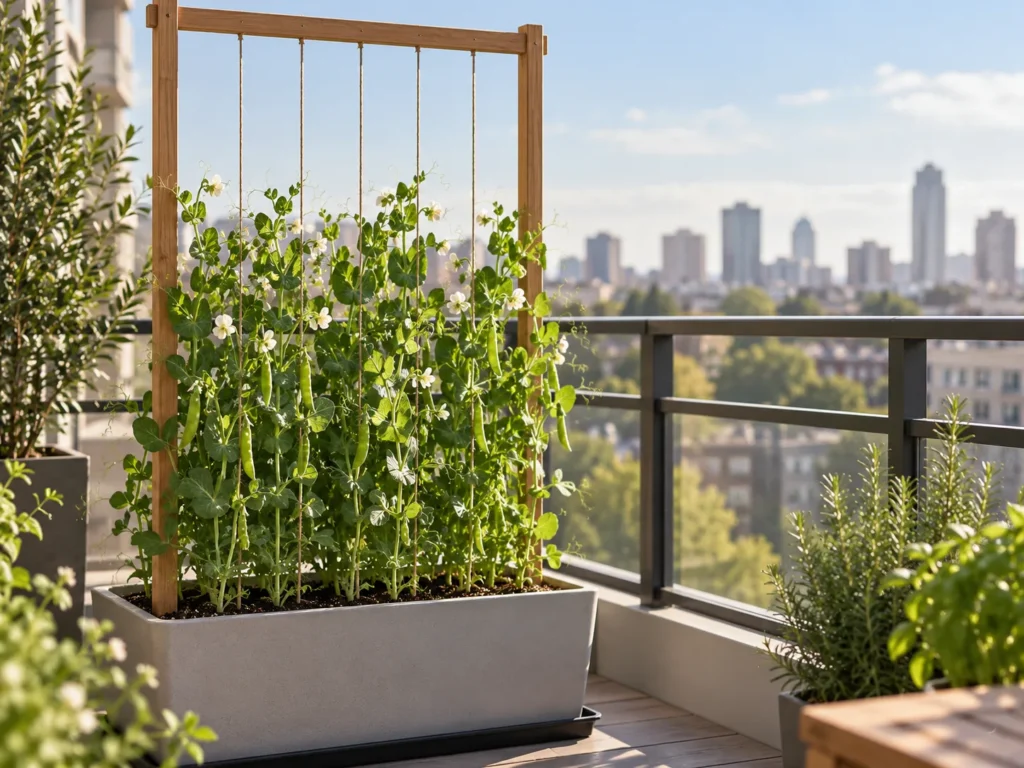
This build is an H-shaped frame of two posts and a crossbar that stands inside its own planter. The soil does the anchoring, the frame stays inside your railing, and the whole thing comes apart at the end of the season.
Step 1: Check Your Lease, Sun and Wind
Start with paperwork, which is the least fun part and the one that saves the most grief. Read your lease or HOA rules for anything about balcony structures, planters or items above railing height, and ask building management if the wording is vague.
Weight matters more than most beginners expect. A 20-inch pot filled with moist potting mix can weigh about 100 pounds, and a long planter for a trellis can be heavier still. Ask your building about the balcony’s load limit before you fill a large container, and set it near the wall rather than at the outer edge.
Next, count your sun. Fruiting crops such as beans and cucumbers want 6 to 8 hours of direct sun, and south- and west-facing balconies usually get the most. Spend one clear day noting when light first hits your chosen corner and when it leaves.
Then think about wind and neighbors. On a high floor or an exposed corner, a tall frame catches gusts like a sail, so plan a shorter build and bush-type varieties, or browse these plants that handle high-rise wind. Water that drains from your planter can drip onto the balcony below, so a drip tray belongs in the plan from day one. Keep the whole trellis inside the railing line and clear of doors and walkways.
Step 2: Choose a Planter That Won’t Tip
Pick a square or rectangular planter with straight sides and a broad base, heavy enough once filled to balance the frame and the vines above it. Tapered pots that narrow at the bottom are the ones that topple, because the heavy top growth sits over a small footprint.
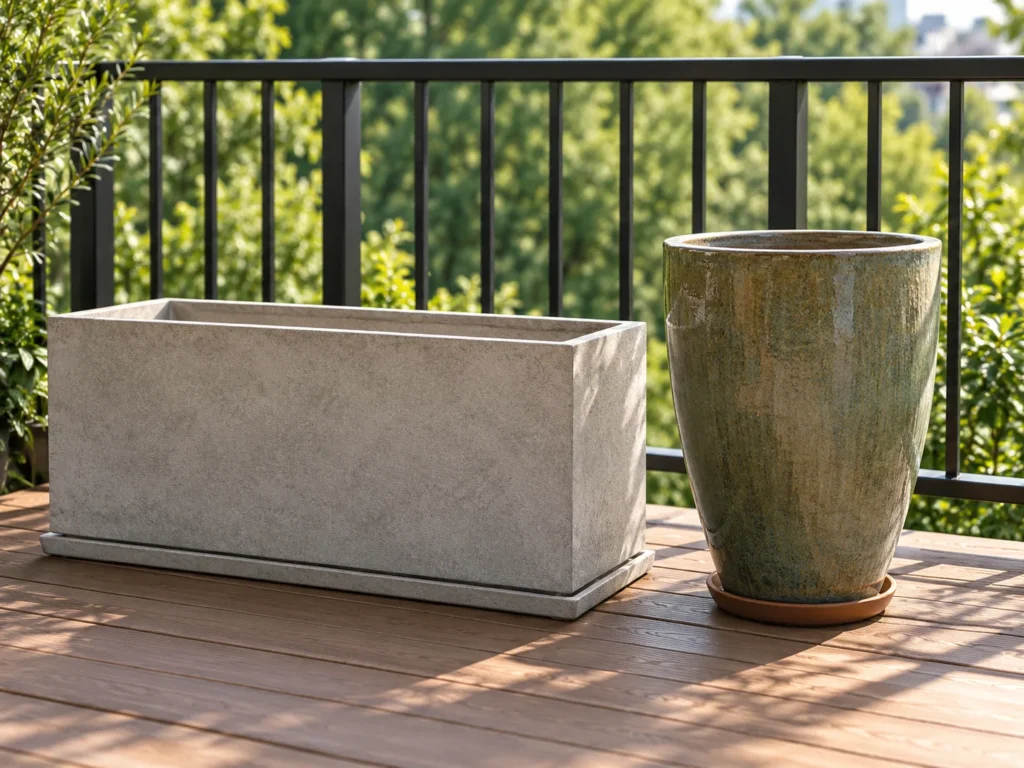
Size it by the number of plants. Oregon State University Extension recommends one bean or pea seedling per 5-gallon container, at least 12 inches deep, so budget about 5 gallons of mix for each plant you want on the frame. A planter holding roughly 20 gallons gives four climbers room to root.
Color counts in full sun. Dark containers can run 20 to 30°F hotter than the surrounding air, which stresses roots near the walls of the pot. On a sunny balcony, choose a light-colored planter, or shade a dark one by standing a smaller pot or a low board in front of its sunniest side.
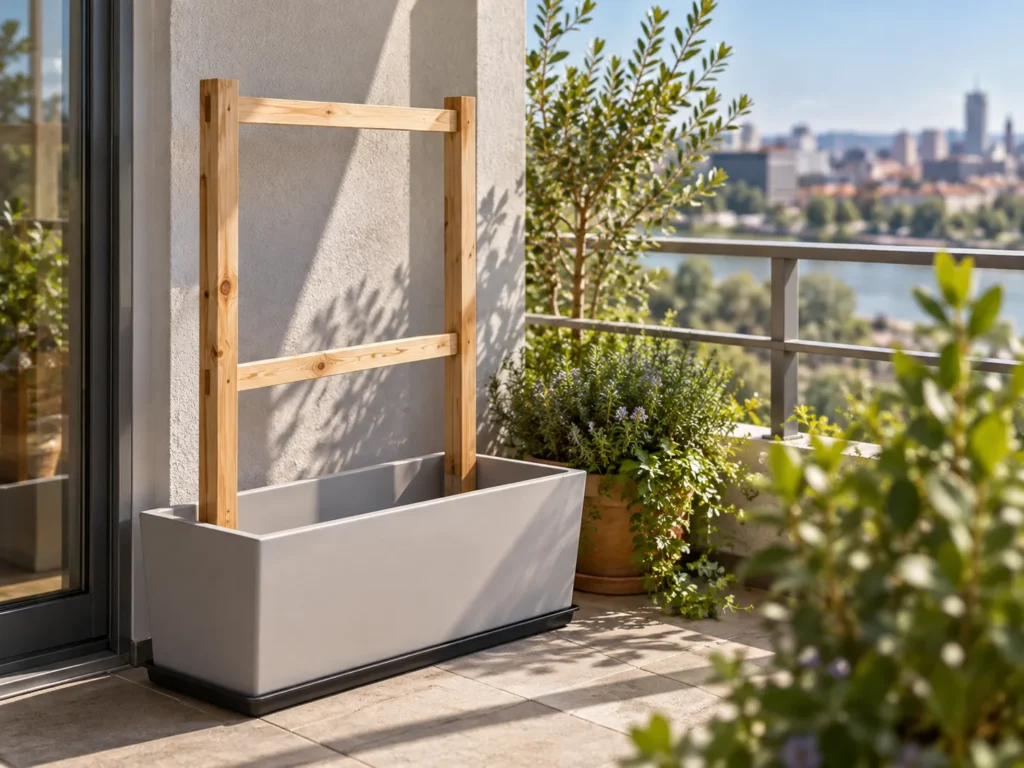
Step 3: Build the H-Frame
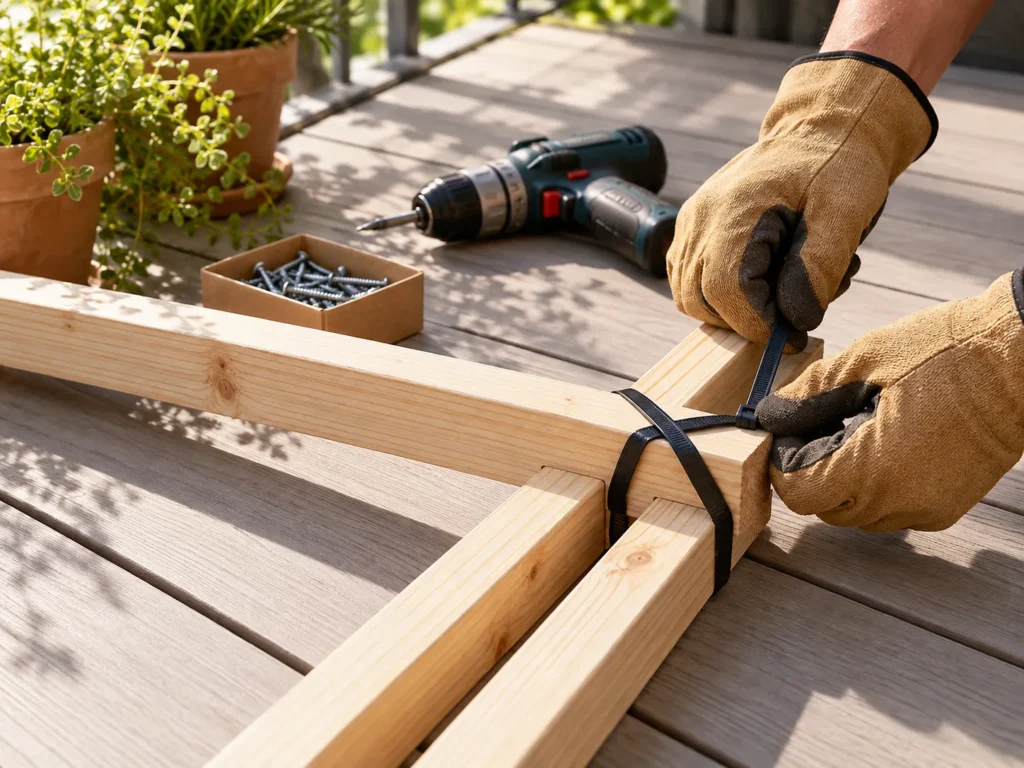
Lay the two stakes on the floor, parallel, as far apart as the inside length of your planter allows. Fasten the crossbar across their tops with two exterior screws per joint, or with two heavy zip ties wrapped in an X pattern if you’d rather skip the screwdriver.
For extra rigidity, add a second, lower crossbar a few inches above where the soil line will sit. It keeps the uprights parallel and gives you a second anchor point for strings. This frame holds climbing plants, which makes it a different project from a no-drill vertical garden wall, where the frame carries planters instead.
Step 4: Set the Frame Before Adding Soil
Stand the empty planter in its final spot first, because it gets very hard to move once full. Then lower the frame in so the base of each stake rests on the floor of the planter, at opposite ends.
Supports go in at planting time, before any roots exist to damage. Pushing a stake through an established root system later tears roots and leaves the frame sitting in loose soil.
Step 5: Fill With Potting Mix and Water It In
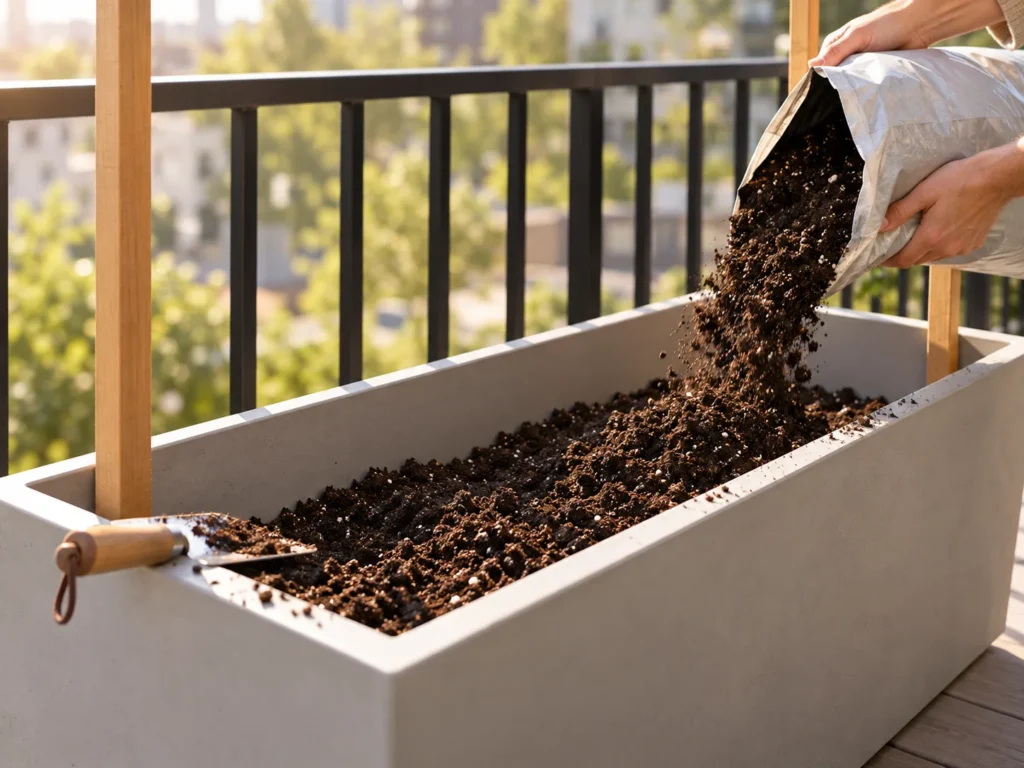
Fill the planter with commercial potting mix, never soil dug from a garden bed, which packs down hard in containers and drains poorly. Confirm the drainage holes are open before you start.
Add the mix in layers, firming each one gently around the stakes with your hands. Stop about an inch below the rim, then water slowly until it runs from the drainage holes. The mix will settle, so top it up and firm it again.
Now give the frame a gentle push from the side. A slight flex is fine; if the whole frame rocks, firm the mix around the stakes again. On an exposed balcony, also strap the planter to the railing with a ratchet or webbing strap looped around it, which holds it steady without a single screw.
Step 6: String Twine or Hang Netting
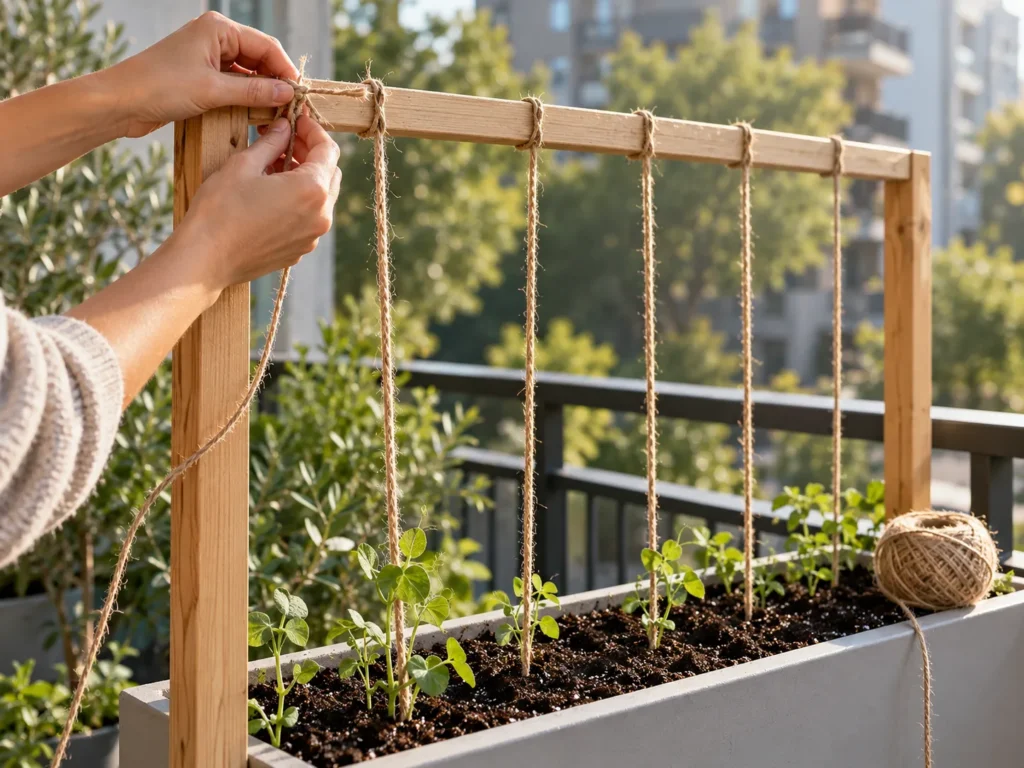
Tie vertical lines of twine from the top crossbar down to the lower crossbar, or to a short stake pushed into the soil beneath each line. Space them a few inches apart so every plant has its own line, and pull each one snug enough that it doesn’t sag.
If you prefer netting, choose a mesh whose openings are no wider than 4 inches, then tie it to the crossbars at each corner and every foot or so between. That size gives tendrils plenty to grab while leaving room for your hand when you harvest.
Natural sisal, cotton or hemp twine has a bonus at season’s end: you can cut the whole tangle of dead vines and string free and compost it together. Plastic netting must be picked clean of vines before reuse. If you cut wire mesh instead, wear gloves and eye protection, since the cut ends are sharp.
Step 7: Plant and Start Training
Sow seeds or set seedlings along the base, one beside each line or a few inches apart under netting, following the timing in How to Use It. Water them in gently so the mix stays level.
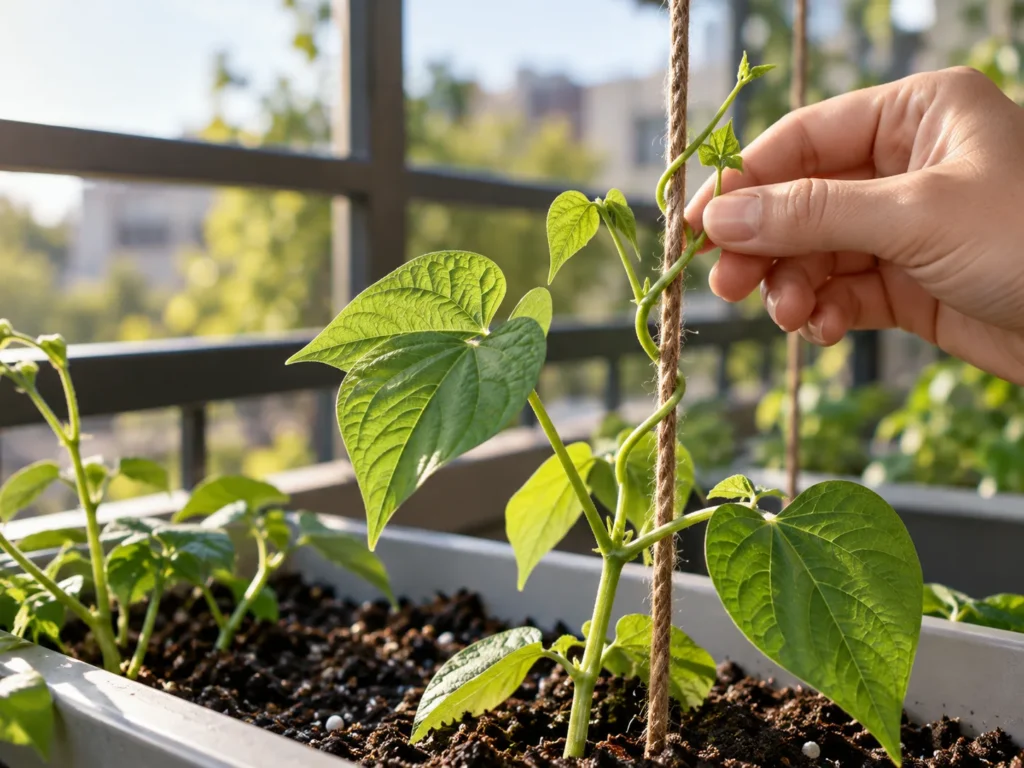
Young plants often need a nudge to find their support. Every few days, loosely weave the growing tips through the netting or wrap them around the twine, which takes about two minutes. Once the first tendrils or stems take hold, the plants mostly climb on their own.
How to Use It
A trellis works when the plant on it matches the support, the season and your space. The biggest factor is how the plant grabs on: tendril climbers like peas need thin string or netting they can coil around, while twining climbers like pole beans wind their whole stem around a line or pole.
| Climber | How it climbs | Typical height | When to plant in spring |
|---|---|---|---|
| Pea (Pisum sativum) | Tendrils; grabs thin string or netting | Tall types up to 5 ft; bush types 2 to 3 ft | As soon as the soil can be worked |
| Pole bean (Phaseolus vulgaris) | Twining stem; wraps twine or poles | 6 ft or more | Once the soil has warmed |
| Cucumber (Cucumis sativus) | Tendrils; needs some guiding onto the frame | Grows well on a 3 to 4 ft trellis | After your last frost, with soil at least 70°F at 1 inch deep |
| Climbing nasturtium (Tropaeolum majus) | Twining | Up to 10 ft | After frost danger passes; a warm-weather annual |
For a first trellis, we’d start with tall peas, because they go in earliest, climb by tendrils that suit twine perfectly and stay within the frame’s height. They also clear out by early summer, since peas stop flowering once temperatures climb above 85°F. That timing opens a neat sequence: sow peas now, then plant beans or cucumbers along the same lines once the soil warms, and pull the peas when they finish.
Cucumbers bring their own care details, from pollination to pot size. This guide to growing cucumbers vertically in pots covers them in full.
Pet Check Before You Plant
Several popular ornamental climbers are risky in a pet household, and with a cat and a dog in my own apartment, this is the step I’d never skip. Look up the exact species on the ASPCA list before you buy, since common names get shared between very different plants.
- Morning glory (Ipomoea spp.) is listed as toxic to dogs and cats.
- Clematis (Clematis spp.) is also toxic to dogs and cats.
- Sweet pea (Lathyrus odoratus) has poisonous seeds and shouldn’t grow near edible peas, where the pods are easy to mix up.
- Nasturtium is listed as non-toxic by the ASPCA, but some horticultural references still flag it as a problem for pets, so keep it out of reach if your cat or dog chews plants.
Non-toxic doesn’t mean a pet can graze on it freely, either. If a pet eats part of any plant and seems unwell, call your veterinarian.
Training, Ties and Watering
Keep weaving stray tips onto the support every few days through spring, as in Step 7. Check any ties on heavier stems while you’re there and loosen them if they’re cutting in; soft cloth strips or loose twine loops work better than tight wire.
Containers on a sunny, breezy balcony can dry out fast, especially once the vines fill the frame. Check the mix daily by pushing a finger an inch down, and when it’s dry, water until it runs from the drainage holes into the tray. Empty the tray afterward so roots don’t sit in water and it doesn’t overflow onto the balcony below.
Troubleshooting
Vines sprawl at the base instead of climbing. Usually the support is the wrong thickness for the plant: pea tendrils can’t wrap a thick pole, so add twine or netting. A second cause is simply that the plant hasn’t found the line yet; guide the tips by hand for a week.
The frame leans or rocks after wind or watering. Most often the mix hasn’t settled, so top it up and firm it around the stakes. If the planter itself tips, it’s probably too narrow or tapered for the frame’s height; switch to a wider, straight-sided planter, shorten the frame or move it somewhere more sheltered.
Leaves wilt at midday. Check the mix first; dry soil is the likely cause on a trellis. If the soil is moist, look at the pot: a dark planter in afternoon sun can overheat roots, so shade it as described in Step 2.
Cucumbers get wedged in the netting. Fruit that grows through a mesh opening can get stuck and misshapen. Check the vines every day or two once fruit forms and ease young cucumbers back to the front of the netting.
Cucumber flowers drop without fruit. Male flowers open first, so early drop is normal. If it continues, cool cloudy weather or few visiting pollinators may be the cause; patience usually fixes it as weather warms.
Peas stop producing in early summer. That’s heat, which is expected. Pull them and plant beans or cucumbers on the same lines, and sow earlier next spring.
Variations
If the two-post frame doesn’t suit your balcony, these four builds handle other spaces and climbers. Pick by your balcony’s conditions first and your plant second.
| Trellis | Best for | Balcony condition | Renter note |
|---|---|---|---|
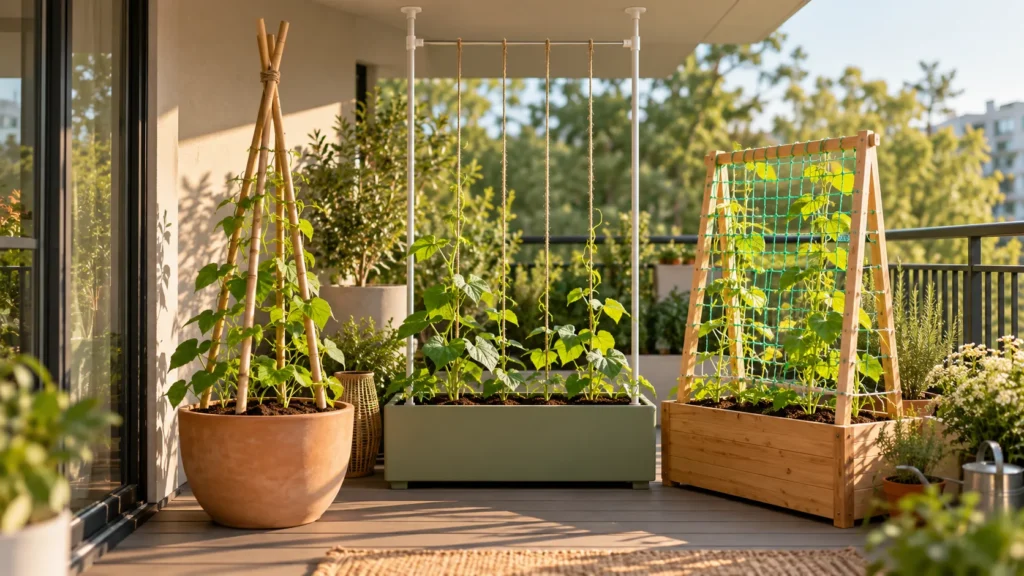
| Bamboo teepee in a pot | Pole beans, peas | Windy or tiny spaces; keep it short when exposed | Fully self-contained |
| Tension-rod string trellis | Light annual climbers | Covered balcony with a solid ceiling or overhang | No holes; stay within the rod’s load rating |
| Freestanding A-frame or lattice panel | Heavier vines such as cucumbers | Floor space for a wider footprint | Freestanding; check rules on screens |
| Upcycled ladder | Decorative and light climbers | Sheltered corners | Strap it so wind can’t topple it |
Bamboo Teepee in a Pot
Push three or four bamboo poles to the bottom of a round or square pot, lean them together and tie the tops with twine. A three-pole tripod suits pole beans well, since their twining stems climb the poles without any string. In wind, keep the poles short and choose bush peas, which top out at 2 to 3 feet.
Tension-Rod String Trellis
This one needs a covered balcony, because the rod presses between a solid ceiling or overhang and the floor or a heavy planter. Tie twine from the rod down to the soil for light annual climbers. Follow the product’s load rating, pad the ends so they don’t mark the ceiling, and recheck the rod’s tension every week or two.
Freestanding A-Frame or Lattice Panel
Two panels hinged at the top, or a lattice panel set in a long planter, carry heavier crops such as cucumbers, which do well on a 3 to 4 foot frame. The wider footprint makes it steadier but takes floor space. These budget balcony ideas include a freestanding screen version.
Upcycled Ladder Trellis
An old wooden step ladder or narrow ladder shelf makes a charming frame for light climbers, with planters set at its feet. Ladders aren’t built for wind loads, so strap one to the railing and keep it in the most sheltered corner you have.
Frequently Asked Questions
How tall should a balcony trellis be?
For most DIY trellis ideas for small balcony spaces, a frame about 5 to 6 feet tall is enough. That height carries tall peas, which top out around 5 feet, and gives cucumbers more than the 3 to 4 feet they need. Pole beans can outgrow it, so let the extra growth drape back over the crossbar. On a windy, exposed floor, go shorter and grow bush types instead.
Can I grow tomatoes on this trellis?
Yes, as long as you tie them. Tomatoes don’t climb by tendrils or twining stems, so they won’t grab the twine on their own. Set the support at planting time, then fasten the main stem loosely with soft cloth strips as it lengthens. Like beans and cucumbers, tomatoes are warm-season crops that want 6 to 8 hours of direct sun, so plant them after your last frost.
Will a trellis planter stain my balcony floor?
It can. Water draining from a container can stain concrete and wood decking, and the same runoff is what drips onto the balcony below. A saucer or drip tray under the planter prevents it, as long as you empty it after watering. Self-watering containers solve the problem too, since they hold the excess water inside the pot.
Can I grow sweet peas if I don’t have pets?
You can grow them for flowers, but treat them as ornamental only. Sweet pea seeds and pods are poisonous to people, and the plant is easy to confuse with edible garden peas. If you also grow edible peas, give the sweet peas their own planter on another part of the balcony, and keep them out of reach of small children.
What should I do with the trellis at the end of the season?
Take it apart and store it indoors or under cover until spring. Cut the spent vines free first (natural twine can go to the compost with them), then rinse the stakes and let them dry before storing. Untreated wood and bamboo usually last a season or two, so check the bases for soft or rotted spots before you set the frame up again.
What Actually Matters
A balcony trellis succeeds when it stays put, suits the plant and fits your building’s rules. If you remember one thing, make it the planter: a wide, straight-sided container full of settled mix is what turns a few sticks into a frame that survives a gusty afternoon.
Your next step this week is the sun count and the lease check from Step 1. Once both look good, gather the materials and get peas in while the weather is still cool.
If this first climber goes well, these beginner container vegetables make good company on the rest of the balcony.
Sources
- University of Maryland Extension – Growing Vegetables in Containers – sun hours for warm-season crops, south and west exposures, wet pot weight, deck staining, saucers and self-watering containers, drips onto neighbors
- Oregon State University Extension – Container Gardening Basics – container volume and depth, one bean or pea per 5 gallons, potting soil, drainage, daily soil checks
- University of Illinois Extension – Containers – container weight in proportion to top growth, wind tipping, dark pots and root heat
- NC State Extension, Swain County – Hot Pots – What?!? – dark containers 20 to 30°F above air temperature
- University of Wisconsin Extension – Trellising, Staking, and Caging (A3933) – stake length and thickness
- Virginia Cooperative Extension – Vertical Gardening Using Trellises, Stakes, and Cages – 4-inch maximum openings, stake materials, tripods for pole beans
- University of Minnesota Extension – Trellises and Cages; Growing Peas; Growing Beans; Growing Cucumbers – installing supports including for tomatoes, training, twine types, mesh safety, crop heights, planting times, pea heat limit, cucumber soil temperature and pollination
- University of Maryland Extension – Q&A: Building Raised Garden Beds With Treated Lumber – CCA and ACQ treated wood
- ASPCA – Toxic and Non-Toxic Plants: Morning Glory, Clematis, Nasturtium – pet toxicity
- NC State Extension Gardener Plant Toolbox – Lathyrus odoratus and Tropaeolum majus – sweet pea seed and pod toxicity to people, nasturtium climbing height and pet flag