


The nursery tag said “compact,” so you gave one zucchini seedling the railing planter. Three weeks later it has shouldered the basil aside, the leaves are the size of dinner plates, and every morning a fresh yellow flower opens, wilts by evening, and leaves nothing behind it.
The plant is fine. It’s doing what zucchini does, and the planter is the part that can’t keep up. Learning how to grow zucchini in pots successfully comes down to one large pot, enough direct sun, a steady watering habit and some patience with those first flowers, the same balance that makes cucumbers in pots work on a balcony. This guide walks through all four, with numbers from US extension sources.
Table of Contents
At a Glance
- One plant per pot of at least 5 gallons and 12 to 18 inches deep, with a drainage hole and no gravel layer.
- At least 6 hours of direct sun, ideally 8 to 10. South- and west-facing balconies usually get there; north-facing ones rarely do.
- Sow straight into the pot once the mix reaches 70°F; bush types are ready to pick 50 to 65 days after transplanting.
- The first flush of flowers is male and drops off; fruit comes once females, the ones with a tiny zucchini behind the petals, open alongside them.
- In summer heat a fruiting plant in a pot this size usually wants water every day; a finger in the mix settles it.
Best for a sunny south- or west-facing balcony with room for one bucket-sized pot. With less space, choose a bush variety and the largest pot you can safely lift; under 6 hours of direct sun, grow herbs or leafy greens instead.
What You’ll Need
One pot, one bag of mix and one packet of bush seed is enough for a first zucchini. Everything else here just makes the summer easier.
Essentials, all low-cost to mid-range:
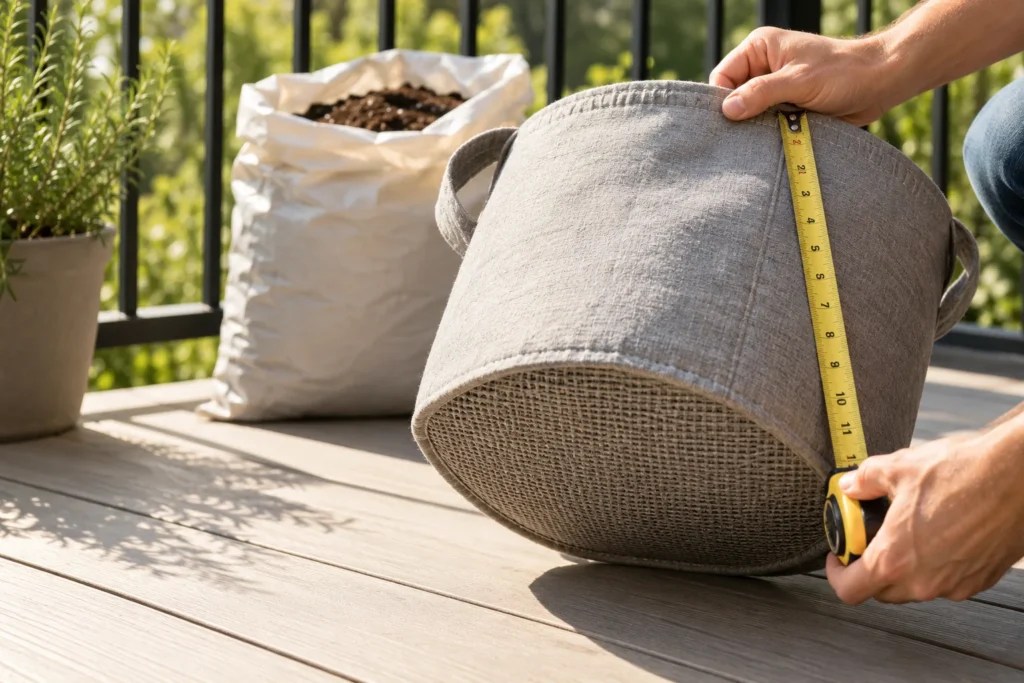
- A container of 5 gallons or more with a drainage hole: plastic, fabric grow bag or glazed. Pick a light colour where you can, because dark containers in full summer sun heat up enough to damage roots and dry out fast.
- Commercial potting mix, never garden soil, which packs down and holds water against the roots.
- One packet of bush zucchini seed, or a single transplant if the season is running short.
- A watering can or a hose that reaches the balcony.
- A saucer, if your building expects you to catch drainage.
Optional, but worth having: a slow-release vegetable fertilizer if the mix lacks one, plus a liquid vegetable feed for later; straw or shredded leaves to mulch the surface; a small tomato cage for an upright type; a soil thermometer; and lightweight floating row cover for the seedling weeks, when cucumber beetles do the most harm.
Starting from zero? The beginner container vegetable setup guide covers the same kit for a whole balcony.
Before You Start
Zucchini (Cucurbita pepo) doesn’t fail in pots because it’s fussy. It fails because the balcony couldn’t deliver the sun, water or room the plant was always going to ask for. Five quick checks settle it.
Sun. Count real hours of direct light over a day. Summer squash needs at least 6 hours of direct sun, with 8 to 10 preferred. South-facing usually clears that, west-facing often does, and north-facing almost never makes it. With 6 hours or more, zucchini sits happily among plants that handle full-sun balcony heat.
Wind and height. Zucchini leaves are enormous and tear in gusts, and a top-heavy plant in a light pot topples. Match the pot’s weight to the growth above it, keep it in a sheltered corner, and borrow from wind-resistant balcony plants if you’re more than a few floors up.
Weight, drainage and the lease. A 5-gallon pot of wet mix is heavy, and whatever drains out lands on the balcony below. Read your lease and building rules on load and drainage before you buy.
Pets. Zucchini squash is listed as non-toxic to dogs and cats by the ASPCA, though a chewed leaf or stolen fruit can still upset a stomach. The real balcony risk is the bag of fertilizer or compost, flagged for the same reason, so keep those sealed away.
Season: what to do now, in summer. Zucchini needs roughly 50 to 65 days from transplant to first picking, and Maryland’s extension gives July 1 to 15 as the second-crop window in that state. Find your first fall frost date through your local extension office or the USDA Plant Hardiness Zone Map, then count the days from today. With about 60 or more frost-free days left, sow now. With fewer, buy a transplant to save two or three weeks, or wait for spring.
How to Grow Zucchini in Pots Successfully: Step-by-Step
Eight actions, in the order the plant needs them, from choosing seed to picking the first fruit.
Step 1: Choose a Compact Bush Variety
Summer squash grows as a bush rather than a long vine, which is the main reason it works in a pot at all. University of Wisconsin-Madison Extension lists the cultivars below as suited to containers.
| Variety | Fruit type | Why pick it |
|---|---|---|
| ‘Astia’ | Green zucchini | Bred for containers; classic slicing fruit |
| ‘Sweet Zuke’ | Green zucchini | Compact bush; mild fruit for grilling |
| ‘Zebra Zuke’ | Striped zucchini | Stripes make fruit easier to spot |
| ‘Golden Zebra’ | Yellow zucchini | Yellow skin stands out under leaves |
| ‘Multipik’ | Yellow straightneck | Straightneck shape; container-rated |
| ‘Supersett’ | Yellow crookneck | Crookneck type for variety |
| ‘Golden Scallopini Bush’ | Scallop (pattypan) | Round fruit on a true bush |
Check the packet for two words. “Bush” means it belongs in this list. “Parthenocarpic” means the variety sets fruit without pollination, so it can stay under insect netting all season. For a first pot on a high floor where you rarely see a bee, we’d start with a parthenocarpic bush type for exactly that reason: it removes pollination as a way to fail.
Step 2: Set Up a Pot of at Least 5 Gallons With Drainage
Give one plant a container of at least 5 gallons and 12 to 18 inches deep, with a hole in the bottom. A bucket with holes drilled in it qualifies; so does a 7- or 10-gallon fabric bag. One plant per pot, and nothing supports squeezing in a second.
Skip the gravel layer in the bottom; it slows drainage instead of improving it. Fill with mix all the way down and let the hole do its job.
Placement matters as much as size. In a corner that bakes all afternoon, choose a light-coloured pot or shade a dark one’s sides with another pot. If you can only water once a day, go up to the largest pot you can still lift when wet.
Step 3: Fill With Potting Mix and a Starter Feed
Fill the pot to about an inch below the rim with potting mix, firming lightly. If the bag doesn’t list a fertilizer, mix in a slow-release vegetable fertilizer at its label rate; that covers the first several weeks.
Keep lawn products well away: “weed and feed” fertilizers carry herbicides that damage squash, and a bag on a small balcony is easy to grab by mistake.
Step 4: Sow Directly, or Plant a Hardened Transplant
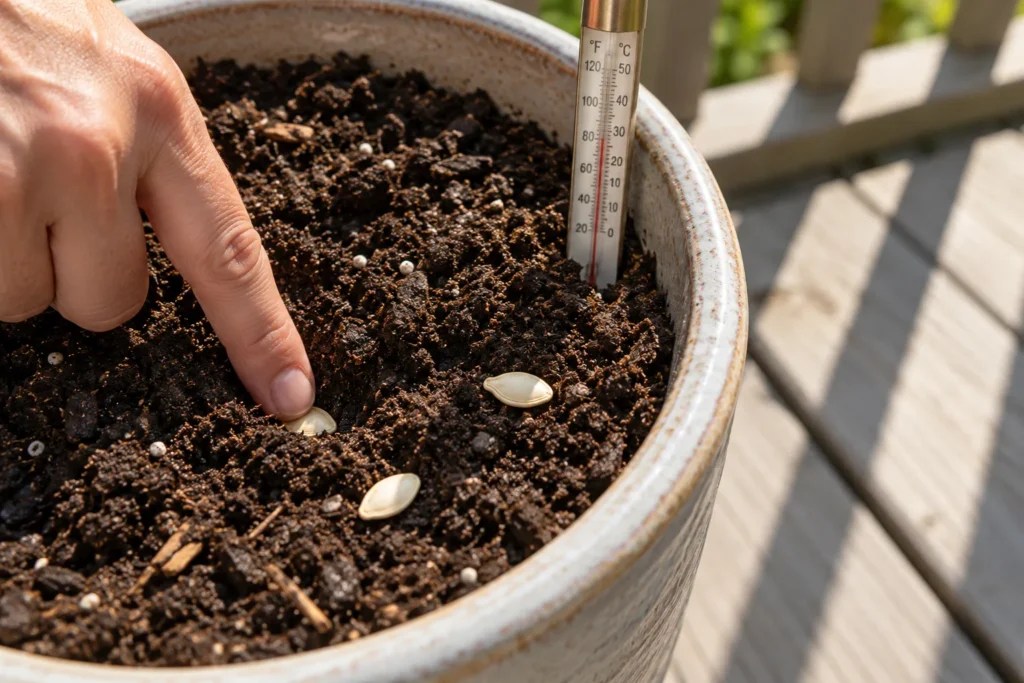
Sow when the mix measures 70°F at 2 inches deep, which on a sunny balcony in summer is most days. Push 2 or 3 seeds about half an inch into the centre of the pot, water gently, and once the seedlings have a pair of true leaves, snip all but the strongest at soil level with scissors.
Direct sowing is the better default because squash seedlings sulk after root disturbance. Buy a transplant only when you’re racing the frost. If you do, keep the root ball intact and harden it off first: 7 to 10 days outside, starting with two or three hours of shade and adding time daily, with nights at 60°F or warmer and no fertilizer. Frost injures the top growth at any stage, so cover the pot on a cold night.
Step 5: Water Like a Container, Not a Garden Bed
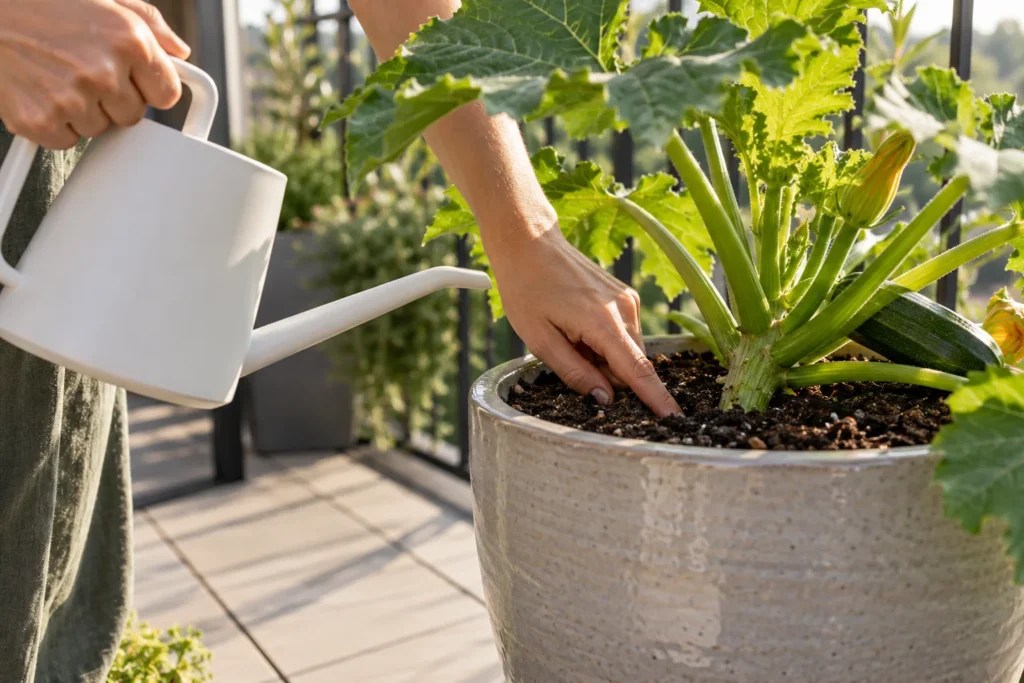
Garden guides quote about 1 inch of water a week for squash in the ground. Treat that as a bed figure: a bucket-sized pot in July holds far less, and once the plant is large and fruiting, container guides expect daily watering in hot weather. We’d plan on a daily check from the day the first flower opens.
Push a finger into the mix to the second knuckle each morning. Dry at that depth means water slowly at the base until it runs from the hole; damp means come back tomorrow. Keep the leaves dry, since wet foliage invites the fungal problems in Troubleshooting. It’s the same routine that keeps watering fruiting plants in pots on track, and it surprised me when I started: my tomato and chilli pepper pots on the balcony dried out far faster in a hot spell than garden advice suggested, and the finger check caught it before the plants did.
Mulch the surface with straw or shredded leaves before the hottest weeks to slow evaporation.
Step 6: Feed When Female Flowers Appear
The slow-release feed from Step 3 carries the plant through its leafy weeks. Once the first female flowers show, start a vegetable fertilizer at its label rate and frequency, because fruiting drains a small volume of mix quickly. The logic matches feeding fruiting container crops generally.
Go easy on nitrogen. A heavy dose pushes big soft leaves and is one trigger for blossom end rot. Every few weeks, water the pot through with plain water until it runs freely from the hole to flush built-up fertilizer salts.
Step 7: Check Pollination and Hand-Pollinate if Fruit Is Not Setting
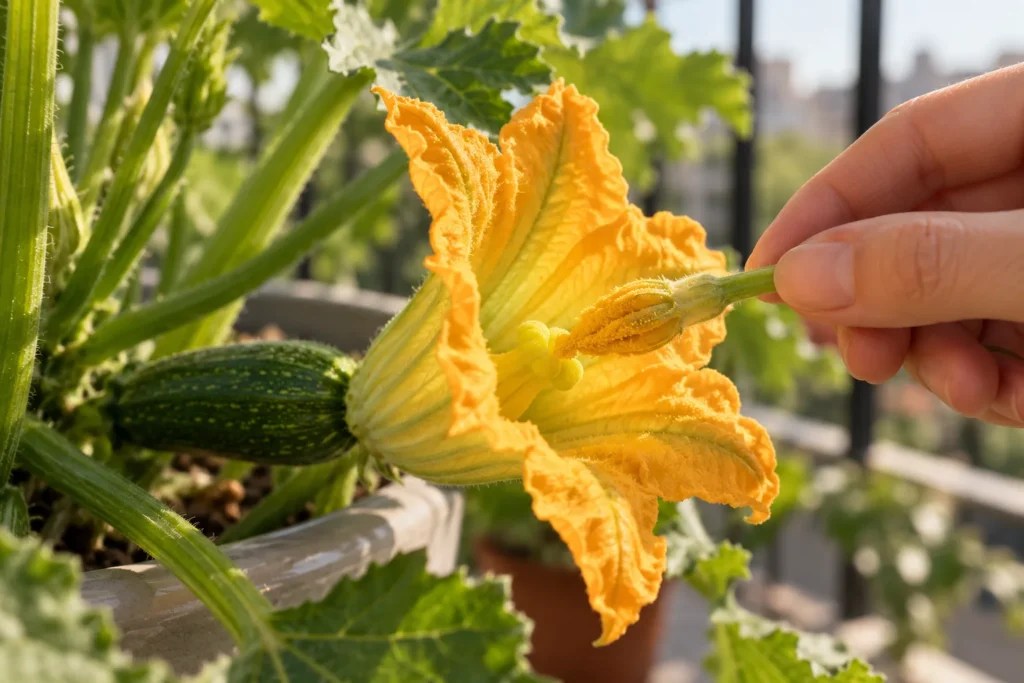
Zucchini carries separate male and female flowers on the same plant. Males sit on slender stems, open first, usually 1 to 2 weeks before any female, and drop after a day. A female carries a tiny zucchini between the petals and the stem. A plant that flowers for two weeks with nothing to show is usually doing exactly what it should; it starts with males.

Once both kinds open on the same morning, bees normally handle the rest. Set drops in cool, rainy or overcast spells, and on a high floor the bees may simply not arrive. I notice far more bees on the balcony when the mint is in flower, so a flowering herb pot beside the zucchini gives them a reason to visit.
If female flowers keep shrivelling without fruit, pollinate by hand. Early in the morning, while both are open, pick a male, strip its petals to expose the pollen, and dab it onto the centre of a female, one fresh male per female. Avoid any pesticide during bloom, and take off any row cover the day the first flower opens unless the variety is parthenocarpic.
Step 8: Harvest at 6 to 8 Inches and Keep Picking
Cut elongated zucchini when they reach about 6 to 8 inches long and 1.5 to 2 inches across, with a knife or pruners. Check every day or two, because one hidden under a leaf can double over a weekend.
Remove any fruit that got away from you even if you won’t eat it; oversized fruit left on the plant cuts the number of new ones. Pick when the leaves are dry, use fruit within about four days in the fridge, and eat the surplus male flowers, picked the morning they open.

Zucchini in Pots Care Calendar
The pot has about two months of changing needs, counted here from sowing so the table works in any zone.
| Stage | What you’ll see | What to do | Watch for |
|---|---|---|---|
| Week 0 | Mix at 70°F or warmer | Sow 2 to 3 seeds half an inch deep; water in | Cold nights; cover the pot if frost threatens |
| Weeks 1 to 3 | Seedlings, then true leaves | Light, even watering; thin to one; row cover if beetles are about | Cucumber beetles, worst from seed leaves to the three-leaf stage |
| Weeks 3 to 5 | Fast leaf growth; first male flowers that drop | Start the daily finger check; stake an upright type | Nothing yet; male-only flowering is normal |
| Weeks 5 to 8 | Female flowers; first fruit set | Daily water in heat; start liquid feed; check set | Females shrivelling; frass at the stem base |
| Weeks 8 onward | First harvest, then steady picking; older leaves tiring | Pick every day or two; flush the pot with plain water | Powdery mildew on older leaves; squash bug eggs under leaves |
| First frost | Top growth collapses | Cut the plant down and bin the debris | Don’t reuse the mix unless composted; it can carry disease |
Common Mistakes
Most lost zucchini pots trace back to a decision made in the first week.
- A vining or unlabelled variety in a 5-gallon pot. It outgrows the container by midsummer; Step 1 has the bush list.
- A black plastic pot in the hottest, most exposed corner. The roots cook; Step 2 covers colour and placement.
- Reusing last year’s mix. It drains poorly and can carry disease; see the last row of the calendar.
- Reading normal male-flower drop as a nutrient problem and adding fertilizer, which raises the risk of blossom end rot; Step 7 explains the sequence.
Troubleshooting
Match what you see to a row before you change anything; most zucchini problems look alike at first, and the three kinds of “rotting fruit” need three different responses.
| What you see | Likely causes | How to tell | What to do |
|---|---|---|---|
| Flowers drop, no fruit forms | Early male-only flush (most likely); unpollinated females in cool, wet spells; few bees | No tiny fruit behind the petals means all males so far | Wait; once females open, hand-pollinate in the morning (Step 7) |
| Small fruit yellows and shrivels from the tip; some oddly shaped | Unpollinated or partly pollinated female | Aborts within days; no sunken patch or mould | Remove it; hand-pollinate the next females |
| Brown, sunken, leathery patch on the blossom end | Blossom end rot: calcium not reaching the fruit after uneven water, root stress or heavy nitrogen | Dry and leathery, no fuzz | Remove the fruit; keep moisture even (Step 5); cut back nitrogen |
| Fruit turns soft with fuzzy black growth after wet weather | Choanephora fruit rot | Black fuzzy mould on fruit or spent flower | Remove and bin; keep foliage dry; pick often |
| Plant wilts suddenly and collapses; sawdust-like frass at the stem base | Squash vine borer; zucchini (Cucurbita pepo) is highly susceptible | Frass and a small hole near the base of the main stem | Slit the stem, remove the larva, bury the cut section in mix; bin infested stems, never compost them |
| Wilts by day, recovers overnight, then browns and dies | Bacterial wilt from cucumber beetles (milder in squash than cucumber) | Beetles seen earlier; wilt spreads vine by vine | No cure; remove the plant; cover the next sowing until flowering |
| Yellow spots turning brown; flat grey-brown bugs about 5/8 inch; bronze egg clusters in a V between veins | Squash bugs | Clusters of about 20 eggs, each about 1/16 inch, under leaves | Crush eggs, knock adults into soapy water, check under a board laid on the deck each morning; sprays rarely needed |
| White powdery blotches on older leaves, mid to late summer | Powdery mildew, favoured by humid air at 68 to 81°F, shade, crowding and over-feeding | Powder rubs off; starts low on the plant | Improve air flow; remove the worst leaves; fungicide only if its label lists squash |
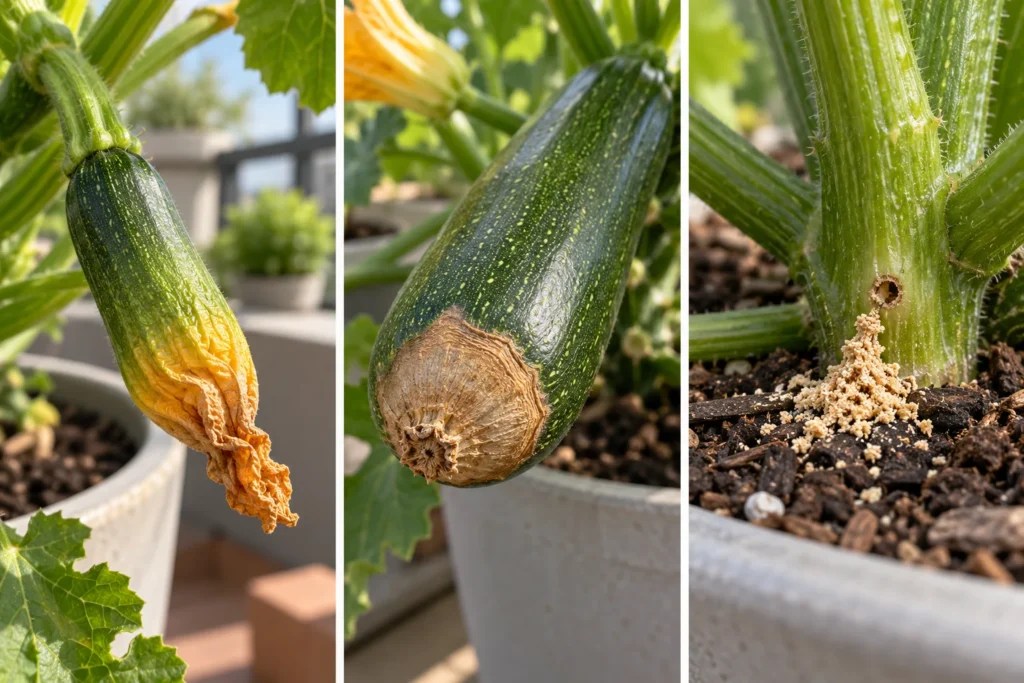
Two of these end the plant. A borer that has hollowed the main stem, or bacterial wilt, won’t recover in a pot; clear the container and, with about 60 frost-free days ahead, resow in fresh mix. With fewer, give the pot to a quick fall salad crop.
Any spray, including the Bt aizawai products UConn Extension describes for squash vine borer control at the stem base, must list squash on its label, go on at the label rate, and stay off the plant during bloom and above 85°F.
Frequently Asked Questions
Do I need two zucchini plants to get fruit?
How long does zucchini take to grow in a pot?
Can I grow zucchini indoors or on a windowsill?
Can I grow zucchini in the same pot as other vegetables?
Why are the leaves on my potted zucchini turning yellow?
What Actually Matters
If you remember three things, make them pot size, sun hours and patience with the first flowers. One plant in a bucket-sized pot with 6 or more hours of direct sun will outproduce three crammed into a window box, and a fortnight of male flowers dropping is the plant warming up rather than giving up.
Of the three, sun is the one you can’t fix later, which is why knowing how to grow zucchini in pots successfully starts before you buy a seed packet. Count the hours on your balcony this weekend.
If the hours and the frost date both check out, pick up one packet of bush seed, one bag of potting mix and the biggest pot you can lift, and sow this week.
Sources
- University of Minnesota Extension – Growing summer squash and zucchini in home gardens – soil temperature, sowing, watering reference, flowering, harvest, storage, Choanephora rot.
- University of Maryland Extension – Growing Summer Squash (Zucchini) in a Home Garden – sun hours, days to harvest, second-crop window, flower timing, feeding, harvest size.
- University of Wisconsin-Madison Extension – Growing Vegetables in Containers (XHT1278); Vegetable Varieties for Containers (XHT1273); Cucumber Beetle (XHT1092) – pot size, drainage, daily watering, container cultivars, beetle damage, 85°F spray limit.
- Texas A&M AgriLife Extension – Vegetable Gardening in Containers (E-545) – one plant per 5-gallon pot, mulch, flushing salts, not reusing mix.
- University of Illinois Extension – Containers – dark pots overheating, pot weight in wind.
- UC Agriculture and Natural Resources – Pollinating Squash – hand-pollination method, fruit abortion without pollination.
- NC State Extension (Pender County) – Why Are My Squash Rotting? – blossom end rot causes.
- UConn Extension – Squash Vine Borer in Home Gardens – symptoms, stem slitting, Bt aizawai, stem disposal.
- University of Minnesota Extension – Squash bugs; Bacterial wilt; Powdery mildew of cucurbits – pest sizes, wilt symptoms, mildew conditions, label rules.
- University of Nebraska-Lincoln Extension – Hardening Off Transplants – 7 to 10 days, nights 60°F or warmer.
- ASPCA – Zucchini Squash; Pets and Produce: Top Tips on Vegetable Garden Safety – pet safety.
- USDA Agricultural Research Service – Plant Hardiness Zone Map – zone lookup.
