
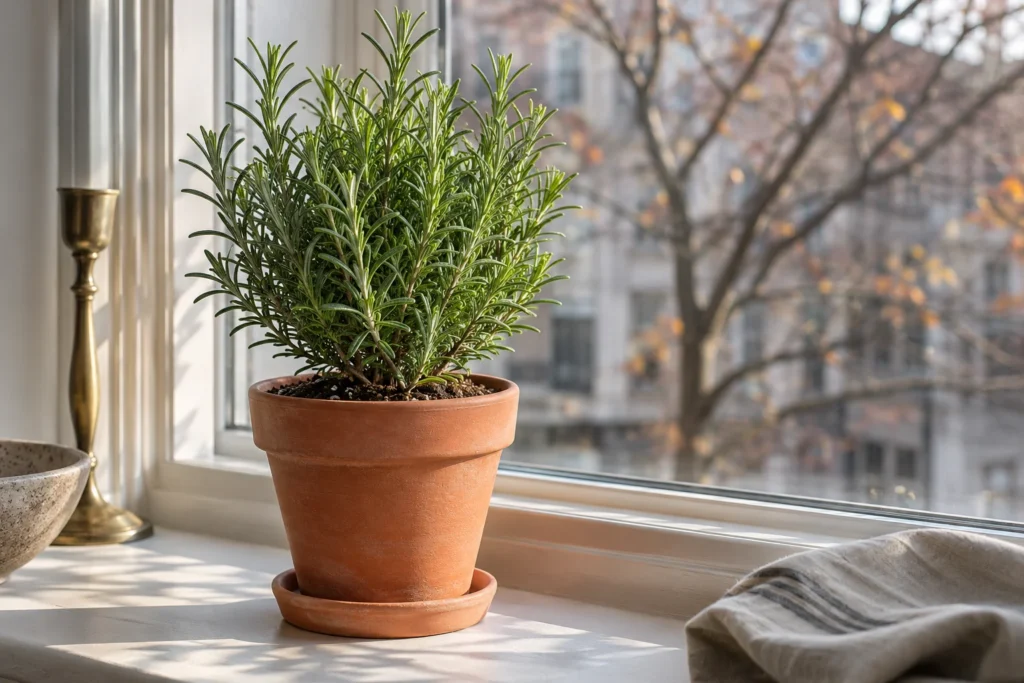
The rosemary you bought for the balcony in May is still green in November, the forecast finally says frost, and the only free spot inside is a windowsill right above a radiator. You’ve heard the warning that rosemary dies indoors. It often does, and almost always for the same two reasons: too little light and roots that stay wet.
Learning how to grow rosemary indoors comes down to giving a Mediterranean shrub a lot of sun, a cool room and a pot that dries out, inside a heated apartment that offers the opposite. If you’re setting up several herbs at once, our guide to growing herbs indoors year round has the general rules; this one is rosemary only.
Table of Contents
At a Glance
- Rosemary (Salvia rosmarinus, formerly Rosmarinus officinalis) lives indoors with at least 6 hours of direct sun or a grow light, a gritty mix in a terracotta pot, and water only when the top inch is dry.
- Cool beats cozy: days of 65 to 75 F and nights of 55 to 65 F suit it; a spot above a heat register does not.
- Bring outdoor pots in 2 to 3 weeks before your first frost, after a pest check under the shower.
- Expect little growth from November to February; harvest lightly, not more than about a third of the top growth.
- The ASPCA lists rosemary as non-toxic to dogs and cats, so a windowsill pot is safe around pets, though it isn’t a chew toy.
Best for a south or west window, or any window plus a low-cost clip-on grow light; skip for now if your only spot is a warm, dim corner.
What You’ll Need
One starter plant, one pot, one bag of mix and a bright spot cover the basics; a grow light and a small fan are the two upgrades that change the outcome.
Essentials
- A nursery rosemary, usually sold in a 4-inch pot, or a rooted cutting. Upright types such as ‘Tuscan Blue’ and ‘Arp’ stay tidy on a sill; trailing ‘Prostratus’ or ‘Blue Boy’ suit a hanging pot or shelf edge.
- An unglazed terracotta pot with a drainage hole, 2 to 4 inches wider than the nursery pot, plus a saucer.
- Potting mix with extra perlite, coarse sand or fine gravel stirred in.
- A shallow tray and a handful of pebbles for humidity.
- Clean scissors or snips.
Optional, but worth it
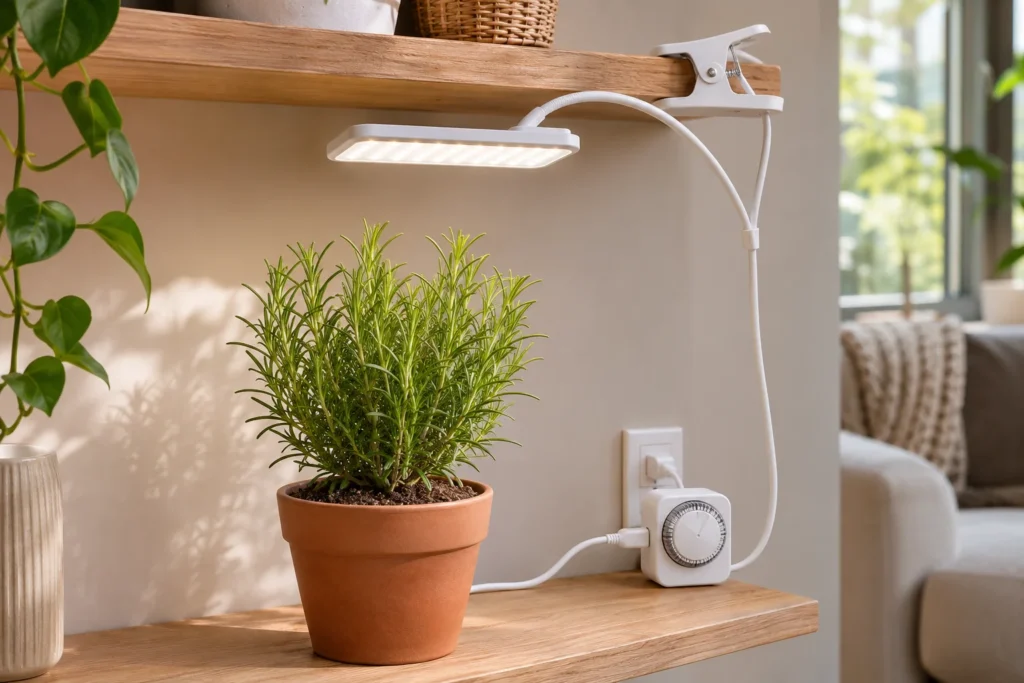
- A full-spectrum LED grow light on a plug-in timer (low-cost clip-on models suit one pot and need no drilling).
- A small desk fan for air movement in a stuffy room.
- Insecticidal soap labeled for houseplants and edible crops, kept on hand for spider mites.
On how to start: buy a plant this fall, root cuttings next spring, and treat seed as a hobby project. Rosemary seed germinates slowly with low viability, seedlings take years to become usable, and named varieties don’t come true from seed.
Before You Start
Rosemary is reliably perennial outdoors only in USDA zones 8 to 10, so across most of the US it either comes inside for winter or gets replaced each spring.
Check your zone first. In zones 8 to 10 a pot on a sheltered balcony can usually stay out, and our guide on how to winterize potted plants on a balcony covers that route. ‘Arp’ is the hardiest common variety, to about zone 7 with protection, but a pot is exposed on all sides, so treat zone 7 as a gamble and anything colder as an indoor winter. The NC State Extension plant profile adds that overwatering is the usual cause of decline, which is the whole indoor story in one line.
Then check your window honestly. Full sun means 6 or more hours of direct sun a day, and a sill gets less than it seems because glass, screens and low winter sun angles all take a share. Count the hours in November, not June.
- Grow: a south or west window with 6 or more hours of winter sun, in a room that stays cool at night.
- Adjust: an east or north window, or a sunny window in a room kept warm all day. Add a grow light and use the coolest bright spot you have.
- Skip for now: no direct sun and no room for a lamp. Rosemary declines slowly there; grow a shade-tolerant herb instead and come back to rosemary with a light or a balcony.
Step-by-Step: How to Grow Rosemary Indoors
Light and pot come first, then the move indoors, then the winter routine, and finally feeding and harvesting once it’s settled.
Step 1: Pick the Brightest, Coolest Spot (and Decide on a Grow Light)
Put the pot where it gets the most direct winter sun and the least furnace heat: a south window first, a west window second, and either one in a cool bedroom or hallway rather than beside a heat register. Rotate the pot a quarter turn weekly so the room-facing side doesn’t thin out.
If the window gives under 6 hours of direct sun in winter, add a light rather than hoping. Iowa State Extension’s advice for indoor herbs is a full-spectrum grow light 6 to 12 inches above the leaves, on a timer for 12 to 16 hours a day; plants need more hours under a lamp than in sun. Choose an LED that stays cool to the touch, since a hot bulb that close scorches needles.
| Light option | Direct sun or lamp time | Best for | Watch out for |
|---|---|---|---|
| South window, no lamp | 6 to 8+ hours of direct sun | Unobstructed sills, cool rooms | Heat registers under the window |
| East or west window plus lamp | 3 to 5 hours of sun, lamp to reach 12 to 16 hours total | Most apartments | Lamp set too high |
| North window plus lamp | Lamp 12 to 16 hours | Renters with one window | Treat the lamp as the only light |
| Lamp only (shelf or cabinet) | 12 to 16 hours on a timer | Dim rooms, plant shelves | Raise the fixture as the plant grows |
Step 2: Pot It in a Fast-Draining Mix
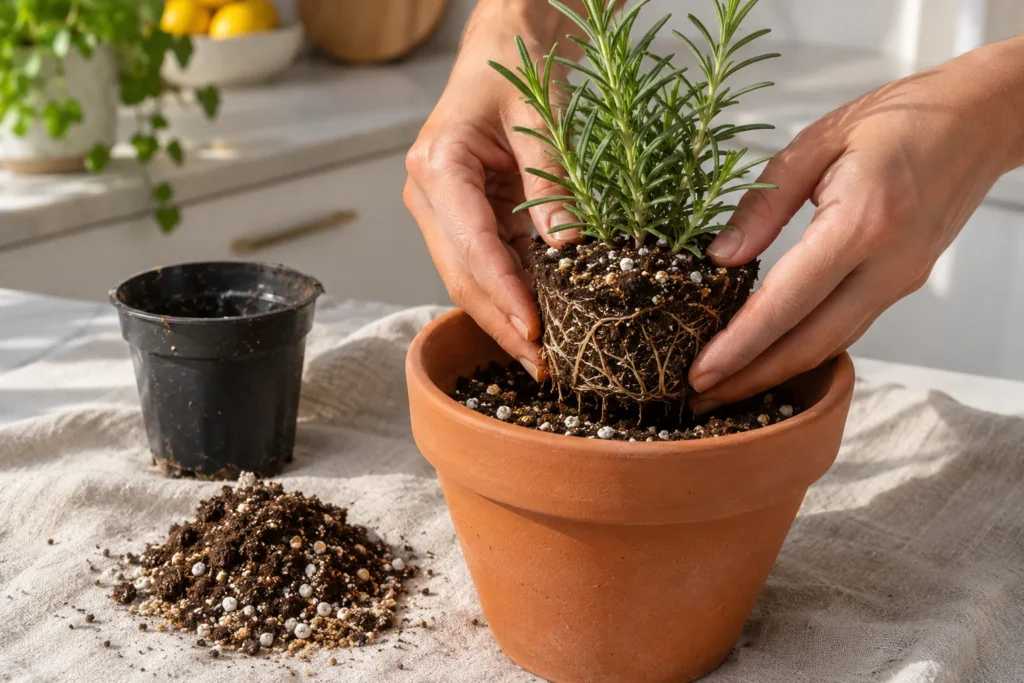
Give rosemary a pot that breathes and a mix that drains in seconds. Unglazed terracotta loses moisture through its walls, so the mix dries between waterings the way the plant’s rocky Mediterranean home does; glazed or plastic pots hold water longer and make root rot more likely in a heated room.
Size up gently: 2 to 4 inches wider than the nursery pot, and deep, because rosemary has a deep root system. An oversized pot holds a ring of wet mix the roots never reach. Stir extra perlite, coarse sand or fine gravel through a standard houseplant mix until water runs through it freely; our guide to choosing a potting mix for houseplants explains what each ingredient does. Keep the plant at the depth it grew before, water once to settle the mix, then let it dry.
Step 3: Acclimate a Plant Coming In From Outside
Bring a balcony rosemary in 2 to 3 weeks before your area’s average first frost, so it adjusts to lower light while the weather is still mild. Penn State Extension’s herb guide recommends that lead time, then a south window or supplemental light with good air circulation once the plant is inside.
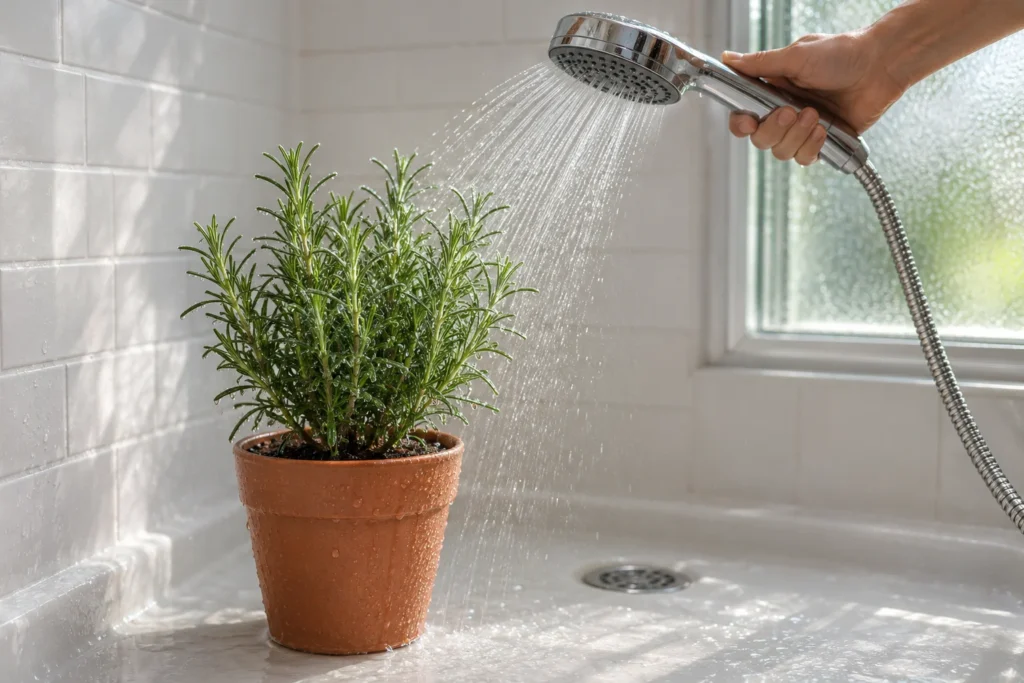
Before it crosses the threshold, give it a pest check. Rinse the foliage in the shower with a firm spray, turning the plant so the undersides of the needles get hit; spider mites, aphids and whiteflies ride indoors on outdoor plants and are the pests extension guides list most often on indoor rosemary. Look at the stem tips for speckling, webbing or tiny insects, and keep the new arrival a few feet from other houseplants for two weeks.
Some needle drop in the first month is normal as the plant sheds foliage it can’t support in weaker light; green stem tips mean it’s adjusting, and little new growth before late winter is expected.
Step 4: Water Only When the Top Inch Is Dry
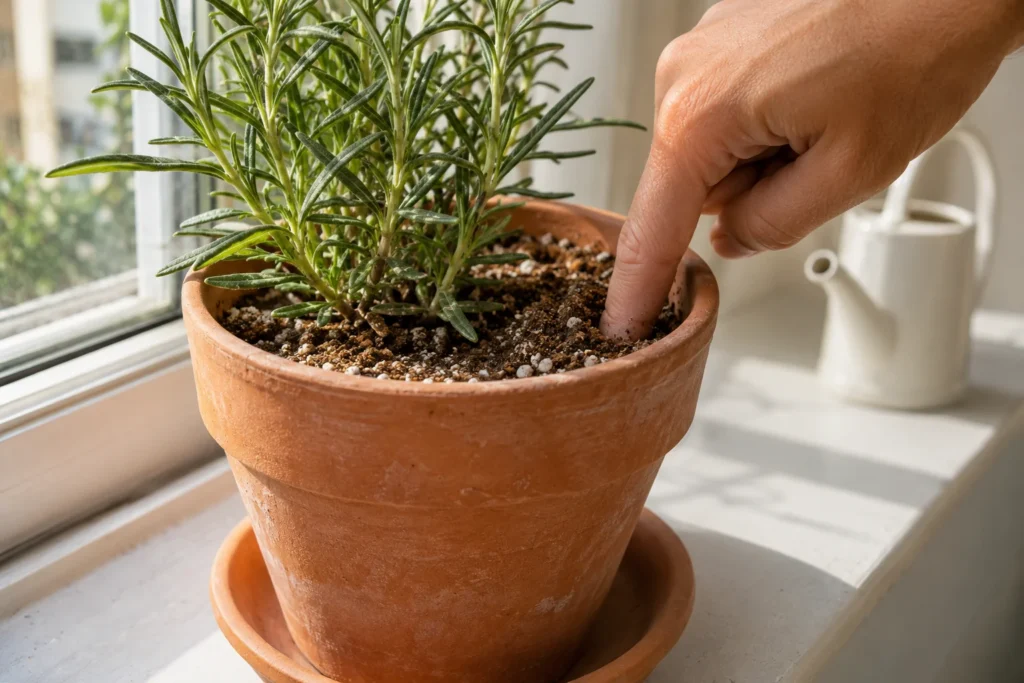
Push a finger an inch into the mix once or twice a week; water thoroughly only when that inch feels dry, then empty the saucer once the pot has finished draining. Indoor rosemary dies from wet roots far more often than from thirst.
Dry is not the same as bone dry. Rosemary tolerates drought in the ground but resents a root ball that dries out completely in a pot, so don’t let the mix pull away from the pot walls. Pour at the base rather than over the foliage, because wet needles in a still room invite the white film covered in Troubleshooting. As growth slows from late fall, stretch the interval; the finger test decides, not the calendar.
Step 5: Keep the Room Cool and the Air Moving
Temperature decides more than most beginners expect. University of Maryland Extension’s indoor herb guidance puts the comfortable range at 65 to 75 F by day and 55 to 65 F at night, and a bright spot that stays at or below 65 F suits rosemary even better. Given a warm living room or a cool, bright spare room, we’d pick the cool one: a cool plant uses less water and shrugs off the pests that boom in furnace heat.
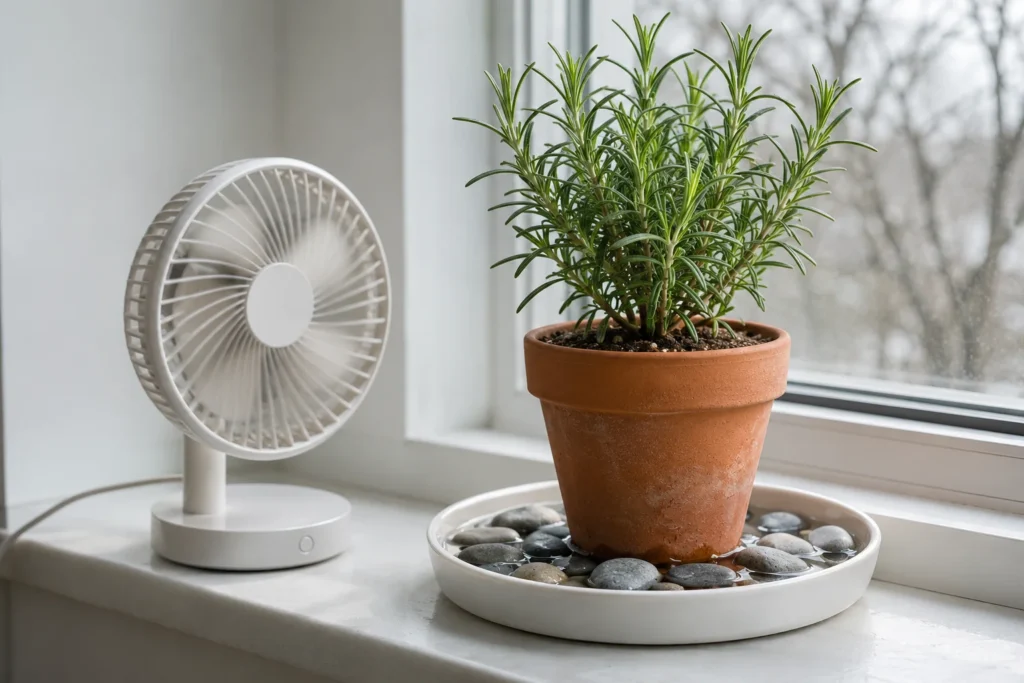
Humidity is where advice seems to conflict. Rosemary wants more moisture in the air than a heated apartment offers, and dry air shows up as brown needle tips, yet damp, still air is exactly what powdery mildew needs. The way through is a pebble tray plus moving air: stand the pot on pebbles with the water level below their tops, and run a small fan on low a few feet away for a few hours a day. Mist lightly in the morning only if the air is very dry and moving well; in a stuffy room or closed cabinet, skip misting.
Step 6: Feed Lightly, and Not in Winter
Skip fertilizer from the time the plant comes in until new growth shows in late winter or early spring. A plant idling in low light can’t use the nutrients, and high-nitrogen feeding pushes the soft growth powdery mildew attacks first. Once growth restarts, use a balanced water-soluble fertilizer at half the label strength, and stop again in fall; rosemary comes from lean, rocky ground and grows tighter, more aromatic foliage when it isn’t pushed.
Step 7: Harvest and Prune to Keep It Compact
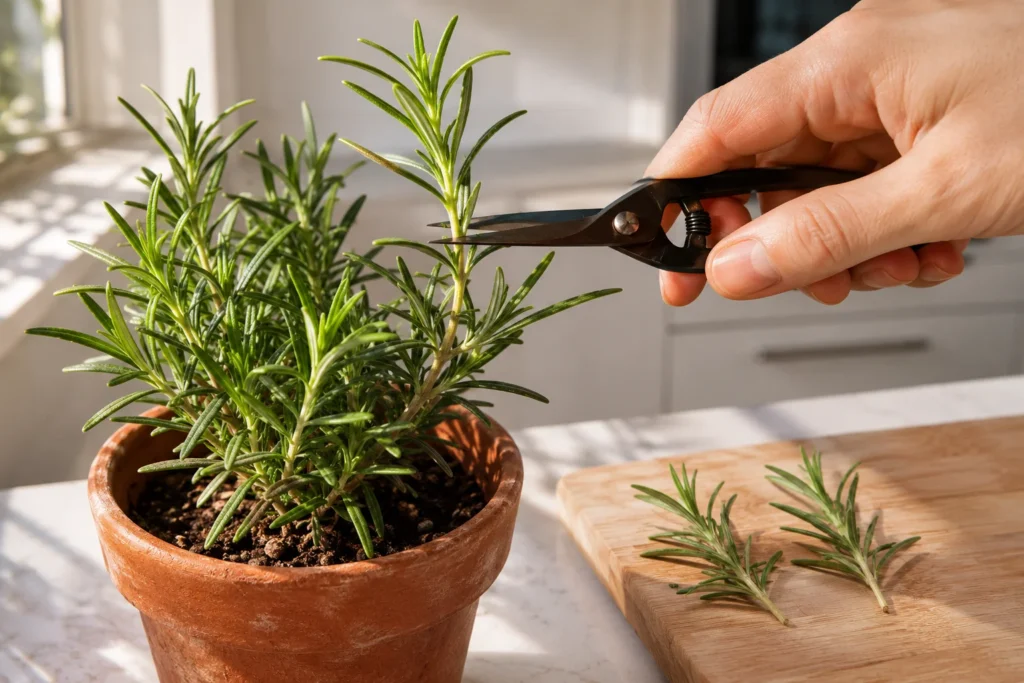
Snip soft green tips just above a pair of leaves and take no more than about a third of the top growth at one time, then let the plant recover before the next cut. Tip harvesting is also the pruning: every cut encourages branching below it and keeps the plant dense instead of leggy.
In winter, cut only what you’ll cook with that week, since the plant isn’t replacing growth; from spring, cut more freely. For drying, take sprigs before the plant blooms, when the leaves hold the most oil, and hang them in a ventilated spot out of direct sun.
First-Year Calendar for Indoor Rosemary
Pin each task to your frost dates and the plant’s growth rather than to a month.
| Season | What to do | What to skip |
|---|---|---|
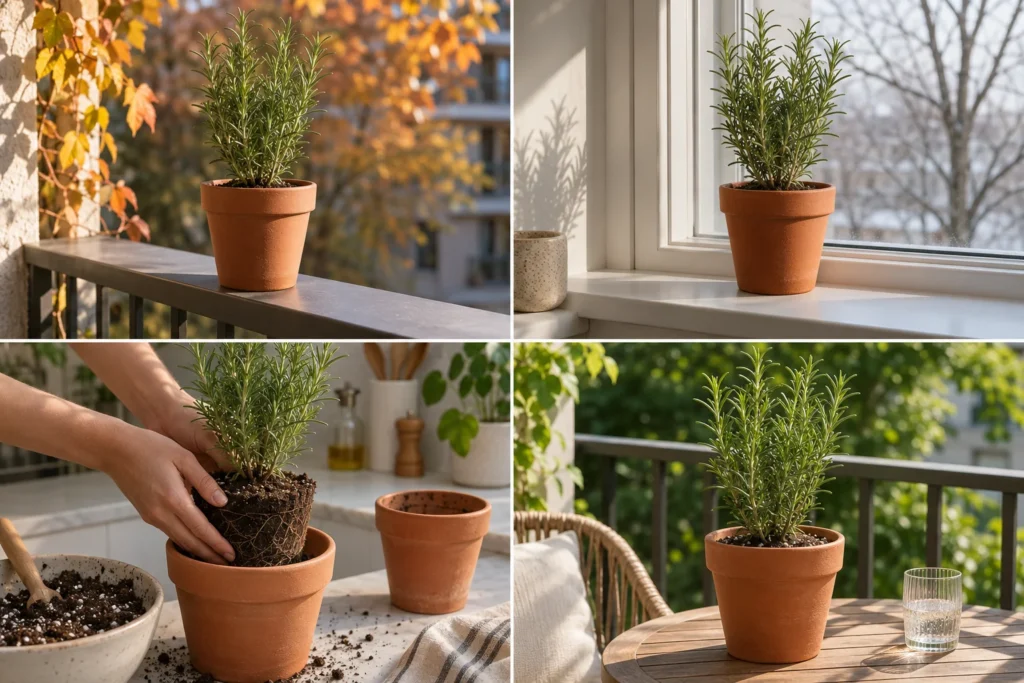
| Fall (now) | Bring pots in before first frost (Step 3); pest check; set up the light; stretch watering as growth slows | Fertilizer; a warm spot by the heater |
| Winter | Finger test weekly; rotate the pot; check needle undersides for mites; harvest lightly; enjoy any late-winter flowers | Misting in still air; repotting; heavy cuts |
| Spring | Repot in early spring if roots fill the pot; resume half-strength feeding when growth shows; move outside after frost danger passes and keep misting until it adjusts; take cuttings | Moving out on the first warm day; full sun on day one |
| Summer | Outdoors in full sun, or the brightest window with the lamp; finger test far more often in heat; harvest freely | Letting the pot sit in a full saucer after rain |
Spring cuttings are the cheapest insurance: a 6-inch tip with the lower leaves stripped, dipped in rooting hormone and set in a sterile, airy mix with bottom heat of 70 to 75 F roots in about 10 to 20 days.
Common Mistakes
- Going up three pot sizes “so it has room”. The unused mix stays wet for weeks. Size up 2 to 4 inches at a time, as in Step 2.
- Misting a plant in a stuffy room. Moisture without airflow is a powdery mildew setup. Pair the pebble tray with a fan instead (Step 5).
- Feeding it to “perk it up” in January. A resting plant can’t use it, and the soft growth it forces is mildew bait (Step 6).
- Spraying dish soap on pests. It can strip the waxy cuticle from the needles; use a labeled insecticidal soap instead (see Troubleshooting).
Troubleshooting Indoor Rosemary
Start with the symptom you can see, then check the soil and the undersides of the needles before you change anything.
| What you see | Likely causes | How to tell them apart | Fix |
|---|---|---|---|
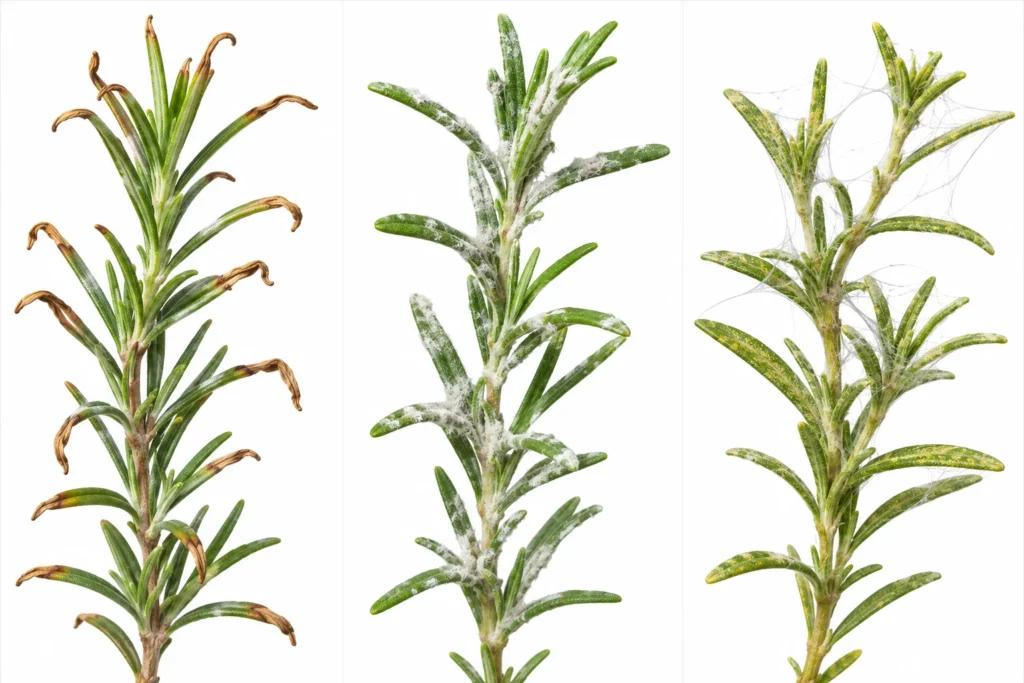
| Brown, crisp needle tips | Dry air; root rot from wet mix | Dry air: mix is dry, stems stay green. Root rot: mix stays wet, whole stems brown from the base | Dry air: pebble tray, cooler spot. Root rot: unpot, trim dark mushy roots, repot in dry gritty mix, water less |
| White, dusty film on needles or stems | Powdery mildew | Rubs off as powder; starts in patches on newer growth; room is still and damp | Isolate, cut off coated shoots, run a fan, water at the base only, stop feeding; discard a plant that’s mostly coated |
| Fine pale speckling, dull needles, faint webbing at tips | Spider mites | Tap a stem over white paper; moving specks confirm mites | Rinse under a firm spray every few days, undersides included; if they persist, use insecticidal soap labeled for houseplants and edible crops, per the label |
| Pale, stretched stems with gaps between leaves | Too little light | New growth is thin and leans hard toward the window | Move to a south window or add a lamp (Step 1); cut leggy tips back to a leaf pair once light improves |
| Wilting even though the mix is wet | Root rot | Mix smells sour, pot feels heavy, roots are dark and soft | Trim rotten roots and repot in fresh dry mix; take healthy tip cuttings as a backup |
Two of these deserve a deeper read: our guide to spider mite treatments for houseplants covers protecting the rest of your shelf, and the root rot signs and rescue walkthrough shows healthy and rotten roots side by side.
Insecticidal soap works on contact against soft-bodied pests such as mites, aphids and whiteflies, and many formulations are labeled for food crops up to the day of harvest. Don’t spray a drought-stressed plant, test one branch and wait a day before treating the whole plant, and rinse sprigs before cooking. When a plant is mostly brown wood with a few green tips by February, root those tips and compost the rest.
Frequently Asked Questions
Can I grow rosemary indoors with no sunny window at all?
Yes, under a full-spectrum LED grow light run 12 to 16 hours a day on a timer, with the fixture 6 to 12 inches above the foliage. That is the only light source in a dim room, so set it up before the plant arrives rather than after it starts stretching, and keep the room cool so the plant isn’t asking for more light than the lamp can give. Raise the lamp as the plant grows to hold that distance.
Can rosemary spend the winter in an unheated garage or a cold room?
It can, as long as the space stays above freezing and has a window or a lamp. A garage works for rosemary when the temperature never drops below freezing, and a cool, bright room that stays at or below 65 F suits the plant better than a warm living room. Check the soil less often in a cold room, since the mix dries slowly, and still give it the brightest spot available.
Why does my rosemary smell weaker since it came indoors?
Too little light is the usual cause. Herbs grown in weak light become thin and leggy with smaller leaves and a weaker aroma, which is why a sunny south window or a lamp matters as much for flavor as for survival. Move the plant to more light, hold off on fertilizer until growth restarts, and the new tips that form in late winter should smell like the plant you bought.
Will rosemary flower indoors, and can I eat the flowers?
Often, yes. Indoor rosemary may produce small blue, pink or white flowers in late winter or early spring, and potted plants overwintered inside can keep blooming into summer. The flowers are edible, so they can go into salads or on roasted vegetables. If you want sprigs for drying, cut them before the plant blooms, when the leaves hold the most flavor.
Should I repot a new nursery rosemary straight away in fall?
Only if roots are already growing out of the drainage hole; otherwise wait for early spring, when the plant can grow into the fresh mix. A fall repot adds wet mix around roots that are slowing down for winter, which is the condition root rot likes. If you do need to repot now, go up just one pot size, use the gritty mix from Step 2, and water once to settle it.
What Actually Matters
Indoor rosemary is a light-and-water problem wearing a humidity costume. Give it the sunniest, coolest window you own or a lamp on a timer, keep it in terracotta with a gritty mix, and let the top inch dry before you reach for the watering can; the pebble tray, the fan and the light feeding are refinements, not rescues.
If you pick one priority this week, make it light. A plant in a south window with a slightly careless owner usually outlives a pampered plant in a dim corner.
Today’s job, with frost in the forecast: rinse the plant, carry it to the brightest cool sill you have, and set a timer on a lamp if that sill gets under 6 hours of sun. Come spring, take a few cuttings; our guide to propagating plants from cuttings uses the same method, so you won’t be down to one woody survivor next February.
Sources
- NC State Extension Gardener Plant Toolbox – Salvia rosmarinus (Rosemary) – zones, sun hours, overwatering, pests, cultivars.
- Penn State Extension – Herb Garden Plants: Rosemary – bring-in timing, cuttings method, ‘Arp’, seed limits.
- University of Maryland Extension (Frederick County) – Growing Kitchen Herbs Indoors – temperatures, watering, mix, pot size, feeding, harvest limit.
- University of Maryland Extension – Signs and symptoms of spider mites on indoor plants – symptoms, water spray, insecticidal soap.
- NDSU Extension – Dakota Gardener: Growing rosemary indoors – sun hours, deep terracotta pot, pebble tray, flowering.
- University of Wisconsin-Madison Extension, Kenosha County – Holiday Rosemary – 65 F ceiling, rotation, finger test, no winter feeding.
- University of Illinois Extension – Rosemary – cool sunny spot, dry air and brown tips, slow winter growth, cuttings over seed.
- Iowa State University Extension and Outreach – How can I provide more light for my herbs indoors? – lamp distance and hours.
- Missouri Botanical Garden – Powdery mildew indoors – symptoms, conditions, controls.
- UConn Extension IPM – Insecticidal Soaps – contact action, food-crop labels, spot test, dish soap.
- ASPCA Animal Poison Control – Rosemary – non-toxic to dogs, cats and horses.
- University of Arizona Cooperative Extension, Yavapai County – Rosemary (Backyard Gardener #221) – nursery pot size, drying, cuttings-grown varieties.